
Giving an Indian Rhino a Spa Treatment
55sUnique behind-the-scenes look at rhino care and their sensitive skin is both educational and visually engaging.
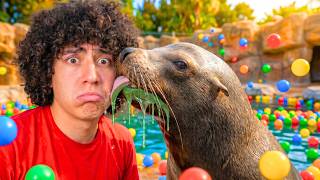
▶ Play Clip"The sea lion spit is a minor moment; the title exaggerates a single gag in a lengthy zoo tour."
A vlogger visits Parque de las Leyendas in Peru, a zoo built on ancient ruins, aiming to experience as many animals as possible. The video documents hands-on encounters with a variety of species, from an Indian rhino spa treatment to a sea lion spitting in his face, while highlighting animal care and conditioning techniques.
There are over 10,000 zoos worldwide; the oldest is over 274 years old in Vienna. The vlogger's goal is to visit them all, starting with Parque de las Leyendas in Peru.
The vlogger meets Valentina, a 5-year-old Indian rhino from Belgium, describing her docile nature and armor-like skin folds.
A red clay treatment is applied to protect the rhino's sensitive skin from the sun, demonstrating positive reinforcement as the rhino willingly participates.
The vlogger interacts with a sea lion named Titan, who spits in his face. He describes the smell as similar to armpit odor.
Capybaras are trained using positive reinforcement to step onto a scale for weighing. The process takes patience and rewards with food.
An ultrasound model is used for practice, and environmental enrichment (e.g., food balls) keeps capybaras mentally stimulated.
A 25-year veteran caretaker checks a spectacled bear named Amadeo for wounds using a long spoon tool; only minor scratches are found.
Fish popsicles (ice blocks with fish inside) are used to simulate natural foraging behavior for giant river otters.
X-rays are taken of turtles to check health and identify eggs. The vlogger learns that male turtles have a concave plastron to fit onto females during mating.
Siba, a white Bengal tigress, was the first born in captivity in Peru. Rejected by her mother, she was hand-raised by humans and now weighs 120kg.
White spots on the back of tiger ears mimic eyes, intimidating potential predators when the tiger drinks water.
The favorite moment was the Indian rhino. The vlogger thanks Parque de las Leyendas and encourages viewers to visit.
The video showcases a day filled with intimate animal encounters at Parque de las Leyendas, blending entertainment with insights into zoo animal care and enrichment techniques.
How old is the oldest zoo mentioned in the video?
Over 274 years old.
00:15
Why is red clay applied to the rhino's skin?
To protect from the sun.
01:37
What method is used to weigh the capybaras without stress?
Positive reinforcement with food to condition them onto the scale.
05:17
What is the difference between male and female turtle shells?
Male plastron is concave; female is flat.
14:45
Why do sea turtle males have claws?
To grip the female's slippery shell during mating.
15:27
How was the white Bengal tiger Siba raised?
Hand-raised by humans after being rejected by her mother.
17:19
What is the purpose of the white spots on a tiger's ears?
They mimic eyes to intimidate predators when the tiger drinks.
18:43
Oldest Zoo
Historical fact about the oldest zoo in Vienna, over 274 years old.
00:15Rhino Clay Spa
Demonstrates a practical method of sun protection using positive reinforcement.
01:37Capybara Weighing Training
Illustrates modern animal training methods that minimize stress.
05:17Turtle Sex Determination
Explains a unique anatomical adaptation for mating.
14:45Tiger Hand-Raising
Story of a rejected tiger cub raised by humans, highlighting conservation efforts.
17:19Tiger Ear Spots
Interesting evolutionary adaptation for survival.
18:43[00:03] Gee. [laughter] eat it. There are more than 10,000 zoos in the world , such as the Mangerindo, Minajerie del Jardin des Plantes,
[00:15] that thing in France. Or the Tigergarten [music] shopbom in Vienna, Austria, at over 274 years old, this being the oldest of [music] all. And I have a mission: to visit them all before I die. The problem is that to achieve
[00:28] this I would have to visit 10 zoos every month for the rest of my life, which is almost impossible. But I can start by visiting the Parque de las Leyendas in Peru, a zoo built on ancient ruins more
[00:40] built on ancient ruins more than 2,000 years old. to see this. This is the first time I've seen her. And look, I had
[00:55] swear. You know that I had been with rhinos before, but I had never been with an Indian rhino. Seriously, it literally looks like he's white rhinoceros is also like that, because when we film with them you can see
[01:08] super strong, but in her case, her divisions, like her folds, are really does look like a piece of armor too. It's very tough. He's going to Valentina. And it's very docile. It is very docile. She is 5 years old. Wine from Belgium. She has her
[01:23] boyfriend in Brazil, and the idea is that, since it's a species that's idea is to be able to breed her at some point and bring her boyfriend from Brazil, and love happen. They just brought us some red clay and we're going to give it a spa treatment. We'll go
[01:37] whenever she wants. As soon as I get back. The idea is to cover it with all this clay a very large, very imposing animal, its skin is very sensitive to the sun. So the idea is to soak it to put a layer of clay on it so that
[01:50] burn it or bother it. Okay, Valentina has arrived and look, we just put it on and have a great time. Oh, it's really tough. But you know what I realize? The white rhinoceros is harder because in the
[02:04] elephant video, remember when I told you that the foot looked very hard, but it's like soft? I feel the same because they come, even though it's very hard, it's like it lets itself be crushed. It's very different. The white rhinoceros, right? That one is really
[02:17] The white rhinoceros, right? That one is really tough. personal matter. Valentina loved it when I did this for her. It's true that he liked it. True, true. This is the best plan I've made so far in
[02:32] Peru. Look, to reward her, I'll give her a little bit of celery, and I'm going to take advantage of the fact that she opens her show you something. Look, look, he has very few teeth because his baby teeth are only just coming in. Then she looks really funny. It's like a little grimace, but
[02:44] years old. It was a rhinoceros that lives well over 50, so it's doing very well. That is. Oh, I swear to you, of everything I've done in parks and reserves, this is the best so far.
[03:11] He's a titan. It's a sea lion. He just spat in my face. Terrible. They didn't manage to. That was it yes, that was it. That was it. Your face is yellow. No, no, no. No, but look, look, he just hit me, I mean, he
[03:25] spat in my face like that. Look, a lion spat on me first, a sea lion believe me. But look, that's what I can spit out. If it smells strong right now, I do this. My face smells like... I don't
[03:38] know what to compare it to, like a bad smell, but like armpit odor, something like that. It's truly enormous, I mean, it's called Titan because logically it's a tremendous showing me right now that they basically put a condition on it in order to
[03:52] open. Look, you can check that everything inside is okay so you can check parts of its body, such as its fins. He bends down, they put this In fact, a curious fact is that they have fingernails. I feel that with evolution they will gradually
[04:05] disappear because they do n't have a specific function. Look at her little nails here. They are truly tiny nails that serve no purpose. Look, only the ones on the fins here, the ones at the back, look, they have
[04:17] larger, more developed claws so that they explained to me that it's basically so they can scratch themselves. But oh well, let's keep disgusting. I feel like he's going to keep spitting on me, but oh well, I'm already flying badly, it doesn't matter anymore
[04:30] spitting on me, but oh well, I'm already flying badly, it doesn't matter anymore .
[04:46] . This is impressive. Too much of a crack. Despite being surprises me a lot. And it drags on too much. That's awesome.
[05:04] call them, live. And we're going to do something very interesting because first, well, I been with them, I realized that while I was here. So, let's condition him. So that? So that we can weigh them. And I'm going to show you, I
[05:17] explained to me how it works. And I'm going to show you, come closer. Oh, it just to show you what we're going to do. Basically, the idea is to get them to weigh them and know if they are at a healthy weight and all that. Nando, it slipped my mind, it's okay, be
[05:32] and all that. Nando, it slipped my mind, it's okay, be patient. Did touch it, I generate a sound with this other little thing and then I give it to him in the food. Good. And so on until we reach the scales. Good. Did
[05:50] you see how impressive it was? Her mouth is too small. Nando, no, don't get distracted. Nando, we were getting close. Nando, play. It requires quite a bit of patience. Nando, Nando, Nando, don't leave me, Nando, don't leave me
[06:03] . Very well, now only the back legs remain Very well, now only the back legs remain . Nando, please. understood me. Yes, they already did it. He did it very well, I mean, it looks simple, but
[06:17] conditioning a wild animal. It's not simply like teaching done to make it as traumatic as possible for the animal, so that it doesn't have to be grabbed, put on the scale, or resisted. Instead, this is simply done,
[06:29] positive reinforcement, which in this case is its food, it gets on and these more accurate, more precise data are obtained, without stressing it out . I'm going to keep trying Three hours later. Okay, I did it. You didn't see it,
[06:42] the female. I couldn't do it with Nando, but with Alicia I was able to. It took me less time, like 6 or 10 minutes, something like that. She weighs 9.55g. They are actually quite their mouths are very small. She's very small. And you know what, they
[06:58] pet them, it's like they like being petted. In fact, they are very calm animals. I mean, it's like a huge, calm rat. Well, yes, by the world, that is, it's related to rats. But these are prettier, to be honest.
[07:12] There is love, the truth. I'm going to take this opportunity to show you their habitat, which is really beautiful. Look, here's your little pool because remember, the chiburos quite a large pool here. There are three capybaras in total, so it's a
[07:24] . Apart from the swimming pool, they have something that I've done for my cows. They attach brushes to the posts here so the dogs can scratch themselves. I do the same with cows, and look , look, look at this. They're
[07:37] Touch them gently, with soft movements, as they might get scared. Remember that in their nature they are the prey, not the predator. Any sudden movement scares them, but Nando is completely
[07:50] take to make any procedure as painless as possible for the animal. This here is an ultrasound machine, and this is used when an animal has testicles to find out if there are any. Basically, they made a model so that if in the future it happens
[08:04] raised, they can adapt first and then, once they've gone through the process, they'll be basically this is what you put on your skin and this completely simulates it. Look at the computer, the image, I mean, [laughs] this model is very well made.
[08:19] mean, this has to be done because there are many procedures, right? do to get the weight, there will also be an blood sample; everything has to be conditioned so that the experience
[08:32] for the animal is as calm as possible. Here is an example. To feed them every day, environmental reinforcement is provided. So they have these balls that have holes in them, and the idea is that the animal has to pull on
[08:45] put it in a bucket and let it eat it and that's it, no. The idea is for him to diet, which is basically alfalfa, and this is their favorite food. reinforce the environment with alfalfa. So, basically, you grab it little by
[09:00] little, you put it in and leave it like that. so that the animal will go, look for it, pull on it , eat it, and change its routine a little day, it would be unnatural, because that's not how it is in their habitat;
[09:13] best simulation. Feeding them this way is also to keep them distracted, because in their nature it's not like someone is putting food in front of them, but rather they have to invest time in going to find it.
[09:26] So, in this way, they get distracted and pretend they have to go get their food, and they're here for a while eating, because if we would be lazy, wouldn't it? They would get
[09:39] bored at some point too, wouldn't they? Everything was let go in order to reinforce, reinforce, reinforce, so that this is the best for them.
[09:54] different because we're going to condition him to check his body if there's anything right. Basically a general check-up. It's huge, it's 8 you can see. He is much taller than me. We're giving tours and it's very
[10:09] of these because, well, as you know, we've worked a lot with them in Colombia, but this one is huge, it's taller than me. Look at its claws, they're Colombia, right? Many people believe that all antijos bears have the
[10:23] reality, they do not. In fact, they hardly have it anymore in Colombia . He's bigger, he's because when I approached the other one I said, "Don't mess with me because I knew it could happen." And look, do you know what happens? The places where there are bears
[10:37] all smell very similar, I mean, I can already identify the smell of a bear. And look, yes, if you notice, but this varies from bear to bear. In other words, as I was saying, in even have the spot, but it is still a spectacled bear. Many people
[10:50] think there are two different species, but no, it's just one, it's just that this characteristic is lost over time. I've just been told that around this time of year, when it's cuts. So, what we're going to do is that Mr. Amadeo, who has been
[11:03] working here for, how many years? More than 25, 25 years, I wasn't even born yet and he So, imagine the experience he has. Uh, he's going to be here giving the feed her, then he'll check her for any wounds or anything like that
[11:17] , and treat them with creams. And well, basically check if there is a bad wound, well, nothing needs to be done. So what happens here is that they start to tool. It's a long spoon. It's like a long spoon;
[11:32] absolutely everything is checked. That it has no wound. One was found, but it's like it was scratched, like this. It was found, that is, it was scratched hard and it's already dry. So there's no need to intervene because the body already treated itself. Then it would be
[11:46] doing something unnecessary. It is awarded.
[12:01] Epic moment of the day. We're going to feed a giant river otter. These ones here, right where you see them, the jaguar doesn't attack them. What's going on? First, they are background are the other little birds who are already
[12:14] sounds a bit gross, but they are very brave, they are very strong, they have incredibly sharp teeth that can even kill alligators because they live in packs. Then, six of them grab an alligator and eat it. And look at
[12:27] this. They made them several fish popsicles, basically as another do is break the ice so they can get the fish out and simulate a situation where they can't easily catch the fish, as would happen in the
[12:40] Amazon. I mean, it's the fishy side, literally. I'm going to throw it at him now. They are calmer than the others. Let's see how they react. Oh no, they still search for it very, very hard. What happens then is that she's going to start
[12:53] fish and she's basically going to try to eat it as quickly as possible because they don't have much patience. An ice cream for each one. Two little fish. Here it goes. And he's looking for it. They have one of two. Or to break
[13:08] the ice. I don't think they'll do it, it's too difficult. Or move it, move it, move it, stayed there waiting. Do you want more? Do you want more? you want more? Do you want more? Of course, they want more.
[13:27] had done on eagles, but never on turtles. Basically, we're going to take some X-rays to first check that everything is okay. He's very bony, so we need to Check if there are any accumulated eggs or anything, and check that they are
[13:40] okay too. And besides that, to have a reference of a healthy turtle so that if there is a sick one, we know what a healthy turtle looks like, right? But look, there's quite a lot of protocol, always the gloves, the
[13:52] protocol, always the gloves, the goggles, the suit because this stuff has with our body. Let's do it to her first. Look, Let's do it to her first. Look, here's a mark, a cross, to
[14:05] can do the process correctly. You can't see it, but I have a control here. It's already see it, but I have a control here. It's already green and here I go. 1, two, three. It's done. Check this out. It's just too impressive how the
[14:18] turtle's entire skeleton looks. Basically, everything we just did was so check that everything is in order. So, look, there you can see all its bones, you can even see its head, you can see its hip here, you can see its legs, it's not
[14:31] told something that really shocked me because I had no idea, and it is, look, if you look, here is a female and a male. This one here is the look at it from below, as you can see, the female is completely flat. But the
[14:45] male has one that's kind of concave, it's like it has a little hole there. So that? When the male is going to mount the female to reproduce, they basically fit together. In know that, but yes. Look, it literally has a little hole. If you mount it on top, it
[14:58] fits. I'm going to do it. I'm going to do it, but so you can see that it fits. this female is too big for Yes, it's because the female is big. Well, you know, male is like this, female is like that. They're going to give another great piece of information. In
[15:14] this case, to make it easier for the male to reproduce with the female, it has the hole that I just explained to you. In sea turtles, the explained to you. In sea turtles, the male has claws. Because? Because
[15:27] logically, sea turtles slip. Of course, to be able to mount it and to be able to hold on there, it has nails. This means that the female's shell may be scratched by males. Check this out. If the X-ray
[15:42] . Look at how the eggs look. This is not a turtle, it's another Leave a comment with your guess based on this clue. Look, you're
[15:54] this clue. Look, you're not going to guess. It's impossible. main reasons I wanted to come was to see the Peruvian women first, and the
[16:09] Indian rhinoceros first, because the rhinoceros is my favorite, but there is also a white Bengal tigress. This is really is an incredibly impressive animal because it's a tiger, but
[16:24] white. It's like a limited edition. But look, his name is Siba, he is 13 years old. That's it, S. feed a Bengal tiger, or even see one in person.
[16:39] even see one in person. That's right, Dad, that's right, V. It's a very imposing animal. I mean, look, I know I've done things with tigers, quite a few, but never with a white one. This makes it very special. She's too beautiful. I loved it
[16:51] . That's it, girl. That. No, I don't have much to 1000 things, but right now I'm kind of focused on watching it and enjoying focused on watching it and enjoying this moment. Well,
[17:06] impressive fact about Sa, and that is that first of all, she is completely Peruvian. So, what do I mean by this? So she's Peruvian. Basically, she is the first Bengal tiger tigress born in captivity here in Peru. What happened? Her mother rejected her.
[17:19] So it was created by hand, that is, by humans. And now that we've arrived, she was kind of focused on something. I thought he was my brother. I said, "He wants to eat it." He saw it and said, "Rich." I don't think so either. But hey, it's because her
[17:34] human mom is here. She was the one who raised her. Well, she was born 13 years ago, weighed Well, she was born 13 years ago, weighed about 800g and now weighs about 120kg first days of life we had to provide
[17:47] assistance. We kept her in an incubator. Uh, we gave her her milk, her chick, her meat and attention, 24 hours a day for a good period of time difficult to create a tiger. Yes, it's difficult. It's quite a challenge because,
[18:00] well, they are quite delicate animals and when they grow very quickly and their temperamental and there is a risk that they will start nipping and biting you. In Yes, I carried it. These days you can't even
[18:14] but he sees you as his mom, right? Yes, yes, yes. Every time he sees me coming up through his display area, well, he peeks out and waves through the glass. arrived, the food was right next to me, and you'd think, well, you focus on the
[18:29] . What a great story! Okay, I just realized something. I don't know if you've seen this picture of the tiger that , drinking water, and you can see the two little dots on its ears as if they
[18:43] were eyes, because as far as I know, nature... Well, no, this is how it is in nature. The biggest one wins, it doesn't intimidate. What happens when they are drinking water? They do this and their part, like this, their elbow,
[18:56] looks like their ears and the ears have a little spot, they pretend to be their eyes. Look, she has spots, but they're white, obviously. Yes, you can see behind the ear it's black with a very pretty little white spot. I just realized that
[19:09] the whites as well. Wait, I know the animal roulette is over , but don't worry, there are many more that I took care of. But if I show you all the video, it would be endless, and we don't want that. So get
[19:21] ready because here come the best moments of the video. And look at all this nonsense here. One might think, "It's his food. Why
[19:34] did I ask this? How much does he read?" And they told me, "Approximately a month and a half." strangest animals is the giraffe , but camels are like a
[19:46] huge evolved llama, also with a lot of hair, but with two humps. lot of hair, but with two humps. [music] Do get dirty [music] that their fur becomes stiff, and that smells like
[20:01] understand? I'm not going to explain what you're going to do. Look at this. It's very quiet. That is surprising . How old is he? He's 14 years old, he arrived when he was 9 months old, a little boy, and well, nothing, he's already very confident.
[20:15] put things in your pocket here and he kind of understands. Take out the monkey. important to mention that his balls are as big as my face. The man
[20:30] is macho. For me, between the ostrich, the elandu, and the emu, the one that looks the most striking, the most aggressive, the one that would make me because first of all, its eyes are completely red. Apart from that, well
[20:45] , I mean, they are a little smaller, but their beak is sharper, it's more pointed, like an arrow. They have three fingers, but they also look quite sharp. Let's see. Okay. It doesn't hurt anyway. It feels very
[20:58] similar to when an ostrich eats from your hand. Maybe this one is a little. I've never seen the wings of an emu. This is their best. No, the wing is tiny. It's too small. I've just been
[21:17] unexpected is going to happen. They explained it to me more or less. I didn't understand anything at all. In other words, I'm at zero. I mean, you say the same thing. Look.
[21:40] One more, one more. Give it to him so he leaves, he's really heavy here, he just key. Uh, we came to Prince's place, I mean, of all the animals we've seen, they've
[21:53] first time in my life I've seen a full house so close. Check this out. How curious. The females are larger and are the ones who rule the pack. are the ones who rule the pack. I'm scratching a yena, how surreal. He
[22:07] relaxed completely. I don't know what's quite relaxed in his mind. almost fell asleep. Now they're going to make me stop, man.
[22:19] Let's feed them. Basically, you throw the food in the deepest part and they go crazy. It's like when you throw corn to the chickens and they all come running, but with penguins and anchovies. Look at the
[22:32] penguins and anchovies. Look at the number of fish every day. we end this video. The truth is, for me the whole video was
[22:46] much, I was with so many animals. The Indian rhinoceros was epic. That was my favorite moment of the day. Uh, and well, thank you so much, Peru. I treated me so well. So, Peruvians, I
[22:58] soon because it's not like I saw a lot, it's just the legends. Thank you so much. I want the Peruvian flag in the comments and well I want to thank the Parque de las Leyendas for opening its doors to me And
[23:10] incredible experience alongside these amazing animals. Farmers, I truly special park where you can enjoy a day full of learning, nature, and so many amazing, epic animals. Thanks again to Parque Las
[23:22] allowing me to show you a little bit of all the work, care, and love unforgettable experience. And well, remember that if you liked this video, subscribe, and share it. And if I forgot anyone, well, you
[23:35] forgot anyone, well, you know what to do. Bye farmers.

⚡ Saved you 0h 23m reading this? Transcribe any YouTube video for free — no signup needed.