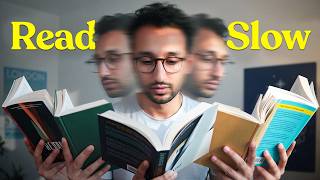

The Pillow Rule: Read More by Charging Your Phone Outside
45sThis rule offers a simple, actionable environmental design hack that contrasts sharply with common smartphone addiction, making it highly shareable.
▶ Play Clip"Title accurately promises 10 rules to read more books, and the video delivers exactly that with clear, actionable advice."
This video presents 10 actionable rules to help you read more books by redesigning your physical and digital environment, changing your mindset, and leveraging tools like audiobooks and gamification. The speaker shares personal strategies that have drastically increased his own reading volume.
Keep a Kindle or book on your bedside table and charge your phone outside the bedroom. This removes temptation and makes reading the default evening activity.
Remove social media apps from your home screen and place the Kindle app first. Add widgets for current reads to make reading the default when you pick up your phone.
Listen to audiobooks during mindless tasks like commuting, chores, or waiting. Use 1.5x-2.5x speed to create 30-60 minutes of reading time daily.
Read multiple books in parallel (fiction, non-fiction, spiritual) so you can switch based on energy levels. Avoid getting stuck on one book.
Give yourself permission to stop reading a book you don't enjoy. Life is too short to force yourself through unengaging content.
Start with page-turners (trashy fiction, romantasy, mysteries) to build the habit. You can tackle classics later once reading becomes enjoyable.
Use Goodreads to track books, see stats, and leave reviews. The gamification element motivates you to read more, similar to tracking workouts.
Listen to audiobooks at 1.5x-2x speed and train yourself to read faster by eliminating subvocalization. This allows you to consume more books in the same time.
When someone recommends a book, buy it immediately without overthinking. The ROI is huge even if you don't read it for years.
Adopt the identity of 'I am a reader.' Always have a book ready so that in spare moments you naturally read instead of scrolling social media.
Reading more books is about designing your environment and mindset to make reading the default activity. The goal isn't quantity but the inspiration, education, and entertainment books provide.
Kindle
tool
Audible
tool
Goodreads
tool
Shortform
tool
Momentum (habit tracker)
tool
Day One (journaling app)
tool
Waking Up (meditation app)
tool
Voice Pal
tool
The Personal MBA by Josh Kaufman
book
Dark Age by Pierce Brown
book
Sapiens by Yuval Noah Harari
book
Fourth Wing
book
Wuthering Heights
book
Atomic Habits by James Clear
book
A Feel Good Productivity
book
Waking Up by Sam Harris
book
Naval Ravikant
person
James Clear
person
Brandon Sanderson
person
Robert Jordan
person
Free book recommendations list
link
Spring Reset workshop registration
link
What is the 'Pillow Rule' for reading more books?
Keep a Kindle or book on your bedside table and charge your phone outside the bedroom to make reading the default evening activity.
How can you design your phone's home screen to encourage reading?
Remove social media apps from the home screen and place the Kindle app first, along with reading widgets.
02:30
What is the 'multitasking rule' for reading more?
Listen to audiobooks during mindless tasks like commuting or chores, often at 1.5x-2.5x speed.
04:15
Why should you read multiple books in parallel?
So you can switch based on your energy levels and avoid getting stuck on one book.
07:00
What advice did Naval Ravikant give about reading?
Read what you love until you love to read.
09:30
What is the 'impulse buy rule' for books?
When someone recommends a book, buy it immediately without overthinking to avoid friction.
14:00
How can you change your identity to become a reader?
Tell yourself 'I am a reader' and always have a book ready so that in spare moments you naturally read instead of scrolling social media.
15:30
What tool does the speaker recommend for in-depth book summaries?
Shortform, which provides chapter-by-chapter breakdowns, smart analysis, and exercises.
05:30
What is the benefit of listening to audiobooks at faster speeds?
It allows you to consume more books in the same amount of time, and comprehension can be maintained with practice.
12:30
Why should you give yourself permission to abandon a book?
Life is too short to force yourself through unengaging content; it's okay to move on without guilt.
08:30
Physical environment design
The Pillow Rule is a simple, actionable change that removes temptation and makes reading the default.
Read what you love until you love to read
This advice from Naval Ravikant reframes reading as a habit to be built, not a chore.
09:30Identity shift to become a reader
Adopting the identity 'I am a reader' leverages self-perception to drive consistent behavior.
15:30Audiobooks for multitasking
Listening during mindless tasks creates 30-60 minutes of reading time daily out of thin air.
04:15Impulse buy rule
Reducing friction at acquisition ensures you never miss a potentially life-changing book.
14:00[00:00] In this video, we're going over 10 rules that if you apply, it will drastically increase the number of books that you are able to read this year. All right, so let's start with rule number one. Now, what a lot of people do is that they will say something like, "I don't have time to read." And yet, if you look at their screen time, they will have hours and hours on Instagram, on Tik Tok, on YouTube, that
[00:16] kind of thing. Now, I used to struggle with this, but for me, the single biggest thing that helped was what I call rule number one, which is the pillow rule, where basically the rule is that you should always have a Kindle or a book on your bedside table, and you should always charge your phone outside of your bedroom. This means that in the evening when it's time to get into bed, the only device that you have
[00:33] access to is a book or a Kindle. I personally like the Kindle because the light means that I don't need to have like a reading light or whatever. And if your phone is being charged in a different room, it means you just remove all of this temptation to spend time on Instagram, Tik Tok, YouTube, Reddit, whatever you're into. And really, this rule is all about physical environment design. If you design your environment in a way that
[00:49] nudges you towards the habits that you actually want to go towards and nudges you away from the stuff you don't want to do, life becomes a lot easier and you don't need to rely on willpower. For me, this has been the single most meaningful rule that has made the most amount of difference in terms of how many books I can read every year. Oh, by the way, quick announcement. On Saturday the 4th of April, I'm going
[01:05] to be hosting my usual completely free quarterly reflection workshop, the spring reset. The idea is that this is a totally free workshop. There's a link down below to register if you'd like. And I will be hosting it and me and hopefully you and several thousand people from all around the world. We're going to get together on a Zoom workshop together. We're going to be reflecting on how 2026 has gone so far. And we're going to be
[01:22] setting some goals for the next 90 days. It's the spring reset. It's going to be fun. It's going to be vibe. There's more details linked down below if you would like to join. And I will hopefully see you on Saturday the 4th of April. Okay, so let's move on to rule number two. Now, here's the thing. When you pick up your phone, there is a certain amount of muscle memory you have that will cause your thumb
[01:38] to probably go on the apps that you have logged the most screen time on. If you're anything like most people, uh it will probably be something like YouTube or Instagram or Tik Tok or whatever. And that stuff is so ingrained into us is that it becomes almost habitual, like before you even realize it, you've opened a social media app and you're starting to scroll vertical videos. The best trick I have found for this personally is to
[01:54] remove the social media apps from my home screen. Some people go the full hog and like uninstall them from their phones altogether. I don't personally do that because various reasons. But what I do do lol is that the very first app that I see on my home screen is the Kindle app. On my home screen, I also have Momentum, which is a habit tracker. I've got Day One, which is a journaling app. I've got the Waking
[02:11] Up app, which is a meditation app. I've got Voice Pal, which is like a ghostriter type app. I've got my calendar. I've got my to-do list. And so, when I open up my phone, when I'm on the toilet or when I'm on public transport or when I'm like waiting in line for something, the first app that my eyes are drawn to is the Kindle app. And that means that that is usually the first app that I
[02:27] open when I'm on my phone. On one of my other phone screens, I also have the Kindle widget and the Audible widget that shows like the book that I'm currently reading on Kindle, in this case, The Personal MBA by Josh Kafman, and the book that I'm currently listening to on Audible, in this case, Dark Age by Pierce Brown. So, the rule here is to design your digital environment in a way that favors reading. Make it harder
[02:43] for yourself to access the social media apps that would otherwise take your attention away from reading. And what we're trying to do is to make reading the default thing that we do when we open up our phones rather than scrolling. All right, let's move on to rule number three. Now, the issue that a lot of people have is that they will say that they don't have the time for reading. And when you say that, you kind
[03:00] of imagine that like in order to have the time for reading, you have to be able to sit down on a leather armchair and you have to get a book out and you have to have a whole hour of uninterrupted time. Most of us probably don't have hours of uninterrupted time every day. So, the rule here that I follow to solve this problem is the multitasking rule, which is basically that when my hands are busy doing
[03:16] something that is mind-numbing or like menial, I have my AirPods in and I'm usually listening to some kind of audio book. That's not to say that you should always fill your ears with chattering at all times. And of course, there is value in like, you know, mindfully washing the dishes or mindfully just being on the toilet without listening to anything or mindfully taking a walk in the park and all that kind of stuff. But if you
[03:32] want to read more books, it's actually very, very helpful to be listening to audiobooks. Back in the day when I had a real job and I would commute an hour back and forth from work to the hospital every single day, I'd be listening to audio books usually at 1.5 to 2.5x speed depending on the speed of the narrator. And so through that, those 2 hours of commuting every single day, I got through so many books. Some
[03:49] of them were business books. Some of them were like personal development books. Most of them were fantasy fiction books by Brandon Sanderson. So if you follow this habit, if you follow this rule, you will create 30 to 60 minutes a day at least of reading time completely out of thin air that was otherwise spent either listening to music or not listening to anything at all or maybe just like having like YouTube on in the background while
[04:05] you're like doing the dishes or something. You could totally replace all of that time by listening to audio books and they would probably have a bigger impact on your life. By the way, if you want to read harder books or just level up your reading in general or you want to be more discerning about which books you actually spend time on without worrying that you're wasting hours on the wrong book, then one thing that really helps
[04:21] with all of these things is Short Form, who are very kindly sponsoring this video. Now, Short Form is basically like having your most intelligent friend break down a book for you. They don't just give you like a 10-minute AI summary of a book, but they provide proper in-depth guides with chapterby chapter breakdowns and smart analysis. And it connects the stuff in that book to ideas from other authors. And there are even exercises that they include to
[04:38] help you actually apply what you've learned. They cover loads of topics that I'm personally into, including productivity, psychology, business, self-improvement. They even have a study guide on my own book, A Feel Good Productivity, which is interesting. And they are adding new guides every single week, and you can even vote on which books they cover next. I recently went back to that guide on the book Waking Up by Sam Harris, and I genuinely picked up things that
[04:54] I completely missed when I first read the book. They've also got audio versions of everything, so you can listen on the go, and there is even a browser extension that summarizes articles and YouTube videos if you want to go down that rabbit hole. Now, what I love about short form is that it doesn't actually replace reading. It makes me a better reader. I'll often use it to revisit books that I've read or to explore a new
[05:10] book and I'll read the short form guide and then that will help me decide if it's actually worth diving deeper into that book. So, if you'd like to give it a go, head over to shortform.com/dall and that will give you a free trial and $50 off the annual plan as well. So, thank you again to Short Form for sponsoring this video. And now, let's get back to it. All right, the next rule really helps if you
[05:27] are anything like me and you sometimes get stuck on a book. I noticed this a few years ago when Sapiens first came out and I was like, "Okay, well, I should probably read Sapiens cuz everyone is reading Sapiens and it was kind of boring and I got stuck on it for like three months because I kept on thinking I had to get through the book. I had to finish the book." But then I got a really
[05:43] good piece of advice from the internet which was to not be a monogous reader instead of thinking that you have to only read one book at a time. It is actually worth having multiple books that you are reading in parallel because maybe you don't feel like doing the heavy thing like reading sapiens or whatever and instead you feel like something light and so you might want to read fourth wing or some romanty thing or whatever. So
[05:59] for me these days I've got two books active on Audible, a fiction and a non-fiction usually. And then also on my Kindle I usually have some kind of fiction, some kind of non-fiction and also some kind of spiritual literature type thing cuz reading the spirituality books actually really helps me fall asleep. And so if you do something like that, it means you can switch books based on your energy levels, and you don't have to be wedded
[06:16] to just focusing on one book at a time. Oh, by the way, if you are interested in some book recommendations, I've actually got a whole list of 100 life-changing books that have been recommended by various guests on the podcast that I used to host called Deep Dive. It's completely free to download. It'll be linked down below if you are interested. This leads us onto the next rule, which is a habit that school has actually ingrained into
[06:32] us that really doesn't help when we are adults and we're trying to read more books. That reading is supposed to be work. You are some kind of a bad person if you don't finish a book. Now, that feeling is completely unhelpful if we're actually trying to read more books because the rule here is that you should give yourself permission to abandon a book that you don't like. If a book is not gripping your attention, it's not
[06:48] your fault. It's not even the author's fault. Maybe it's just it's not the right time for you to read that particular book. And it's totally okay to move on from that book and not feel guilty about abandoning it. Life is generally too short to spend battling through and working through books that you really don't enjoy reading. And so it's really helpful to get out of this like school mindset and to not like pedestalize books that like
[07:05] oh my god I'm a terrible person if I didn't finish that book like maybe I'm an idiot. I was like no it's totally okay to read stuff that is actually gripping you. This brings us on to the next rule which is a tip I got from Naval Rabbitant. And the rule here is read what you love until you love to read. This is amazing advice. Like a lot of us really struggle with reading. And a big
[07:21] part of that is because we sort of feel like we have to read the smart books or like the classics or whatever. But the problem with smart books and classics is that they're actually quite hard to read. And there are so many books that are effortless to read, like the page turners. They make you want to actually find out more, find out what happens next without you having to spend ages trying to get into it and
[07:37] like trying to sort of feel like you're some sort of highbrow person. So NAL's advice, which I completely agree with and which has completely changed my life, is read what you love until you love to read. I've probably read over a thousand books over the years and I still have not really read any of what you would consider the classics. I've ne I've never managed to finish a Charles Dickens book. I've tried reading Wthering Heights and
[07:54] it was like boring. And at some point I'm going to get into these classics and read these like kind of big history books and like these big like literature classics and stuff. But even at this stage in my life where I've read a lot of books, they're still just kind of boring. And so if you're approaching reading thinking that you have to read these classics, that's like, you know, going to the gym for the first time
[08:10] and trying to bench 100 kg on the bench press. Like it's probably not going to happen. You would probably just injure yourself and then you would be like, "Oh man, the gym sucks. I don't want to do this again." But instead, if you were to pick up something trashy, something like trashy holiday fiction, romantisy, murder mysteries, drama, like fiction stuff that is engaging and pulls you through it, and you read enough of those, then you start
[08:26] to develop the skill of reading. You start to be able to train your focus and your attention. You start to love the act of reading in itself. And then, sure, you can challenge yourself with the fancier, more intelligent books further down the line. So, give yourself permission to read trashy books. Building the habit of reading, even trashy books, is going to improve your life way more than only reading prestige books. The next rule really helps when
[08:43] reading feels like a slog, which is to find some kind of way to gamify the process. I have an account on Goodreads. It synchronizes with my Amazon Kindle account. And so, whenever I start reading a book on Kindle, it automatically syncs to my Goodreads account. This means that my Goodreads account is actually a somewhat accurate log of most of the books that I've either started reading or finished reading on my Kindle. And that's kind of cool
[08:59] to see. It's nice to see my reading stats. It's nice to see how many books I've read on Kindle in a given year. It's nice to see my good readads ranking where I can be like, "Oh, I'm like the number seven person in the UK in terms of good readads, in terms of like like whatever." And then when you get to the end of the book and it asks you to rate the book, it's kind of
[09:15] nice to rate a book like see how much you enjoyed it and maybe leave a little review about it. There's something about that process about logging the books that you read that starts to feel quite like gamified. And like, you know, it's not really about the quantity of books you read. It's about like how the books you read change you and entertain you and inspire you and educate you. But it is still kind of nice to
[09:32] have like a little bit of gamification in that process. It's like, you know, when I go for a run, I like to track the runs because I like to see the lines going up. When I go to the gym, I track my workouts. Even if I'm not doing progressive overload because it's just nice to see the number going up. Similarly, when you are reading books and you have a way to see the number going up, it
[09:48] feels like you're sort of playing a game with yourself. All right, the next rule is that when you are reading books or also when you are listening to books, it is actually totally okay to read faster or to listen faster. I realized this when I was listening to the Wheel of Time series on Audible. It's a really long series by Robert Jordan uh where the final three books are written by Brandon Sanderson. Really long series where
[10:04] in the middle it got super super boring. And that was when back in like 2018 or something when I was I was listening to the series. That was when I discovered that you could actually listen on audible at 1.5x speed or 2x speed. And that just like changed my life because suddenly when the narrator is speaking at twice the speed, it actually makes the book more enjoyable. Especially if it's a bit of a slow to get
[10:21] through. There's like a three or four books like in the middle of the series that are a bit slow. I'm so glad that I gave myself permission to listen to those at like double speed because then when I got through the slow bit and then the final like four books were like complete bangers, I switched those to like 1.5x speed cuz at that point I was kind of used to listening to things fast. And over time
[10:37] you actually do end up training your listening speed to the point that that actually ends up being no difference in your comprehension listening to a book at one time speed, 1.5 or two times speed or even 2.5. The more you train your listening speed and genuinely absorb it at like a faster speed level, which means in the same amount of time you could just listen to more books. Similarly, with reading, there is no law that says
[10:53] that you have to read at a particular speed of reading. Some readers like to sub vocalize where it's sort of like you hear the words in your head as you're reading. That's a fairly slow way of reading. If you want, you can train yourself to eliminate sub vocalization and then you can read a little bit faster. And if you're able to read fast, it actually helps you get through especially the more boring bits of books just
[11:10] quicker, which is just a nicer way of reading and a better way of being able to read more books. At this point, some people be like, "Well, screw you. This is terrible advice. This is toxic productivity. You should enjoy the roses and stuff." to which I would say that it's totally possible to enjoy the roses. And sometimes the roses are even nicer when you're getting through them a little bit faster. There is no additional nobility or
[11:26] prestige in listening or reading a book slowly. Just like there's no additional nobility or prestige and reading it fast. It's just like up to you. Just like all of us walk at different paces and there's nothing like good or bad about walking slow or walking fast. Similarly, all of us read at different paces and you can in fact train yourself to read or listen at higher speeds which just allows you to read more books. Next up,
[11:42] we have the impulse buy rule. When I first started making money from like my side business when I was in med school, I came across this rule which is that whenever you see a book recommended, you should just buy the book. You should treat it like an impulse buy. You should not think about it. Obviously, if you have no money, you have to start thinking about it. But I'm sure you have ways of acquiring books even
[11:59] if you are completely broke like I was back when I was a teenager. And so for me, if anyone recommends me any kind of book at all, I will immediately open up my phone, go to amazon.co.uk and just buy it on Kindle or download it on Audible using my Audible credits or whatever I feel like doing. And I don't think twice about it. And there have been a bunch of books that I've impulse bought over the
[12:15] years where, you know, I buy the book and then maybe like two years later I'll discover it on my Kindle and I'll start reading it and I'll get one like life-changing idea from it that changes my life or changes my perspective or changes my experience. And so the return on investment of these is absolutely huge. So the trick here is if you can don't create friction at the point of acquisition. If someone recommends you a book,
[12:31] just like buy the book and don't think too hard about it and feel free to like reduce your expenses in other like less interesting areas of life like takeaways or restaurant meals or whatever if you need to compensate for the fact that you're spending a bit more money on books. The final rule relates to something that James Clear talks about a lot in his book atomic habits which is the identity shift. A lot of us have
[12:48] the identity like we have told ourselves that I am not a reader or I struggle to read and these identity statements are very powerful and also very unhelpful if you're actually trying to read more books. And so one level up is you know I'm trying to read more books. I'm actively working on it. But even that is sort of implying to yourself that you are not the sort of person who reads stuff. Whereas if you can
[13:04] genuinely sigh up yourself into telling yourself that I am a reader and you for example always have a book that you're reading, you then start to think of yourself as a reader. And if you're a reader then like what do you do when you've got a moment of spare time? You don't pick up your phone and start scrolling Tik Tok. You pick up your phone, hit Kindle, and start reading on Kindle or you pick up a
[13:20] physical book and actually start reading it. And so when you have that kind of identity change and when you always have the ability to read in any kind of moment of downtime, that then drastically increases the amount of books that you're able to read. Now, this whole video has been about how to read more books. But obviously reading more books isn't really the point. The point is the inspiration, the motivation, the education, the learning, the entertainment
[13:37] that you get from the books that you read. And if you are interested in a method for actually remembering more of the stuff that you read, there's a video over here. It's a couple years old, but it's still very relevant. This video kind of goes through my own system for how I connect up various different apps together so that I can remember everything that I read. So, if you're interested in remembering more of the things you
[13:53] read, you should check out that video over there. Thanks for watching. Till you later.


⚡ Saved you 0h 13m reading this? Transcribe any YouTube video for free — no signup needed.