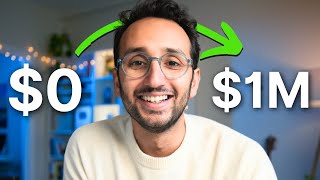

Investing Basics: How to Start
45sThe opening quickly addresses the confusion and fear beginners face, making it relatable and hooking viewers who feel overwhelmed.
▶ Play Clip"The title promises a beginner's guide and delivers exactly that, with clear explanations and actionable advice."
This video is a beginner's guide to investing, covering the basics of why and how to invest, common fears, and an alternative 'fast lane' approach. The host explains key concepts like inflation, stocks, dividends, and index funds, recommending that beginners invest in broad market index funds like the S&P 500 rather than picking individual stocks.
Inflation erodes the purchasing power of money over time, so investing is necessary to grow wealth.
Investments grow through income (like rent or dividends) and appreciation in value.
Buying a stock means owning a percentage of a company. You can profit from price increases and dividends.
Warren Buffett advises beginners to avoid stock picking and instead invest in index funds like the S&P 500.
An index fund is a basket of stocks that tracks a market index, like the S&P 500, providing diversification.
Use a broker platform (e.g., Trading212, Vanguard) to buy index funds. Start with small amounts.
If you hold through downturns, the market historically recovers and grows over the long term.
Instead of investing in others' businesses, invest in yourself and your own business for higher returns.
For beginners, the safest and most effective strategy is to invest regularly in a low-cost index fund like the S&P 500. However, for potentially higher returns, consider investing in your own skills and business.
What is the main reason to invest rather than save?
To combat inflation, which erodes purchasing power over time.
01:08
What are the two ways an investment can make money?
Through income (e.g., rent, dividends) and appreciation in value.
01:37
What does buying a stock represent?
A percentage ownership in the company.
03:25
What is an index fund?
A fund that tracks a stock market index, like the S&P 500, holding a basket of stocks.
06:07
Why does Warren Buffett recommend index funds for beginners?
Because most people cannot consistently pick winning stocks, and index funds provide diversification and market returns.
05:10
What is the S&P 500?
An index of the top 500 largest publicly traded companies in the US.
06:07
What should you do if the market crashes after you invest?
Hold your investment; historically the market recovers and grows over the long term.
12:00
What is 'fast lane investing'?
Investing in yourself and your own business rather than in other companies' stocks.
15:29
What is the average annual return of the S&P 500 mentioned in the video?
About 7%.
16:38
Warren Buffett's Advice
The host cites Warren Buffett to emphasize that beginners should not pick stocks, a key takeaway.
05:10Market Crash Resilience
The host explains that holding through a crash leads to recovery, countering a common fear.
12:00Fast Lane vs Slow Lane
Introduces the concept of investing in yourself for potentially higher returns, a motivational shift.
15:29[00:00] So let's say you want to get started with this investing thing. You might have a bit of money saved, it's probably not enough for a house, but you decide you should probably invest it in something. You could invest in stocks, shares, equities, government bonds, corporate bonds, real estate, foreign exchange, crypto, NFTs, futures, fine art, watches.
[00:15] There seems to be tons of stuff out there. And you might have even seen those ads on YouTube from the gurus talking about day trading and trading foreign exchange and how you could make money in that way through investing. And on top of all this confusion, there's the very real fear that you might lose all of that money that you've worked so hard to save up.
[00:29] So in light of all of that, this is the ultimate guide to investing for beginners. And we're going to split this video up into four parts, which are going to be timestamped down below so you can skip around if you like it. Part one is going to be about the basics and the philosophy behind investing.
[00:41] Part two is about why and how to invest your money in stocks and shares. In part three, we're going to be addressing common fears and questions and concerns about investing, like, why did I lose all my money? And then in part four, we're going to talk about fast lane investing, which is an alternative
[00:53] approach to the traditional investing thing to build wealth. Part one, the philosophy and the basics of investing. So let's start by talking about what is the point of investing. The point of investing is for your money to be able to make more money. So let's say you start off with $1,000 that you saved up through your hard-earned labor.
[01:08] Now, you could put that money under your mattress, or you could put it in a bank current account. But the problem with that is that there's this thing called inflation that you might have been reading about on the news. And so your $1,000 might be able to buy you a MacBook Air right now. But a few years from now, when inflation goes up, that MacBook Air is going to cost $1,200.
[01:23] And so over time, your money loses its purchasing power, which is why you want to ideally invest in something, because when you invest in something, your money grows magically on its own, more on that later. And that means you can combat the effects of inflation. And that brings us to the next question, which is how does the money magically grow in the
[01:37] first place? And generally, the philosophy behind investing is that you buy something now, and that something makes you more money over time. And there are two ways in which the thing that you buy can make you more money. Let's say you buy a house. It costs a certain amount of money to buy a house right now, but there's two ways the
[01:51] house makes you money. For one, you can rent the house out, and so you're getting rental income every month. And secondly, hopefully, in theory, the value of the house will also rise over time. If you haven't bought the house and you just have that money sitting in a bank account,
[02:03] then over time you're going to be losing money because inflation is going to eat away at your savings. Now, houses are an interesting example because you get rental income, and it's very easy for us to imagine what that looks like. You're like, everyone pays rent, and so you're making money. But with most other asset classes, you don't have this equivalent of rental.
[02:16] Instead, a lot of these things you're buying, and then you're hoping that you can sell them for a higher price over time. The main exception to this is some stocks and shares, which we're going to talk about a little bit later in the video. And these asset classes are a long list of things that you probably have heard of, but you might not be entirely familiar with.
[02:30] You know, we've got stocks, shares, and equities, which are kind of the same thing. We've got hedge funds. We've got index funds. We've got bonds, government bonds, corporate bonds. You might have heard some people investing in watches and in fine arts. You've probably heard of people investing in crypto, and you're gaining lots or losing lots.
[02:43] In my case, losing quite a bit of money because crypto has crashed recently. And a lot of this can get very complicated quite quickly, and so we're going to simplify things. And for the rest of this video, we're going to talk about investing in stocks and shares, because that is the main kind of investing that normal people like you and me can unlock fairly easily.
[02:58] You don't need to have large amounts of money which you need to invest in a house. You don't need to take on huge amounts of risk and gambling and stuff like you need to do with crypto. And you don't need to be an accredited investor or anything like you need to invest in, like, angel investing companies or all this fun stuff. So stocks and shares are kind of the basics of investing.
[03:12] And usually when people talk about investing their money, what they're referring to is, I want to buy some Tesla or I want to buy some Netflix or I want to buy some Amazon. and so we're going to talk about that. Part two, why and how to invest in stocks and shares. So when you're investing in stocks and shares, for example,
[03:25] you're basically buying a percentage ownership in the company that you're investing in. So let's say I wanted to buy shares in Apple, for example. Apple is a publicly traded company, which means the public can trade Apple stock. Now, in a dream world, I would just be able to go to apple.com forward slash buy
[03:39] and I'd be able to buy a stock of Apple and now I own some percentage of the company. In reality, I can't do that directly. I have to go through a middleman, which we call a broker. But once I've gone through this middleman platform, I now personally own a piece of Apple.
[03:51] Now, I can make money from stocks and shares in two different ways. Firstly, I can make money because I'm hoping the price of Apple or whatever stock I've invested in is going to rise over time. So, 10 years later, I could sell it for a lot more money than I bought it, fingers crossed. But the second way in which you can make money through stocks and shares is similar to how you make rental income on a house.
[04:07] Because certain companies will pay what they call dividends. So, for example, in the UK, there's a company called BT, which is Telecom, and they pay dividends. So when you own a piece of BT, you're not just hoping that the price will rise over time. They're also literally paying out some of the profits that the company makes to their shareholders.
[04:21] And so if, for example, you were ridiculously rich and you owned 20% of BT, then every time they declare a dividend, which might be every three months, you would get 20% of the profits that they are distributing to shareholders. In reality, you and me were probably not going to own 20% of a huge company like that
[04:35] because that would cost absolutely billions. But instead, we might get $10, $15, $20, like $5, $5.47 here and there. And if you invest in a lot of companies that are paying out dividends, then it feels like you've got this free kind of rental income, but really it's profits from these companies
[04:49] coming into your account every month, and that's pretty cool. So at this point, okay, cool, you can now buy stocks in these different companies, you can own a small percentage of that company but how are you supposed to choose which companies Should you put all your money in Apple or Netflix or Disney or should you go with Shell or British Petroleum or Ralph Lauren or like I don know Geneleaver or these brands that you might be familiar with
[05:10] Now, at this point, people have varying different opinions on the matter, but I'm going to cite Warren Buffett's opinion on this, which is also my opinion on this, which is that if you're a beginner to investing, unless you are legitimately a financial professional who literally does this full-time for a living, you should not try and pick stocks.
[05:25] The average person will not know enough to know which stocks to buy. Or won't know enough to know when to buy them. But they don't have to. Because they can buy all of America for an index fund. Because realistically, you and me, we're not really going to have an insight into,
[05:40] oh, I reckon Apple's going to do really well because whatever. Or I reckon Disney's going to do really well because whatever. There are literally financial professionals whose full-time day job it is to do that kind of analysis. And even then, they don't get it right a lot of the time. And so what you can instead do is, instead of worrying about stock picking,
[05:54] what you should do, probably, not financial advice, well, is invest in an index fund. And that begs the question, what the hell is an index fund? Well, an index fund is a fund, and a fund is a basket, like a group of stocks and shares, or other things, but stocks and shares, for example.
[06:07] And the index component means that this fund tracks a particular stock market index. For example, in the US, there is a really famous index fund called the S&P 500. And this is basically the top 500 biggest companies in the US.
[06:19] And you can see here, these are the components of the S&P 500 right now. So Apple makes up 6.4% with the S&P 500, big company. Then we've got Microsoft, Amazon, Alphabet, which is Google, Gertrude Hathaway, which is one Buffett company, Alphabet, Class C, which is also Google,
[06:32] NVIDIA, Tesla, ExxonMobil. You might be familiar with quite a lot of these companies. But if we scroll all the way down to the 500 company, we've got, I don't know, Ralph Lauren and Hasbro, and I didn't realize Hasbro was in the S&P 500,
[06:44] but you can see that Hasbro makes up 0.21% of the S&P 500 compared to Apple's 6.4% because those companies are hugely different in, I guess, market cap or valuation. So the point of the S&P 500 is that it gives you a single number
[06:57] that you can graph over time of how valuable the U.S. stock market is. Because to be honest, most of the value of the U.S. stock market is in these 500 companies. And so if the value of these 500 companies is slowly increasing over time, which it generally does,
[07:09] that means the U.S. stock market is doing well and these companies are doing well and life is all good. If, for example, you're in a recession where the stock market is going down or if, for example, COVID has just become a thing and the stock market has gone down, That means that collectively, people have decided that the value of these stocks is lower than it once was, and so the graph will go down in those moments.
[07:27] So, what does this all mean for you and me as normal retail investors? Well, basically what it means is we can invest in an index fund. So, let's say I put $1,000 into the S&P 500 index fund. That's very good, because it means that my $1,000 is now split between 500 of these companies.
[07:42] And crucially, it's split based on the weighting in the S&P 500. So of my $1,000 that I've just put into the S&P 500, 6.4% would be in Apple stock. And so now I own $64 worth of Apple stock.
[07:54] And that's pretty cool. I now own a bit of Apple. 5.4% of that would be Microsoft. So I now own $54 worth of Microsoft stock. And 0.015% of that is going to be Ralph Lauren, which is $498 on the S&P 500.
[08:07] And so I now own $14 worth of Ralph Lauren stock. Now this is a very good thing. And this is what Warren Buffett recommends. My view is for most people, it's the first thing to do is still on the S&P 500. He says that, hey, if you had an extra $100,000 to invest, you should just put it straight into the S&P 500 or some other big index fund.
[08:24] Because over time, your money is going to track the market. You're not trying to say, hey, I have a crucial insight into the market and I know that Apple is going to outperform all these other companies. Instead of you thinking, you know what? I'm just a normal person. I don't have time to spend 80,000 hours a week trying to research the shit out of all this stuff.
[08:39] I'm just going to kind of diversify my money across all these top 500 big companies in the US. I think overall US companies are going to go up over time, and therefore I don't have to think too hard about this. So what's your alternative? Well, we talked about how you could theoretically pick stocks yourself.
[08:52] So you could say, you know what, I'm going to ignore the S&P 500, but chances are you are not going to beat the market. Chances are, unless you just get really lucky, you're not going to be reliably able to get the returns that you would get by just investing in all 500 of these companies.
[09:04] Now, there's been a bunch of studies and surveys, and Warren Buffett even did a challenge experiment thing about this that basically show that very few funds overall actually outperform the S&P 500. And if you've got a fund that beats the S&P 500, i.e. it does better in that year than the S&P 500 did,
[09:19] it's unlikely to do the same the following year. And so a lot of these funds are trying to, quote, beat the market. But as Warren Buffett and a lot of these other people say, you cannot beat the market, so let's just invest in the market directly. Just put your money in an index fund and don't think too hard about it.
[09:32] Every single person I know who has invested by picking stocks has lost money. and every single person I know who has invested by just investing in an index fund has made money over time. The next question that this raises is, okay, cool, I want to invest in a stock market index fund.
[09:45] How the hell do I do that? Do I just go on s&p500.com forward slash buy and buy some index funds? Again, it's not quite how it works. You need a bit of a middleman and that's where these kind of online platforms come in.
[09:57] Now, this is going to vary depending on whatever country you're in. So if you want to find a stocks and shares investment platform in your country, then just Google that. In the UK for example there are loads The ones that I personally use are Charles Stanley Direct because that the first one I started using in 2015 I also use Vanguard Vanguard is super big and super legit You can check it out And the app that I use personally for investing in individual stocks these days is Trading212
[10:15] And in fact, incidentally, this video is now sponsored by Trading212. This is kind of fun. As you can tell, I'm recording on a different day. Anyway, if you want to get started with investing, Trading212 genuinely is the app that I use. It's the best way to get started. You can trade stocks and shares. You can also open an ISA and individual savings account if you're in the UK.
[10:29] One of the cool things about Trading212 is you can practice investing with practice money. So everything about the market is identical. It's just that you're investing fake money rather than real money. And if you're uncomfortable investing real money for now, this is a great way to become more familiar with the concept of investing.
[10:42] And then once you're ready to invest with real money, you can just switch using a simple button on the app. And you can deposit money through Apple Pay up to £2,000. And then you can use bank transfer subsequently. And the other cool thing about Trading212 is it's got this really cool Pies feature, where basically you can look on the app and you can see other investment Pies
[10:56] that other people have created. So you'll have these like finance bros that are creating their custom pies and you'll see that they've allocated 10% to the S&P or 20% to the 50100 or this percent to Apple or Tesla or Microsoft or whatever. And then you can see the performance of that specific pie over time.
[11:10] And then what you can do if you really want to is you can copy and paste someone's pies that they have built into your own investing account. And now you can automatically, with a single click, invest, let's say, £100 into that pie and so that £100 will then be split amongst the various allocations that a person has
[11:23] decided to do in the pie. And that's great. Like, obviously, I still recommend investing in some broad stock market index funds like the S&P 500, even though I don't get financial advice. Anyway, if you fancy giving it a go, it's commission-free. It's completely free to sign up. You don't have to pay anything. You can go to Trading212.
[11:35] It's available on the App Store, on iOS, and on Android. And if you use the coupon code ALI, at least when you sign up, that will give you a free share up to the value of £100. So you can get completely free money by just signing up for Trading212. Check it out with the link in the video description
[11:48] or search Trading212 on any of the App Stores. So thank you so much, Trading212, for sponsoring this video. Part three, common fears, concerns, and questions about investing. So it'd be probably very unlikely to lose money because Vanguard collapsed overnight.
[12:00] But you might lose money if the value of your investments goes down. And this is where people get really, really, really worried because they always think, ah, you know, if I invested my pardoned cash into these stocks and shares, what if it goes to zero? What if I lose my money?
[12:12] Now, this is a common fear. And certainly, let's say you invested $1,000 into the S&P 500 just before the financial crash in 2008. And then the market crashed by, I don't know, 60% or whatever it was. And so now your $1,000 is worth like $400.
[12:24] And now you're thinking, oh my God, I can't believe I've lost 60% of my money. Now, if at that point you sell, now you have realized the loss. Now you've literally lost money because you bought the thing for $1,000 and you sold it for $400. But if you had just held on in the market, recovered over time, and by 2012 it was at the same levels,
[12:38] and then it was just going up and up and up. So even if you had invested lots of money just before the 2008 financial crisis, if you had just stuck your guns and left that money in there, you'd have doubled or tripled or something your money by now.
[12:50] because overall the stock market broadly goes up over a long enough time horizon. It's the same with house prices. You can buy a house, and if you try and sell it next week, then maybe the price will have gone down. But if you try and sell it 20 years from now, chances are, unless your country has been destroyed, the price will have gone up.
[13:03] And the longer you can leave your money in the index funds or in whatever, the more it compounds over time. And as Einstein is famously purported to have said, compounding for the eighth wonder of the world. What are the chances that all 500 of the biggest companies in the U.S.
[13:16] suddenly are going to drop to zero value overnight? Basically, 0%. I think if all 500 of the biggest companies in the US all have their values up to 0, we're going to have bigger problems in the world than the value of my stock market portfolio.
[13:30] And the reason why I think it's reasonable to make the bet that over time the stock market goes up is because every day thousands of people are going to work in each of these companies. Every single day, value is being created by the employees at Apple. They're researching new technology. They're building new stuff.
[13:42] They're adding an extra camera or an extra lens to the iPhone. And all that means that because these people are putting in the input of human labor, you would expect the value of the company to rise with time because they're making more and more cool stuff. And because people are going to want to continue to buy that more and more of that cool stuff.
[13:56] Now, another question people sometimes have is how much money do I need to get started? Do I need to be like super rich to start investing? And the answer is no. Again, it depends on which platform you're using. But for example, in Trading 212 or Vanguard, Vanguard, I think you just need £100 to invest.
[14:08] Trading 212, I think you can start with like £5. And again, this is massively varied depending on your country. So do some research, figure out what are the most reputable and legit platforms in your country, and then you can invest based on that. Now, there's two other categories of stuff that I invest in.
[14:20] I invest in real estate, so I've got a few properties in the portfolio. I'm not going to talk about that because I've done a video about that over there, buying versus renting, and that's usually outside the range for most people until you've already made a lot of money to be able to afford a deposit on a house and get a mortgage. And I also invest some amount of money in crypto.
[14:33] As we can see here, the total value of my crypto portfolio is $200,000, but I have actually lost $65,000. So I've put in $265K into crypto and currently it's worth $200K. What can you do? I'm hoping the price rises at times.
[14:45] So generally, when it comes to recommending investing in crypto, people often ask about this. I would say, if you want to take a gamble, fine, but make sure the only money you're putting into your crypto account is money that you can 100% afford to lose. Don't try and think of investing in general or crypto in particular as a get-rich-quick scheme.
[15:00] But generally, if you want to invest your money in stocks and shares, as one bucket says, and as I do, and as I generally recommend, even though I not a financial advisor not financial advisor etc It pretty reasonable to put that money in a stock market index fund like the S 500 for example By the way if you enjoying this video so far I love to hear in the comments what been your biggest concern about getting started with investing
[15:17] What is the thing that's holding you back? Part 4. Fast lane investing, the alternative approach to building wealth. So far, we've talked about what some people would somewhat disparagingly call the slow lane approach to building wealth.
[15:29] That's why there's a slow lane and there's the fast lane. Now, this is terminology from M.J. DeMarco's book, The Millionaire Fast Lane, which is actually a really good book. So the basic idea of slowly investing is that, hey, I've got some money, I'm going to do my day job, I'm going to save up 10% of my paycheck, and every month I'm going to put $10 into my savings account.
[15:45] And then I'm going to invest that money in the S&P 500, and then 50 years from now, by the time I'm 65, that money will have compounded, and then I'll be a millionaire. This is a very, very slow form of investing. It's a very slow way to build wealth.
[15:58] It's only fine to invest in stock market index funds. I do that as well. But there is another approach to investing, and it's worth talking about that here, because when we hear investing, a lot of us just default to thinking, oh, I guess I should buy stocks and shares, or I guess I need to buy a house.
[16:11] But if we really think about it, what is the point of investing money? The point of investing money is for your existing money to make more money further down the line. That's all the point is. The point is not to invest in stocks and shares. Stocks and shares are a vehicle by which you can turn your money into more money further
[16:24] down the line. But when it comes to fast-sane investing, fast-sane investing is basically that instead of investing in someone else's business, i.e. Apple or Amazon or Google or whatever, you're investing instead in yourself and in your own business. The S&P 500 goes up by 7% each
[16:38] year, again, on average. So if I put $1,000 into the S&P 500, it would be worth, on average, $1,070 12 months from now. And so the question becomes, can I do something better with that $1,000 to make more than $70 in the next 12 months? And generally the answer is, hell
[16:52] yes. There are kind of two things I could invest in. I could invest in my own ability to make money. So for example, let's say I'm a healthcare assistant in a hospital, and I can take a course for £100, and that course gives me the ability to become a phlebotomist, someone
[17:06] who takes blood. And let's say I'm making £15 an hour as a healthcare assistant, but I could be making £25 an hour as a phlebotomist. Now all of a sudden, I've paid £100, I've invested £100 into my own skills, but I've been able to increase my earning capacity by nearly 2x.
[17:20] And therefore, within four hours of working as a phlebotomist, I will have paid off my £100 investment. And now if I work as a philbotomist instead of a healthcare assistant, I'm now earning more than £10 an hour. And so every 10 hours of the work that I do, I'll be earning that £100 back.
[17:33] And so my return on this £100 is way, way, way higher than just 7%. Because I've fundamentally increased my own value to the market, I've fundamentally increased my own ability to make money. This is why investing in your own education is generally a very reasonable thing to do.
[17:46] Yes, you can find out lots of stuff on YouTube, and I'm always in favour of like, hey, if you're broke, don't buy fancy courses, don't take out loans to buy courses, find free information on the internet. But I've got so many friends who have an extra £2,000 and they put it in the S&P 500 because they're hoping it will grow over the next 50 years.
[18:01] Rather than just spending some money on a weekend course on whatever skill they want to improve, then they can use that skill to literally make way, way, way more money than they would by just sticking in the S&P 500. So that's kind of one way of fast-rate investing. You invest in your own ability to make money.
[18:14] But the other way of fast-rate investing is by investing in your own business. Obviously, this only applies if you have a business slash want to start a business. But generally, the way to get rich quickly, quickly over the next 10 years rather than the next 70 years, is to build your own business, to own your own business, and to increase
[18:29] the value of that business rather than giving the money to Apple or to Tesla. So for example, if I wanted to, I could start my own coffee shop, or my own online business, or my own YouTube channel, which is a business. If I wanted to, I could start my own web design agency or social media marketing agency.
[18:42] If I wanted to, I could learn how to code and I could build software and I could turn it into an app. I'd back myself to be able to make a business and teach myself the basics of how to run that business and make that business more valuable in terms of return percentage than the 7% I would get in the S&P 500.
[18:55] And when I interviewed Alex Formozzi, who's like a $200 million entrepreneur, he kind of calls it investing in the S&P versus investing in the S&E. It's the whole S&P 500 versus S&E 500, but you'll get a significantly higher return investing
[19:08] in your own ability to make money than you will in any market. And his advice as well is that you should invest in the S&E. You should invest in yourself. Invest in your own skills. Invest in your own ability to make money. invest in your own business because the returns on that are way more likely
[19:20] to be ridiculously higher than just that 37% that you get by investing in the S&P 500. So if, for example, you are interested in investing in your own education and you want to sell a YouTube channel and really take it seriously and treat it like a business, you might like to check out
[19:32] my own course, Part-Time YouTuber Academy. It's great. People love it. Good vibes. That'll be linked down below. And that course is basically about teaching you the things you need to know to systemize and scale a YouTube channel if you want to treat it like a business. It's not a course for people who want to do it
[19:44] as a hobby, but it's like me you want to turn your channel into a business and make money that way, that's a course that might help you. But of course, everything is available on YouTube for free as well. So if you're broke, or if you have loads of time and not much money, then of course you can find all this information for free on the internet. Anyway, I hope you found this video
[19:57] useful. If you're interested in learning more about this fast lane investing approach to building wealth, you should check out this video here, which is my book review of The Millionaire Fast Lane by N.J. DeMarco, which is the best book I've ever read on how to make money in a quick fashion, quick meaning in the next 10 years rather than the next 60
[20:11] years. So check out that video over there. Thank you so much for watching, and I'll see you hopefully in the next video.
⚡ Saved you 0h 20m reading this? Transcribe any YouTube video for free — no signup needed.