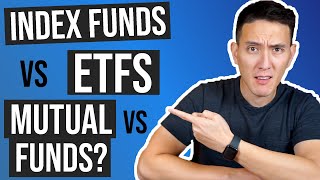

Index Funds vs Mutual Funds vs ETFs: The Truth
45sThis hook directly addresses a common confusion for beginner investors, promising to save money and hassle, which is highly relatable and clickable.
▶ Play Clip"Title accurately promises a clear comparison of the three fund types, and the video delivers exactly that."
This video explains the differences between index funds, mutual funds, and ETFs, highlighting their commonalities and key distinctions to help investors make informed choices.
The video aims to clarify the differences between index funds, mutual funds, and ETFs, which are often confused by beginners.
All three funds allow investors to own a small percentage of many underlying assets through one transaction, providing diversification.
Mutual funds are actively managed by a professional, leading to higher fees (1-2% expense ratio) that can significantly reduce returns over time.
Index funds use passive management to track a market index (e.g., S&P 500), resulting in very low fees (as low as 0.04%) and often outperform active funds long-term.
ETFs trade like stocks on exchanges, offering intraday trading and lower minimum investments, but may incur commission fees unless using a discount broker.
Index funds are ideal for passive, set-and-forget investors who meet minimums; ETFs suit those wanting flexibility or lower entry costs. Mutual funds are generally discouraged due to high fees.
Index funds and ETFs are both low-cost, diversified options, while mutual funds' high fees make them less attractive. Choose based on your investment style and minimum requirements.
What is the main commonality of index funds, mutual funds, and ETFs?
They allow you to own a small percentage of all underlying assets through one transaction, providing diversification.
01:12
What is the typical expense ratio range for mutual funds?
1% to 2% per year.
03:40
How much can a 1% fee reduce a $100,000 portfolio over time compared to a 0.25% fee?
Over $30,000.
04:08
What is the key difference between mutual funds and index funds?
Mutual funds are actively managed, while index funds are passively managed.
02:55
What is the minimum investment for VFIAX index fund?
$3,000.
07:30
How often can you trade an index fund?
Once per day.
06:36
What does ETF stand for?
Exchange-Traded Fund.
06:22
What advantage do ETFs have over index funds?
They can be bought and sold like stocks throughout the trading day.
06:22
Who won the million-dollar wager between an index fund and an actively managed hedge fund?
Warren Buffett, who bet on the index fund approach.
05:28
Like Button Joke
Humorous aside where the speaker claims funds love hitting the like button, engaging the audience.
02:10Warren Buffett's Bet
Reveals that Buffett's index fund bet beat an actively managed hedge fund, reinforcing the value of passive investing.
05:28Mutual Funds Suck
Blunt, memorable statement summarizing the speaker's strong opinion against mutual funds due to high fees.
07:57[00:00] Hello guys, welcome back to my channel. It's Humphrey here. Whether you're new to the channel or you're a returning subscriber, thank you for being here. Today we're talking about the differences between index funds, mutual funds, and ETFs. If you're like me, when I was starting
[00:12] out investing, I didn't really know the difference between these three funds and oftentimes the terms were used interchangeably. But I'm telling you right now, if you do know the difference between what an index fund, a mutual fund, and an ETF is, it's going to save you a lot of money and hassle
[00:26] in the long run. So if you stick around to the end of this video, I'll guarantee that you'll know what the differences between these three funds are, some examples of these three funds, as well as I will tell you what I think the best option for you to choose is in your own
[00:39] investment portfolio. Again, this type of stuff really isn't taught in schools, and I wish that eight years ago when I started investing that I had watched a video like this just to know the differences between these three funds, and that would have in turn taken me a lot of heartache and a lot of money in fees. So anyway, let's get right
[00:54] into it, and let's first talk about the commonalities of these three funds, and then we'll talk about the differences. The main commonality of all these funds is that by doing one transaction, you're able to own a small percentage of all of its underlying assets.
[01:12] So what do I mean by this? Imagine you have a candy jar, and within that jar, it's filled with a bunch of M&Ms. Pretend in this example that each M&M is a stock or an investment that grows over time. And in a perfect portfolio, you have a wide range of M&Ms.
[01:25] But if you only buy one M&M, you're essentially, what you're doing is you're putting all of your money or your investment into one basket, a.k.a. that one M&M. It's incredibly risky. So what you can actually do with an index fund, a mutual fund, or an ETF is that you can buy the candy jar.
[01:41] And the candy jar itself has access to all of the M&Ms that are within the candy jar. But the difference is when you do buy the candy jar, you just get a small percentage of every M&M in that candy jar. Basically, that's kind of a funny example, but what I'm trying to say is when you buy that one fund,
[01:57] you're essentially just buying little bits and pieces of everything that it owns. So number one, that's really convenient, but number two, it's also offering you a lot of diversification. And all diversification really means here is that your risk is now distributed across all of the assets that you own.
[02:10] So that the commonality Mutual funds ETFs and index funds all allow you to make one transaction but then you own a small percentage of everything that it has The second commonality that all of these funds actually have is that they all hit the like button And no I not joking It really serious They all love to just destroy
[02:28] that like button. So if you could do the same thing as these mutual funds, ETFs and index funds, I would certainly appreciate it. The algorithm will certainly appreciate it. And hopefully this channel will just be able to get more views and more exposure so that more people can learn about
[02:41] investing. Jokes aside, the second commonality that they actually have is, I already mentioned it earlier, it's diversification. So we've basically already covered what the commonalities of all these funds are. So what are the differences of these funds? Let's talk about that. The first
[02:55] fund I want to talk about first is actually the mutual fund. And the reason is, is that it offers a different type of investment strategy than index funds and ETFs do. Mutual funds are a group of 40 to 100 stocks typically, but it's professionally managed by a professional stock manager. That's
[03:10] its main difference between index funds and ETFs, it uses an active management style. So this professional stock manager is basically choosing which stocks and securities go into the mutual fund and go out of the mutual fund as he or she pleases. So when you have a professional manager
[03:26] in an active management style, they actually need to be compensated somehow. So basically, that's the biggest difference here. Mutual funds will charge typically higher fees to basically help compensate the portfolio manager that's making all the decisions. Typically, mutual funds
[03:40] like to charge between 1% to 2% per year of what you have invested in the mutual fund. This is sometimes called the expense ratio. Now, I know a 1% fee doesn't seem like a lot, but imagine you have $100,000 in a one mutual fund.
[03:53] That's actually $1,000 per year that you're paying just so that they can actively manage your investment. And their goal aim is just to beat the S&P 500 return of the year, and some years they do, which is really, really great, but some years they actually don't beat the market.
[04:08] According to SEC.gov, a 1% fee annually can reduce your portfolio value by over $30,000 compared to a portfolio with a lower fee, such as 0.25%. So because of fees, that's personally why I do not like mutual funds.
[04:22] I do think that this fee will slowly eat into your investment returns over a long period of time. By investing in mutual funds you paying unnecessarily for a fee that I don think is quite justified because you can get virtually very similar products in index funds and ETFs which I about to show you next And the main advantage that an index fund or an ETF has over a mutual fund
[04:41] is the fact that they have very low fees, sometimes even as low as 0.04%. So how do those index funds and ETFs get such low fees when virtually it's the same product? Let's talk about that.
[04:53] The biggest difference of an index fund is that they have a passive management style. So what that means is there's no active fund manager. So you're probably now wondering, well then, Humphrey, who the hell picks the stock? Well, my friend, an index fund is just constructed to basically match the return and the risk of its underlying market.
[05:10] In this case, with DFIX, you can buy an index fund that tracks the entire S&P 500. For around $300, you get to own a small percentage of the entire index. And the whole theory is that index funds will outperform actively managed portfolios over a long period of time for the average investor.
[05:28] And Warren Buffett absolutely believes in this type of strategy. In 2007, he actually placed a million-dollar wager that his index fund approach would be an actively managed hedge fund over a period of 10 years.
[05:40] And guess what, guys? He's won. So basically, an index fund offers passive management, tracks a different type of market. Typically, the S&P 500 is an example of one, or the Dow Jones Industrial Average is another example of one that you can buy.
[05:53] and what it does is it typically offers you really, really low fees in exchange for the passive management style. It often looks to match the return and the risk of the market that it's tracking and it's typically better for the average investor over a long period of time.
[06:07] So now that we know what an index fund is, we know what a mutual fund is, what then is an ETF because how could it be any more different than these two? So an ETF is very similar. It's still a basket of securities. So when you buy the ETF, you're still getting a small percentage of the
[06:22] basket of securities. The only difference with an ETF, which stands for exchange for your fund, is it means that you can buy and sell an ETF just like you would a stock on the market. Because of that flexibility, it gives you a lot more control. Now, I didn't mention this earlier,
[06:36] but an index fund only trades once per day, so there's only one time a day you can actually buy and sell it. Now, if you do buy an ETF on the market, you'll have to pay any commission fees for using a brokerage service to actually buy the ETF That is unless of course you have access to a discount brokerage such as Robinhood which offers zero commission on trade If you guys would like to use my Robinhood referral link the link is in the description below
[07:00] I believe you do get a free stock if you use my referral link, but don't feel pressured to use it. You can just go ahead and sign up for Robinhood on your own as well. I do think that Robinhood is one of the friendliest beginner platforms for beginner investors. The other difference with ETS is that, especially with the new invention of all these online brokerages that are offering fractional shares,
[07:18] you can actually buy into an ETF for less than what it's actually worth. You just get a portion of that share. Now, contrast that to an index fund where typically they have minimum investment requirements.
[07:30] So a fund such as VFIAX, like I mentioned earlier, actually has a minimum investment of $3,000. Since ETFs do trade on the market, you're able to buy and sell them as you please, which gives you a lot of flexibility. But honestly, guys, if you're just buying ETF to track the market,
[07:44] I would either stick to an index fund or if you are going to do it through an ETF, just buy and hold it for a long period of time. So with that being said, which investment is the right one for you? So we already know that we don't like mutual funds.
[07:57] If you've been watching the video up to this point, that's really awesome. Mutual funds suck. Of the remaining options, I would say I would like to go for an index fund because I prefer a very passive strategy where I'm not having to constantly manage or think about my investments.
[08:10] If you're able to meet the minimums of an index fund, one of the benefits of having an index fund is automatically reinvested dividends. That way, it's kind of just a product where you just set it and forget it and come back to it in 5 or 10 years,
[08:22] and hopefully you're just balling out by then. I would say buy an ETF if you're interested in what the underlying asset of that ETF is tracking, or if you just really want the flexibility of buying and selling it in the market,
[08:34] or maybe you just don't have enough money to meet the minimum on an index fund just yet. In any case, guys, I don't think you can really go wrong with choosing between an index fund or an ETF. I do think you can go wrong with a mutual fund, especially if the fees are too high for that fund.
[08:48] So as always, just make sure to keep an eye on the expense ratios and make sure that it makes sense for your investment. If you guys found this video at all helpful, please remember to like it, subscribe to my channel for weekly videos from me. Make sure to click that notification bell so that when I do post a video, you can hear from me right away.
[09:04] Again, I answer all comments, so leave me a comment. I'd love to get back to you. And again, thanks for being here. I really appreciate you guys being here, and I'll see you guys in the next one.



⚡ Saved you 0h 09m reading this? Transcribe any YouTube video for free — no signup needed.