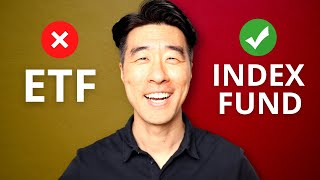

Why I Dump ETFs for Index Funds
45sThe controversial opening statement challenges a popular investment trend, sparking debate among viewers.
▶ Play Clip"Title accurately reflects the video's content: a clear preference for index funds over ETFs for long-term investors."
In this video, Dave from Financial Tortoise argues that long-term buy-and-hold investors don't need ETFs and may be better off with traditional index funds. He compares the characteristics, costs, and convenience of both investment vehicles, explaining why he personally prefers index funds for their simplicity and automation features.
For long-term buy-and-hold investors, ETFs are unnecessary; index funds are sufficient and often more convenient.
Index funds are passively managed mutual funds that track an index, offering diversification and low costs.
Index funds provide broad diversification, reducing risk compared to picking individual stocks.
Index funds have expense ratios well under 0.1%, significantly lower than actively managed funds (1-2%).
Index funds eliminate the need for an investment manager, saving on fees and allowing self-management.
Index funds trade at NAV, calculated once after market close, unlike ETFs which fluctuate throughout the day.
ETFs are similar to index funds but trade like stocks, offering intraday pricing, shorting, and options.
Long-term investors don't need intraday trading, shorting, or options; simplicity is key.
ETFs often lack automatic investment capabilities due to fractional share restrictions, especially at Vanguard.
Index funds have higher minimums (e.g., $3,000) but allow fractional shares; ETFs have no minimum but require whole shares.
Dave prefers index funds for automated investing, saving time and ensuring consistent contributions.
For long-term buy-and-hold investors, index funds offer simplicity, automation, and lower costs without the unnecessary features of ETFs. The choice ultimately comes down to personal preference, but index funds can be a more convenient option.
What are the two types of mutual funds?
Actively managed funds and passively managed funds (index funds).
00:40
What is an index fund?
A passively managed fund that tracks an index, attempting to match the return of that market segment.
00:54
What is the typical expense ratio range for index funds?
Well under 0.1% (e.g., 0.04% for VTSAX and VFIAX).
02:56
What is the expense ratio for VTSAX and VFIAX?
0.04%.
03:08
What does NAV stand for and when is it calculated?
Net Asset Value; it is calculated once after the market closes.
04:39
What is a key difference between ETFs and index funds regarding pricing?
ETF prices fluctuate throughout the trading day, while index fund NAV is set once after market close.
06:09
Why can't you set up automatic investments in Vanguard ETFs?
Because Vanguard ETFs do not allow fractional share purchases, so you need exact change each time.
08:43
What is the minimum investment for VTSAX?
$3,000.
09:09
What is the minimum investment for VTI?
No minimum; you just need enough to purchase one share.
09:23
What happens if you sell VTI to buy VTSAX?
It triggers a capital gains event and you must pay taxes.
09:49
Bold Claim
The speaker immediately states a controversial opinion that long-term investors don't need ETFs, setting the tone for the video.
Netflix vs Blockbuster Analogy
A memorable analogy illustrating the risk of picking individual stocks versus diversification.
02:01Car Dealership Analogy
A relatable analogy comparing ETFs to a car with unnecessary bells and whistles for a simple commute.
06:51[00:00] I know this will get some comments, but if you're a long-term buy-and-hold investor, I personally believe that you don't need to bother with ETFs. Exchange Traded Funds Hi, if you're new to the channel, my name is Dave from Financial Tortoise, where we learn to grow our wealth slow and steady.
[00:14] In the world of investing, the debate between ETFs and index funds is a heated one. Though I'll be honest, from a big-factor perspective, you really can't go wrong with either one. If you're saving and investing, you're already winning. But since I primarily invest with index funds, in this video,
[00:27] I do want to make the argument that if you're a long-term buy and hold investor, you don't need ETFs in your portfolio. First, let's talk about index funds. Index funds are actually a type of mutual funds. At the basic level, there are actually two types of mutual
[00:40] funds, actively managed funds and passively managed funds. In an actively managed fund, there is an active fund manager who selects specific stocks or bonds based on analysis. This could be based on technical analysis or fundamental analysis. Passively managed fund,
[00:54] which is an index fund, simply tracks an index, attempting to match the return of the segment of the market that it is indexing. An S&P 500 index fund matches the 500 largest publicly traded companies in the United States.
[01:06] A total stock market index fund replicates all the publicly traded companies in the United States. A total international index fund replicates the broad cross-section of thousands of reputable international stocks around the world. With a small management fee for each fund, ranging from 0.04% to 0.11%,
[01:22] you can be invested in an index fund within a matter of minutes. Before the introduction of mutual funds and index funds, if you as an investor wanted diversification in your portfolio, you essentially needed to create it on your own. You had to research individual companies and purchase enough stocks
[01:36] to create your ideal diversified portfolio. Frankly, it was very time-consuming and unrealistic for most people. Most often, individuals would hire brokers through this manual work, which just added more cost. And because of this reason,
[01:49] indexing, in many experts' opinion, is really one of the best ways to invest. Let's talk about a few of its characteristics. The first that I mentioned already is its diversification. Index funds by nature are highly diversified and therefore less risky.
[02:01] Diversification is the key to reducing investment risk. The fastest way to get rich overnight is to own the next Netflix. But the fastest way to lose all your money is to own the next Blockbusters. To know what companies will do well or not do well is nearly impossible.
[02:15] However, you don't need a magic ball in order to get healthy returns on your investment. If you buy a fund that tracks the S&P 500 or a total self-market index, your investment is highly diversified and its performance will match that of the company that the fund
[02:27] is indexing. The second characteristic of an index fund is this low operating cost. Actively managed mutual funds are known to charge anywhere between 1-2% expense ratios. This means that between 1-2% of your investment is deducted each year to pay the fund manager
[02:42] to run the fund. On a portfolio that comes after to annually By contrast index funds are much cheaper given no person is actually managing the fund performance There isn a person deciding which fund to buy or sell or when to buy or sell them
[02:56] The fund simply replicates the index. As a result, most index funds have an expense ratio well under 0.1%. VTSAX and VFIAX, Vanguard Total Stock Market Index Fund and Vanguard S&P 500 Index Fund
[03:08] have a respective expense ratio of 0.04%. On a $100,000 portfolio, this comes out to about $40 annually. I'll take $40 expense over $2,000 any day. And the real power of low operating costs really comes to play when you incorporate compounding into the formula.
[03:24] These expense ratios can net you or cost you hundreds of thousands of dollars over a period of 10 to 20 years. Costs matter, and taxably managed index funds have rock-bottom costs. The third, and one of my favorite characteristics of index funds, is that there really isn't a need to hire an investment manager to monitor your portfolio.
[03:40] I believe that with the right information, any one of us can effectively manage our own portfolio. When you have an investment manager, they take a huge chunk of the portfolio to manage your money for you. This is real money that is going into someone else's pocket instead of staying and compounding your account.
[03:55] Some argue that they're all really good investment managers whose performance is worth cost. Peter Lynch managed the Fidelity Management Funds from 1978 to 1990 and posted an average annual return of 29%. However, such individuals are so rare that some investment scholars attribute their consistent
[04:10] performance to luck rather than skill. Just like stocks, many of yesterday's superstar managers can quickly turn its face on their performers. And how can you effectively identify who tomorrow's superstars will be? This unfortunately is a futile pursuit.
[04:23] The bottom line is that with index funds, who is managing the fund is not an issue. Index funds only track the index. Nothing more, nothing less. The fourth characteristic of an index fund is that when you purchase a share of an index fund, or even an activate managed mutual fund, we're always paying what is called the net
[04:39] asset value, the NAB. The NAB represents the per share value of all the stocks that the fund owns. For example, currently, the NAB for Vanguard's Total Stock Market Index Fund, the DTSAX, is around $100 per share. The NAB for Vanguard's 500 index fund, the VFIAX,
[04:55] is around $400 per share. And unlike a stock price or an ETF that fluctuates throughout the trading day, and index funds NAD is adjusted once after the market closes. So technically, when we submit a buy or sell order for a share of an index fund, we won't
[05:09] know the actual price until the market closes. Alright, let's talk about ETFs, exchange traded funds. This picture, ETFs are virtually identical to index funds in a lot of ways. Just like index funds, it provides a low-cost rate to achieve great diversification.
[05:23] VTI, Vanguard Total Stock Market Index Fund ETF, tracks total stock market index exactly like the VTSA. VOO Gangart 500 index fund ETF has the S 500 stock market index exactly like the VFIAX And just like index funds they quite affordable with expense ratios of 0
[05:42] Index funds like VTFIAX and VFIAX, if you remember, have an expense ratio of 0.04%. So ETFs are actually a 0.01% cheaper. However, there are a few significant differences that need to be highlighted.
[05:55] Exchange Trader Funds, as its name implies, has the ability to trade like stocks on an exchange. Some investors wanted the ability to trade index funds in a way similar to trading a stock. ETF was their solution. It's an ideal blend between index funds and individual stocks.
[06:09] Just like buying or selling a stock, the price of the Vanguard Total Market ETF, the VTI, fluctuates throughout the day when the market is open. This is why when you're looking at the purchase price of a VTI versus VTSIX, you see the opening price, previous close price, and the day range.
[06:24] You also see the bids and ask spreads just like what you see in an individual stock. If I wanted to buy VTI, I know pretty much what price I'm going to pay within a range of fee pennies. What this means is that an ETF gives an investor the ability to time to purchase,
[06:38] short it, or buy and sell options on it. All the things that you can do with individual stocks. Index funds don't come with all these bells and whistles. And at a glance, ETFs seem like a better deal. You get all the bells and whistles even though you may not think you'll need it right away.
[06:51] Let's say that you go to a car dealership to buy a simple car that will take you from point A to point B. But then you see another car at the same price that can do all the things that the first car can do, but with more bells and whistles. What would you pick? Probably the car with the bells and whistles, right?
[07:04] But let me share with you a few reasons why ETFs may not be the best choice if you're a long-term buy and hold investor. First, long-term buy and hold investors don't need all the additional features that ETFs offer. Buy and hold investors who plan on buying investments regularly and plan on holding it for a long period of time, don't try to time the market.
[07:21] Buy and hold long-term investors wouldn't even think about trying to short an ETF. or buy or sell cost or put options on ETF. Simplicity has been given the gain for index investors and a good low-cost index fund is just like that.
[07:33] The second reason is the fact that you can set up automatic investments with ETF, a function that is crucial to buy and hold investors. And this is due to a concept called fashionable shares or more specifically, if you can purchase a fund in fashionable shares.
[07:46] It sounds fancy, but if you know basic algebra, you get the concept. It means just what it sounds like. When you have the ability to purchase a fund as a fashionable share, you have the ability to buy a fraction of the share. You aren't locked into needing to buy the whole share.
[07:58] For example, let's say VTSAX is trading in $100 per share today. You might only have $50 to invest, so you can just buy a fraction of that $100 share. Essentially, half a share with that $50. Now, VTSAX, the index fund,
[08:11] allows you to purchase the fund as a fraction of share. However, VTI, the ETF equivalent, does not. With VTSAX it doesn matter how much you have you can invest that full amount into the fund regardless if the money you have is a dollar or a thousand dollars ETI on the other hand because it doesn allow fractional shares you in essence might have money left over or not be able to afford a share that day
[08:30] Almost like needing exact change at the grocery store. One thing I do want to call out is that this is Vanguard platform specific. Other firms like Fidelity allow for fractional shares for a ETF. We'll need to wait and see if this trend will be widely important across all investment
[08:43] firms. But for now, if you're invested in Vanguard like me, just know that you can't make fractional share purchases with VTI. And this is the primary reason why you can't make automatic investments or withdrawals into or out of an ETF. This makes sense given you can't do fractional
[08:57] share purchases of VTI. You'll need exact change each time, so you'll need to manually make purchases. For index funds, on the other hand, you can set up automatic investments or withdrawals into and out of any Vanguard's mutual funds based on your preference. But
[09:09] there is a good argument that many people make as regards to ETF over index funds, and that is the minimum investment. Index funds most often have a minimal amount of cash and need to have in order to invest. In the case of Vanguard Total Market Invex Fund, it is $3,000.
[09:23] A DTSAX equivalent ETF like DTI has no minimum. You just need enough to purchase one single share. In this category, an ETF like DTI has a big advantage. Because they're traded like stocks, there is no minimum investment. You just need enough to purchase a single share.
[09:37] However, my personal opinion is that we should try to save $3,000 to invest in DTSAX. While you can convert a DTSAX for DTI pretty easily, the other way isn't so straightforward. You can't convert VTI to VTSAF.
[09:49] You'll need to sell VTI, which will trigger a capital gains event which we'll need to pay taxes on. Alright, despite all my personal preferences, many people still prefer an ETF over Invest Funds. And this is because of reasons I mentioned earlier in this video.
[10:01] Timing of share price, minimum investment, and expense ratio. And I completely respect that. They're all very important and valid reasons. Because again, in the big scheme of things, if you're saving and investing consistently, you're already winning.
[10:13] winning. Index fund versus ETF is just a personal preference. You can't go wrong with the other one. But I do want to share with you one final reason why I personally prefer index funds or ETFs, and that is because it saves me time. I like the idea of automating my buy order so that the trade
[10:28] is executed regularly every month without me even realizing that it's happening, whether I'm working or on a vacation trip with my family. Compared to having to find time on Monday while the market is open to put in a buy order, tackling how many shares I can buy based on the share price,
[10:41] Watch it to make sure the order executes and get annoyed by the fact that there are a few dollars left over that can't be invested. Yes, does ETF allow for specific share price? Does it have lower expense ratio? Does it allow me to get in with less than $3,000?
[10:54] Of course, but for me, I prefer to spend extra time making more money to invest in the market and with my family. Thank you guys for watching. If you'd like to learn more about my favorite index funds, check out my video here. Until next time, all the best.
⚡ Saved you 0h 11m reading this? Transcribe any YouTube video for free — no signup needed.