
Index Funds vs ETFs: Which Is Better?
45sThis segment hooks viewers by comparing index funds and ETFs to iPhone vs Android, making a complex topic relatable and sparking curiosity.
▶ Play Clip"Title accurately reflects content: compares index funds and ETFs for European investors, delivering on the promise."
Index funds and ETFs are both investment vehicles that track market indexes, offering similar returns. The choice between them depends on availability in your country, convenience, and tax implications. Index mutual funds allow direct investment with the fund, while ETFs are traded on stock exchanges like stocks.
Both index funds and ETFs track market indexes and provide virtually identical investment results, akin to iPhone vs Android.
An index fund tracks a market index like S&P 500 or FTSE 100. Two main types: index mutual funds and ETFs.
Investors give money directly to the fund manager, who pools it and invests in the index. You buy fund units from the fund.
ETFs are bought and sold on stock exchanges like individual stocks. You need a brokerage account and buy shares from other investors.
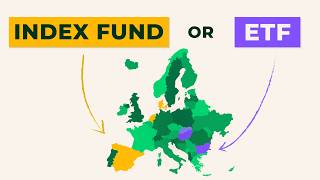
1. Availability: ETFs more common in Eastern/Central Europe; both available in UK, Western Europe, Scandinavia. 2. Convenience: Index mutual funds don't need brokerage. 3. Taxes: varies by country (e.g., Spain, Denmark, Netherlands favor certain index funds; Bulgaria, Hungary, Slovakia favor ETFs).
Choose between index mutual funds and ETFs based on availability, convenience, and tax treatment in your country. Both deliver similar investment performance.
What are the two main types of index funds?
Index mutual funds and exchange-traded funds (ETFs).
01:24
How do you buy an index mutual fund?
You go directly to the fund and invest money; the fund gives you units.
01:37
How do you buy an ETF?
You open a brokerage account and buy shares on a stock exchange from other investors.
02:14
In which European countries are index mutual funds more tax-advantageous?
Spain, Denmark, and the Netherlands.
03:48
In which European countries are ETFs usually better for taxes?
Bulgaria, Hungary, and Slovakia.
03:48
iPhone vs Android analogy
Simplifies the comparison between index funds and ETFs using a relatable analogy.
00:34Introvert vs extrovert analogy
Humorous analogy explaining the difference in how you invest in each fund type.
02:14Three key factors for choosing
Provides a clear, actionable framework for decision-making.
03:00[00:00] Which is better in your country? Index funds or ETFs? If you live in Europe and want to start investing, you've probably heard about index funds and ETFs. Warren Buffett recommends them. Nobel Prize winners recommend them. It's the easiest way to invest and get good results.
[00:17] But what's the difference between index funds and ETFs? And which type of fund is better for you? Hi, I'm Tom Crosshill. I'm a professional investor who has invested hundreds of millions of euros in these funds. And here's how I put it. Index funds and ETFs are like iPhone and Android.
[00:34] They're basically the same thing. Both of these phones make calls, browse the internet, and shoot videos. They will get you the same practical results. And it's the same deal with index funds and ETFs. They get you virtually identical investment results. Which is better for you
[00:50] depends on 1. What's available in your country? 2. Which user experience you prefer? And 3 Everyone favorite subject taxes So let dive in An index fund is any fund that tracks a market index If you don know what that means watch this video where I explain indexes and index funds in detail But basically
[01:12] if an index fund tracks the S&P 500, it invests in 500 of the biggest American companies. If it tracks the FTSE 100, it invests in 100 of the biggest UK companies and so forth.
[01:24] The two main types of index funds are index mutual funds and exchange-traded funds, or ETFs. An index mutual fund is what you'd call a traditional investment fund. There is a fund
[01:37] manager who gathers clients' money into a common pot and invests this money in the index. To buy an index mutual fund, you simply go to the fund and you say, I want to invest 1,000 euros. And the
[01:50] fund says, great, you now own 500 fund units. We will invest your money in the S&P 500 for a low fee. So that's an index mutual fund. Now an ETF an exchange fund is a bit different While an index mutual fund is like an extrovert that likes talking to people an ETF is an introvert who has a closed policy Boundaries people
[02:14] Boundaries. You can't invest directly in an ETF. Instead, you can only buy shares of the ETF on a stock exchange. So, you open a brokerage account and you buy ETF shares from other investors just
[02:27] like you'd buy shares of Apple or Microsoft or any other company. Now, in the background, there's a lot of financial magic happening to make sure that you buy these ETF shares at a fair price and that it's always possible to buy and sell these ETF shares. But at the end of
[02:44] the day, it's that simple. If you buy an S&P 500 ETF on the stock exchange, you have just invested in the S&P 500. And your investment result will be pretty much identical as if you had invested
[02:56] in an S&P 500 index mutual fund. It's just that the purchase process was different. Alright, but how do you choose between index mutual funds and ETFs? There are 3 main questions to answer Question 1 Availability Which type of fund is actually available in your country In many European countries including most of Eastern and Central
[03:17] Europe, index mutual funds are hard to find and ETFs are much more widely available. In bigger and richer countries, including the UK, Western Europe, and Scandinavia, you have access to both index
[03:30] mutual funds and ETFs. Question 2. Convenience. Which do you prefer from a convenience perspective? Index mutual funds can be more convenient because you don't need to open a brokerage account. You just invest directly with the fund. Question 3. Taxes. Which is better for taxes in your country?
[03:48] In Spain, Denmark, and the Netherlands, certain types of index mutual funds have tax advantages. In Bulgaria, Hungary, and Slovakia, ETFs are usually better for taxes. In most other European
[04:03] countries, there is no tax difference. So, I hope that that helps you choose between index mutual funds and ETFs, depending on your country. But otherwise, thanks for watching and see you soon!
⚡ Saved you 0h 04m reading this? Transcribe any YouTube video for free — no signup needed.