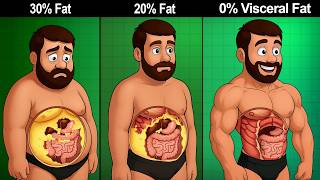
The Fat You Can't Grab Is Killing You
38sVisually describes the hidden danger of visceral fat wrapping around organs, shocking viewers into paying attention.
▶ Play Clip Gravity Transformation - Fat Loss Experts
"The title accurately reflects the content; the video genuinely covers 10 evidence-based steps to lose visceral fat."
The video explains the difference between harmless subcutaneous fat and dangerous visceral fat that wraps around internal organs, increasing risks of diabetes and heart disease. It then presents 10 science-backed steps to reduce visceral fat, including tracking waist circumference, resistance training, cutting liquid calories, walking after meals, prioritizing protein, and managing stress and sleep.
Visceral fat wraps around organs and pumps toxic compounds into the blood; it's more dangerous than subcutaneous fat.
Use waist-to-height ratio (under 0.5) instead of scale to track progress.
3 sessions per week improve insulin sensitivity and teach body to store glucose in muscles, not belly.
Sugary drinks, fruit juice, energy drinks, and alcohol cause blood sugar spikes and insulin floods, leading to fat storage.
10-minute walk after meals reduces post-meal glucose and insulin spikes better than one long walk earlier.
Aim for 0.7-1g per pound of body weight; protein preserves muscle and reduces hunger.
Not the clock but habits; choose protein-rich snacks if hungry.
Intervals (e.g., 30s hard, 90s easy x10) outperform steady-state cardio for belly fat.
Can help by reducing eating window and improving insulin sensitivity.
Omega-3s, polyphenols, cruciferous vegetables lower inflammation and help mobilize fat.
High cortisol from poor sleep and chronic stress signals body to store fat around waist; 7-9 hours sleep resets cortisol rhythm.
What waist-to-height ratio is strongly linked to health risks from visceral fat?
A waist-to-height ratio over 0.5 (waist under half your height).
01:11
How does resistance training directly combat insulin resistance?
By increasing glucose transporters in muscle cells, making muscles soak up glucose instead of storing it as fat.
02:15
Name three types of liquid calories that drive visceral fat gain.
Sugary drinks, fruit juice, energy drinks, and alcohol.
03:17
How short can a post-meal walk be to still reduce blood sugar spikes?
Even a 10-minute walk is enough to reduce post-meal blood sugar and insulin spikes.
04:36
What is the recommended daily protein intake for visceral fat loss?
0.7 to 1 gram of protein per pound of body weight per day.
06:12
What does visceral fat release into the bloodstream that creates a vicious cycle of fat storage?
Inflammatory chemicals called cytokines that drive more fat storage.
09:48
Which hormone, when elevated, signals the body to store fat specifically around the abdomen?
Cortisol, the stress hormone.
10:44
What advantage do dieters who sleep well have over those who are sleep-deprived?
They lose more fat and preserve more muscle.
11:15
Visceral fat pumps toxic compounds
Clearly distinguishes subcutaneous fat from the more dangerous visceral fat that raises diabetes and heart disease risk.
00:27Measure waist-to-height ratio
Provides a simple, actionable alternative to the scale for tracking visceral fat loss.
01:28Resistance training improves insulin sensitivity
Explains the mechanism by which lifting weights directly counteracts fat storage.
02:15Post-meal walks blunt glucose spikes
Shows that short walks after meals are more effective than longer exercise earlier in the day.
04:36Inflammation from visceral fat creates a cycle
Highlights how visceral fat itself perpetuates fat storage through inflammatory chemicals.
09:48[00:00] If you could peel back your skin and
[00:02] look inside your belly, you'd see two
[00:04] very different types of fat. One is the
[00:06] pinchable layer just under your skin.
[00:08] Annoying, but mostly harmless. The other
[00:10] is the fat you can't grab. It wraps
[00:12] around your organs like bubble wrap,
[00:14] pressing on your liver, squeezing your
[00:16] pancreas, and even pushing your stomach
[00:17] forward. This is visceral fat, and it's
[00:20] far more dangerous than the fat you see
[00:21] in the mirror. It doesn't just make your
[00:23] waistline bigger. It pumps toxic
[00:25] compounds into your blood, raises your
[00:27] risk for diabetes, and makes heart
[00:29] disease more likely. The good news is
[00:30] that visceral fat is also the kind that
[00:32] responds the fastest when you change
[00:34] your habits. So, I want to walk you
[00:36] through 10 proven ways to shrink it
[00:38] quickly based on sciencebacked methods
[00:40] that actually work. The first thing you
[00:43] need to do is stop obsessing over the
[00:45] bathroom scale and start tracking your
[00:47] waist. The scale can be tricky because
[00:50] it doesn't tell you whether you lost the
[00:52] weight from water, muscle, or fat. And
[00:54] if you're not tracking properly, you
[00:56] have no idea if you actually are making
[00:58] progress with eliminating this very
[01:00] dangerous type of fat. You could step on
[01:02] the scale and see a pound down, but if
[01:04] that pound came from lean muscle, you
[01:06] didn't really make progress in regard to
[01:08] belly fat. A far better measure of
[01:10] progress is your waist circumference,
[01:12] especially when you compare it to your
[01:14] height. Research shows that a waist to
[01:16] height ratio over.5 is strongly linked
[01:18] to health risks associated with visceral
[01:21] fat. That means if you're 70 in tall or
[01:23] 5'10, your waist should ideally be under
[01:26] 35 in. A simple tape measure tells you
[01:29] what the scale can't. And that's whether
[01:31] the dangerous fat inside your belly is
[01:33] shrinking or not. If every couple weeks
[01:35] that number moves down, you know you're
[01:37] heading in the right direction. But for
[01:39] example, doing a ton of cardio without
[01:41] lifting weights can make you lose
[01:43] muscle, which will look like weight loss
[01:44] on the scale, but all that belly fat is
[01:46] still there. And that brings us straight
[01:48] to step two, which is resistance
[01:51] training. Most people picture endless
[01:53] cardio sessions when they think about
[01:54] losing their belly fat. But lifting
[01:56] weights actually attacks the root cause.
[01:59] Visceral fat thrives when your insulin
[02:00] sensitivity is poor. When your muscles
[02:03] resist insulin, glucose floats around in
[02:05] your blood until your liver finally
[02:06] turns it into fat. And that fat is very
[02:08] often stored around your belly. But
[02:11] every time you contract your muscles
[02:12] against resistance, whether that's with
[02:15] dumbbells, barbells, machines, or just
[02:17] your body weight, you increase the
[02:19] number of glucose transporters in your
[02:21] muscle cells. These are like doors that
[02:24] open up and let glucose in, making your
[02:26] muscles soak up carbs like a sponge.
[02:29] That glucose goes into fueling and
[02:31] repairing your muscles instead of
[02:32] getting stashed as fat around your
[02:34] organs. And the benefits go even deeper.
[02:37] Lifting weights increases lean muscle
[02:39] mass, which itself raises your daily
[02:41] energy burn. A pound of muscle isn't
[02:43] going to burn thousands of calories, but
[02:45] over months and years, more lean mass
[02:47] means a faster metabolism. Studies
[02:50] consistently show that just two or three
[02:52] resistance training sessions a week, can
[02:54] significantly reduce visceral fat, even
[02:56] if your overall weight doesn't change
[02:58] much. Cardio burns calories while you're
[03:00] doing it, but resistance training
[03:02] changes the way your body partitions
[03:04] calories after the workout. In other
[03:06] words, you're teaching your body to
[03:07] store energy in the right places. Every
[03:10] rep you do is like telling your
[03:11] metabolism, "Feed the muscles, not the
[03:13] belly." Next, if you're looking for the
[03:16] fastest lever you can pull, cut liquid
[03:18] calories first. Sugary drinks, fruit
[03:21] juice, energy drinks, and alcohol are
[03:23] some of the biggest reasons for visceral
[03:24] fat gain. They deliver a huge load of
[03:26] sugar or empty calories in seconds with
[03:29] no fiber to slow things down. That means
[03:31] your blood sugar spikes, insulin floods
[03:34] in, and your liver has no choice but to
[03:36] convert the overflow into fat. And
[03:38] here's the kicker. Visceral fat is the
[03:40] prime storage depot. Your body loves to
[03:42] store all that fat in your center of
[03:44] mass for future use in case of something
[03:46] like a famine in the future. Alcohol
[03:49] makes this worse because your liver has
[03:51] to prioritize metabolizing the alcohol
[03:53] itself, which pushes everything else you
[03:56] ate towards fat storage. The fix is
[03:58] simple but powerful. Swap. soda or juice
[04:01] for sparkling water with lemon. Replace
[04:04] sweetened coffee drinks with black
[04:06] coffee or coffee with just a splash of
[04:08] cream or milk. Cut back on beer and
[04:10] cocktails and go for lower calorie
[04:12] options like a caloriefree mixed drink
[04:14] with a shot of vodka. And only do this
[04:16] occasionally. Dropping just 120 ounce
[04:19] soda per day cuts 240 calories. Over the
[04:22] course of a month, that's more than
[04:23] 7,000 calories or about 2 lbs of fat.
[04:26] And a large portion of it will come
[04:27] straight from your belly. Another
[04:29] underrated but incredibly effective
[04:31] tactic is walking after meals. Think of
[04:33] this as intercepting calories before
[04:35] they ever get stored as fat. When you
[04:37] walk after eating, your muscles act like
[04:39] sponges, soaking up glucose from your
[04:41] bloodstream. Even 10 minutes is enough
[04:43] to dramatically reduce post-meal blood
[04:45] sugar and insulin spikes. In fact,
[04:48] studies show that three 10-minute walks
[04:49] after meals control blood sugar better
[04:51] than one big 30-inute walk earlier in
[04:54] the day. This matters because visceral
[04:56] fat accumulation is strongly tied to
[04:57] repeated high spikes of glucose and
[05:00] insulin. Blunt the spikes and you reduce
[05:02] the signal for your body to store fat in
[05:04] your belly. This doesn't have to be a
[05:07] power walk. Even a slow stroll after
[05:09] dinner, walking around the block or on a
[05:11] treadmill does the trick. Over time,
[05:13] those little post-meal walks add up to
[05:15] hundreds of extra calories burned,
[05:17] steadier energy for your body, and less
[05:19] fat storage. It's one of the simplest
[05:21] things you can do. No equipment, no
[05:23] cost, no learning curve, yet the payoff
[05:25] is huge. And of course, your diet plays
[05:27] a major role. You're not going to walk
[05:29] off a bunch of Oreos, even though the
[05:30] walk will still provide benefits. But
[05:33] that's why another one of the most
[05:34] powerful levers is prioritizing protein.
[05:37] Protein isn't just for building muscle.
[05:39] It's actually also essential if you want
[05:40] to lose visceral fat while preserving
[05:43] muscle. When you're in a calorie
[05:44] deficit, your body will use both fat and
[05:46] muscle for energy unless you give it a
[05:48] reason to spare that muscle. Protein is
[05:50] that reason. Multiple studies show that
[05:52] higher protein diets lead to greater fat
[05:54] loss and less muscle loss compared to
[05:56] low protein diets. Protein also has
[05:58] unique advantages. It blunts hunger
[06:00] hormones like ghrein, boost satiety
[06:02] hormones like GLP-1, peptide y, and has
[06:06] the highest thermic effect of food,
[06:07] meaning you burn more calories digesting
[06:10] it compared to carbs or fats. A good
[06:12] target is about 7 to 1 gram of protein
[06:15] per pound of body weight per day. That
[06:17] might look like eggs at breakfast,
[06:18] chicken breast or beans at lunch, Greek
[06:20] yogurt or a shake as a snack, and fish
[06:23] or tofu at dinner. You don't have to be
[06:25] perfect, but making sure protein is
[06:27] present in every meal tilts the odds
[06:29] heavily in your favor. Next, let's
[06:31] tackle late night eating. Carbs at night
[06:33] aren't magically fattening. What really
[06:35] matters is the total calories and
[06:36] nutrients you eat over the day. But
[06:38] here's the catch. Insulin sensitivity
[06:40] does tend to be lower in the evening,
[06:42] and even more importantly, nighttime is
[06:44] when most people slip up. After a long
[06:46] day, willpower is drained. And that's
[06:48] when the chips, cookies, and drinks come
[06:50] out. It's not the clock that's the
[06:52] problem. It's the habits. It's the
[06:54] association of enjoying a snack every
[06:56] time you play your favorite TV show,
[06:58] video game, or movie. Those extra
[07:00] evening calories often push you into
[07:02] surplus territory. And those surplus
[07:04] calories go straight to fat. So, instead
[07:06] of banning food at night, the smarter
[07:08] move is to be mindful of what you eat
[07:10] and how much. If you're hungry, go for
[07:12] protein richch foods like cottage
[07:13] cheese, Greek yogurt, or even a simple
[07:15] shake. Or maybe you even have a full
[07:18] meal with salmon or chicken. Or you
[07:20] stick to high protein snacks like beef
[07:22] jerky. These keep you full without
[07:24] creating a huge calorie impact. If you
[07:26] want something crunchy, raw veggies or
[07:28] butterless popcorn can work since it's
[07:31] filling and low in calories. The rule
[07:33] isn't never eat at night. It's don't let
[07:36] late night eating turn into uncontrolled
[07:38] snacking where you're stuffing your face
[07:40] with you don't even know what while
[07:42] falling asleep. Let's move on to cardio,
[07:45] which still has its place, but if your
[07:46] goal is to lose visceral fat fast,
[07:48] intervals are where you'll get the
[07:50] biggest bang for your buck.
[07:51] High-intensity interval training or hit
[07:53] consistently outperforms steadystate
[07:56] cardio when it comes to shrinking belly
[07:57] fat. The reason is that intervals
[08:00] combine short bursts of near max effort
[08:02] with recovery periods, forcing your body
[08:04] to adapt in ways steadystate cardio
[08:06] doesn't. You stress both your aerobic
[08:08] and anorobic systems, improving
[08:10] mitochondrial function and boosting
[08:12] insulin sensitivity. A classic beginner
[08:15] protocol is 30 seconds hard, 90 seconds
[08:18] easy, repeated 8 to 10 times. That could
[08:20] be done on a bike, a rower, sprinting,
[08:23] jump rope, or even bodyweight moves like
[08:25] burpees. It's intense, but it's short.
[08:27] As you get more advanced, you can do 60
[08:29] seconds on, 60 seconds off. You don't
[08:31] have to eliminate steadystate cardio
[08:33] completely. Long walks, hikes, or jog
[08:35] are great for overall calorie burning
[08:37] activities, as long as they're not done
[08:38] in excess, where they begin to interfere
[08:41] with your weight training. But adding
[08:42] two or three interval sessions per week
[08:44] can accelerate belly fat loss
[08:46] significantly. Fasting is another tool
[08:49] worth mentioning. Intermittent fasting
[08:51] isn't magic, but it can help reduce
[08:53] visceral fat when used strategically.
[08:56] The main advantage isn't that fasting
[08:58] changes your hormones in some magical
[09:00] way, though it does improve insulin
[09:02] sensitivity and increases fat oxidation.
[09:04] But the real benefit is that it reduces
[09:06] your eating window. Fewer eating
[09:08] opportunities usually means fewer
[09:10] overall calories. Even a simple 12 to
[09:13] 16-hour overnight fast can be effective.
[09:15] For some people, skipping breakfast is
[09:17] easiest. For others, setting a firm cut
[09:20] off later in the day around dinner is
[09:22] even better. Research shows intermittent
[09:24] fasting can reduce visceral fat more
[09:26] effectively than continuous calorie
[09:28] restriction, even when total calories
[09:30] are the same. That said, it's not for
[09:33] everyone. Some feel really good with it.
[09:35] Meanwhile, others end up feeling unwell
[09:37] and binging later in the day. The key is
[09:39] to use it as a framework that helps you
[09:41] control calories without feeling
[09:42] restricted. Another overlooked factor is
[09:44] inflammation. Visceral fat isn't just
[09:46] sitting there. It's biologically active,
[09:48] releasing inflammatory chemicals called
[09:50] cytoines into your bloodstream. These
[09:53] chemicals create a vicious cycle where
[09:54] inflammation drives more fat storage,
[09:57] especially in the belly, and the fat
[09:58] itself produces even more inflammation.
[10:01] Breaking that cycle requires lowering
[10:03] inflammation through your diet. That
[10:05] means cutting down on ultrarocessed
[10:07] foods, refined seed oils like soybean or
[10:09] corn oil, and excess sugar. On the flip
[10:12] side, adding anti-inflammatory foods can
[10:14] also play a smaller but still important
[10:16] impact. Omega-3 fats from salmon,
[10:18] sardines, chia seeds, and flax help
[10:20] regulate inflammation. Polyphenols from
[10:23] berries, olive oil, green tea, and even
[10:25] dark chocolate reduce oxidative stress.
[10:28] Cruciferous vegetables like broccoli,
[10:29] cauliflower, and kale support
[10:31] detoxification pathways in the liver.
[10:33] You don't need a perfect diet, but
[10:35] shifting from processed junk towards
[10:37] whole nutrient-rich foods lowers
[10:39] inflammation, which makes it easier to
[10:41] mobilize and burn visceral fat. And
[10:43] finally, we circle back to where so much
[10:45] of this begins, stress and sleep.
[10:47] Visceral fat is extremely sensitive to
[10:49] cortisol, the stress hormone. When
[10:51] cortisol stays elevated from poor sleep,
[10:54] constant late night scrolling, or too
[10:55] much caffeine, your body shifts into fat
[10:58] storage mode, especially around your
[10:59] abdominal region. That's why people who
[11:01] are chronically stressed often carry
[11:03] more weight around the waist. Building a
[11:05] consistent sleep routine is one of the
[11:07] most underrated fat loss tools you can
[11:09] use. Dimming the lights in the evening,
[11:12] shutting off screens an hour before bed,
[11:14] keeping your room cool and dark, and
[11:16] aiming for 7 to n hours of sleep resets
[11:19] your cortisol rhythm. Studies show that
[11:21] dieters who sleep well don't just lose
[11:23] more weight, they lose more fat and
[11:25] preserve more muscle compared to those
[11:27] who are sleepd deprived. Bottom line is
[11:29] when you sleep, your hormones are primed
[11:31] for fat loss. When you don't, they're
[11:33] mostly primed for muscle loss. So, that
[11:36] about wraps it up. I really hope this
[11:38] video helps you start making the changes
[11:40] that you know you need to to make sure
[11:42] that you get rid of that belly fat. If
[11:43] you want extra support and a done for
[11:46] you plan that helps motivate you
[11:47] mentally as much as it physically
[11:49] provides for you with a meal plan, a
[11:51] workout plan, and a coach, check out my
[11:54] free 6E shred. As long as you follow
[11:56] through and stick to the plan, not only
[11:58] will you get rid of that belly fat for
[12:00] free, but you'll also learn what you
[12:02] have to do to sustainably keep it off
[12:04] for good. To find out more, click the
[12:05] link below in the description, or you
[12:07] can head straight on over to my website
[12:09] at gravitytrformation.com.
[12:11] I'll see you guys soon.
[12:16] [Applause]
⚡ Saved you 0h 12m reading this? Transcribe any YouTube video for free — no signup needed.