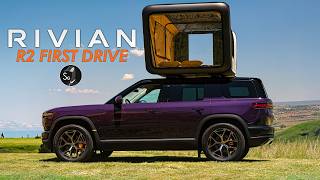

Rivian R2: Make or Break EV
37sHigh stakes and affordability angle grab attention, as Rivian's survival hinges on this $45k EV.
▶ Play Clip"The title is accurate; the video is a detailed launch review of the Rivian R2, including specs, engineering details, and driving impressions."
The Rivian R2 is a mid-sized electric SUV that represents the company's most important product to date, aiming to be affordable and competitive. The base model starts at $45,000 with over 300 miles of range, while the performance variant offers over 600 horsepower and a 0-60 time under four seconds. The vehicle is designed to be a compelling option that can do everything well, from off-roading to daily commuting.
The base model starts at just over $45,000, has an estimated range over 300 miles, and is rear-wheel drive. The mid-grade has 330 miles range and 450 horsepower. The performance variant starts under $60,000, has 330 miles range, and over 600 horsepower.
Rivian's CEO believes EVs sell when they are compelling products, not just due to subsidies. The R2 aims to unseat the Tesla Model Y as the most desirable EV.
The R2 uses semi-active dampers instead of air suspension, and has a unibody construction instead of body-on-frame, saving 2,000 pounds. It uses passive coil springs and a passive anti-roll bar.
The R2 has a 40% front, 60% rear torque distribution, making it drive more like a rear-wheel drive car. It uses a hydraulic brake-by-wire system with a pedal simulator.
The R2 uses a zone-based electrical architecture, saving 2.3 miles of wiring compared to the R1. It has a vertically integrated energy management control unit that enables bidirectional charging.
The reviewer was impressed with the R2's driving dynamics, noting it feels like a mature second-generation product. It has good chassis balance and is fun to drive, though the steering is slow.
What is the starting price of the base model Rivian R2?
The base model starts at just over $45,000.
00:28
What is the 0-60 time for the performance variant of the Rivian R2?
The performance variant does 0-60 in under four seconds.
00:53
What type of suspension does the Rivian R2 use instead of air suspension?
The R2 uses semi-active dampers instead of air suspension.
06:11
What is the key difference in construction between the R1 and R2?
The R2 uses a unibody construction, while the R1 used body-on-frame.
06:32
What is the torque distribution of the Rivian R2?
The R2 has a 40% front, 60% rear torque distribution.
09:18
What type of brake system does the Rivian R2 use?
The R2 uses a hydraulic brake-by-wire system with a pedal simulator.
12:18
How much wiring was saved in the R2 compared to the R1?
The R2 saved 2.3 miles of wiring compared to the R1.
19:03
What feature does the R2's energy management control unit enable?
The R2's energy management control unit enables bidirectional AC charging.
20:11
Affordable Pricing
The base model starts at just over $45,000, making it a key competitor in the mid-range EV market.
00:28Compelling Product Philosophy
Rivian's CEO argues that EVs sell when they are compelling products, not just because of subsidies.
03:27Simplified Suspension
The R2 uses semi-active dampers instead of air suspension, reducing cost and complexity while maintaining performance.
06:11Vertical Integration
Rivian vertically integrated power electronics to reduce cost and enable new features like bidirectional charging.
17:44Positive First Impressions
The reviewer was highly impressed with the R2's driving dynamics, comparing it favorably to the Lucid Air Sapphire.
30:47[00:00] This is going to be a launch video on the brand new Rivian R2.
[00:13] This being a launch video, we don't get a lot of time with the car. So what is the R2? Well, it is Rivian's most important product ever to this state. It is essentially their make-it-or-break-it vehicle. It is their mid-sized. Essentially, they are moving this car into the affordability range, and that's why you
[00:28] should care. The base model, or the standard trim, which is rear-wheel drive, which comes out in 2027, starts at just over $45,000, and has an estimated range over 300 miles and makes a ton of
[00:41] horsepower. More than you'll ever need it. The mid-grade vehicle that you're probably actually going to be buying has a range of 330 miles estimated, does 0-60 and some more in the fours, and makes 450 horsepower.
[00:53] And then the launch variant that we drove, the performance package, starts at just under 60, has a range of 330 miles and does 0-60 under four seconds and makes over 600 horsepower. This is a vehicle that's built around affordability, actually working, and being competitive in
[01:08] its segment. According to the CEO of Rivian, who we actually spent time interviewing, their philosophy through this car is to build a vehicle that currently is not available in the market. Something that can do everything. Go off-road.
[01:20] Be good on the daily commute. Be highly efficient. And essentially, unseat the Model Y is, essentially, the most desirable EV currently sold in the market.
[01:36] The head's to put myself in the video. You know, I'm too cool for school. I'll take off my sunglasses. I wasn't there. And your tracksuit? Yeah, my tracksuit, yeah. Because I'm running nowhere. I'm running to the refrigerator for some snacks after this.
[01:48] So I was not at this event. But I have a lot of questions for you. When we found out that we were invited to this, I'm like, it's one day, what can we actually put together? So this is really challenging because you did not get a lot of time driving the car.
[02:01] Oh god no. Like zero time. So just preface this and understand that. No time to shoot B-roll. Right. So it's more about learning from the people who designed this and worked on it. And whether the cars good or not is going to be later, we're going to have to spend a lot more time with it to give it a real objective opinion.
[02:17] So I had about two hours driving the car. We're on the street, an hour off road, a real off-road course, which it really can off-road. But what they did give me is a ton of access. If you wanted it and some of the outlets were complaining that it was too information heavy, which is too bad.
[02:30] Okay. Access to the people who made the vehicle. They are well aware that people who want to buy EVs in this space are technically minded and want to care about the technology. So I got access to basically every head including the CEO.
[02:42] Okay. So my first question is why we talked about this in the first part of the year EVs. It's going to have a really hard time in the United States. So why does this exist and what's their goal for trying to get people to buy this? Well, that was a question I asked RJ.
[02:55] It was sort of a contentious question. And he answered it very well. And I'm sure the answer will be available on our Patreon. They allowed us to use the full answer. But essentially he has this mentality that the reason why a lot of the EVs have not been successful from traditional OEMs is the lack of their ability to innovate because they're bogged down by being a traditional OEM.
[03:14] They have a lot of baggage and there has not been a compelling option in the EV space. And his counter to why EVs are not being bought is they are being purchased. Look to the Model Y and the Model 3.
[03:27] They sell at enormous numbers and they aren't really that subsidized from the Tesla side of things. The reason people buy them is they're a compelling product. So the point of the R2 is to meet the sales numbers of a Y which is a very lofty goal.
[03:41] He mentioned over 300,000 units when they're fully spun out. That's crazy. Which is a huge number built in high level profitability for a company, including their CAPEX expenditure. When they're spinning up at their past, let's say, 200,000 units.
[03:53] They're talking about 20% profitability per unit sold. They want to make sure that there's a supply chain in place and that this is a good car. His essential answer to me is like, hey, between the political environment, the lack of subsidies blah, blah, blah. Why would anyone buy this?
[04:05] If you build a good car that does everything well without excuses, people will buy it. So, Jack had the opportunity to speak with several people and we're going to start with your conversation with the Chief Engineer, June. Max Koff.
[04:24] I'm here with Max Koff, the Chief Engineer of the Rivian R2. And you do have the honor of having the best mustache of any Chief Engineer of Ever Interview. Thank you. Such an honor.
[04:36] You know, the car is one thing, but the fact that you have a tremendous mustache is far more important to me. All right. So, that's the way you've been with Rivian since basically the beginning at this point and you've worked on R1S and R1T.
[04:50] And we've only driven the R1S, but this truck has, or SUV, whatever you want to call the R2, has the unenviable task of basically being the most important vehicle that you currently make. It's what's going to pay your bills and you had the very difficult task of driving down the bomb cost where you can get this thing affordable, 45 to $60,000.
[05:12] While also not being a total PLS to drive, which that's the goal. Keep reducing costs and decontenting a car are often not great recipes for consumer satisfaction and driving dynamics.
[05:26] So, before we talk about some of the philosophical things, can you give me an overview of how this car is dynamically and technically different than the vehicles that people know and love at this point, the R1S and the R1T? Yeah. So, we wanted to have a lot in common with the R1S in terms of driving character, but on R1, we have very complex chassis and powertrain systems, and it allows this massive breadth of performance.
[05:51] On R2, we shrink that a little bit, but we still want this character of the vehicle that can go both equally comfortable on-road and off-road. And so, to do that, we employ semi-active dampers on the car, so we have very curated drive modes for on-road, we have sport, we have all purpose, and then we have some off-road modes, rally and all terrain.
[06:11] And so, we really leverage the semi-active dampers to change the ride feel and the body control throughout those modes. The big difference from a chassis side to R1 is that we get rid of the air suspension, we get rid of the kinetic roll control, and we go with much simpler, but more robust and more cost-friendly systems for passive coil springs and a passive annual bar.
[06:32] But, I guess, starting even before that, you went from a body on frame as well. Sure. To a unibody, you dropped 2,000 pounds, you've got rid of the multi-link front and rear. It is now a traditional subframe front and rear strut front, multi-link rear, which is both a pro and a con.
[06:48] The loss of weight is great, but traditionally, having a multi-link in the front end leads to better driving dynamics, but again, the bomb cost being a big part of this. Exactly. So, it's not only bomb cost, but also we want it to be easier to service, easier to manufacture, you know, we're making much higher volume of these vehicles, so they have to roll off the factory line in a much quicker rate.
[07:07] And our focus across the vehicle, not just with chassis, is simplification and really improving the design through engineering efficiencies. And so, like you touched on it with the body on frame to unibody, you know, we get a much stiffer body actually.
[07:20] We have a structural pack in this car versus R1, and so that's providing a lot of torsional rigidity and bending stiffness to the body. So, from a hardware perspective, steel front or subframes, the body in white is largely steel.
[07:35] There have been a couple of components, which are aluminum, getting costs, makes sense. The fact that you can get one of these vehicles in the future for what's called it just under $50,000 before taxes. Very, very impressive. But from a, I guess, driving character side of things, this is primarily going to be driven on road.
[07:53] It needs to go off-road, but you don't have that many levers to pull compared to R1S and R1T, just working with semi-active dampers only. Higher trim levels, what are you playing with and what are you trying to prioritize and trying to give you that you call breadth of capability?
[08:07] Yeah, so, you know, on the launch parent, we have the dual motor, 656 horsepower, 6.9 pound feet of torque. So, it's got plenty of, what a power. A lot of power. Good zero to 60, but amazing top end.
[08:19] When you experience this tomorrow, the 60-plus acceleration is wild. So, like you said, we are with this vehicle more biased towards on-road, but there's some key elements in the way that we laid out the architecture,
[08:31] that we wanted this to be able to, again, spread both on an off-road, and some of those are free. One of the lessons we carried over from R1 was the way that we do the kinematics and compliance. So, compared to the other vehicles in our segment, we have more wheel travel,
[08:45] and we really have a kind of our secret sauce in the bushing and spring and jounce bumper world. So, we allow, you know, we're relatively soft, longitudinally, so when you hit a big pothole or something off-road, we allow that wheel to move rearward, so we allow to dissipate the energy, but then we're pretty stiff laterally.
[09:02] So, you don't have a lot of camber compliance, you don't have a lot of tow compliance, and the other big thing is we've changed the torque distribution of the hardware for the front and rear driving. So, on R1, we're a 50-50 front and rear, on R2, we're a 40% front, 60% rear,
[09:18] and so it drives much more like a rear-wheel drive car, which is better from a drivability perspective. You don't have less torque steer, and then just the natural characteristic of the car is a little bit more fun to drive. I need to give people the disclaimer that you are not.
[09:30] In EV car weenie, you like cars. Like, the Rivian originally started on potentially building a sports car. While you joined, you have a GT3 in your own personal garage, so you like the way cars drive, which is important.
[09:42] And one of the things I'm going to bring up is that we're at the sort of... From a market perspective, I'm not going to talk about competitors. Most of the cars in this segment, which I will talk about competitors, are all electric jelly beans, right?
[09:55] And every EV is fast, you know, you're like 600 horsepower. And every EV in the market has 500, 600 horsepower. Yep, so what is going to matter other than the styling, which as I mentioned in the beginning of this video, this car looks like a Patagonia quarter, except that came to life and became an SUV.
[10:09] What really matters is how the car is from a dynamic perspective. So can you walk me through the balance? Through the development process, we've played around with a bunch of different settings to understand where this car wants to live. You know, we started a little bit softer and we didn't really like it.
[10:24] It wasn't composed enough. The ride frequency was lower to begin with. Exactly, yeah. And so what we prioritize, you know, part of our Rivian DNA, as you said, as all vehicles get very fast acceleration, what stands out are the dynamics and the NVH and the ride characteristics.
[10:38] So we wanted something that was so composed on road that's equally comfortable on a long road trip, as it is like going through some twisty canyon roads. So, you know, semi-active dampers help from that perspective of, okay, I want this car to be soft and compliant.
[10:52] It's allowing a lot of wheel travel in sport mode, everything stiffens up. But from a kind of base chassis standpoint, we set the cars up to be relatively neutral. So we want the car to respond to your inputs.
[11:05] And whether that's, you know, with the regen and our powertrain control, you have a lot of control over the attitude of the car by just, you know, a little bit of lift, mid corner, tucks the nose in and gives you a tighter steering radius, turning radius.
[11:18] But we really want it to be neutral. And then, you know, if you get out of sorts, that's when the chassis controls come in, the stability control and torque vectoring. And so we've really focused on precision for steering. That's a key element, you know, getting the front end to respond to all of your inputs.
[11:35] And then having the rest of the behavior being very linear and predictable. When it comes to braking, so traditionally, there's two schools of thought without brakes are applied in vehicles. And yes, you need brakes. How have you blended in regen or have you separated it entirely?
[11:51] Yes, we've kept it separate. So we do all of the regen off the accelerator pedal. I like that, as I said you earlier. This is good. Yes. And we find through the data and, you know, it's driving the vehicles you very rarely need to use the brakes.
[12:04] So we have a true one pedal regen setup where we can do about 0.3 G's in our high regen setting. And for the brakes on our two, we've moved into a different direction where we actually do a hydraulic brake by wire.
[12:18] And so what this means is we have a pedal simulator that you apply the brake pedal. So you're not actually commanding, you're not actually moving fluid. What you're doing is then telling our controllers, this is how much deceleration I want.
[12:33] And so the controller then decides, do I give you regen, do I give you brake in this instance, we're just doing brake. And then depending on the mode, we determine the output. So, you know, for an off-road mode, if you're rock crawling, you typically want a less sensitive pedal.
[12:48] And so when you're doing sportier driving, you might want a little bit more response. So we have that finite control with the pump that provides the pressure. Your control from a driver perspective is only as good as the feedback, right?
[13:00] Correct. Because the car doesn't drive itself. I know it's got a ton of driving functions. But when you're actually driving it, it doesn't drive itself. Correct. How do you reconcile its capability of control with actual feedback loop as a driver?
[13:14] What are you, I guess, how are you translating what is happening in the brakes to the driver? Is the vibration through the pedal, is the vibration through the car? How are you trying to translate that? Yeah, good question. So the system we use, it's a one-box, so it's a pump essentially on the firewall.
[13:31] And what we found is we've actually struck a really nice balance of feedback of when you're in ABS, so when the wheels are locked, you feel the vibration through the steering or through the brake pedal that's connected to the firewall and where the one-box system is.
[13:45] And you get this pulsation. The pedal is not actually moving, but you're hearing the valves kind of tick and you're feeling this vibration through your foot. And we think it's a really good balance of like NVH and feedback without being overly interested.
[13:58] Because being an off-road vehicle, you'll be in ABS, probably more often than you would be in a regular street car, for that matter. I guess I know I've sort of beat you into the ground at this point of all these questions, so I do genuinely appreciate it.
[14:11] From a motor strategy, it's the last thing I want to talk about, how is it changed, how are you handling regen, which axles doing what? Yeah, good question. So with R2, we knew from the beginning that the base variant would be a single drive unit.
[14:26] And so this also played into the decision of where do we want the torque distribution. So for that single drive unit variant, it's going to be rear-wheel drive. And so what we do, and in our all-purpose mode, the front axle is disconnected most of the time.
[14:40] And so we do all the regen through the rear axle, and if you need additional regen or you have a slip event on the rear, we then engage the front, but it's almost all through the rear axle. And so that then carries over the same strategy for all vehicles built on this platform.
[14:57] So that was a lot, and I think I could tell personally as my conversations evolved with Jack remotely, that his misery level was like pretty high because of trying to do all this in a short period of time.
[15:09] But I think after you talk to the chief engineer and you start having some of these conversations, I could see your mood change quite a bit. What was your take away from the conversation? I think what's interesting about Rivian versus some of the other EV manufacturers versus a legacy OEM making EVs.
[15:26] They're bogged down from both a leadership perspective, basically trying to iterate on current architectures or taking a lot of the baggage from an engineering perspective and the constraints put on them and trying to basically create deeply compromised EVs because of all the various problems.
[15:40] In the case of Rivian, everyone there is much like a brand like Lucy, just fighting for their own survival when it comes to this product has to be good. And if it does well, candidly, my stock price is going to be worth a lot more money.
[15:53] So there's both the pride perspective and the financial carrot that a lot of traditional OEMs just can't meet. Their leadership side is far more pragmatic. They're more focused on the thing has to be good, but it doesn't have to be perfect in every space.
[16:10] It just has to be good at everything more importantly and honestly, mostly, but it has to be able to be built. They have to make these things. So to kind of clarify Jack's statement about perfect versus something that can just do everything, one of our favorite SUVs is the RAV4.
[16:25] And it's not because it's perfect, it's far from it, but it makes us excited because it does everything well and then it holds its value in the key important thing and a price range like this, it has to work every single time.
[16:38] Right in it, you drive it anywhere, the basics have to work and so many brands are struggling with this right now, namely in the EV space and it's been an ongoing issue. The death of the EV outside of Tesla will be cars that are just disposable and don't work.
[16:51] So what was your takeaway from their philosophy of this getting back into the car and less on the business side? Everyone I spoke to had the same approach, at least that I think if I were working there, this thing just has to work.
[17:04] So the idea of simplification comes with electronic hardware and that's why I interviewed video. Hi, I'm the Thea logical ballin on the senior vice president of electrical hardware at Rivian.
[17:17] So you have, from my understanding, we've spent some time with Max over here, but this is essentially a ground up new product and sort of the backbone of this outside of the body and white and the mechanical architecture is electronic architecture.
[17:29] Can you walk me through some of your design logic and your focus on about obviously reducing complexity, increasing profitability and reducing your overall bomb cost overall? Absolutely, so we've always been a very technology forward company, we pride ourselves on really having best and class technology.
[17:44] So our mandate going into this was R2 should really have the best and class technology at this time, which is even better than what was available when our one was launched. Naturally. But I'd almost half the bomb cost, right? So that's a really tall order. So how do we do it?
[18:00] We started out first by building on what we did for our one gen two. So when we introduced our one gen two, we talked about how we went from a domain based architecture to a zone architecture. That helped us consolidate a lot of PCs, reduce mass, reduce cost. It helped us eliminate 1.6 miles of wiring.
[18:18] So that was one big, and what we did going to, that was one big step and what we did going into R2 is build on that. So we really maintained the zone architecture. It's not to say we use the same zone controllers. We developed new ones for R2 but we built on that same methodology.
[18:33] How large of reduction in ECUs are controllers that you move from R1 to R2? So typically we use the term ECUs for the low voltage side and largely we kept them same. We kept the count state the same.
[18:46] So we kept three zone controllers, eight as an entertainment. So we didn't try to further consolidate the low voltage controllers. What we did was we did optimize them and we optimized the packaging and we drove what that drove is really a harness cost reduction and a harness reduction.
[19:03] So we actually saved another 2.3 miles of wiring from our harness that actually was a way we could, and that's a great way to actually reduce cost without impacting the customer. And without taking features. Now we see a little tiny part of it came from the fact that R2 is a smaller vehicle. It's a little shorter, the wires a little shorter, but most of it came from design.
[19:24] But what we talked about consolidation, we actually did that in a different space. We did that in the energy space. So on R1, Gen2 and all R1 products before, we had a lot of supplier parts to do our energy power conversion.
[19:39] So we had a supplier on board charge, a supplier DC, DC converter, DC-DC converter. What we did is we actually took all those three and we took two more of our in-house components, our BMS and our southern controller,
[19:52] actually put them all together and built what we call our energy management control unit, which actually sits on top of the battery pack and forms what we call the powerhouse. And what this does is the same benefits that we got in the low voltage and consolidation cost reduction, mass reduction.
[20:11] It also enabled more feature because now we can do AC export. So we actually have bi-directional AC now. Charge your house. Yes, that's right. So we'll be able to enable that. And so your battery pack can actually back up your house. That'll be coming soon.
[20:25] Over time, it's not available at launch, but the technology in the car enables it. So, you know, we should be able to enable it over time. How challenging was it to be basically a non-vertically integrated OEM in the past and now becoming vertically integrated?
[20:39] Yeah, internally factories blah, blah, blah. So we were always vertically integrated. Actually, when RG started, I think that was a, you know, sort of grounding principle that he had. But we weren't vertically integrated in every domain. So, you know, for example, we always did our own in-house ECUs.
[20:54] R1 Gen1, they were zonal, not zonal, they were domain based. R1 Gen2, we might, we still stay vertically integrated, but we made them zonal. On the power electronic side, we had actually already had some capability in-house. So we built our own inverter. And we did that for R1 Gen1 and R1 Gen2.
[21:15] Well, we used them for the motor piece, but we always been in the inverter in-house. So we always had that. We also have our power electronics capability demonstrating our ran charger. So if you look at our RIVian invention network, the power electronics in there is all vertically integrated in-house design. So we had that capability. So now, we just expanded that into include on-board charging.
[21:38] So we did off-board charging, we included on-board charging. And so it was, I would say, in this particular area, we were not fully vertically integrated and now we are. How do you handle communication between all the various modules on the car?
[21:51] So we have a variety of, you know, communication links. And it really depends on the need, right? So a lot of people would say, oh, do you have ethernet? Of course we have ethernet on the car. We have gigabit ethernet running around the car. But we also have can. We also have lin. We also have GMSL, which is a high speed link for camera. So we really use the right link for the right data. So, you know, you don't need to use ethernet for everything.
[22:15] It's excessive bandwidth. It's expensive. So you use the right technology for the right use. So from a bomb cost reduction, there's this concept that traditionally when you lower the bomb cost, you strip away content in the car.
[22:28] As we've talked to Max, you stripped away some of the complexity when it comes to the larger mechanical systems on the suspension side and the motor side. What were you focusing on from electronic architecture from a consumer perspective? Obviously these two giant screens in your AI.
[22:41] Right. So, I mean, I would say from a stripping away point of view, we didn't really take much away that a customer can see. Yeah, you could see, I think in fact the borders are thinner. It's a nicer screen. That display is a little smaller. So, in a sense, however, it really doesn't take away anything because it actually fits really well within this steering wheel.
[23:01] And so it's a better fit. It is a little smaller. So it does save you a little bit of money. But things that I can tell you, one of the things you look at is the speakers. So traditionally in the R1S, we had a speaker here and a speaker on that door. We've replaced that with a force balance speaker. You would have two speakers that are there.
[23:20] Right. So that's a great example of how we got wiring reductions. And so routing wires all the way there. Two sets of wires. You have one set of wires going in there. Right. So, clever, simplistic engineering for the thing on what you need to.
[23:34] That's right. And not RJ. Jeff loves to say that actually got, so the reason we did that was not the main reason we did it. But the reason we did that was those are force balance speakers. And what they do is they cancel the mechanical vibration of each other. And so when you have speakers and doors sometimes you hear rattle in the vibration of the door, you don't get that.
[23:54] So it's actually we did that for purity of sound, but a side benefit of that is we got some wiring reduction. So if you think of it, a lot of the reduction simplification is not really. We tried to make sure it's not apparent to the customer. So another good example I give you is we had a driver monitoring camera always in the R1 Gen 2. That was an IR camera.
[24:14] And we said, you know, it would really nicely be good to do more with it. So now in the R2, it's actually an RGB IR. It's a color and IR camera, which means that we'll be able to give you features that use that.
[24:28] We're going to start with something called pet mode where people can look at their pet in the car and see how the thing is doing. If they left them, or you could imagine many other users, right, you could imagine video conferencing somebody and talking to them on that. So the hard way here is there to enable a lot of features.
[24:49] So I think we have a really high level, a good high level understanding of what this brand is trying to do with this. The question with EVs specifically is there's more honesty about who they're for now, right? Before it was like everybody needs to have an EV. Internal combustion is stupid. We're past that. Now EVs, they're niche, but they're gaining a popularity for people that have a garage and a charger.
[25:11] But clearly their ambition is not just to poach people away from Tesla or Hyundai and some of the other electric car brands. Who is this for? And what is it for? To me, it's the Patagonia crowd. It's somebody who wants the idea of the camping go off road. They also want something that they can take to dinner and drive to work and pick up their kids.
[25:30] They are not just trying to conquest people out of model wise. They want to bring in that's not that there's no way to hit their sales number if they do that. They want to pull people from the lifestyle like Subaru buyer. They want to pull people from cheaps and for runners and Broncos.
[25:45] Someone who wants the idea of a deeply off road cable vehicle while also being something that's good to drive on the street, which to be fair, most of those off-road sell vehicles are not. Yeah. Well, I'll be curious to see what your thoughts are during the drive, Jack.
[25:58] All right. Chris, we're in the Rivian R2 outside of Park City and we have about 15 minutes to shoot this drive program. Are you ready to experience over 600 horsepower in the Rivian?
[26:11] Oh, yeah. Wow. That's going a lot of time. This thing does zero to 60 and just under four seconds and they are claiming the best of all worlds with this vehicle.
[26:23] We're going to drive it off road later. Maybe that will be on camera. Maybe it won't be who knows this event. It does not give us a lot of time. But they are claiming it is basically dynamically superior to the, I guess, R1S and the truck variant we drove in the past.
[26:39] And a better cruiser. And at this price point, the conversation you and I have had with Mark a bunch is how do you distinguish yourself in this high 40s to $60,000 EV space.
[26:54] And I think it's through styling and driving dynamics. And I think you would tend to agree with me that the styling of this vehicle is at least unique. Yeah, what is it? In this segment, cars are beans are their boxes. And this is box. And it's one of the better executed ones.
[27:10] I think it really does look very, very good. Dynamically, we drove it on the highway naturally. We can't demonstrate that. But it got pretty decent efficiency. The autonomous driving features work very well. I think they are every bit as good as their competitors.
[27:23] I don't know. We've not spent enough time with it to say it's class-leading or not. But it centers itself well. It knows when and how to make lane changes. It doesn't seem to get flammocks by construction zones. I'm pretty impressed with it. From a ride in handling perspective in normal. It's not a BMW iX, right?
[27:41] It's not that level of like bodysauffness. But it does a good job observing all of the large amplitude impacts. It doesn't seem to be constantly flammocks by the low amplitude constant ones that you get that seemed upset a lot of cars as our ears are popping going down the hill.
[27:56] From an input side of things, I think the cars got good chassis balance like you can tell right now. The body lane is telling you where you have grip and where you don't. But from like a brake feel perspective, at least on the street in our driving conditions and the steering does not have a ton of feel.
[28:15] And the steering is surprisingly slow. I'm sure it helps offer it. But when you're in like tight twisty sections as we're about to get into. The front, you can kind of guess how much mechanical grip you have left in it. But it doesn't talk to you through the wheel.
[28:36] I think some of the lucid variant vehicles like the gravity does a better job in that regards. The steering is very slow. But it's super direct. You know exactly how much wheel to feed in. I don't think you're sort of like you're never guessing. And I like the fact that you can balance this off the front and then lean on the rear to get this car to rotate like just there.
[28:55] It's very, very fun for something this big and boy does it hustle. One thing to know we're on the semi active dampers that they call and not the passive base, not the passive base dampers.
[29:09] Which we've not driven. I have no idea how that feels. Is there anything else? I mean, really from a driving perspective, this is very surprisingly at least in our experience good.
[29:21] Yes, I mean, I never really had a complaint about how the R1S drove. Oh, the trim outer. Yeah, it drove. It was very aggressive. Yes, it was very impressive. It drove very truckish. This addresses a lot of the other issues that we have.
[29:36] You know, it feels like a unibody SUV where that felt more like an actual truck, truck this. Yes, you know, again, the styling may think this is going to feel more like a forerunner or something.
[29:48] But this just feels like a big luxury SUV was like much slower steering, which I think for regular people. I mean, the idea of going off road is great, but most of the time you'll be driving on a straight line going to and from work to and from picking up your kitchen school, the grocery store.
[30:03] I think on that side of it, I really appreciate the dynamics of this vehicle. It just feels like a much, honestly, feels like a second-gen product, a lot more than the R1 second-gen did.
[30:16] This feels a lot more mature. I would take this over at R1 any day of the week. Yes, absolutely. Before I talk about the final thoughts, there's a very strong asterisk behind all of this. We did not spend a lot of time with the vehicle.
[30:29] An hour on the street and an hour on the road. And whether this is a good vehicle is going to come down to the fact that it actually works. And I won't know until we live with one of these for an extended period of time. With that said, I said this to Mark as soon as I landed. This is one of the times I've been most impressed by a product with these short period of time.
[30:47] Last time I felt this way about a car where I went in with minimal or negative expectations and came away with very positive impressions was when we first did the Lucid Air Sapphire. And it comes from the fact that they are building something like Lucid attempted to do with the air that the market had not seen yet.
[31:02] Something that in the case of an EV was good or great at nearly everything and it doesn't have to be perfect. A lot of other EVs have some strong asterisk like the gravity may have a great packaging, good efficiency but it doesn't seem to work that well.
[31:17] And it's very expensive and it looks like a mini fan. The air, great packaging, very efficient, a sedan and expensive. In the case of the R2, it meets all the marks it needs to do. It's good to drive on the street, it's capable off road.
[31:30] It's fairly efficient and over three miles per kilowatt hour in the real world and probably at 80 miles an hour 250, 240 mile range. It is well packaged. The interior space, the technology, there's still some physical controls. All the things that you're looking for in a vehicle like this.
[31:45] Most importantly, it has the level of desirability. It looks good. The interior looks good. It's comfortable, it's quiet enough. It does all the things it needs to do. It just is going to come down to the fact that will this actually work, will they be able to build them?
[31:57] If it does both of those things, I think it's going to be a really, really compelling EV SUV for someone that again can live within the compromises and confines of EV ownership.
⚡ Saved you 0h 32m reading this? Transcribe any YouTube video for free — no signup needed.