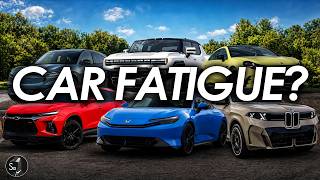

Cars Cost $50k? No Wonder Interest is Dying
50sHigh cost of cars is relatable and shocking, tapping into financial anxiety.
▶ Play Clip"Delivers on the question with solid reasoning, though some points are familiar to enthusiasts."
This video explores why people are losing interest in cars in 2026, citing high costs, market homogeneity, poor repairability, loss of driving feel, and tech fatigue as key factors.
Average new car price approaches $50,000, with higher financing, insurance, and gas costs making ownership financially risky.
Too many similar SUVs and crossovers from different brands create fatigue; the Ford Mustang Mach-E example dilutes the Mustang brand.
Brands copy Tesla's tech-first approach, resulting in identical interiors with large screens and decluttered dashboards, making cars feel generic.
Modern cars lose half their value in 4–5 years, parts become scarce after 10 years, and advanced electronics require dealer-only repairs.
Heavy tech systems add weight and reduce emotional connection; enthusiasts crave analog sensations like engine noise and mechanical feedback.
Half-baked tech (touch controls, non-physical door handles) is implemented before it's reliable, alienating drivers who prefer consistency.
The combination of high costs, sameness, poor longevity, and overbearing technology is causing consumers to lose interest in modern cars, pushing them to either hold onto older vehicles or look elsewhere.
What is the average new car price mentioned in the video?
Nearly $50,000.
00:49
Why are modern cars harder to repair?
They require advanced diagnostic tools and electronic parts that become obsolete, often needing dealer service.
04:38
What example is given of a car that diluted a brand's identity?
The Ford Mustang Mach-E, an electric SUV using the Mustang name.
02:28
What percentage of value do modern cars typically lose in 4–5 years?
About half (50%).
05:08
What is the main complaint about tech in modern cars?
It is half-baked, implemented poorly, and makes cars more cumbersome, leading to driver fatigue.
09:15
Average car price hits $50k
Establishes the core financial barrier that deters buyers.
00:49Mustang Mach-E brand dilution
Shows how iconic brands are compromised by chasing trends.
02:28Modern cars lose half value in 4-5 years
Highlights a key financial risk of new car ownership.
05:08Lack of emotional connection in modern cars
Contrasts performance metrics with the missing sensory experience that enthusiasts want.
07:10Tech fatigue and human evolution gap
Explains why overbearing technology alienates drivers rather than helping them.
09:15[00:11] believe people are losing interest in cars in 2026. Some of this is very United States centric, but I do believe that a lot of these topics apply to the rest of the world. Now, we've scraped a lot of
[00:23] information from our viewers, people that love cars, hate cars, dealerships, people in the industry, or even engineers to kind of formulate some of these. And this is our opinion. However, we are pretty aligned with reality on
[00:35] this since we live and breathe the car world. Let's start with number one. Big shock. This is the Captain obvious reason here that people are steering cars. When you look at the average
[00:49] pushing almost $50,000, which I never thought I would say that, it makes people a lot more phobic and careful about making these decisions. Because that price, not only is the car more expensive, your financing's more
[01:04] car longer, and your insurance costs go sky high with a lot of these new new vehicles. Because any type of minor collision or accident, given the tech, the safety suites in these cars, and the amount of airbags, among other things,
[01:18] have driven up insurance costs in many areas of the country, along with crazy weather patterns. In Illinois alone, we get more flooding. Other areas of the condition, which puts you in a higher risk category. So, when people look at
[01:33] that buying cost of a brand new car, it's not just the payments anymore. Gas prices can be wildly different depending on the week or what the political climate is, but overall, this is a big risk for a lot of people. And cars
[01:47] I I'm going to just say it. The next item is probably one of the biggest item is probably one of the biggest factors. Too many of these cars are the same. This has always been a problem in
[02:02] product history, whether it's car companies, technology, you name it. When one brand has the ultimate success, other companies want to get on that train right away and make something very similar. The difference in this era is
[02:15] there's too many cars, too many models that are stepping over each other. We don't need 20 different brands making the same size, same class of SUV with the same features and basically, they're all homogeneous. So, it's flooded the
[02:28] market with too many options and there's this level of fatigue and we see this Like this brand, they created an electric Mustang and anybody on the surface or enthusiast would say that's a
[02:40] really bad idea. You're watering down the the the overall brand of what Mustang was and then you make it a homogeneous EV, which in our current interested in the United States and there's just better options. The second
[02:55] part of making all these vehicles the same is the tech bandwagoning and this is something that we constantly talk about. When Tesla came around, people were like, "Oh my gosh, can you believe that they did this? They made a car that
[03:07] was tech first. It was a tech play and a car second." And now you fast forward to 2026 when their uh supervised self-driving mode is functioning properly in most conditions, you see all these other cars and all
[03:22] same thing, sticking a tablet in the center, the decluttering their interior to try to make it easier to manufacture, cheaper to manufacture. Everybody wants But again, this goes back to the fact is that wouldn't be such a big deal if
[03:37] there were like 10 different cars on the market, but there's hundreds and get in these things and it's like, "What car am I in?" I I mean, literally. So, if you're a customer and you're looking to spend
[03:49] this kind of money, new or used, do you really want a car that is the same? Like everything's the same. And and I think that's that's a huge issue why people are starting to lose interest in a lot of these cars in 2026.
[04:09] >> but it's the return on the ownership experience relative to the cost. Now, I can't talk about the emotional experience, the visual experience, the usability, but what I can speak to is cars are still
[04:23] depreciating assets. When you buy them, you lose money on them. E- even Toyotas, you're still going to lose something. The key difference here is repairability and longevity of modern vehicles. You know, you could argue 20 years ago,
[04:38] bring some of these old cars in for oil leaks and in in mechanical issues that traditionally in the past, you could get parts for a lot of these cars, and most anybody can work on it. Now, the modern systems in these vehicles require
[04:53] advanced diagnostic tools. A lot of the parts that are going to be in here that might may fail, the electronics, will be end-of-life and very obscure and hard to mechanical piece, screw it back together. It's circuit boards, it's
[05:08] computer systems, it's all the electronics, the screens, all of this. chains for long periods of time. So, if you want to take something like this, spend 50 grand on it, you have to be prepared now to lose half its value in
[05:21] four or five years or more, and then you have to to play the game of can I even get parts for this thing in 10, 15 years, and who's going to work on it outside of a dealer? And probably in in many cases, you're seeing end-of-life
[05:34] parts right at that 10-year point or before, where you're waiting for parts on back order until that supply chain keeps up. And these modern era of cars, a lot of them are not sold in mass numbers like some of the old ones, it
[05:47] becomes a far sketchier prospect. And another reason why people have become disinterested or more phobic in buying into the new car platforms.
[06:03] somebody that likes to drive a car to a certain extent, or a very specific car that's about [music] you doing this. It's an enthusiast argument, and this is engineers, and brands don't quite understand. There are enough cars on the
[06:17] you. You could be almost unable to drive in a from point A to point B without crashing. That's not what I'm talking about. I'm talking about cars that are designed to
[06:30] >> [music] >> And the formal act of driving is being eroded away by all the tech systems and electromechanical systems that are put in every car. It's adding weight, it's adding complication, it's adding
[06:44] engineering times time frame to make these systems feel more cohesive like to drive want to do in these specialized cars is feel something. And I understand you want to add more
[06:56] sets, blah blah blah, to sell more and more cars. But as the price has gone up on these fun cars, so has the lack of feel or connection to them as well. Again, they become more homogeneous because every
[07:10] brand is selling one thing: 0 to 60 time, 0 to 100 time, quarter mile time, a lap time, but the emotion is largely devoid in a lot of these. And you see it more with the German cars. When we say in the United States, we want a V8, we
[07:23] want a V10, we want a V12, we want these big engines, we want to hear something. It's the equivalent of the same reason why we like action movies. It's brash, it's it doesn't make sense, it's just comedy. You want to hear and feel that
[07:35] experience, and you want to do this, you want to drive a car. And a lot of these fun cars, again, are turning more into like this. It just they're trying to do very good thing that they're supposed to do, and that is to make you feel like
[07:51] yourself. >> [music] and I know that's a broad term. I'm not talking about the safety systems that
[08:05] are in cars like airbags or crash avoidance or blind spot monitoring. A point where they are helping people prevent crashes. You can be a very you're going safely without hitting somebody else, and that's what it's
[08:20] done. It's helped a lot of these cars become more accessible to more people. I'm talking about the tech implementation, the entertainment trying to put screens everywhere, trying to replace controls that have always
[08:35] worked for the human condition. Uh non-physical door handles, everything that's in a touch interface where you can't interact with the car anymore. And when I talked about the formal act of driving, this is exactly what I'm
[08:48] talking about. Humans are not evolving as fast as the technology is. We still as fast as the technology is. We still have the this animal brain that is can't keep up with the fact that everything is going digital, that computerization and
[09:01] technology is starting to become just overbearing in every corner of our life. And there's this level of fatigue with throats. You could argue the cost, repairability, but at the end of the day
[09:15] a lot of this tech is half-baked. It's not implemented well, and it's not making things better for people. It's just making it more difficult and cumbersome, and it's making people feel a bit more alienated. Because what what
[09:28] we really like as humans often times is yeah, we like cool new stuff and all that. We like shiny things and flexing and all that, but we also like consistency, things that we know work every single time. And in a car, you're
[09:42] these things that have worked really well, and you're trying to replace that before people are actually ready. And more importantly, before the technology another reason why people are so fatigued with all of this, especially in
[09:56] cars. I'm not even talking about other industries. And there's ways to do this and back off to make the cars more accessible and friendly to people to get that's my list for now. I'll be curious to see what your feedback is, and people
[10:11] course, people that are working on cars, how you feel about all this. Thanks for how you feel about all this. Thanks for watching. I'll see you next video.
⚡ Saved you 0h 10m reading this? Transcribe any YouTube video for free — no signup needed.