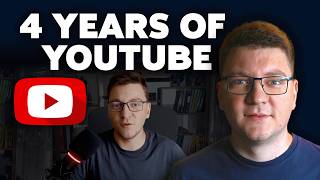

4 Years on Tech YouTube: What I Learned
46sPersonal milestone and reflection resonate with creators and engineers, offering a relatable behind-the-scenes look.
▶ Play Clip"The title promises lessons from four years on tech YouTube, and the video delivers personal reflections and insights, though it's more of a retrospective than a deep-dive tutorial."
In this reflective video, the creator marks four years since uploading their first YouTube video, discussing the evolution of their channel, the .NET community, and the impact of AI on software engineering. They share personal milestones, including becoming a Microsoft MVP, and offer insights into the future of the profession.
The video marks four years since the creator's first YouTube upload, prompting reflection on changes in the .NET community and tech.
The first video, 'Why I'm Starting a Software Engineering YouTube Channel,' outlined a vision focused on software architecture topics like clean architecture and domain-driven design, which the creator feels they've delivered on.
Recording the intro video took days due to inexperience; the creator used a phone's front camera, resulting in a mirrored, off-center video, illustrating that initial efforts don't need to be perfect.
The most-watched video, about clean architecture with .NET 6, has nearly 300,000 views, though the creator doesn't consider it their best work on the topic.
Becoming a Microsoft MVP is a proud milestone, with the creator renewed for the fourth time, showcasing the channel's impact.
The creator admits to losing motivation due to the AI trend dominating content, but plans to shift focus back to high-level software architecture and system design.
A hike conversation with a friend in 2024 about AI's future; the friend thought software engineering was over, but the creator was skeptical, yet AI has progressed faster than expected.
Software engineering isn't obsolete; while simpler coding is automated, AI can't handle high-level system design, architecture, DevOps, and production shipping, which remain human domains.
The creator expresses gratitude to viewers and optimism for software engineers, emphasizing that AI will augment rather than replace the need for skilled professionals in complex, high-level tasks.
What was the creator's original vision for their YouTube channel?
To create content about software architecture, like clean architecture, modular monoliths, and domain-driven design, which was lacking in the .NET space.
00:44
How many views did the most popular video on the channel have?
Almost 300,000 views.
02:13
What achievement is the creator most proud of?
Becoming a Microsoft MVP, renewed for the fourth time.
02:40
What did the creator's friend Mike predict about software engineering in 2024?
He was convinced that software engineering was entirely over.
04:16
According to the creator, what tasks can AI not do in software engineering?
High-level system design, software architecture, DevOps, and shipping everything into production.
05:25
Start Imperfectly
Encourages viewers to start projects without waiting for perfection, a practical principle for creators and entrepreneurs.
01:47MVP Recognition
Demonstrates the tangible rewards of consistent content creation, motivating aspiring creators.
02:40AI Progress Surpasses Expectations
Highlights the rapid acceleration of AI capabilities, a key insight for professionals planning their careers.
04:44AI Cannot Replace High-Level Skills
Clarifies that AI automates simple coding but not complex architecture, reinforcing the value of deep expertise.
05:25[00:03] be wondering why this date is significant. To you, it might not be probably, but to me, it marks 4 years since I've uploaded my first YouTube video. And a lot of things have changed in those past 4 years in the broader
[00:16] .NET community, the technology space, and software engineering in general. So, I wanted to make this quick video to kind of reminisce on where I started, where I am now, and where I'm going next. was actually the first video I
[00:30] ever released titled "Why I'm Starting a Software Engineering YouTube Channel." And in this video, younger and a lot lighter me outlined what my vision was to say I've delivered on most of these points. My idea with this channel was
[00:44] actually pretty simple. I was and still am very interested in software architecture, like clean architecture, modular monoliths, domain-driven design, systems. And at the time, it was my opinion that we lacked enough content
[00:59] about this in the .NET space. So, I thought to myself, if I'm already enthusiastic about this, why not start making some videos about these topics and see where that lands me. These were topics I genuinely enjoyed talking about
[01:11] anyway, and I used to do internal presentations in the companies I worked at about these topics. So, the only skill left to learn was to actually talk to the camera, which surprisingly is a lot more difficult than I thought. For
[01:23] example, it took me a couple of days to record this intro video, even though it's like 3 minutes long. I recorded it from scratch a couple of times, and it still didn't turn out great. First, I was using my mobile phone to record this
[01:35] with the front-facing camera, which is why the video is mirrored, and you can even see that I didn't center my face in the video. So, if you're second-guessing yourself, if you should start something, whatever that is, maybe a YouTube
[01:47] channel, maybe starting a blog, maybe launching that SaaS, just go ahead and do it. The first version doesn't have to be clean and polished. You'll get there over time if what you're building is valuable to someone else. And I also
[01:59] find it a little funny that my most watched video on this channel was also released almost 4 years ago. It's about my clean architecture setup with .NET 6, which was the current version at the time. And as of today, it has almost
[02:13] 300,000 views, by far outpacing any other video on my channel. I also don't consider this to be my best video about clean architecture, but for some reason, it's the most popular. I guess there's not much I can do about it, but if you
[02:26] do end up looking for clean architecture videos on my channel, take a look at the more recent ones rather than this one. But nonetheless, the core ideas I talked about here are still relevant today even with the advent of AI. Making tech
[02:40] YouTube videos about .NET has changed quite a bit about my life in the past 4 years. One of the things I'm most proud of is becoming a Microsoft MVP. And actually, here is my MVP trophy with a
[02:54] couple of tokens that I've got over the years. I'm still missing the latest one as I've been renewed as a Microsoft MVP for the fourth time, but hopefully see it in the shelf behind me. It still amazes me that I'm able to do this for a
[03:07] living, and one thing I consider important is not losing yourself in the process. I think I've done a fairly good job at this, except lately, I've kind of lost the spark to make videos, mostly because everything that's trending is
[03:21] AI, and I don't really want to make this an AI channel. Even though my latest couple of videos have been talking exactly about this. Now, I do want to make a considerable shift and talk about things that I consider will always be
[03:34] high-level videos about software architecture, system design, and building distributed systems. And while I'm on the topic of AI, I remember this conversation I had with my good friend Mike. Shout out to Mike, by the way.
[03:48] While we were on a hike in the Serbian mountains some 2 years ago. I'm actually going to drop in a couple of photos from that hike as I talk along in this video, beauty that we have in Serbia, and maybe one day you'll come and visit if you
[04:03] love hiking as we've got tons of mountains and trails to explore. Now, while we were on this hike, we struck up the topic of where we think AI is headed. Now, mind you, this was some 2 years ago, and the year I started my
[04:16] channel, 2022, was when ChatGPT was released. This was in early 2024. Now, my friend Mike was convinced at the time that software engineering was entirely over, and I was having an argument with him about this as I was already using
[04:29] the time, and I was definitely not impressed by what they could do. Now, I progress in the coming years, and I thought in some 5 or 6 years from then we would get to where we actually are today. So, the point I'm trying to make
[04:44] is that AI is progressing a lot faster than a lot of us could have expected, moving their entire software engineering departments to use tools like GitHub Copilot, Code X, Cloud Code, Cursor, and I know my last video got a lot of people
[04:59] angry, but I generally think there is no stopping this train. The players behind stop, and a lot of money has been spent to get us where we are today. And these companies have to turn a profit somehow, otherwise all these investments don't
[05:13] make sense. So, I'm just going to ask you, how do you think that's going to happen? Regardless of what you might be led to believe, software engineering is not obsolete. Writing code for a bunch of applications out there that are more
[05:25] on the simpler spectrum, that part is more or less solved. However, there are still things that AI cannot do, and this is where you come in as a software engineer. You're still the driver of high-level system design, software
[05:37] architecture, DevOps, and shipping everything into production. So, I think most of your energy going forward. Now, I don't want to turn this more into a rant than it already is. I just want to say that I appreciate you for watching
[05:50] my videos in the past 4 years. I think the future is very bright for software engineers. We have a lot more work to do. So, thanks a lot for watching this do. So, thanks a lot for watching this video and until next time, stay awesome.


⚡ Saved you 0h 06m reading this? Transcribe any YouTube video for free — no signup needed.