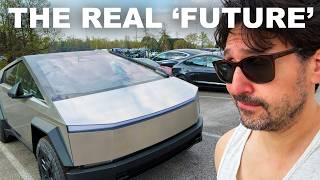

Why the Cybertruck looks old
45sThe clip challenges the Cybertruck's futuristic image by revealing its 80s-inspired design, sparking debate among fans and critics.
▶ Play Clip"Title is honest: the video does make a serious point about the Cybertruck, using it as a metaphor for broader societal issues."
The video uses the Tesla Cybertruck's retro-futuristic design as a springboard to explore why the present doesn't match 20th-century sci-fi predictions. The speaker argues that the future has indeed arrived—just not in the expected form—and criticizes those who cling to past fantasies, particularly Elon Musk, for ignoring real progress and causing harm through policy decisions.
Elon Musk's son Saxon asked, 'Why doesn’t the future look like the future?' Musk claims this inspired the Cybertruck's design, aiming to create something that looks like what 1980s sci-fi predicted.
The speaker argues the Cybertruck looks old-fashioned because it imitates 1980s designs (e.g., the armored vehicle from 'Aliens'). To modern eyes, it's a retro throwback, not futuristic.
The speaker suggests Musk and others see 20th-century sci-fi as unfulfilled potential, blaming failures or 'those people' for holding back progress.
A person from the 1980s would find today's world futuristic: cars are aerodynamic, smartphones surpass Star Trek's tricorders, and Tokyo at night resembles Blade Runner.
HIV is now manageable or curable, a stark contrast to the 1980s death sentence. The speaker criticizes Musk for cutting foreign aid that funds HIV treatment.
The adult answer to Saxon's question: real progress is hard, requires collaboration, and unfolds incrementally, often unnoticed unless we make an effort to see it.
Clinging to past futuristic visions is like a 'lost cause' mythology. People feel deprived of a fantasy they never truly had, like the idealized 1950s economy.
Instead of chasing fantasies, the speaker chooses to notice and appreciate the real progress made, which is different but still good, and could be better if we look forward.
The future is already here, just not in the way we expected. We should appreciate real, incremental progress rather than clinging to outdated sci-fi fantasies.
What question did Elon Musk's son Saxon ask that inspired the Cybertruck?
Why doesn’t the future look like the future?
00:29
According to the speaker, why does the Cybertruck look old-fashioned?
It imitates 1980s sci-fi designs, like the armored vehicle from 'Aliens', making it a retro throwback.
02:25
What example does the speaker give to show that the present is futuristic?
Smartphones can do almost everything Star Trek's tricorders could, and Tokyo at night looks like Blade Runner.
06:06
How has HIV treatment changed since the 1980s?
HIV is now virtually curable in some people and manageable as a chronic condition, whereas in the 80s it was a death sentence.
06:48
What does the speaker criticize Elon Musk for regarding HIV?
Musk cut funding for U.S. foreign aid that helps treat HIV in poor countries, leading to preventable deaths.
08:01
What is the 'adult answer' to why the future doesn't look like sci-fi predictions?
Real progress is hard, requires collaboration, and unfolds incrementally, often unnoticed.
10:02
What does the speaker compare clinging to past futuristic visions to?
A kind of revanchism or 'lost cause' mythology.
10:47
Cybertruck as Retro Throwback
Explains why the Cybertruck looks old-fashioned despite being marketed as futuristic.
01:53Present Is Futuristic
Challenges the assumption that today's world isn't futuristic by citing concrete examples.
05:18HIV Progress
Highlights a major medical advancement that contrasts with the 1980s, illustrating real progress.
06:48Real Progress Is Incremental
Provides a mature perspective on how progress actually happens, countering sci-fi fantasies.
10:02Revanchism and Lost Cause
Critiques the nostalgia for a future that never existed, linking it to political attitudes.
11:03[00:00] Yeah, I know it's random but, I wrote you something about the Tesla Cybertruck. There's a bunch of unsold ones at this dealership over there. Anyway, bear with me.
[00:13] There is a story told in Walter Isaacson's biography of Elon Musk from a couple years ago that goes like this. Elon says he was hanging out with his son Saxon (look to camera). He was hanging out with his son Saxon,
[00:29] and thus spoke Saxon: “Why doesn’t the future look like the future?” No idea of this story is true, by the way, but, "Why doesn’t the future look like the
[00:43] future?” is a thing that lots of people do ask, in different ways, and it's easy to understand why. Broadly speaking, the science fiction of the 20th century predicted that our
[00:56] time would look very different than it actually does now. By our time, they predicted we'd have houses that look like flying saucers, or hovering cars,
[01:09] or post-apocolyptic wastelands — (fingers crossed) not yet ... I don't think?
[01:21] So the question is why doesn't their future — our present — look more like what they predicted? Why does the early-mid 21st century look the way it actually turned out to look?
[01:38] Elon says that this question, as asked by his son, inspired the design of the cybertruck. Something that looks like what someone in the 1980s would have predicted.
[01:53] Something that beloved distopian sci-fi hero John Bladerunner would have driven. The idea behind this design has always made me laugh, because I think Elon Musk means for
[02:06] this "truck" to look futuristic, but to me — and perhaps to you — it actually looks kinda old-fashioned. It looks like something from the 80s, because it kinda is. It's an imititation of
[02:25] designs from 40 years ago. It looks like the armored vehicle from "Aliens," 1986. The fact that that design was intended by James Cameron to look futuristic is
[02:39] irrelevant — it's still a design from the 80s, so it naturally looks old-fashioned to people like you and me, and so does its present-day imitator, the Cybertruck.
[02:53] The reason I'm talking about this now, by the way, is that MY son — who does not have an implicitly racist name — my son and I were talking through our feelings on the cybertruck the other day. He thinks they look kinda cool but he's troubled by Elon's whole "If you crash into another car,
[03:10] you'll win" schtick. My son sincerely does not wish to hurt other people. Imagine that. Anyway, Elon Musk — due to his Peter Pan syndrome, or perhaps just due to his relatively advanced age
[03:27] at this point — Musk doesn't seem to realize that an 80s design in our time looks the way a 50s design would have looked to someone in the 80s. Something like, "Tom Corbett, Space Cadet."
[03:44] That looks like something from the 1950s because it is, even though it believes itself to be futuristic — believing it doesn't make it so. It's still clearly from the 50s just as the Cybertruck
[04:01] is clearly a 21st century retro throwback to a product of 20th century imagination. Or at least, that's what the Cybertruck obviously looks like to me. Let me know
[04:15] if you agree — I suspect at least some of you do. But I don't think Elon Musk see the Cybertruck as a retro throwback. I think this 80s-inspired
[04:28] design actually does look furustic to him, and here is a darker potential explanation for that. I suspect that Elon, and people like him, see the 20th century scifi vision of our
[04:46] time to be a kind of unfulfilled potential. They see it as where we rightly should be by now if not for all the ways we've failed, or if not for "those people" holding us back.
[05:06] When Elon Musk hears his son ask, "Why doesn't the future look like the future," his answer is predicated on the assumption that the present, our time,
[05:18] would not look futuristic to someone from the 80s or the 50s, and I think that it actually would. Yeah, a lot of our world would still look pretty familiar to a person time traveling
[05:34] from the 80s. Our cars don't hover yet, but they do look pretty different from 80s cars. 80s cars were mostly still all straight lines and steel. Now,
[05:47] even a basic-ass car is plastic-composit and aerodynamically curvey. I think a 2026 Toyota Corolla really would look futurstic to a frozen and unthawed 80s man, or certainly a 50s man.
[06:06] And holy crap, tricorders from Star Trek are real now. A smartphone can literally do almost everything that Star Trek envisioned for the personal communicaiton devices
[06:19] of the 23rd century. We're actually 200 years aheard of schedule on this one. Have you ever been to Tokoyo at night? Tokoyo at night straight up looks like the vision of
[06:33] future Los Angeles we see in Blade Runner. I think a person who walked out of that movie in 1982 and stepped into today's Tokyo at night would think they were still in the movie.
[06:48] I think a person from the 80s would be pretty amazed to hear that almost nobody has to die of HIV anymore. HIV is virtually curable in some people, it can be managed as a chronic condition
[07:03] in most others. There are prophilatics now that can keep you from getting infected in the first place. In the 80s and 90s, HIV was a death sentence. They drilled that into our heads
[07:16] when we were young and sexually active in that era. HIV was the scariest thing in the world. My best friend who was more into sports than I was cried the night Magic Johnson announced he was
[07:31] positive in a speech that everyone thought was his Lou Gehrig moment, his goodbye. Magic Johnson is, of course, still healthy today, and a billionare.
[07:48] Because now, scientically speaking, almost nobody has to die of HIV, which makes it all the more ironic that literally millions of people who could have been saved by
[08:01] these medicines are now dying because Elon Musk bought his way into the U.S. government and chose to use his awesome power there to, of all things, eliminate funding for U.S. foreign aid.
[08:17] The world's richest man decided that the world's poorest people are not worth the equivalent of spare change, probably because he views them as genetic trash to be discarded,
[08:33] which is something he says out loud, all the time now, and we let him get away with it. Even if you believe that some people really are genetically inferior, and it
[08:49] you further believe that you somehow possess the divind rod to reliably tell them apart, I dare you to say into the eyes of a child: "You must die — scared, alone,
[09:06] and in pain — so that I might realize the future I was promised in a movie."
[09:18] But hey, at least the deficit's under control. What I'm arguing is that the future does look like the future. It just doesn't look
[09:31] quite like the future we expected, because how could we know? Nobody can predict the future. Turns out this is it.
[09:43] And maybe we didn't notice because it kinda crept up on us, the way the future usually does. I'm a couple months away from walking my older boy home from his elementary school for the last time. I could swear I just dropped him off for first grade.
[10:02] The more adult answer to little Saxon's ostensible question is that real, grown-up progress is hard, it requires lots of people to work together for a long time toward common goals,
[10:19] it requires not only great ideas but great labor to make those ideas come alive, and this kind of real, tangible, durable progress usually unfolds incrementally
[10:35] enough that you might not even notice it's happening — unless you make an effort to.
[10:47] Clinging to futuristic visions from the past is like a kind of revanchism, a "lost cause' mythology. I think some people feel deprived of yesteday's future even though
[11:03] they never actually had it in the first place. All they ever really had was the fantasy of it. Some people feel deprived of a U.S. economy where the uneducated,
[11:18] unprialedved working man could own a beautiful three-bedroom home or maybe some farmland and support his homemaker wife and two point five kids on a single salary for low-skilled
[11:30] labor — that was always mostly a fantasy. You never lost it because you never really had it.
[11:43] I grew up in the 80s and 90s, and I also thought Blade Runner and Star Trek looked really cool. Part of me is a little disappointed that the future doesn't look like that, at least not yet. But rather than spending my time chasing a fantasy,
[12:03] I choose instead to put that effort toward noticing and appreciating the progress we actually ended up making, which is different than what I expected, but still really good,
[12:18] in so many ways, and it could be even better if we keep looking foward, not back.
[12:30] Just because something lacks the comfort of nostalgia does not mean it is bad. Just beacuse something, or someone, turns out different than what you expected does not mean they are bad.
[12:50] The future will look like the future no matter what, because we could not go back even if we wanted to. The only way available is foward. So get in loser, we're going that-a-way.
[13:12] You know something else from our present that is really quite futuristic? Squarespace. You know when I built my first website in the late 90s I literally had to learn to code. I mean,
[13:26] it was basic html, but that was still a heavy lift for me to do something really simple, like put my creative portfolio online for other people to see. Now you just start with a beautiful,
[13:38] human-designed template or you tell the computer what you want and it spits out a draft in seconds. You go in and tweak it to your heart's content. Drag and drop stuff. A payment block here to
[13:50] take people's money, a calander block there to let people schedule appointments with you, really anything most people could ever possibly need in a website is a few clicks away. Bring you own pictures and stuff or use their stock art,
[14:05] which is all integrated into Squarespace, along with the payment processiing, newsletter tools, social integration — EVERYTHING. And they host your site for you too. When you're ready to pay
[14:17] to make your site live, or to register a custom domain, do something good for our collective future and save yourself 10 percent with my code Ragusea. Thank you, Squarespace.
[14:30] And thank you to everybody working hard to build a real, grown-up future.




⚡ Saved you 0h 14m reading this? Transcribe any YouTube video for free — no signup needed.