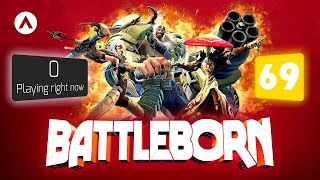

Battleborn's Tragic Launch vs Overwatch
47sThe dramatic story of a game doomed by bad timing and direct competition with Overwatch is compelling and relatable to gamers.
▶ Play Clip"The title promises a tragic story, and the video delivers a detailed, well-researched account of Battleborn's failure, though it could be more concise."
The video chronicles the development, release, and eventual demise of Gearbox Software's hero shooter Battleborn. It explores the game's ambitious blend of FPS, MOBA, and RPG elements, its unfortunate launch timing against Blizzard's Overwatch, and the series of events that led to its shutdown in 2021.
Borderlands (2009) established Gearbox as a master of hybrid genres, blending FPS and RPG. This success inspired the studio to create Battleborn, a hero shooter combining MOBA, FPS, and action-RPG elements.
Battleborn lacked focus compared to Overwatch, which Randy Pitchford acknowledged. He argued that Battleborn was unfairly compared to Overwatch, and its launch three weeks before Overwatch robbed it of success.
Pitchford's idea for Battleborn stemmed from a desire to combine the depth of shooters like Duke Nukem 3D with the 'long-range loop' of RPGs like Diablo, a concept that had already worked for Borderlands.
Battleborn evolved from the ill-received 'Brothers in Arms: Furious Four' project. After negative fan reaction, Gearbox reworked it into a new IP, moving further from traditional FPS norms.
Creative Director Randy Varnell called Battleborn a 'hero game', focusing on a diverse cast of characters and RPG progression. The team was unaware of Blizzard's Overwatch plans, believing their idea was revolutionary.
Battleborn's tone shifted from serious to goofier during development. The story drew inspiration from Game of Thrones, with factions feuding while ignoring a common threat, and from Star Wars, JPRGs, and anime for character identities.
Gearbox focused on a diverse cast and RPG loops. They implemented a fast leveling system that reset each match to allow friends to play together regardless of level, and added NPCs to help newcomers compete with veterans.
Pitchford boasted that Battleborn would require more effort than the first 10 years of Gearbox combined. The game featured striking 2D visuals influenced by Pixar and Japanese animation, aiming to be a jack-of-all-trades.
Battleborn was delayed to May 3, 2016. In March, Blizzard announced Overwatch for May 24, three weeks later. Pitchford admitted fear, knowing Activision would outspend them with 'brute force'.
The open beta in April 2016 received middling impressions, with many saying Battleborn played fine but lacked direction. The game launched to similar criticism and mediocre review scores.
Battleborn received a 40% discount on Steam within a month, but player numbers plummeted from 12,000 to 600 by July. Take-Two confirmed sales were below expectations in August 2016.
Kotaku reported plans for a free-to-play version, which 2K initially denied. A 'free trial' launched in June 2017, but Pitchford continued to defend the game, citing 3.5 million users and blaming Overwatch comparisons.
In September 2017, Gearbox announced the Fall Update as the final content drop. The game was gradually sunsetted, and online servers shut down in January 2021, making Battleborn unplayable.
Battleborn's tragedy lies in its ambitious but unfocused design and the unfortunate timing of its release against Overwatch, which overshadowed it. Despite its eventual failure, the experience may have benefited Gearbox in the long run, but the game's legacy is one of a promising project stunted by circumstance.
What was the primary reason Randy Pitchford gave for Battleborn's failure?
He argued that Battleborn was unfairly compared to Overwatch, and its launch three weeks before Overwatch robbed it of success.
01:19
What game laid the foundation for Battleborn?
Brothers in Arms: Furious Four, which was later uncoupled from the Brothers in Arms name and evolved into Battleborn.
05:01
What was the 'hero game' concept as described by Randy Varnell?
A game where players choose from several different character types, each with unique skills, and pit them against each other in online matches.
06:31
What was the premise of Battleborn's story?
Numerous factions battle for control of Solus, the last star, while facing a common enemy, The Varelsi, who destroyed all other solar bodies.
07:58
How did Gearbox ensure players of different levels could play together?
They implemented a fast leveling system that reset after every match.
10:30
What was the release date of Battleborn and Overwatch?
Battleborn was released on May 3, 2016, and Overwatch on May 24, 2016.
13:32
What was the peak number of concurrent players on Steam for Battleborn on day one?
Approximately 12,000 players.
15:36
When did Battleborn's online servers officially shut down?
In January 2021.
19:42
Lack of Focus
Identifies a core design flaw that contributed to Battleborn's failure.
01:03Pitchford's Vision
Explains the creative inspiration behind Battleborn, linking it to Borderlands' success.
04:01Overwatch Announcement
Highlights the critical moment when Battleborn's fate was sealed by competition.
13:15Player Decline
Shows the rapid loss of player interest despite discounts and content promises.
15:21Sunsetting
Marks the official end of Battleborn, making it unplayable.
19:42[00:15] The release of Borderlands in 2009 marked the first step towards Gearbox Software cementing itself as a master of developing hybrid experiences, games capable of artfully blending together otherwise disparate genres. For the cel-shaded, vault-hunting romp,
[00:30] such a blend consisted primarily of first-person shooter mechanics and elements consistent with role-playing games. Borderlands went on to enjoy success beyond Gearbox and its publishing partner’s wildest imaginations. It made sense, then, that the studio similarly combined
[00:46] genres when trying to break ground in the hero shooter space with a brand-new IP, Battleborn. A fast-paced shooter comprised of a story campaign and competitive multiplayer modes, Battleborn checked several boxes to become equal parts MOBA, first-person shooter, and action-RPG. But
[01:03] in striving to cover a wide gamut of experiences in one, the hero-based FPS title lacked focus. Its immediate competition, Blizzard Entertainment’s Overwatch, suffered from no such lack of discipline, an argument Gearbox President Randy Pitchford readily acknowledged when dissecting why
[01:19] Blizzard’s endeavor overshadowed that of his team. Pitchford would argue that Battleborn earned the label of failure only because of misguided Overwatch comparisons. To the studio executive, Gearbox’s ambitious new property could have held its own just fine, yet unfavorable
[01:35] circumstances—namely its launch three weeks before Overwatch—robbed it of any real chance of doing as much. Regardless, steep discounts, a dismal player retention rate, and reports of a
[01:47] last-ditch effort to explore free-to-play options followed Battleborn like a plague within months of its debut. Any attempts at driving engagement were met with disinterest, resulting in an unfortunate but predictably quick demise. This is the tragedy of Battleborn.
[04:01] There exists a clear throughline between Randy Pitchford’s connection to first-person shooters and RPGs and the creation of Borderlands, a connection that later drove Gearbox’s roundabout conception of Battleborn. According to statements the executive made in a Glixel interview, it all
[04:17] dated back to the realization that the depth and subtly of 3D action shooters like Duke Nukem 3D could pair well with the “long-range loop” endemic to roguelike and RPG experiences such as Diablo.
[04:29] Though Pitchford and Company’s industry ascent came courtesy of shooters, there was always an appreciation for how the RPG loop revolved around character progression. The team figured that type of layered structure needn’t be mutually exclusive with the short-term, visceral joy of moving and
[04:44] shooting in an FPS. Marrying these two disparate parts breathed life into Borderlands. But, strangely, Brothers in Arms—Gearbox’s first original IP—laid the foundation upon which the developers eventually built Battleborn. Ubisoft’s E3 2011 press event featured a surprise
[05:01] announcement of Brothers in Arms: Furious Four. Instead of the franchise’s familiar and grounded tone, the Furious Four teaser depicted an Inglourious Basterds-esque veneer that many fans of the beloved shooter series quickly lambasted. A Senior Producer at Ubisoft at
[05:16] the time, Nourredine Abboud, told Kotaku in 2011 that the Tarantino-inspired approached stemmed from the publisher and developer’s uncertainty about where to evolve Brothers in Arms. Considering that starting point and the ill-received E3 reveal, Gearbox knew returning
[05:31] to the drawing board was the best path forward. Approximately one year later, the studio informed a PAX Prime audience that Furious Four had been uncoupled from the Brothers in Arms name, meaning the Texas-based outfit would create another new first-person shooter IP. Several rounds of
[05:48] iteration turned the overly stylish Brothers in Arms project into something entirely different, a hybrid that moved even further than Borderlands from the norms long-established in the FPS genre. Those norms were more or less set in stone during the seventh-console generation,
[06:02] Pitchford explained. Selling FPS titles to consumers typically focused on the abilities of a single hero; BioShock, for instance, placed an emphasis on the player character wielding standard weapons in one hand and special powers in the opposite. Since so much of
[06:16] the industry had mastered the art of designing a single playable hero, Gearbox surmised the next logical step rested in letting users choose from several different character types in one game. Putting those characters and their respective skills on a wide spectrum, then pitting players
[06:31] against one another in online matches served as the cornerstone of what Battleborn’s Creative Director Randy Varnell called a “hero game” in Game Informer’s August 2014 cover story[a]. Because the game was created in somewhat of a vacuum, void of any knowledge regarding
[06:46] Blizzard’s plans for Overwatch, the Battleborn developers felt their hero shooter idea would prove as revolutionary as blending together FPS and role-playing mechanics for Borderlands. All in all, the concept seemed a good bet, considering how easily audiences were drawn to Borderlands’s
[07:01] cast of playable Vault Hunters. The success of MOBAs constituted another motivating factor behind Furious Four’s evolution into Battleborn. Drafting an interesting concept present but one challenge in the grand scheme of things, though. The real test expressed itself through the creation of fun
[07:18] systems and a compelling game world that would hopefully attract users and keep them invested.
[07:42] Battleborn boasted more of a serious tone in its embryonic phase; Varnell said the goofier bent spawned over the course of development since the creative crew struggled with divesting from what had become its signature humor. Thus, colorful insults and one-liners about the love of battle
[07:58] fueled much of the banter between characters. But the tonal shift had no bearing on the game’s cataclysmic premise, which revolved around numerous factions battling for control of Solus, the last star and only remaining energy source in the universe. The factions shared a common enemy
[08:15] in The Varelsi, the dark force responsible for destroying every other solar body; as the warring groups fought amongst themselves, the threat of the enigmatic force continuously mounted. Gearbox tied it all together with a five-player story campaign and multiplayer matches,
[08:31] both of which heavily featured the villainous Varelsi. Despite tone changes during production, the studio approached the storytelling seriously, with the factions especially coming to life courtesy of inspiration from Game of Thrones. That George R.R.
[08:46] Martin’s characters were neither unilaterally good nor bad counted as one such influence. The motivations of Game of Thrones’s factions proved integral to Battleborn’s creation as well; some groups regularly feuded over personal reasons, others for resource-related purposes.
[09:02] Either way, all ignored the “big threat up North” looming over the realm. From that thread, Gearbox imagined a situation wherein the rival forces in Game of Thrones would have to lay aside their differences and focus their collective energies on eliminating the common foe.
[09:18] Varnell told Game Informer these reflections on the popular TV show and book series represented the “great inspiration” for Battleborn. Meanwhile, Star Wars, various JPRGs, and Japanese anime
[09:30] helped lay the foundations[b] for the identity of each in-game faction and character—barring the musclebound commando named Montana who’d previously appeared in the Furious Four teaser. Given its pedigree, Gearbox understood the ins and outs of story and character would mean
[09:45] little without fun gameplay. The studio leaned on the hero game motif as a result, specifically prioritizing a diverse cast of characters and RPG gameplay loops. Battleborn’s playable heroes
[09:57] targeted all types of playstyles; while some wielded rifles or Gatling guns, others utilized magic arrows or telekinetic swords. Character designs similarly explored a range of aesthetics, with the shooter playing host to Sith-like space samurai and bipedal mushroom people.
[10:13] In addition to constructing a cast reminiscent of popular MOBAs, developers also closely examined how the genre implemented progression systems. Gearbox particularly wanted to ensure players could always team up with their friends regardless of each person’s respective level; Battleborn,
[10:30] thus, received a speedy leveling system that reset after every match. Since simplicity and replayablity reigned supreme when it came to gameplay, the studio further tackled issues that had long plagued the likes of Call of Duty. Newcomers to Activision’s annual Call of Duty
[10:46] releases often struggled when competing against veterans of the franchise. Pitchford claimed the new hero shooter would combat the problem by employing the concept of “layering the competitive game on top of the player-versus-environment game.” Enemy NPCs were also implemented for
[11:00] less-experienced users. Needless to say, Gearbox aimed to appease those well-versed in first-person shooters and non. The end result ultimately wouldn’t go as planned.
[11:27] In the Game
[11:47] Informer issue that accompanied Battleborn’s reveal, Randy Pitchford boasted that “by the time it ships, the amount of effort that’s gone into Battleborn will be greater than the first 10 years of Gearbox’s existence all added together.” The studio President insisted
[12:02] it was their most ambitious project, with more staffers and “mindshare” dedicated to it than any previous endeavor. After its rollercoaster of a time during the seventh-console generation, which included victories such as Borderlands 1 and 2 and losses like Duke Nukem Forever and Aliens:
[12:19] Colonia Marines, Gearbox needed another win. The team and its publishing partners at 2K Games seemed to believe Battleborn would deliver. It arguably had the look of a winner, thanks in no small part to the striking 2D visuals produced by
[12:35] Art Director Scott Kester, Art Producer Sarah Rosa, and Effects Director Michel Gange, the latter of whom had an impressive resume spanning The Iron Giant and Star Wars: The Clone Wars.
[12:47] Speaking to Official Xbox Magazine about the competitive shooter’s artistic approach, Rosa said marrying Western CGI, specifically the polish of Pixar films, with Japanese animation helped capture a “graphic action-y feel,” which brought flair to the environmental effects and
[13:03] special abilities. Not unlike the gameplay and narrative, Battleborn’s art direction also borrowed from a trove of influences—fighting games, MOBAs, and RPGs, and movies included—all
[13:15] amounted to an ill-fated adventure that tried being everything for everyone. Announced for a 2016 release on PC, PS4, and Xbox One, the hero shooter originally bore a February due date. 2K later delayed it to May 3rd of that year, a business decision the publisher
[13:32] could not have predicted would eventually be considered unwise. In March 2016, Blizzard Entertainment revealed plans to launch its own hero shooter, Overwatch, on May 24th—three weeks
[13:44] after Battleborn’s scheduled debut. Such news spelled trouble for the new Gearbox IP, and Randy Pitchford and crew instantly recognized as much. In a post-launch interview with Glixel, Pitchford admitted fear gripped the Gearbox offices when Blizzard unveiled the Overwatch
[14:00] date. Battleborn’s release had already been set in stone for several months, so a second delay wasn’t optional. Pitchford said when discussing the matter with 2K’s parent company, Take-Two Interactive, he emphasized that Overwatch publisher Activision would “outspend” them with
[14:16] sheer “brute force.” Simply put, there was nothing anyone could do on Battleborn’s side of the fence. Shipping a good game possible and hoping for the best constituted the attitude going forward.
[14:28] Before its wider release, Gearbox and 2K hosted a beta open to the public. The open beta period lasted for 10 days in April 2016; impressions from outlets and players said more or less the same
[14:40] thing—Battleborn played just fine, not bad but it offered nothing particularly special, either. Many believed it lacked direction, reducing the game to jack of all trades, master of none.
[14:52] Of course, the shooter launched to similar criticism, earning middling review scores[c] and little in the way of fanfare. This didn’t necessarily translate to poor sales out of the been “tracking just ahead” of Borderlands 1 in terms of sales. Detailed data would be kept under
[15:09] wraps for quite some time either way; and things especially began looking gloomy once Overwatch hit stores, dominating market share and mindshare. Battleborn received a 40 percent discount on
[15:21] Steam by the end of its launch month. But the steep price reduction hardly impacted the player base on PC, evidenced by Steam Charts showing a drastic decline in active users. In July, the number of players dropped as low as 600, a substantial shift from the approximately
[15:36] 12,000 who boarded the trip to Solus on day one. Some attributed the rapid collapse to the introduction of microtransactions and Premium Currency, with Gearbox’s promises of continuing to deploy free content having no effect on the game’s potential growth.
[15:51] Take-Two confirmed the suspected commercial shortcomings in an August 2016 financial report, as CEO Strauss Zelnick revealed that Battleborn sold below expectations. The executive insisted
[16:03] the shooter could still cultivate an audience, reiterating 2K’s intention of supporting it long term. Gearbox’s previous announcement of five free playable heroes and a Season Pass packing five DLC add-ons outlined the immediate post-launch plans; yet, the future beyond these prearranged releases
[16:19] looked murky at best. As such, after only a handful of months on the market, reports of a free-to-play version started hinting at Battleborn’s last bastion of hope.
[16:53] Based on sources familiar with Battleborn’s production, Kotaku wrote a report in September 2016 that alleged developers were priming the underperforming shooter for a free-to-play release. Reportedly, such a launch had already suffered two delays. The publication’s sources
[17:09] 2K Games supposedly dismissed the idea outright, wanting to ship a full-priced, $60 package. calling the story false in a post on his personal Twitter account. In a subsequent tweet,
[17:28] the Gearbox President teased an unannounced “trial version” of Battleborn, purposefully avoiding the free-to-play nomenclature. Vague naming conventions aside, the hero shooter essentially embraced the free-to-play route with a so-called “free trial” iteration in June 2017. It included
[17:45] unlimited access to every competitive multiplayer mode, along with a rotating cast of six playable characters. Fans who previously purchased the title were promoted as Founders, thereby gaining access to several pieces of free content meant to compensate them for being early adopters.
[18:00] In the months leading up to the free-to-play rollout, Pitchford gave interviews wherein he staunchly defended Battleborn’s market performance. Its perceived failure merely constituted a matter of perception, based wholly on the impossible-to-avoid comparisons
[18:14] to Overwatch. The executive divulged in January 2017 that Battleborn had amassed three and a half million users up until that point. He lamented that, as far as the general consensus was concerned, these numbers relative to Overwatch’s success equaled failure;
[18:30] by comparison the Blizzard-created hero shooter hosted upwards of 25 million registered users around the same time. But if Battleborn had landed without direct competition looming, Pitchford maintained it would’ve been deemed a success, even if
[18:44] Still, the outspoken industry veteran had no trouble acknowledging Battleborn’s weaknesses when stacked against Overwatch’s better qualities. Blizzard perfectly executed the hero shooter
[18:57] concept in his eyes, due in part because the team existed on a plane that others aspired to, but also because Overwatch had more of a “narrow focus” than Battleborn. The constant comparisons were what truly pushed down the latter, he argued, stating that anyone
[19:11] who spent significant time playing both games could articulate the differences. Meanwhile, examining them superficially suggested they approached the subgenre from the same angle. He called it “bad strategy” to operate on the notion of becoming the best at something when,
[19:25] on the other hand, offering a unique service meant competing with one’s self. For Gearbox and Battleborn, then, Pitchford felt the jig was up once Blizzard entered the race. Gearbox’s participation in the race screeched to a halt in September 2017. Just 15 months
[19:42] after Battleborn debuted, the company announced the Fall Update[d] would mark the final curtain call for new content drops. 2K and Gearbox began “gradually sunsetting” the game in late 2019 until online servers officially shut down in January 2021, thus making Battleborn unplayable.
[20:00] When asked why[e] Borderlands 3 didn’t serve as Gearbox’s first project for eighth-gen consoles, Pitchford confessed it would’ve crumbled beneath the weight of high expectations in a next-generation environment—pressure the crew was not yet ready to face. Handing off a third
[20:15] Borderlands game, the Pre-Sequel, to 2K Australia, then focusing on what eventually morphed into Battleborn relieved some pressure. Yet, the fruits born from sidelining its golden goose and building a hero shooter resulted in the developer’s attempt at breaking new ground technically
[20:30] ceasing to exist after only five years. Gearbox, and perhaps Borderlands 3, likely benefited from Battleborn’s creation, but it’s unfortunate that the domineering impact of Overwatch stunted
[20:42] the growth of a project designed to push the envelope—even if the best game won out in the end.
⚡ Saved you 0h 22m reading this? Transcribe any YouTube video for free — no signup needed.