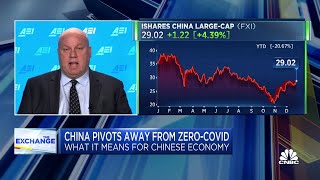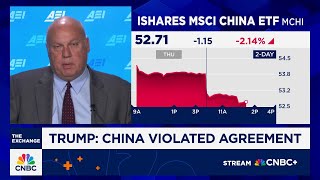

China Deal is 'Utter Nonsense'?
42sDirect, controversial claim that the US-China agreement is meaningless, sparking debate.
▶ Play Clip"The title promises analysis of trade tensions, and the content delivers, but it's a typical news segment with some filler and no groundbreaking insights."
In this segment, economists Ed Mills and Derek Scissors analyze the US-China trade negotiations, focusing on the lack of a substantive agreement from the Geneva talks and the Trump administration's strategy of escalating threats to gain leverage. They discuss the market's likely reaction to further tariff threats and the differences between Trump's first and second terms regarding China.
The Geneva agreement lacks public text or substantial administration comment. Claims that China will reform and rebalance to consumption are dismissed as 'utter nonsense.'
The administration faces PR and legal setbacks. They need a win but cannot claim restoring rare earth exports as a victory since that could have been achieved months ago by doing nothing.
Targeting subsidiaries and parent companies is seen as overdue. The licensing requirements mean the U.S. can approve licenses, so the threat is being ramped up slowly, and people may be overreacting.
In Trump's first term, China was 'all bark no bite,' but now they are strategic, targeting choke points and not quick to negotiate. Trump is ramping up pressure to force negotiations.
Trump escalates with tariffs (145% as an embargo) while publicly claiming talks are happening to let China save face and come to the table.
Trump wants leverage before negotiating, so more threats are likely. However, the market may not take them seriously given past patterns, but betting on Trump to always back down carries risk.
The administration will likely continue escalating threats to build leverage, but markets may dismiss them as posturing. However, there is a risk that Trump could follow through on China, which would surprise the market.
No Substance in Geneva Agreement
Highlights the lack of concrete progress in US-China trade talks, a key market concern.
00:15China's Strategic Shift
Explains why China is more difficult to negotiate with now, affecting market expectations.
01:48Trump's Two-Path Strategy
Reveals a nuanced approach to forcing negotiations while saving face, useful for understanding policy moves.
02:37Market May Look Through Threats
Suggests markets may dismiss tariff threats, but warns of the risk of betting on Trump backing down.
03:28[00:00] Ed Mills is still with us. Also joining us now is Derek Scissors, Asia economist at the American Enterprise Institute. Derek, how are you thinking through this as we head into the weekend? Well, I think the key point is the agreement in Geneva, the agreement to do what?
[00:15] There's no text that's public of any substance. There's been no comment by the administration of anything substantial. We had Secretary Besson and President Trump saying afterwards that China was going to reform and be a different economy and rebalance to consumption,
[00:28] all of which was utter nonsense. So when you don't have an agreement in hand and you are the only thing you've said as of a few weeks ago was ridiculous, you're stuck with, well, nothing's happening. What did I get out of this?
[00:42] Which is where the administration is now. As you mentioned earlier, they've taken a couple of blows, both PR with the with the taco stuff and legally. So, you know, what are they going to what's a win here for the administration?
[00:55] THE AMERICAN PEOPLE ARE NOT GOING TO BE ABLE TO FIND ANYTHING WE DON KNOW WHAT IT IS IT CERTAINLY ISN JUST RESTORING WERE EARTH EXPORTS WE COULD HAVE HAD THAT A FEW MONTHS AGO BY DOING NOTHING It certainly isn just restoring rare earth exports We could have had that a few months ago by doing nothing So the administration has put itself in a box by claiming there was going to be a big concession from China which is very unlikely
[01:09] They're not getting anything really quickly, which is also very unlikely. So they have to resort to threats. I think the threats also are being overstated really briefly.
[01:21] Wow, we're going to actually target subsidiaries as well as parent companies. We should have done that a decade ago. And second, this is all licensing requirements, which means the U.S. can approve the licenses. So we're ramping up a threat slowly.
[01:35] People may be overreacting to it. The real problem is we don't have an endpoint. Ed, do you see an endpoint here, or how should markets be thinking about this then? I do think that there's going to be an endpoint, Kelly.
[01:48] When I've gotten different polls here at Raymond James, experts are kind of anticipating that we get to the end point. I do think that the big thing that different in Trump 2 than 1 as it relates to China is that in 1 China was all bark no bite We spent all this time about will China put different U companies on the unreliable
[02:08] entity list? And that never happened. In 2.0, they are being very strategic, looking at different choke points in terms of what we need and responding in kind. And they're not as
[02:20] quick to go to the negotiating table. And so what we do see from President Trump is trying to ramp up that pressure, trying to get them to the negotiating table. That's why we went to 145% tariffs on China, because that was effectively an embargo. That forced them to have the conversation.
[02:37] But before they were willing to have the conversation, Trump came out multiple times saying, oh, we're talking all the time, even though we weren't talking. So Trump is doing a two-path here, escalating on one hand and giving olive branches or kind of de-escalating by saying
[02:51] that the conversations are already happening so that China doesn't lose face as they come to the negotiating table. So final question then Derek is A should we expect the president to now move back in the direction of putting higher tariffs on China Should we expect Truth Social posts saying yep we going back to these high
[03:12] triple-digit rates and so forth? A, should we expect that? And B, even if he did that, would there be a similar market reaction to what we had last time, or would they look through it? Well, I do think President Trump has been very consistent that he wants what he sees as leverage
[03:28] before he gets to the negotiating table. I still don't know what he's actually looking for, trying to buy more U.S. products maybe. But he's making a system out wanting more leverage. So we've had a blow to his leverage. He's going to try to build up leverage. He's going to make
[03:40] more threats. The U.S. is going to take more actions. I think that's going to happen. I do think the market might not take it that seriously because we've already gone down this road and we went down this road with his first term tariffs and then we had a phase one trade deal blown up
[03:53] by COVID. So I think we will get more threats. The market will look through it. That's probably a good bet. But I think betting on Trump always to chicken out, at some point you're going to get burned and it might be over China.
⚡ Saved you 0h 04m reading this? Transcribe any YouTube video for free — no signup needed.