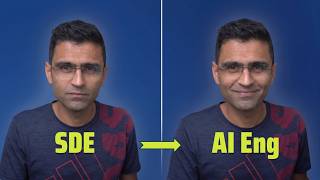

Don't Spend 6 Months Learning Python
41sSoftware engineers can fast-track AI upskilling by transferring their existing coding knowledge, saving months of time.
▶ Play Clip"Delivers exactly what the title promises with a detailed 8-week plan, though the repeated live-cohort plugs add some noise."
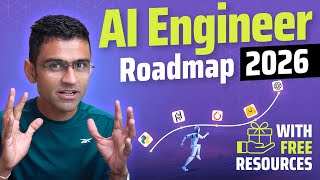
Dhaval, an AI consultant and co-founder of Atli Technologies, presents a practical eight-week AI engineering roadmap for software engineers with at least two years of experience. He breaks down weekly technical topics, free learning resources, hands-on assignments, and the growing importance of soft skills like communication and personal branding.
An AI engineer is a software engineer with strong backend skills plus LLM/AI model understanding and AI system design.
The roadmap PDF is built exclusively for software engineers with 2+ years of experience, assuming 4-5 hours per day, 5-6 days a week, using free resources.
Map existing programming knowledge (e.g., Java/.NET) to Python and FastAPI instead of learning from scratch. Use AI coding tools like Claude Code and ChatGPT to speed up development.
Groq (called 'Grok' in the video) allows learners to call LLM models for free with an API key, making it easier to practice building AI projects without spending money.
Learn about skills.md, claude.md, context supply, and token optimization. These principles are essential for effectively using AI tools as a software engineer.
Understand GenAI basics, agents, LLM configuration parameters, embeddings, and vector databases. Start with open-source Chroma DB, but get hands-on with commercial options like Qdrant and Pinecone.
As AI tools reduce the importance of pure coding skills, soft skills are increasing in value. A mix of 30% technical and 70% soft skills makes an engineer 'invincible'.
Build credibility through open source, competitions, or speaking, then stream it through LinkedIn and X. Online presence is the new resume.
60-70% of the company's client projects are RAG (retrieval augmented generation) projects. Learn RAG pipelines, document parsing, chunking, and LangChain basics.
The product owner/business manager and software engineer roles are merging into 'product engineer' — 50% technical skills and 50% product/business knowledge.
Code a RAG pipeline in pure Python before using frameworks like LangChain, because frameworks change frequently. Using Claude Code is okay, but you should understand the code.
Learn AI agents, react loops, routing based on intent and task complexity, AI agent security, guardrails, and evaluation techniques for probabilistic AI outputs.
Watch 'Death by PowerPoint' to learn effective, engaging presentations. Storytelling beats boring technical diagrams.
Use LangSmith for observability and monitoring, AWS Agent Core for deploying agents, and contribute to open source by searching for 'good first issue' tags.
A resume showing five merged PRs in a repository immediately gets an interview call. Only about 1% of reviewed resumes have such contributions.
Use LangGraph for deep, custom control (manual mode vs auto mode), and explore CrewAI and MCP servers. Build a multi-agent marketing system and an MCP server for a public API.
Learn token cost optimization through caching, rate limiting, model selection and cascading. Also explore multimodal RAG, fine-tuning with Unsloth, and local model deployment with Ollama.
DSPy is a framework for building AI applications using a declarative programming approach.
Deploy AI models on Azure, AWS, or GCP. Learn one cloud deeply (Azure is recommended), then transfer concepts to other clouds.
Form a study group, hold weekly check-ins, and spend less time consuming information and more time digesting, implementing, and sharing.
Python
tool
FastAPI
tool
OpenAI API
service
Groq API
tool
Claude Code
tool
ChatGPT
tool
Google Antigravity
tool
Cursor
tool
Chroma DB
tool
Qdrant
tool
Pinecone
tool
LangChain
tool
LangGraph
tool
LangSmith
tool
AWS Agent Core
service
Docling
tool
Andrej Karpathy
person
Think School
service
Transformers GitHub repository
link
Unsloth
tool
Ollama
tool
DSPy
tool
Microsoft Azure
service
AWS
service
Google AI Studio
service
service
X (Twitter)
service
Death by PowerPoint presentation
link
Roadmap PDF
link
What is an AI engineer?
A software engineer with great backend skills plus LLM/AI model understanding plus AI system design.
00:02
Which programming language is essential for AI engineering?
Python.
01:55
What free tool allows learners to call LLM APIs without spending money?
Groq (referred to as 'Grok' in the video).
03:51
What are the three components of the LangChain ecosystem?
LangChain (general framework), LangGraph (custom agents), and LangSmith (observability and monitoring).
22:00
What is RAG?
Retrieval Augmented Generation — pointing an LLM to internal organizational data so it can work on that knowledge base.
12:18
What percentage of the speaker's client projects are RAG projects?
60 to 70%.
12:06
Why do AI systems need a different evaluation paradigm than traditional software?
AI systems are probabilistic — asking the same question can produce different outputs each time.
18:54
Which vector databases are commonly used commercially?
Qdrant and Pinecone (Chroma DB is more for learning).
06:11
What analogy is used for LangGraph versus LangChain?
LangChain is like auto mode on a DSLR camera, while LangGraph is manual mode for deep custom control.
25:09
What techniques help optimize LLM API costs?
Caching, rate limiting, model selection, and cascading.
27:17
Which framework helps run LLMs locally for data privacy?
Ollama.
28:42
What is DSPy used for?
Building AI applications using a declarative programming approach.
28:56
What new role merges technical skills and business/product knowledge?
Product engineer — roughly 50% technical skills and 50% product owner/business soft skills plus domain knowledge.
16:05
What GitHub tag should you search for to find beginner-friendly open source issues?
Good first issue (or good second issue).
24:11
AI engineer = software engineer + LLM + system design
Gives career switchers a precise, non-trivial target skill set instead of a vague job title.
00:02Soft skills outweigh pure coding skills
Highlights the fundamental shift in what makes engineers employable in the AI era.
07:1960–70% of AI projects are RAG
Shows learners exactly where to focus their effort to get industry-relevant skills.
12:06Open source PRs trigger immediate interviews
A concrete, verifiable differentiator that most candidates still ignore.
23:10Learn one cloud deeply, then transfer
Reduces the overwhelm of multi-cloud learning by leveraging concept transfer.
29:37[00:02] become AI engineer because AI engineer is equal to software engineer with great backend skills plus LLM and AI model understanding plus AI system design. Many software engineers today want to transition to AI engineering role
[00:16] because that's where the future is. They start by becoming integrator which means they will call LLM APIs to build AI features into current software and later on they can learn how to fine-tune LLM models or even build ML and DL models
[00:31] from scratch. Before we start, a short introduction on myself. I'm Dhaval. I worked with big tech companies like Bloomberg and Nvidia for many years. At present, I'm the co-founder of AI consultancy company at Lake where we
[00:44] have transitioned many of our existing software engineers into AI engineers role and that helped us implement more than 25 AI projects for our clients based in US and UAE. Whatever I'm going to share today is based on real-life
[01:00] industry experience and today I will show you a most practical road map which will help you learn AI engineering. This contains week-by-week study plan with free learning resources. Here is the PDF of the road map. This is built
[01:15] exclusively for software engineers with minimum two years of software development experience. It is a fast-paced program which you can finish in two months using free resources. We are going to assume you're spending 4 to
[01:29] are going to assume you're spending 4 to 5 hours, 5 to 6 days a week. Now, exact time that you take to learn all these skills depends on your learning speed, your dedication and few other factors. This includes both technical skills and
[01:43] soft skills. In the AI era, soft skills are equally important, folks, okay? In week one, you will learn AI and Python fundamentals. Python is the programming
[01:55] language for AI. There is no doubt about it. Here I'm showing you a code snippet it. Here I'm showing you a code snippet of how you can call Open AI API from Python code. Python is something that people use across the industry, hence
[02:09] Okay, Python data types, functions, exceptions, loops, control flow, all of these. Now, as a software engineer, you already know about if for loop,
[02:23] object-oriented programming, and so on. Now, you can use this transfer learning. You need to map the concepts that you have learned in different programming language. Let's say you know Java, you have worked in Java. You need to map
[02:37] those concepts to Python. That way, your learning becomes very, very easy. Fast learning becomes very, very easy. Fast API is super important. It is used to build a backend. Now, as a Java or .NET developer, you would have built backend
[02:50] already. So, once again, you need to map those concepts to quickly learn all these things. You don't want to spend six months learning Python and Fast API, six months learning Python and Fast API, folks. We live in the world of wide
[03:04] folks. We live in the world of wide coding, AI first engineering. You should be uh willing to uh use this Claude code, ChatGPT, etc. tools to write code faster, okay? Forget syntax. You don't have to remember syntax now nowadays.
[03:21] Focus on fundamentals. Focus on building, okay? Now, once you have cleared some of the Python fundamentals, once again, you don't need to go too much in depth in Python, okay? Just map your programming concepts to Python.
[03:37] Then, uh this is the most important tool, folks, Grok, okay? So, Grok is a tool, folks, Grok, okay? So, Grok is a tool that will allow you to call LLM freely. So, in your learning phase, you don't want to spend
[03:51] money, And this is an amazing tool for learning, folks. You can call all these models, you can create free API key, and you can you can build AI projects for free, okay? So,
[04:05] Grok is something very important. You can register your account on this platform. And they have documents if you want to And they have documents if you want to uh call it from Python. It's super easy.
[04:19] Uh so, let's see. Uh this is Grok. Okay, so client import uh this is I think open AI API code. But if I go to Grok, see Grok API key, you
[04:32] have to first get. And then you will use this Grok module, And then you will use this Grok module, and this is how you call uh let's say this Llama model for whatever use case you want to call
[04:44] it, okay? So, you have to build uh this code using Grok so that you know how to call LLM APIs from your uh Python code.
[04:56] Then you have to be very strong in live coding. I call it AI first engineering because live coding sounds like trivial hobby thing. As a software developer, you are building complex systems where you will use Claude. Claude is my
[05:13] favorite tool, by the way. Uh I use Claude code all the time. And recently Claude code all the time. And recently we have published crash courses for all these tools. So, here's the one for Claude which we made it live just
[05:26] yesterday. Then we have one for Google antigravity, Cursor, and so on. These tools are easy to learn for you as a software developer, but there are some live coding principles that you need to know, such as what is skills.md file,
[05:41] what is claude.md file, how do you effectively supply context and optimize on your token usage. All this discipline you need to learn, which I have mentioned in those tutorials. Then you need to know generative AI basics. What
[05:56] is GenAI and GenTKAI? What are agents? What are different configuration parameters for LLM such as all of these, okay? What is embedding? Vector database? Use cases of vector database? And when I talk about vector database,
[06:11] see Chroma DB is an open source. So that is where people start their learning journey. But when you work in the industry, people don't use Chroma DB. They use the commercial vector databases such as Quadrant, Pinecone, and so on.
[06:25] So it is better you get hands-on experience on this complex vector databases. I have mentioned uh YouTube tutorials. These are all free learning resources, folks. You don't have to spend any money. And as you see, we have
[06:39] Python tutorials, we have uh tutorials on uh on understanding the theoretical fundamentals for LLM and GenAI and so on. And the most important point here
[06:51] is, folks, you should use Claude Code or ChatGPT as your personal tutor in this entire upskilling journey, okay? Now, let's talk about soft skills. In the modern times, what has become important is you build a
[07:05] what has become important is you build a personality where you are a right mix of soft skills and technical skills. In the previous era, where we used to In the previous era, where we used to write all the code by hand, technical
[07:19] skills mattered a lot. Nowadays, you can write code using Claude Code. So the importance of technical skills is actually reducing. And the importance of soft skills is actually increasing. So let's say
[07:33] actually increasing. So let's say previously, if you have 100% tech skills, okay? You will see these geek programmers working in a company geek programmers working in a company who doesn't know even how to talk, okay?
[07:46] Who are very weirdo type of personality. And these people will survive, okay? So, And these people will survive, okay? So, they will have 100% of tech skills. And let's say zero percent soft skills. Okay?
[08:00] Or let's say even if you have, let's say I should not make it so extreme. Like everyone has some soft skills. So, these kind of people were surviving. Now, in the age of Claude code, these people are going to lose their
[08:14] job, folks. There is no doubt about it. Now, we live in a time where you have, let's say even if you have 30% of soft soft skills, uh tech skills and 70% of soft skills,
[08:28] you will actually become invincible, okay? And when I say tech skills, it includes coding, cloud knowledge, architecture. You should be able to build resilient AI systems. You should be able to optimize your token cost. You
[08:44] be able to optimize your token cost. You should be able to figure out the retry logic. And you know, how to scale your systems to millions of users, okay? Those skills are going to matter. But, even more important thing is soft
[08:57] skills. And therefore, we have this section where these soft skills include the following, okay? So, I'm going to just list it down. So, the first thing is stakeholder management. Then communication.
[09:11] Communication is required for every other soft skills including stakeholder Then presentation. See, all these skills are going to matter a lot, folks, okay? And LinkedIn
[09:24] helps you build the fourth skill which I forgot to mention, which is personal branding. You need to build personal brand. You need to have distribution, folks. Otherwise, you're not adding any value, you know? Cloud code can do
[09:39] coding, it can do architecture. So, what value are you adding? Okay. So, let's talk about personal branding. Here, LinkedIn is the tool from where you can
[09:51] stream your credibility. You build your credibility somewhere else, let's say by building open-source project, by competing in some uh tech competitions, or by speaking at a tech conference. You're building your online credibility.
[10:07] Then, you stream it through LinkedIn, through Twitter, okay? So, Twitter is actually even more important than LinkedIn because most of the AI news updates, most of the activities uh or exchanges uh around AI
[10:22] are happening on Twitter, okay? So, on LinkedIn and Twitter, first create a professional-looking profile, okay? And you can use this checklist, folks. We have built a checklist. You see this checklist? So,
[10:37] once you go through all these points, at the end, you would have created a professional-looking LinkedIn profile. I know many software engineers who don't even have LinkedIn profile, or if they have it, they will only use it when they
[10:52] are switching the jobs, okay? That attitude is not going to work, folks. You have to be active, you have to be uh part of the community if you want to stay relevant, okay? In terms of assignments, in this week, you will
[11:05] build a simple fast API server to display motivational quote, okay? Then, you will build a simple search engine using Chroma or Quadrant, and you will build professional-looking LinkedIn and I would say X profile, okay? Now,
[11:21] and I would say X profile, okay? Now, why LinkedIn and X is important? Because it's like if you have this kind of samosa shop in a small village, although you make very nice samosa, you will not make lot of business. But
[11:36] if you move the same shop to a busy market in Delhi or Bangalore or New money. The product is same. The product here is you folks, okay? You are same, but you are expressing yourself on LinkedIn and
[11:52] X, which is a busy street, and more people are noticing you, okay? In week two, you're going to work on rag fundamentals and LangChain. In most of the projects that we have worked at in Atli Technologies,
[12:06] I would say 60 to 70% projects are rag projects. Rag means retrieval augmented generation, where you can point your LLM to your internal organizational data
[12:18] to your internal organizational data store, and it can work on that knowledge base, and it can do various things for you. So here you will learn the theoretical foundation, which is what is rag, how to build a rag pipeline,
[12:31] document passing and chunking using Docu Ling, LangChain basics, chat models, and all of this. And we have some free learning resources here. So just just
[12:43] look at them, okay? There's a Docu Ling tutorial by Red Hat here. In terms of soft skills, see, creating a profile alone is not enough. You have to start following the
[12:55] prominent uh AI personalities, such as Andrej Karpathy, for example. Okay? And when they make a post, you engage in that post. You write thoughtful comment. Now these people have thousands and
[13:09] thousands of people who are in the AI industry. They are going to notice your personality, okay? Maybe Andrej Karpathy will respond to your comment, and other people will notice you. That way, uh you are building this micro relationship.
[13:25] When you engage in somebody's post asking thoughtful questions, you are leaving a positive impression on their mind. And this relation that you build over a period of time is going to help you
[13:40] when you want to transition full-time to AI engineer role or when you want to switch your job or even when you want to do your own business. Okay? So, this is super important folks. You start commenting meaningfully on AI and career
[13:54] related post. You can do the same thing on LinkedIn as well. Cuz remember that online presence is a new form of resume. Don't go for old ways where you are using your resume to apply in in any
[14:09] job. It's not going to be that effective. Now, these software engineers are working professionals and sometimes they prefer live learning. They don't like watching these YouTube videos with ads and all
[14:22] that, you know? The main issue is the discipline. So, if there is a live learning, they will appreciate. If there is a live doubt clearing, they will appreciate. And that is the reason after
[14:36] so many people requested this, we have launched live AI engineering cohort launched live AI engineering cohort exclusively for software engineers with minimum 2 years of experience. It is 75 days program which will
[14:51] quickly help you gain all these AI engineering skills. There are going to be sessions on weekends. It starts on March 7, 2026. You can enroll even later also. The second cohort will start after
[15:06] after the first cohort is over in 2 months. If you're interested, if you want to know more, check out this page. All the details are included. Now, when it comes to business fundamentals, you want to follow some resources so
[15:23] that you can gain business knowledge. When I was at Bloomberg, we had many data analysts who will have this CFA degree, who will have domain-specific domain-specific degree, let's say in finance or healthcare, it makes total
[15:39] finance or healthcare, it makes total sense. Because we will see this time where the role of and it is happening, okay? It's not future, actually it's happening even right now. The role of product
[15:53] owner or let's say business manager and software engineer is merging. And we are seeing this new role called product engineer. Okay, product engineer is 50%
[16:05] engineer. Okay, product engineer is 50% or let's say technical skills and 50% product owner or what your business requires soft skills, first of all, and it it
[16:18] also requires domain knowledge. And that is the reason we have included some resources where you can build your business fundamentals. business fundamentals. In terms of assignment, you will code a
[16:31] rag pipeline in pure Python because frameworks like LangChain, they keep on making updates. It is helpful if you can build this rag pipeline purely in
[16:44] Python, and folks, you can use Cloud Code for this. It is totally okay, but know, try to understand code also, just in case if it makes mistakes. It is helpful that you have understanding of the code. And after you're done building
[16:58] this rag pipeline in Python, you will code a simple LangChain rag chatbot for finance sector, okay? You will also write meaningful comments on at least 10
[17:10] AI-related LinkedIn or X post and note down your key learnings from three case studies on Think School or any other business school, okay? In week three you will work on agentic AI fundamentals. So, here you
[17:26] will learn what is AI agent a react loop, a reasoning plus action loop, building AI agents in LangChain, routing in AI agents, you know, like how
[17:38] does the routing work? The way these AI agents work is for given intent. So, let's say if you are talking to an AI enabled customer care it will have some kind of routing. It will detect your intent. Okay, you have
[17:53] technical query, you have query related to to pricing, etc. And based on that, it will route. It will also route based on the complexity of the task. So, if you are performing a simple task, it will use some cheap model. But let's say
[18:08] asking deep question which requires thinking, it might use Opus 4.6 thinking, okay? So, that kind of routing is required. Then this is super important, folks, AI agent security. Uh in my company at Lake, when we get
[18:23] clients, the first question every single client has asked is what about security? Is my data secure? I don't want to send my data to Claude server, okay? There are ways to handle security. So, you will learn the
[18:39] fundamentals of that in this week. Guardrails is kind of overlapping with security, and then you will also evaluate your system. AI systems are probabilistic by nature. They're not like software
[18:54] uh where the things are predictable and deterministic. Here, they are probabilistic, hence you need a different paradigm for evaluation. If you're writing code, you can write your test cases, and you
[19:07] can say the output should be exactly this. But in in case of AI, output is going to vary. See, if you ask same question to ChatGPT five times, it gives you different output, okay? That is the reason you need to know the evaluation
[19:21] techniques, okay? We have mentioned the learning resources here. In terms of soft skills, I have noticed that I would say majority of the software engineers are not good at presentation. If you ask them to present something, they will
[19:36] bore you to death, okay? And that is the reason you need to watch this presentation called Death by PowerPoint. It outlines simple techniques to make your presentation effective and compelling. You should be doing a
[19:52] storytelling. You should be engaging with the audience. Don't put your boring with the audience. Don't put your boring technical diagrams in PPT and, you know, make the people in audience go sleep. So, folks, I would say
[20:05] So, folks, I would say this timeless skill is super duper important. Here are the assignment. The second assignment is writing two meaningful post on AI tech topic. The reason I'm giving this assignment is
[20:18] look at this job post, okay? This is a real job post where they say, "Effectively communicate with key stakeholders in written, oral, and presentation format, okay?" So, there are many job posts where even
[20:33] education skills. We have experienced this in my company where we had one project where client came and he was a business person, but nowadays all these business people will talk to ChatGPT and they come up with
[20:48] the technical architecture diagram. They tell us what kind of technical architecture we should be using. We have entered this era where business manager has access to these AI
[21:01] business manager has access to these AI tools and they think they can build even technical architecture. Many of them can surely build, but the problem is a business stakeholder having half-cooked knowledge and a very high confidence.
[21:16] How do you deal with them? You want to talk to them so that you educate them in a right way without hurting their ego. It's very important. So, how to educate business stakeholders and non-tech
[21:31] business stakeholders and non-tech people is going to be an essential skill for you as an AI engineer. Okay? Now, for that, of course, for that we have given this assignment, which will help you build that skill. All right.
[21:45] Now, in week four, we will work on AI application observability and deployment. And there, you will cover LangSmith. So, if you talk about LangChain ecosystem, we have LangChain,
[22:00] which is a general framework. We have LangGraph, which is to build a very customized agents. And you have LangSmith, which is observability and
[22:12] monitoring platform. Okay? So, you can track the the execution of your code. You can have traces, runs, threads, cost tracking, and so on. Then you want to tracking, and so on. Then you want to get clarity on how do you deploy agentic
[22:26] to production. Because as I said, AI systems are probabilistic. The deployment paradigm is a little different than how we would deploy your regular software. Okay? AWS Agent Core is a platform
[22:42] is a platform that helps you deploy the agents into AWS Cloud. We have free tutorials here. See, all these tutorials are free that you can learn. All you need is a
[22:55] laptop and a willpower, folks. Now, you want to start contributing to open source as well because this adds to your online credibility. Whenever I'm hiring a engineers for my team, and if I see a resume where the
[23:10] first line is, I have successfully contributed to open source five PRs merged in this particular repository, I will immediately call that guy for the interview. And guess what? I don't get so many of the these resumes, okay? I
[23:25] get rarely, I think 1% of resumes that I review are having this kind of open want to stand apart in a competition, focus on this. Nowadays, contributing to open source is again very easy. You can use
[23:41] source is again very easy. You can use chat GPT and Claude code as your friend. Go to any repository, okay? I'm going to mention some good repositories that you can start with. And in this repositories,
[23:55] you can search for a tag, okay? So, when you go to GitHub, here I am on the GitHub of Transformers, which is an open source library, and they have more than 1,000 pending issues. Now, let's say you want to help them fix it. What you can
[24:11] want to help them fix it. What you can do is you can search for good first issue, okay? Good second issue, things like that. And these are beginner-friendly bugs that you can fix, okay? I know there are two of them, but
[24:25] You can also search for good second And you can contribute it that way. Once again, contributing to open source is easy. You don't have to be expert. All you need to know is how to use AI tools.
[24:39] Okay? And this is the assignment. In week five, you will focus on multi-agent systems and context engineering. In first four weeks, you have learned how to build AI agents, single AI agent. Now, you are talking about multiple
[24:54] agents, okay? And LangGraph is a framework that will uh let you customize things. It's like you have a DSLR camera and you are recording in auto mode, so that is using LangChain. But if you want
[25:09] to record in a manual mode, so many of these professional photographers, they record in a manual mode. And when you do that, you get lot of control. So LangGraph gives you that
[25:22] kind of custom deep control on building agentic system, especially multi-agent system. CrewAI is another framework, by the way. Okay? So, you will learn all these topics. And for context
[25:36] engineering also, I have uh mentioned few of the topics and these are the resources you can follow. Most of these resources have high views,
[25:48] high engagement, and uh good quality content, folks. So, we uh good quality content, folks. So, we have carefully listed down all these resources, okay? And these are the assignments. You can build a multi-agent
[26:00] system to automate marketing task. And you can build an MCP server for a And you can build an MCP server for a public API. Now comes week six. Here, you are entering the world of advanced AI engineering topics,
[26:15] AI engineering topics, such as optimizing the cost of AI applications, rate limiting, model selection and cascading, response caching. If you keep on calling OpenAI API or Claude API on every single
[26:30] iteration, your bill is going to blow up, folks. This is the experience we have at Athleek, where our clients are like, "No, no, I want to use the best model. Let's go with OpenAI." We start using it
[26:45] and when we deploy it in production, and when they get a bill at the end of the when they get a bill at the end of the month, they are blown away. This is like AWS bill, right? Like AWS, I sometimes feel like is like a black
[26:59] box. You don't have a way to track what kind of bill you are going to get. You know only when you actually have bill in your hand, okay? So that can happen with this LLM APIs. Therefore, from day one, you should be optimizing your token
[27:17] cost. And for that, caching, rate limiting, model selection, and cascading are the techniques that you can use. Then you have to explore the topic of multimodal rag. Especially in the fields
[27:32] of healthcare and manufacturing, there is a lot of usage of computer vision. videos and so on. And that's what multimodal means. Multimodal means not just text, but audio, video, etc. There might be need
[27:48] where you have to fine-tune the LLM. Rag alone may not work. You have to use LoRA, QLoRA, etc. Um and you can do all of that using this module or package or a framework called
[28:03] Unsloth, okay? And I have mentioned all these resources. Running uh a model locally is also very important. So we have bunch of clients from UAE and they
[28:15] have requirements that they want to run things locally. They don't want the data to go out at all. So you know, you see all these businesses uh across the world where they're okay
[28:28] getting a computer, getting bunch of GPUs in-house, but they don't want to send their data outside. And in that case, uh running models locally becomes
[28:42] important, okay? And Ollama is one of those frameworks that helps you do this, and we have a tutorial for this as well. In week seven, you will learn In week seven, you will learn declarative AI using DSPy. DSPy is a
[28:56] framework that you can use to build AI applications using declarative approach. will know about declarative programming. This is the same thing but for AI, okay?
[29:09] resources, assignments, and so on. In week eight, which is the last week, you will learn how to deploy our models to production. Um you will use Azure and AWS, which are two prominent clouds when
[29:24] it comes to building AI solution. Google is also important, Google AI Studio, etc. Okay? See, the way I look at cloud is once you learn one cloud, uh working on other cloud becomes
[29:37] easier. So, you don't have to learn all three. Learn Azure, which is very popular, and then learn either AWS or GCP when you have time, okay? You want to clear your fundamentals on resource groups, subscriptions, regions, storage,
[29:51] IAM, etc. And here also you can use transfer learning technique. Once you know one concept, if you go to AWS or let's say GCP, they will have similar concept. They will just call it by a different name.
[30:04] All right, so look through these topics. Uh once again, if you want to fast-track Uh once again, if you want to fast-track your uh learning uh with live sessions, then we have this particular boot camp. It's a live cohorts, of course. It is
[30:18] going to start on 7th and it will end in few days. We'll close the enrollments. The link is in uh video description below. Now, here are some of the tips for effective learning. You will have your software engineer friends with whom
[30:33] you are discussing over a coffee break what's going to happen to our job, etc. what's going to happen to our job, etc. And many of these people might be uh willing to learn AI. So, why don't you make a group study group? Okay, you can
[30:47] make a study group and you can learn together. That way you can have a weekly check-in. You hold each other accountable for the progress. You can share your learning, your thoughts. It becomes so easy. It's like if I'm going
[31:01] alone to learn yoga, it's difficult. But if I'm going in a group, it's going to be easy. And you need to spend less time in consuming information, more time in digesting, implementing, and sharing. That is the rule of effective learning.
[31:17] That's all we had. I have attached this PDF file in video description below. If PDF file in video description below. If you have any questions, folks, feel free to post in the comment box. We are going to respond to all the questions. Okay, I
[31:30] will try my best to respond to all the queries that you're posting in the comment box below. I wish you all the best and thank you very much for best and thank you very much for watching.

⚡ Saved you 0h 31m reading this? Transcribe any YouTube video for free — no signup needed.