
The Largest Dog That Ever Lived
42sShocking fact about a bear-sized ancient dog grabs attention and sparks curiosity.
▶ Play Clip"Delivers a thorough overview of canine diversity, living up to the title's promise."
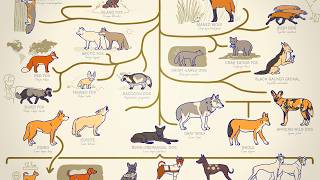
This video provides a comprehensive tour of the canine family, from extinct ancestors like the dire wolf to modern domestic breeds. It covers the evolutionary relationships, unique adaptations, and diversity of wild and domesticated dogs.
Domestic dogs descended from wild ancestors that cozied up to humans 15,000-30,000 years ago. Today, an estimated 1 billion dogs live worldwide.
Epicion was the largest dog ever, size of a grizzly bear. Dire wolves were apex predators in ancient America. Leptoion, the 'dog father,' gave rise to all modern canines.
Gray foxes split off earliest; island foxes evolved dwarfism due to limited food. Red foxes are widespread; a Soviet experiment tamed silver foxes. Arctic foxes change coat color; fennec foxes have large ears for heat dissipation.
Crab-eating foxes, bush dogs (pack hunters), maned wolves (long legs for grasslands), and short-eared dogs (secrete anal gland scent) are unique to South America.
Black-backed jackals have broad diets; African painted dogs endangered; dholes exhibit reticulate evolution; coyotes expanded range due to adaptability.
Grey wolves are pack hunters; domestication led to modern dogs. The Bon-Oberkassel dog (14,000 years ago) was likely a pet. Dingoes arrived in Australia via boat.
Basenjis yodel, Xolos (Mexican hairless) guided souls, Mastiffs weigh over 100kg, Huskies run ultramarathons, Poodles were circus performers, Labs are popular pets, Golden Retrievers from Scotland, German Shepherds are police dogs, Belgian Malinois athletic, Whippets fast, Dachshunds hunted badgers, Greyhounds fast, Chihuahuas small, French Bulldogs popular, Akitas loyal (Hachiko), Great Danes tall, St. Bernards rescue dogs.
Labradoodles are hybrids for allergies; pitbulls often in shelters; muts like Laika the space dog are famous.
What was the largest dog that ever existed?
Epicion, roughly the size of a grizzly bear.
00:45
What phenomenon caused island foxes to become smaller?
Island dwarfism due to limited food on the islands.
02:06
How did the Soviet experiment with silver foxes demonstrate domestication?
After over 40 generations, they produced tame foxes with floppy ears and curly tails that love to snuggle.
02:32
What unique adaptation do fennec foxes have for desert life?
Large ears that dissipate heat and help hear prey under sand.
03:01
Which canine is the only one that can't retract its claws?
The bush dog.
03:42
What is reticulate evolution, and which canine exemplifies it?
Reticulate evolution involves hybridization between species; the dhole may be a hybrid of wolves and painted dogs.
04:37
What is the Bon-Oberkassel dog evidence of?
Early dog domestication as a pet, not just for work, about 14,000 years ago.
05:20
Which dog breed is the best endurance athlete?
Huskies and malamutes, due to their energy reserves and ability to run ultramarathons.
06:26
What is the smallest dog breed?
Chihuahua, with the smallest ever being Pearl at 5 inches long and just over a pound.
07:48
What is the most famous example of a mutt?
Laika, the stray Soviet dog that was the first animal to orbit Earth.
09:09
Largest Dog Ever: Epicion
Provides perspective on the scale of extinct canines compared to modern breeds.
00:45Soviet Fox Domestication Experiment
Demonstrates rapid evolutionary change under selective pressure.
02:32Earliest Known Pet Dog
Shows that dogs were kept as companions, not just workers.
05:20Extreme Size Variation in Breeds
Highlights the incredible diversity achieved through selective breeding.
07:48Laika the Space Dog
A poignant example of a mutt's unexpected role in space exploration.
09:09[00:03] this. And all of these good boys and girls are too. Wild canines are wildly continent. And ever since the wild ancestors of dogs first cozied up to the fires of ancient hunter gatherers somewhere between 15 and 30,000 years
[00:17] ago, domestic dogs have reaped the benefits of one of the most successful history of the planet. An estimated 1 billion modern dogs live all over the world, including several who live with the people that made this video. Hi, I'm
[00:30] David. This is Kubu. And this is Minute Earth. And in this video, I'm going to take you on a tour of the dogormous diversity of the K9 family. Oh yeah, wall. You can order it from our merch shop on dftba.com. I'll talk more about
[00:45] let's start with a few extinct canines first. This is Epicion, the largest dog that ever existed. It was roughly the size of a grizzly bear. And this is the dire wolf, one of the apex predators of the ancient American West. If you go to
[01:00] the labrea tarpits in California, you'll see hundreds of direwolf skulls that seems these puffers just couldn't resist going after giant mammals that had And then the dire wolves got stuck, too. And the last extinct canine we'll
[01:14] discuss is Leptoion, the literal dog father. This little omnivore burst onto the scene more than 30 million years ago in North America. and eventually gave rise to every canine alive today. Now, we're going to pivot to those canines
[01:27] the ones that are least closely related to domestic dogs and get closer and love as we go. This means the first modern group of canines will be touring is the foxes. As scientists have learned more about how canines are related,
[01:40] that we call foxes aren't actually that closely related to one another. For example, there are two foxes that are relatively separate from all the other pups in the canine family. The ancestors of gray foxes split off from the rest of
[01:52] ancient canines before any other species did. Modern gray foxes have long claws allowing them to escape from the coyotes and wolves that live nearby. The island fox is very closely related to the gray fox. A few thousand years ago, a few
[02:06] islands off of the coast of California. Over the ensuing millennia, their descendants shrank about 25% due to the limited food on the islands and became a new species, the island fox. A prime example of the phenomenon of island
[02:19] dwarfism. Okay, let's get into the rest of the fox group. The red fox is perhaps the most widely distributed canine in the world. It scampers around a huge range that includes North America, Europe, Asia, Northern Africa, and the
[02:32] range, their coats appear black or silver. Beginning in 1952, a Soviet some of those silver red foxes to see if he could eventually produce tame how humans had first domesticated wolves. It took a while, but more than
[02:48] 40 generations later, his team has created a small population of tame silver foxes with floppy ears and curly tails who love to snuggle with humans. As winter fades in the far north, the Arctic fox sheds the fluffy white coat
[03:01] and grows in a thinner coat packed with more melanin, which it then uses to blend in with the summer landscape. The fenic fox is a desert dweller, and pretty much every part of its tiny body is optimized for life there. Of course,
[03:14] which dissipate heat and help it listen for prey hiding under the North African sand. It's also got shovel-shaped front feet to help it dig quickly to get into though it looks like a Pokemonified version of, well, a raccoon, is probably
[03:28] pretty closely related to those foxes. It's also the only canine that that's that group. Now, let's head over to another branch of the canine family might be a little less familiar with. Let's start with the crab eatating fox,
[03:42] which again is not really in the fox group. Crab eating foxes stalk mud named after to wander out into the open. Next, let's meet the bush dog, a squat in the marshes of the Amazon rainforest. Bush dogs can actually take down big
[03:57] prey like capibaras by hunting in packs and nipping their quarry's heels until there's the maed wolf, which looks like a red fox with cartoonishly long legs. what's going on in the South American grasslands. Finally, there's the
[04:11] short-eared dog. These elusive South American natives are one of the few from their anal glands. They often live in the abandoned burrows of giant armadillos. Okay, let's turn to the group of canines that are more closely
[04:23] related to modern dogs. The blackbacked jackal is famous for its broad diet. It will eat pretty much everything from grasshoppers to seals to impalas to the hard melons of the nar tree. The African wild dog uh I mean the painted dog has
[04:37] conservation groups attempt to prevent its impending extinction by making it sound well less wild. The endangered doss of southern Asia might be the most famous example of a phenomenon called reticulate evolution. That is they might
[04:51] hybridization between wolves and painted dogs. And here's the infamous coyote. across North America has been bad for most species, it's been a boon for coyotes whose flexible diet, willingness to live near humans, and ability to
[05:06] allowed them to tremendously expand their range and numbers. And of course, there's the grey wolf. Grey wolves are the ultimate pack hunters. Their what led them to the huts of ancient humans, which eventually led to their
[05:20] domestication as the canines we love today, modern dogs. One of the first dogs we know was the Bon Obercastle dog from about 14,000 years ago. She survived a terrible disease as a puppy and likely wasn't any use as a hunting
[05:32] just kept her as a pet for snuggles. those earliest domesticated dogs. It seems as though a group of them traveled by boat from Asia to Australia several thousand years ago. Once they got down
[05:44] literally, and have since become the apex predator of the outback. Since humans have been selectively breeding dogs for all sorts of traits, resulting can't cover them all here, but let's talk about some that really stand out.
[06:00] Benis are short-haired African hunting dogs that are famous for the fact that vocalizations sometimes sound like yodals. Zolos are sometimes called Mexican hairless dogs thanks to their origin and appearance. There's evidence
[06:13] their owners since they were thought to be reliable guides to the underworld. Mastiffs often weigh more than 100 kg and have been used as guard dogs, hunting dogs, and even military dogs. Nowadays, they're more known for their
[06:26] drool than their ferociousness. Huskys and malamutes are often used as sled they are able to use their energy reserves, they can run ultramarathons for days at a time, making them the best endurance athletes on the planet.
[06:39] distinctive curly coats, were often used as performers in old tiny circuses. black, or chocolate colored, were originally bred in Canada to be game their friendly temperament and smarts, labs are now super popular pets. And
[06:55] labs and were bred to do many of the same jobs, they first came from Scotland. Perhaps the most famous golden retriever is Buddy, the star of the Airbud cinematic universe. The German Shepherd is super popular and learns
[07:08] their work as police dogs and search and rescue dogs. Belgian shepherds, as the Malininoa, are extremely athletic and trainable. Whippbits were the known for their speed and nervous energy. Occasionally, a genetic mutation
[07:23] that only occurs in this breed, creates super muscular dogs known as bully whippbits. Dachshunds, also known as wiener dogs, were bred to be able to fit into burrows and flush out badgers. In fact, the German word for badger is
[07:35] docks. Nowadays, though, dachshunds are mostly just cute, long pets. A greyhound can hit speeds of more than 75 km/h. They have the highest percentage of fast switch muscles of any breed. The smallest of all dog breeds, Chihuahua
[07:48] where they originated. The smallest Chihuahua ever, Pearl, is only 5 in long and weighs just over a pound. To me, French bulldogs look kind of like They are now the most popular dog breed in America, having knocked Labs out of
[08:03] the top spot in 2022. Akitas are known for their loyalty. Even after his owner died, Hachiko the Aikita waited at the train station every day for 9 years for him to return home from work. In the process, he became a national hero as
[08:16] the ultimate symbol of faithfulness. Great Danes are the tallest dogs in the world. Standing on his hind legs, the Great Dane Zeus was taller than Shaq. He could drink directly from the kitchen sink. St. Bernards are famous mountain
[08:28] rescue dogs. Barry the St. Bernard is credited with saving more than 40 people in his work for a Swiss monastery. He'd sniff out people trapped in avalanches, on them to warm them up. Of course,
[08:40] that aren't considered purebred at all. Some are like labradoodles, hybrid lab as pets for folks with allergies to pet dander, but now are just the cute non-shedding pet of choice for all sorts of folks. And then there's the pitbull,
[08:54] bunch of different short-haired muscly dog breeds with square heads. Because of fights and often unfair reputation as being aggressive, pitbulls are often in animal shelters in order to make them more adoptable. And finally, there are
[09:09] muts, which are basically combos of all sorts of breeds, like Kate's dog, Watson. Perhaps the most famous MUT is Leica, who started life as a stray Soviet street dog before being selected by scientists to be part of the Sputnik
[09:21] program. She was the first animal to orbit the Earth, though she died before she could get back home. That's a lot of dogs. Thanks for joining us on this tour of the incredible diversity of the K9 family. If you liked
[09:33] that you can get this awesome poster from our DFTBA shop. We've been wanting to make this for so long, and we did so much work to make it both beautiful and educational. It'll look great on your living room and in your classroom. Just
[09:46] go to dfttba.com/minuteear to get one today. And if enough of you the near future. Oh yeah, if you like this kind of video, let me point you of Science, where he makes this kind of stuff all the time. Thanks again for
[10:00] stuff all the time. Thanks again for your support.



⚡ Saved you 0h 10m reading this? Transcribe any YouTube video for free — no signup needed.