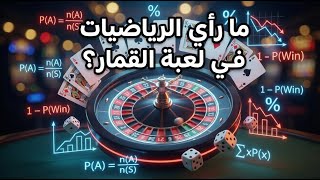

Why Casinos Never Lose (Math Reveals)
60sThe shocking claim that casinos use math to guarantee wins challenges common beliefs and sparks curiosity.
▶ Play Clip"Delivers exactly what the title promises: a mathematical breakdown of why you can't win, with clear examples."
This video reveals the mathematical tricks that gambling companies use to ensure their profits, explaining why players are destined to lose in the long run. It breaks down the odds and house edges in lotteries, roulette, sports betting, and poker, using simple numerical examples to illustrate the inevitable outcome.
Casinos own the most luxurious buildings and latest technologies, not by relying on luck but by using rigorous mathematics. They never actually gamble; they use math to ensure profits.
In a lottery, you buy a $20 ticket and choose 6 numbers from 50. The probability of winning the jackpot is 1 in 15 million, which is extremely low.
If 1 million people buy $20 tickets, the company collects $20 million. They announce a $5 million grand prize and $5 million in smaller prizes, leaving $10 million as guaranteed profit before the drawing.
In roulette, the wheel has 36 numbers (red and black) plus a green zero, making 37 total. Betting on red gives a winning probability of 18/37, or about 47%, giving the casino an edge.
If 37 players each bet $100 on different numbers, including zero, the winners take $3600 (original bet plus double), and the remaining $100 goes to the casino. The zero ensures continuous profit.
In sports betting, companies reduce the payout factor (odds) to include a hidden margin. For example, with odds of 1.91 for both teams, if 1000 people bet $100 on each team, the company collects $200,000 but only pays $185,000 to winners, keeping $15,000 regardless of outcome.
In poker, the casino doesn't play but takes a 5% commission (rake) on each winning round. This acts like a small leak in a fuel tank, slowly draining players' funds even if they are skilled.
A woman bets $100 and wins, but after 5% commission, she gets $195. She loses the next round, leaving $95. She wins again, but after commission, she has about $181. Despite winning two out of three rounds, her capital erodes.
A professional who wins 60% of rounds and accumulates $10,000 in profits pays $500 in commission. To reach that profit, they risked $9,000 in losing bets, so net profit is only $500, while the casino wins the same without risk.
If you are only 5% better than opponents, your advantage goes to covering the rake. To make real profit, you must outperform everyone by 20%, which is impossible as weaker players leave and only professionals remain.
Gambling is not a struggle with luck but against the laws of mathematics designed against you. The law of large numbers ensures the final result favors the company.
The real profit is not in a stroke of luck but in investing your mind in something real you build with your own hands, where the odds are on your side. The only winner in gambling is the player who doesn't play.
The video concludes that gambling is a mathematically rigged system where the house always wins in the long run. The only way to truly win is to not play at all and instead invest in real, skill-based endeavors.
What is the probability of winning the lottery jackpot as described?
1 in 15 million
01:34
How does the lottery company guarantee profit?
By collecting $20 million from 1 million tickets and only paying out $10 million in prizes, keeping $10 million.
02:03
What is the casino's edge in roulette?
The extra green zero, making 37 numbers instead of 36, reducing the probability of winning a red/black bet to 18/37 (about 47%).
03:36
In sports betting, what is the hidden margin?
The reduction of payout odds to guarantee profit regardless of outcome, e.g., odds of 1.91 instead of 2.0.
05:14
What is the rake in poker?
A 5% commission taken by the casino on each winning round.
06:49
Why does a professional poker player still lose to the rake?
Because the 5% commission erodes profits, and to make real profit, one must outperform opponents by 20%, which is unrealistic.
09:05
Casinos use math, not luck
Sets the premise that gambling is a mathematical certainty for the house, not a game of chance.
00:04Lottery odds: 1 in 15 million
Provides a concrete, shocking probability that illustrates the futility of playing.
01:34The zero creates the casino's edge
Explains the technical mechanism behind roulette's house advantage.
03:36Hidden margin in sports betting
Reveals how bookmakers guarantee profit through odds manipulation.
05:14Need to outperform by 20%
Shows the unrealistic skill requirement to overcome the rake, emphasizing the house's advantage.
09:05Only winner is the one who doesn't play
Provides a memorable conclusion that the only way to win is to abstain.
10:00[00:04] and casinos own the most luxurious buildings and the latest technologies in the world? Do you really think they rely on luck like we do? really think they rely on luck like we do?
[00:20] The shocking truth is that these companies never actually gamble; they simply use rigorous mathematics. gamble; they simply use rigorous mathematics. Today, I'll reveal some of the tricks these companies use to push you toward inevitable loss,
[00:34] these companies use to push you toward inevitable loss, even if you win at first. even if you win at first. We'll break it down using simple numbers because We'll break it down using simple numbers because numbers never lie.
[00:53] lottery. The gameplay is simple: you go to a store and buy a gameplay is simple: you go to a store and buy a ticket for $20. They ask you to choose six
[01:05] ticket for $20. They ask you to choose six numbers from a pool of 50 available numbers. numbers from a pool of 50 available numbers. To win the jackpot, your six numbers must exactly match the numbers drawn by the random number generator.
[01:21] by the random number generator. Mathematically, the probability of winning is calculated by multiplying the Mathematically, the probability of winning is calculated by multiplying the cumulative probabilities, and the result is cumulative probabilities, and the result is one chance in 15 million.
[01:34] one chance in 15 million. To grasp how insignificant this number is, imagine a road To grasp how insignificant this number is, imagine a road 15,000 meters long with a coin 15,000 meters long with a coin placed under just one stone. Your
[01:46] placed under just one stone. Your chance of finding it on the first try is the chance of finding it on the first try is the same. Your chance to win the lottery now. Let's look at the company's profit. If one million people bought tickets worth $20 each, the
[02:03] If one million people bought tickets worth $20 each, the company would collect $20 million. The company would announce a company would collect $20 million. The company would announce a grand prize of $5 million and allocate another $5 grand prize of $5 million and allocate another $5 million in smaller consolation prizes.
[02:19] million in smaller consolation prizes. Here, the company takes $10 million as a net Here, the company takes $10 million as a net and guaranteed profit, and this is before the drawing even starts. They aren't and guaranteed profit, and this is before the drawing even starts. They aren't betting with you; they're collecting millions
[02:33] betting with you; they're collecting millions to distribute a small portion to one person or to distribute a small portion to one person or a few people, then they take the lion's share.
[02:52] Now, let's move to the casino and its most famous game, the Wheel of Fortune. It's a 36, alternating between red and black.
[03:08] alternating between red and black. The employee throws a small ball, and you place, say, $100 on a red The employee throws a small ball, and you place, say, $100 on a red
[03:21] 50%. Here's where the technical trick Here's where the technical trick called the casino's edge comes in. The casino adds an called the casino's edge comes in. The casino adds an extra number, a zero. Its green color, this
[03:36] extra number, a zero. Its green color, this zero, makes the total number of squares 37, not 36. Let's calculate it numerically: when you bet on red, your
[03:48] Let's calculate it numerically: when you bet on red, your probability of winning is 18/37, or only 47%.
[04:03] $100 on a different number, and one of them bets on zero (the worst-case scenario for the casino), the ball will land on only one number. The winners
[04:17] will take $3600, which is the total of the original bet plus $3600, which is the total of the original bet plus double, as per the rules. The
[04:29] remaining $100 goes directly to the casino's coffers. directly to the casino's coffers. This small zero is what guarantees the This small zero is what guarantees the casino's continuous profit and makes you lose your money
[04:45] casino's continuous profit and makes you lose your money slowly, no matter how long you stay in the game.
[04:59] In sports betting, you predict the result of a match, and the company gives you what is called the odds or payout factor. and the company gives you what is called the odds or payout factor. In a perfectly even match, the payout factor should be two, meaning you put in $100
[05:14] payout factor should be two, meaning you put in $100 to win another $100. However, companies use to win another $100. However, companies use what is called the hidden margin, meaning they reduce the payout factor to their advantage. Let's suppose, for example, there is a match between Two teams,
[05:31] Let's suppose, for example, there is a match between Two teams, and the company sets odds of 1.91 for and the company sets odds of 1.91 for both teams. If 1,000 people both teams. If 1,000 people bet $100 on the first team
[05:45] bet $100 on the first team and another 1,000 bet $100 on the and another 1,000 bet $100 on the second team, the company will collect $200,000. second team, the company will collect $200,000. Regardless of the match's outcome, the company will
[05:59] Regardless of the match's outcome, the company will only pay the winners $185,000. The difference of $15,000 is a guaranteed profit for the company, without them caring which team wins.
[06:14] for the company, without them caring which team wins. They don't stop at the results; they simply take a They don't stop at the results; they simply take a guaranteed commission from the women's money, even in the worst-case scenario. guaranteed commission from the women's money, even in the worst-case scenario.
[06:35] We come to games of skill like poker. In poker, you sit with other players. The In poker, you sit with other players. The dealer deals cards, and you try to form the strongest hand dealer deals cards, and you try to form the strongest hand to take the pot or money container in the center of
[06:49] the table. Here, the casino doesn't play against you but takes the rick, a Here, the casino doesn't play against you but takes the rick, a 5% tax on each winning round. This 5% tax on each winning round. This tax acts like a small leak in a fuel tank;
[07:04] tax acts like a small leak in a fuel tank; even if you're a skilled driver, you'll run out of fuel in a single round. Finally, let's take the example of a woman who bets. In the first round, let's take the example of a woman who bets. In the first round, she bets $100 and wins. She should have
[07:19] she bets $100 and wins. She should have taken $200, but the casino takes a taken $200, but the casino takes a $5 commission, leaving her with $195. In the second round, she bets $100 and loses, leaving her with $95.
[07:37] loses, leaving her with $95. In the third round, she bets $95 and wins. She should have taken $190, but the casino deducts 5%, leaving her with
[07:53] but the casino deducts 5%, leaving her with approximately $181. Notice what happened: she won approximately $181. Notice what happened: she won two rounds and lost one, meaning she was two rounds and lost one, meaning she was technically successful. However, her original capital began to
[08:06] erode in favor of the casino. Even a professional player faces the same fate. Let's say you're an Even a professional player faces the same fate. Let's say you're an excellent player who wins 60% of the rounds and accumulates
[08:18] excellent player who wins 60% of the rounds and accumulates profits of $10,000. profits of $10,000. The casino will deduct $500 as a commission. To The casino will deduct $500 as a commission. To reach these profits, you take risks
[08:31] reach these profits, you take risks and place bets in rounds you lose, let's say and place bets in rounds you lose, let's say $9,000 in profit. The net here is only $500. You $9,000 in profit. The net here is only $500. You exerted a tremendous mental effort,
[08:45] exerted a tremendous mental effort, while the casino, which was just watching you, while the casino, which was just watching you, won the same amount without risking a single cent. won the same amount without risking a single cent.
[09:05] In reality, if you are only 5% better than your opponents, you don't actually win anything because your advantage goes towards covering the loss. To come out with a real profit, you goes towards covering the loss. To come out with a real profit, you must outperform everyone by 20%, must outperform everyone by 20%, which is impossible because the less skilled players will go
[09:19] which is impossible because the less skilled players will go bankrupt and leave, and only the professionals will remain to devour each other while the casino continues to take until everyone is at zero
[09:31] in the end. Gambling is not a struggle with luck, but a struggle against Gambling is not a struggle with luck, but a struggle against the laws of mathematics designed against you from the outset. the laws of mathematics designed against you from the outset. Companies do not care about your profit today because the law of
[09:47] Companies do not care about your profit today because the law of large numbers will always make the final result large numbers will always make the final result in their favor. My advice to you is not to be a chaser of in their favor. My advice to you is not to be a chaser of mirages, but to be cautious and value your effort. The
[10:00] mirages, but to be cautious and value your effort. The real profit is not in a stroke of luck that disappears in seconds, but real profit is not in a stroke of luck that disappears in seconds, but in investing your mind in something real that you build with your own hands, in investing your mind in something real that you build with your own hands, where the odds are on your side, not against you.
[10:13] where the odds are on your side, not against you. Always remember that in gambling, the only winner is the Always remember that in gambling, the only winner is the player who doesn't play.
⚡ Saved you 0h 10m reading this? Transcribe any YouTube video for free — no signup needed.