
Ladybug Puzzle: Surprising Probability
45sThe counterintuitive result that all numbers have equal probability challenges viewers' intuition, sparking curiosity and debate.
▶ Play Clip"The title promises a solution and delivers exactly that, with a clear and logical explanation."
This video explains the solution to a probability puzzle involving a ladybug on a clock. The ladybug starts at 12 and takes random steps, coloring numbers red. The puzzle asks for the probability that the last number colored is the 6. The solution reveals a surprising symmetry: all numbers between 1 and 11 are equally likely to be last.
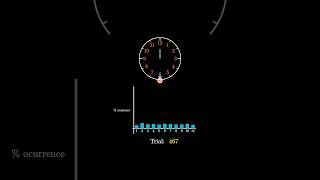
A ladybug starts at 12 o'clock and takes random steps, coloring each number red. The puzzle asks for the probability that the last number colored is the 6.
Simulation shows that all numbers between 1 and 11 seem equally likely to be the last colored, which is surprising because the 6 is farther from the start than 1 or 11.
The key is to wait until the ladybug hits a neighbor of the target number (5 or 7 for 6). This doesn't change the final outcome because it's bound to happen with probability 1.
From the neighbor, the problem becomes a random walk: the probability of reaching the far neighbor (10 steps away) before the near one (1 step away). This is the same for all numbers.
Since the structure is identical for all numbers between 1 and 11, the probability of ending on any specific number is 1 in 11.
What is the probability that the last number colored is the 6?
The probability is 1 in 11.
02:26
Why are all numbers between 1 and 11 equally likely to be the last colored?
Because the structure is identical for all numbers between 1 and 11, they are equally likely to be last.
02:26
What is the key insight to solve the ladybug clock puzzle?
Wait until the ladybug hits one of the neighbors of the target number, then calculate the probability of reaching the far neighbor before the near one.
00:54
What is the probability that the ladybug eventually hits the 5 or the 7?
It is bound to happen with probability 1.
01:07
Conditioning on Neighbors
This is the crucial step that simplifies the problem and reveals the symmetry.
00:54Equal Probability for All Numbers
The surprising result that all numbers between 1 and 11 have the same probability of being last.
02:26Waiting for a Condition
The idea that waiting for a certain event doesn't change the final probability, a powerful tool in probability.
01:07[00:02] starts on the 12 of o'clock. She takes a series of random steps either clockwise or counterclockwise, each with random chance. Each number she touches gets colored red. And the puzzle is, what is the probability that the last number to
[00:15] get colored is a six? If I simulate it many times in a row, recording which number happened to be the last one colored, here's what it looks like. Running [music] this many hundreds of times, a somewhat surprising
[00:27] fact starts to make itself clear. All the numbers between one and 11 seem to one touched. I say this is surprising because initially it feels like ending in a six should be less likely than ending on the
[00:41] numbers closer to the initial position, like the one or the 11. And yet, empirically, that just doesn't seem true. And there is a key insight to understand why. Rather than calculating the probability of ending on a six from
[00:54] the initial position, start by letting the ladybug wander until the first moment that she hits one of the two neighbors of that six, the five or the seven. And then from there, ask the probability of ending in a six. That is
[01:07] a different question, but the reason it doesn't change the answer is because for any run of the simulation, eventually she's going to hit the five or the seven at some point. That's bound to happen with probability one. Waiting for this
[01:19] middle condition does nothing to change the probability of that final outcome. So, from this state, where she's on, say, the seven, what's required to end on the six? Well, she has to reach that untouched five before ever touching the
[01:33] six, meaning she has to eventually end up 10 steps away clockwise on net before ever ending up one step away counterclockwise. If that happens, if all the other numbers, it's a done deal that six is going to be the last.
[01:47] straighten things out and you're taking a random walk where each step is plus one or minus one with a 50/50 chance. And you want to know the probability of ending up at plus 10 before ever touching the negative numbers.
[02:00] >> Again, this is a hard question to answer directly, but the point is that you don't actually have to answer it directly. There's nothing special about probability of ending on the three? Well, let the simulation run until the
[02:14] first moment she hits a two or a four, which again is bound to happen eventually, and then from there it's the probability of taking on net 10 steps around one way before ending one step around the other way. Because
[02:26] identical for all the numbers between one and 11, the answer must be one in one and 11, the answer must be one in 11.



⚡ Saved you 0h 02m reading this? Transcribe any YouTube video for free — no signup needed.