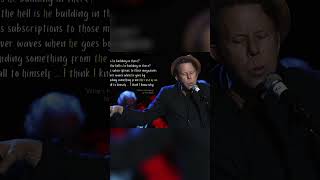

Tom Waits' Point-of-View Songwriting Trick
45sThe creepy 'What's he building in there?' example makes viewers immediately curious how a simple pronoun change changes the whole story.
▶ Play Clip"Delivers exactly what the title promises with a sharp, concise example from Tom Waits."
The video explains how changing point of view in songwriting can alter lyrical meaning, using Tom Waits' 'What's He Building In There?' as a key example. It breaks down how an 'I' narrator who talks about an unseen 'he' creates a gossipy, engaging tone that pulls listeners into the song.
The video starts by discussing how songwriters often write from their own perspective to a specific 'you', then proposes exploring other points of view where the speaker and audience are clearly defined.
Introduces 'What's He Building In There?' by Tom Waits, quoting lines about a mysterious neighbor with magazine subscriptions and reclusive behavior.
The narrator uses 'I' and refers to 'he/him', establishing both a character on stage (the narrator) and another person being discussed. The narrator is not talking to that person directly.
The narrator speaks about the third person to the listeners, creating a gossipy tone. This is effective because the person being discussed has no idea he's being talked about, making the listener feel included.
Changing from a direct 'you' perspective to a third-person narrative can create dramatic irony and intimacy. The Tom Waits example shows how talking about someone to the audience, rather than to them directly, can make a song more engaging.
What Tom Waits song is used as an example of changing perspective?
'What's He Building In There?'
00:17
What pronouns does the narrator use in the song?
The narrator uses 'I' and refers to 'he/him'.
00:31
Why is the perspective in the song effective?
Because the person being talked about has no idea he's being talked about, and the narrator includes the listener in a gossipy tone.
01:04
Tom Waits as Example
Uses a specific, well-known song to illustrate a nuanced songwriting technique, making it tangible.
00:17Gossip as a Tool
Reveals how indirect address to a third person can create intimacy and tension with the audience.
01:04Dramatic Irony
Points out that the subject of the song is unaware he is being discussed, adding a layer of narrative depth.
01:04[00:01] songwriter to be talking from their perspective but not to a specific you. Let's build on that to explore some other points of view that still have a very clear sense of who is speaking and to whom they are speaking. A song that
[00:17] kind of point of view is the song what's he building in there by Tom Weights. What's he building in there? What the hell is he building in there? He has subscriptions to those magazines. He never waves when he goes by. He's hiding
[00:31] something from the rest of us. He's all to himself. I think I know why. From a point of view perspective, we have the presence of an I pronoun. So, we know that the songwriter narrator is a character on the stage of this song.
[00:47] But we also have he and him. We also have this other person on stage, and he's not talking to that other person. This is the really interesting part this other person. He's talking about this other person. He's really talking
[01:04] to us, the listeners. When he says, "What's he building in there?" He's saying it out loud. He could be saying it to himself, but it feels like he's including us in the conversation in a gossipy kind of tone that makes this
[01:18] structure so effective because the person we're talking about or the person Tom Weights is talking about has no idea he's being talked about.




⚡ Saved you 0h 01m reading this? Transcribe any YouTube video for free — no signup needed.