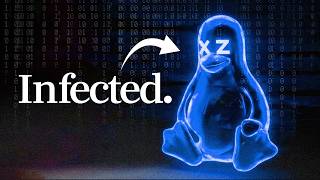

The Hack That Almost Broke the Internet
42sStarts with a dramatic hacker story and a near-global catastrophe, instantly grabbing attention.
▶ Play Clip"The title promises a dramatic hacker story, which is delivered, but the bulk is historical context, not the hack itself."
In 2021, a hacker discovered a critical vulnerability in Linux, the world's most important operating system. The story traces back to Richard Stallman's frustration with a jammed printer, leading to the creation of the Free Software Foundation and GNU project, which eventually combined with Linus Torvalds' Linux kernel to form a free, open-source OS that now powers everything from Android to supercomputers.
In 2021, a hacker uncovered a vulnerability that could compromise millions of servers, enabling spying, ransom, or taking down countries.
Richard Stallman wanted to fix a jammed Xerox 9700 printer but couldn't because Xerox withheld the source code, leading him to realize the social harm of non-disclosure agreements.
AT&T's Unix was once shared freely, but by the 80s they sued clone developers and enforced NDAs, closing off software development.
Stallman quit MIT and established the FSF in 1985, promoting four freedoms: run, study, change, and share software. He created the GNU General Public License.
GNU replicated Unix utilities and shell but lacked a kernel. In 1991, Linus Torvalds created the Linux kernel and adopted the GPL after hearing Stallman speak.
Combined with GNU, Linux formed a complete OS. It now runs on Android (3B+ devices), most electronics, supercomputers, banks, hospitals, and military systems.
Linux's open-source nature made it the backbone of modern computing, but its widespread reliance also creates a single point of failure, as demonstrated by the 2021 vulnerability.
What event triggered Richard Stallman's activism for free software?
A jammed Xerox 9700 printer that he couldn't fix because Xerox withheld the source code.
01:19
What are the four freedoms promoted by the Free Software Foundation?
Freedom to run, study, change, and share software.
04:06
What does GNU stand for?
GNU is Not Unix.
04:23
Who created the Linux kernel and when?
Linus Torvalds in 1991.
05:19
What license did Linus Torvalds adopt for Linux after hearing Stallman?
The GNU General Public License (GPL).
05:19
How many of the top 500 supercomputers run Linux?
Every single one (500 out of 500).
07:52
What is the estimated number of Linux users?
30 million.
07:09
Which mobile operating system is built on Linux?
Android.
08:22
Hacker finds fatal weakness
Opens with a shocking claim that a single vulnerability could compromise millions of servers.
Stallman's door slam
The moment Stallman is denied source code and slams the door, sparking his lifelong mission.
02:16I'd be ashamed of my life
Stallman's powerful quote about not wanting to build walls dividing people.
03:53[00:00] In 2021, a hacker uncovered a fatal weakness in the world's most important operating system. What would he do with a key that gets into any server on the internet?
[00:12] Uh, is this live to the public right now? Yeah, it's live on the server. Look, I'm not pleased. I would like you to change it back. At the time, just about everyone believed that hacking the system was impossible.
[00:24] But they were wrong. Well, I can tell you how many systems would have been compromised. It would have been millions. I should still surprise the mainstream news outlets haven't really covered this very much. How close did we go? We were weeks away from millions of internet servers being accessible to whoever crafted the vector.
[00:42] Anything from spying to ransoms to taking down entire countries, he could have done it with this vector. This hacker had realized the entire operating system rested on a single part maintained by a single person
[00:57] and that by compromising that one part, it could infect almost any server on the Internet. So how could we ever let ourselves get this vulnerable? Well, the story begins with a jammed printer.
[01:19] The AI lab was pleasant. They had just installed the Xerox 9700. It was one of the first ever commercial laser printers. It was a pretty big deal. The only problem was it kept jamming.
[01:34] He'd wait an hour figuring, I know it's going to be jammed, I'll wait an hour and go collect my printout. And then you'd see it had been jammed the whole time. Frustration of the wazoo.
[01:46] Richard Stallman, a researcher at the lab, thought that he had a solution. Years earlier, he had solved a similar problem by coding a simple program that set an alert whenever there was a jam Now, it didn't fix the problem mechanically, but it did make sure that a jam wouldn't go unnoticed
[02:00] He thought he could do a similar thing now The only problem was that Xerox hadn provided them the source code for the printer Without it Stallman couldn write his code So he tracked down the original developer And I said hi I from MIT Could I have a copy of the printer source code
[02:16] And he said, no, I promised not to give you a copy. I was stunned. I was angry. All I could think of was to turn around on my heels and walk out of his room.
[02:30] Maybe I slammed the door. And I thought about it later on, because I realized that I was seeing not just an isolated jerk, but a social phenomenon that was important and affected a lot of people.
[02:45] This social phenomenon had slowly invaded the world of computer research. In the late 60s, engineers at AT&T's Bell Labs invented an operating system called Unix, which they shared widely across universities and research labs.
[02:59] This was a time of freedom. But by the 80s, AT&T started going after Unix clone developers for copyright infringement. Later, they even sued the University of California at Berkeley.
[03:11] The tech landscape had shifted. They wanted to close off software development. Companies were now making their employees sign non-disclosure agreements, prohibiting them from ever sharing their code with other programmers. See, this was my first encounter with a non-disclosure agreement, and I was the victim.
[03:28] And the lesson it taught me was that non-disclosure agreements have victims. They're not innocent. They're not harmless. Stallman wonders, maybe he could adapt to this new world.
[03:40] But I realized that that way I could have fun coding and I could make money. But at the end, I'd have to look back at my career and say, I've spent my life building walls to divide people.
[03:53] I would have been ashamed of my life. So Stallman chose a different path. He quit his job at MIT and in 1985 established the Free Software Foundation. And it worked to promote four basic freedoms.
[04:06] You should be free to run software for any purpose free to study it free to change it and free to share it Now to ensure those freedoms he created a legal license that developers could attach to their code called the General Public License And to stick it to AT he started to work on a project based on Unix
[04:23] but built from the ground up so AT&T couldn't do. He called the project GNU, a recursive acronym for GNU is not Unix. Now, to replicate a Unix system, the GNU project had to recreate three layers of functionality.
[04:38] They needed the utilities, which were the everyday tools and commands, the shell, which is the terminal that people use to interact with the machine, and finally the kernel, which is the core that talks to the hardware and manages memory.
[04:50] Now, over the next seven years, the GNU project made much of that from scratch. It created the GCC code compiler, the BAS shell, and a host of other core utilities. But they were always missing one key component, the kernel.
[05:05] That changed in the fall of 1991. when Stallman visited the University of Helsinki to give a talk promoting the project. In the audience was a young computer science student who just happened to be building his own kernel from scratch.
[05:19] His version wasn't free, but after hearing Stallman speak, the student changed his mind and adopted the general public license. At first, he wanted to call it Free Unix, or Freaks,
[05:31] but his friend thought that sounded terrible, so he renamed it after the student himself, Linus Torvalds. Linus, Unix, well that's how we got Linux.
[05:43] That kernel, combined with the other components from the GNU project, became a whole operating system. Now, technically, Linux only refers to that kernel, but a lot of people use it to refer to the whole operating system.
[05:55] So GNU and Linux and whatever else. Because the code was open and free, and the projects built on it were too, a new model of software development took hold. Anyone could inspect the code, improve it, fix flaws, and generally just push development forward for everyone.
[06:10] So, software split into two competing ideologies. Proprietary closed source systems controlled by companies and open source projects where the code was free It free due to waste It free as in you don have to pay for it It is all free to change it in any way you want And that seems to be the much more important aspect
[06:29] People have to pay for technology, but so often do they run into some roadblocks where if you file a support ticket with some large company, they may or may not get the help they need.
[06:41] And engineers are just fixing to just fix it themselves. Developers could take that basic code, which was freely available, and then add on their own features relevant to their specific device. They didn't have to reinvent the wheel every time.
[06:55] So, that's why Linux spread is all sorts of different applications. Well, I'm Mac, and I'm a PC. No one else. Hi. I'm Linux. There are an estimated 30 million Linux users out there.
[07:09] I'm understanding that. Oh, I'm telling you. And it's not even just limited to computers. Your electronic vacuum is definitely Linux. Your camera is definitely Linux. Most TVs, most electronics are Linux.
[07:24] Linux even runs from the most sensitive machines on the planet. You can assume that Linux is pretty much used in anything of high security need. Not necessarily because Microsoft, for instance, couldn't build something equally secure,
[07:38] but because usually there's secrecy involved in building, let's say, a new weapon system, and you don't necessarily want to have to work with some tech company. You don't want to involve more people than absolutely necessary.
[07:52] Of the top 500 supercomputers in the world, every single one runs Linux. It's used in the Pentagon and on U.S. nuclear submarines. Every bank you can think of, really. the manufacturers, hospitals, governments, defense organizations and things like that,
[08:09] they're all running Linux services. Today, Linux is everywhere. Most people are familiar with Windows and Mac OS, but they are not the most popular operating systems in the world. Nope, they are dwarfed by systems running a Linux kernel.
[08:22] Android with over 3 billion devices is built on Linux, and it also powers the majority

⚡ Saved you 0h 08m reading this? Transcribe any YouTube video for free — no signup needed.