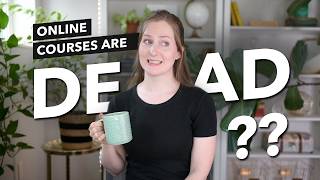

Are Online Courses Dead? She Called BS... Then Kept Selling
60sThe contradiction between calling digital products dead while quietly still selling them sparks immediate curiosity and debate.
▶ Play Clip"Delivers a genuinely honest, data-backed answer to the title's question, though it meanders and ends with a soft plug."
In this video, digital marketing expert Gillian Perkins tackles the question of whether online courses are still selling in 2026. She examines the historical eras of the online course industry, presents market size data from ChatGPT and cited reports, and shares personal experiences and client observations to reveal a nuanced reality: courses are selling more than ever in dollar terms, but competition and buyer sophistication have increased. Her core advice is to prioritize building a trusted audience over running paid ads.
Jessica Stansberry publicly stated she doesn't think digital products are really selling anymore and decided to stop teaching digital products, yet she still has a couple of digital products up for sale that she says are selling.
Online courses are not uniformly dead or alive: some courses still sell very well, others don't, and some sales strategies still work while others have completely stopped working.
Courses were sold via newspaper ads, physical video/audio cassettes, and long-form text-based sales letters full of red underlines, yellow highlights, and wild claims.
Many people jumped into the industry, six-figure launches and million-dollar earnings were common, and many big names rose to popularity but also crashed due to rapid growth and poor business foundations.
COVID-19 drove people to seek home-based income; many watched webinars and bought courses. The presenter experienced her biggest launches ever in 2020, yet notes fewer creators existed before 2020, so top creators made more money in the 2010s.
The online course industry grew from $2–5B per year in the early 2000s to ~$50B by 2010, $107B in 2015, ~$200B in 2019, over $300B in 2024–2025, and is projected to reach $800B+ by 2030, with a slight possible decline in 2026.
The two major shifts since 2020 are increased competition (more players, many starting in 2020) and a mature industry. Some niches, like digital marketing, are saturated, but most industries remain as easy or easier to sell in.
The online marketing niche is the noisiest space with the most critical, careful buyers; long-time professionals are desensitized to typical course offers because they've bought many courses, some unused or overpromised.
Classic evergreen webinar funnels still produce sales in most industries; Jacques Hopkins still makes five figures monthly from his piano course via an evergreen webinar, though his 'online course guy' brand requires more creative tactics like a choose-your-own-adventure webinar.
Amy Porterfield closed her very profitable course program, reportedly making millions in revenue, but speculation suggests she spent millions on ads and a large team; her low organic YouTube numbers versus huge webinar attendance points to heavy paid advertising.
The presenter bought a $200 course on AI video editing after watching a YouTube video, because the information was high-quality and she wanted the complete system—showing video-based courses still convert when paired with content.
Instead of cold pitching or relying solely on paid ads, creators should build an audience first. A deep, trust-based connection—where followers invest time in free content—dramatically increases the likelihood they'll invest money in a course, especially if you offer a unique perspective or story.
Online courses are absolutely still selling—the industry is larger than ever in dollar terms—but it's more competitive and AI adds pressure. The most reliable path to success in 2026 is to build a loyal, engaged audience before worrying about sales.
According to Jessica Stansberry, what did she claim about digital products?
She said she doesn't think digital products are really selling anymore and decided to stop teaching them and take most off the market.
00:44
What was the estimated market size of the online course industry in the early 2000s?
$2–5 billion per year.
06:32
What was the online course industry market size in 2019?
About $200 billion.
07:17
What is the projected market size for the online course industry by 2030?
Over $800 billion.
08:15
How did Amy Porterfield's shutdown of Digital Course Academy spark skepticism?
Many in the industry believe if the course were still making millions in profit, she wouldn't shut it down; speculation is that high ad spend and team costs ate into profits.
16:22
What are the two main differences Gillian Perkins has noticed in the online course industry since 2020?
More competition/more players and saturation in some industries, though most industries remain as easy or easier to sell in.
09:38
Why does Gillian say video-based courses still sell despite ChatGPT?
Video is powerful for showing how to solve problems (not just written instructions), and buyers want real people's experiences, nuance, and support—especially after they've previously failed.
20:14
What is Gillian's core strategy for selling online courses in 2026?
Build an audience first—create deep, trust-based connections through free content so that followers are willing to invest money, rather than relying on cold pitching or paid ads.
21:45
The Industry Has Never Been Bigger
Backed by market data, this counters the narrative that online courses are dead and shows the industry has grown to $300B+, projected $800B by 2030.
06:32Digital Marketing Audiences Are the Toughest
Highlights that buyer sophistication and desensitization vary by niche, explaining why some creators struggle while others thrive.
11:59Evergreen Webinars Still Convert in Unsaturated Niches
Provides evidence that classic funnels work if the niche isn't saturated, using Jacques Hopkins' piano course as a concrete example.
13:46Audience-First Selling Over Paid Ads
Reframes the entire strategy: deep audience trust beats cold traffic and is the most reliable path to course sales today.
21:45[00:02] online course industry lately with people making all sorts of claims and promises that maybe they shouldn't be. And today I think that it is really important that we finally start talking about this because I talk a lot about
[00:14] online courses and digital products here on my YouTube channel and in my business as a whole. And I want you guys to know what the truth is about whether online courses are still selling and what the state of the online course industry is.
[00:31] Now, one of the things that inspired me to make this video today specifically was I was watching a video from my old friend Jessica Stansberry where she was friend Jessica Stansberry where she was talking about calling BS on some of the
[00:44] claims that some people are making in the online course industry. And she came straight at it in her video and said that she does not think that digital products really are selling anymore. And so based on this, she has decided to
[00:56] completely stop teaching digital products and take most of her digital products off of the market. Now, I think that this is pretty interesting because the fact is she actually still has a couple digital products up for sale and
[01:09] she says that they are selling. So, I wanted to really like clear up this question of are they selling because I think that the answer is nuanced. That the answer is that some digital courses still sell really well and others do not
[01:23] still sell really well and others do not sell. Also, some sales strategies still work really well, but some have completely stopped working. Now, one of about is the different eras of the course sales industry because like
[01:37] pre-2010 was a very different time than 2020 or where we are today. But before about why I think that this is so important. If you have an online course right now and you are maybe struggling to sell it, you might be wondering, is
[01:52] it just you? Is it your marketing? Or actually, is it just like the circumstance? Is it just that in today's market you can't sell your online course? Or what might apply to even more of you is you might be thinking about
[02:04] creating an online course because you've heard what a good opportunity this can be and about, you know, the passive income you can create with an online course and how scalable they are and all of that. But now maybe you're having
[02:16] some doubts and that could really hold you back and prevent you from wanting to create an online course at all, which is super understandable. Not only do you have people like questioning whether online courses are still viable and
[02:28] whether webinars still work, which we'll definitely talk about later on, but you also maybe have some of your own reasons and doubts like why would people buy online courses when they could just ask chat GBT? And that's a very legitimate
[02:42] question. I mean, really, why would somebody spend $300, $500 on an online course when they could literally just ask chat GBT how to do that thing that they could learn to do from the course and get an answer in a few seconds and
[02:56] totally for free. So, we will definitely be talking about that later on as well. First though, let's talk about these different kind of eras of online courses. So, the first one I would say would be pre-2010.
[03:09] ago, but I'm not quite sure what the date here should be, but basically long time ago people were selling basically the equivalent of online courses in newspapers with ads and they were selling courses that you could buy on
[03:25] video cassette or on audio cassette and of course you would like right away send a check and then they would ship you that physical thing. Now, that gradually morphed into people selling courses online, but they were originally doing
[03:40] it with these like long-form sales letters online. Let me know down in the chat if you remember this wild west era of online course sales where we had these really long text-based sales pages
[03:54] with lots of red underlines and yellow highlights and wild claims. came at kind of the tail end of this because I started getting interested in the online business industry when I was in high school and I graduated in 2010.
[04:11] So, I saw basically the tail end of that. Then we come to 2010 to I would say 2019. Now, this I would say was kind of like the online gold rush, okay? This was kind of like the dot-com bubble of online courses. So many people were
[04:26] jumping into the game and people were legitimately having six-figure launches and were making millions of dollars with online courses. A lot of big names kind online courses. A lot of big names kind of rose to popularity and also died away
[04:41] businesses too quickly and maybe they didn't actually know how to run a business or maybe they got totally overwhelmed by the fame. And of course, there are lots of different reasons for why this happened, but long story short,
[04:55] it was easy to grow, so a lot of people grew really quickly and then there were some consequences of that. Then we come to 2020, which I'm just going to consider it's own era because things were funky in 2020. I mean, we all know
[05:09] and everybody was looking for new opportunities, ways that they could make a living from home. So, a lot of people learned about online courses and online business as a whole. They were watching a lot of webinars, so they were buying a
[05:23] lot of courses about how to make courses or how to start an online business. I know that personally, I experienced my very biggest launches ever in 2020. Now, in some ways, 2020 might have been the very height of the online course
[05:38] industry for those reasons I just mentioned and because we didn't have chat GPT and other AI tools like that yet. On the other hand, I would say that there were a smaller number of course creators prior to 2020. And so, those
[05:53] course creators that were around in the 2010s actually most likely were making more money, at least the top course creators were, than most course creators creators were, than most course creators were in 2020 itself. Now, what I've told
[06:06] you so far has been based purely on my own experience and basically impressions as I've been in this industry either as a consumer or as a business for the last
[06:18] 15 plus years. But, I thought it would be super interesting to ask Chat GPT about this and find out if there's any real data on the online course industry. So, here's what Chat GPT has to say. It says that in the early 2000s that the
[06:32] estimated market size for the online course industry is about 2 to 5 billion dollars. And as I'm understanding it, Chat GPT means per year. Then we come to 2025 to 2010, and it says that it has grown to between 20 billion dollars
[06:49] grown to between 20 billion dollars perhaps around 2005, and then by 2010 it's up to about 50 billion dollars. Okay, so massive growth here. Then in 2015, according to this Forbes article from the end of 2014, it says that the
[07:02] online learning industry is poised to be 107 billion dollars in 2015. Then we've got 2019. So, this is an important point here because this is right before 2020, like I was talking about things really in 2020. But, in
[07:17] just a few years here from 2015 to 2019, online course industry has doubled up to 200 billion. And then we come to 2020, and I think that this is really interesting because this doesn't really match what I experienced in 2020 and
[07:34] what I know because I work in this online course industry, what I heard from so many people. I I so many online businesses hired so many new people in 2020 because of the huge boom that they were experiencing. But according to chat
[07:48] GPT, in 2020, the market was about the same size as it had been in 2019. And what led to that. Okay, and then here are some numbers since 2020, which might actually be the most interesting part of all of this, which is that the online
[08:02] course industry has just continued to grow ever since. So, we've got that like grow ever since. So, we've got that like basically $200 number in 2020 and the article that they're citing here is an article from Yahoo Finance, which I
[08:15] believe is stating this number. But that article also says that it's estimated that the online course industry will grow to over $800 billion by 2030. And the online course industry is still growing. It's up to over $260 billion.
[08:30] In 2024, it has grown significantly up to over $300 billion. Then in 2025, so last year, we were seeing it at well over $300 billion. And now the estimate
[08:44] for 2026, which you know, who's to say if this will come to pass or not, but is that there might be a little bit of a decline. Now, I would say that it's a little bit hard to say exactly why that is because obviously the economy is not
[08:58] in great shape right now and everybody is spending less money on everything right now. And so this might say less about the online course industry than it just says about the economy as a whole. So, I'm really glad we looked at that so
[09:12] that this wasn't just me speculating and telling you my impressions, but that pretty much matches exactly what I have seen, which is that things kind of like came to a head in 2020 and the online course industry was really exciting, but
[09:25] since then it has still continued to grow. It just looks a little bit different. And really, I would say that there are two main big differences that I have personally noticed as I'm working in this industry. One of them is that
[09:38] there is more competition. There are more players in the online course space than there ever has been in the past. A lot of people got their start in 2020 and also the industry has just matured quite a bit. So, now when you come into
[09:54] this industry, it can potentially be a little bit more challenging to stand out from the crowd. And even those of us who have been here for a long time, I'm talking about myself, you know, I got my business started right about 10 years
[10:06] ago in 2016 and started selling online courses in 2017, but also other people who have been in this industry much longer than I have, like my friend Jessica, she got started a couple years before I did. And
[10:20] then people like Amy Porterfield, who has been under a fair amount of scrutiny lately, who have been in this industry even longer. You know, there were quite a few people who did get their start back around 2010 and are still selling
[10:34] online courses today. Now, the other big shift that I've noticed, aside from like more competition, more players, is that some industries have become rather saturated with online courses and it has become more difficult to sell in them,
[10:49] but not all. I would say most industries it is actually just as easy, if not easier than ever, to sell online courses. Really, truly. But, my industry, it's a little bit different. You know, I work in the
[11:02] online marketing industry itself, basically the industry of online courses, the industry of digital marketing. And this industry has been selling online courses longer than any other industry.
[11:16] And because of that, a lot of people in this industry, at least the people who have been in this industry for a pretty long time, tend to be somewhat desensitized to online course offers. A lot of us have bought a lot of online
[11:31] those of you who are just listening to the audio podcast version of this. I've years, and I have learned a thing or that sometimes I buy online courses and then I don't actually use them. Another
[11:46] thing I've learned is that sometimes you buy an online course and it's not nearly as good as you were hoping it would be or as it was promised to be. And that has made me a much more discerning buyer. And I think that that really is
[11:59] the online marketing industry. Not only is it the noisiest space to possibly sell online courses, but you also are facing the savviest buyers. The buyers
[12:11] who are going to be the most critical and the most careful for quite a few different reasons. Now, I'm really glad that I run a few different brands in a few different industries online because I'm able to see, get a better sense of
[12:24] how online courses are selling in different spaces, and able to see that it's not just me when sometimes some strategy that I try in the online marketing industry doesn't work as well as I would hope that it would. I'm also
[12:39] thankful that I have so many clients who have so many businesses in so many different industries because that gives obviously an even much wider perspective. So, personally, what I've experienced over these last 10 or so
[12:52] years of running my online business, and this is where I'm going to get really, really and just honest with you guys, when I first started my online business, of course, I didn't have an audience at all. As my audience grew, it became
[13:04] easier and easier for me to sell my online courses and my other programs and products in my main personal brand where I'm talking about digital marketing. Up until about 2020. And in 2020, I had my very biggest launches with this brand.
[13:19] Since 2020, things have been kind of flat and it has been a somewhat more challenging to make sales in this industry specifically. Now, like I said before, I think that this is because of buyer sophistication. I think that it is
[13:32] because of a lot of saturation, and it certainly is true to some desensitization, if that's the right way to say that word, to some of the most common marketing strategies that we in the online business industry typically
[13:46] use because we know that they are the best strategies that are out there. And specifically here, I am thinking of the classic evergreen webinar funnel that I have used and loved for years. And here's the good news, it still works
[14:00] really well in basically every other industry. Even with Creator Fast Track, which is my YouTube strategy course, which is obviously at least a digital marketing adjacent industry, we still get sales all the time from the
[14:15] evergreen webinar that I recorded a long time ago. I also did an interview with my friend Jacques Hopkins the other day. Jacques has been in this industry since 2013 when he got his start with a piano course called Piano in 21 Days, and he
[14:31] experienced so much success with that that he ended up going on to teach online courses, and so now he's known as the online course guy, and he has a podcast all about online courses. And he was telling me he's experienced
[14:43] piano course, he still consistently makes five figures every month with his evergreen webinar funnel, but with his online course guy brand, he has to work a bit harder. So, he uses this really
[14:57] creative webinar strategy that is like a choose your own adventure type webinar. his website if you're interested in seeing what that's like, and of course using things like live launches. So, we have to get a little bit more creative
[15:11] in this industry to get people to pay attention and actually be sensitive to our offers, but even in this industry, like this is still my bread and butter, my business still primarily sells online courses, and and we're doing just fine.
[15:26] But, like I said, I do want to be super honest and let you know that it is more difficult, definitely more challenging in this industry than it was 10 years ago. No doubt about that. And so, that is kind of where we come back, maybe
[15:40] full circle, back around to what Jessica Standsberry was talking about and what Amy Porterfield did recently, where she chose to totally shut down her online course course, which I believe is called Digital Course Academy. So, she's been
[15:55] running this program for quite a few years and has reportedly been making millions of dollars from it. And then suddenly, a few months ago, she shutting it down, she was not going to be offering it anymore, and instead, she
[16:08] just has a heart for entrepreneurs who are at a more advanced stage, she wants to work with them in a closer capacity. And a lot of people called BS on this. A lot of people did, because those of us who work in the online course industry
[16:22] know that the reality is that if that course was still making her the millions in profit that she claimed, then she wouldn't be shutting it down. Even if she really wanted to work with these other people, she could have done that,
[16:36] too, and she could have let people do a self-study version of her Digital Course something that is definitely totally my opinion, my speculation, but what I would guess was actually happening with Amy's course was that she probably was
[16:50] actually making millions of dollars in revenue from it. I don't think Amy was that in order to make those millions of dollars, she was spending millions on ads to generate enough leads to get those couple thousand people at her
[17:04] webinars, and also hundreds of thousands at least on her really big team that she uses to run those high-production webinars and run all of those ads and support the students that she has. Now, like I said, that's just my speculation.
[17:20] I don't know for sure, but I work in this industry, I make videos on YouTube, I have a podcast, I have an email list, I've run ads myself plenty of times, but to get the numbers that she was getting in some places, like on her webinars,
[17:35] with as small as her numbers are on, say, YouTube or other places where we can publicly see them and they're more organic, it definitely indicates to me that she is probably having to pay for a lot of advertising to be able to make
[17:49] the sales that she's making. Or really, I should say was making since she now chose to shut the whole thing down. Also, she's switching to a business a much smaller team, which is something that a lot of us in this industry have
[18:03] been experiencing and choosing to do because, like I said, there has been some contraction in the market, specifically in the digital marketing niche since 2020. I had my biggest launches in 2020, and so I had to hire a
[18:17] team to support that, but in the last couple of years, I've been slowly downsizing my team and really returning to the solopreneur life that I know, the thing is that there is nothing at all wrong with that. There's nothing
[18:31] wrong with downsizing your company so that you can have higher profit margins. do. But what has given a lot of people the ick about what Amy and a few other people did was that they really weren't honest about that at all. Honest about
[18:46] their reasons why they were making those business shifts, but instead said that a heart for this different group or they felt led to do something without being honest about what the numbers or what the industry really looks like.
[19:00] Now, again, kind of coming full circle to this question of, well, are the into this industry? Like, what's really going on here? I know that personally, I still buy online courses. And if you are wondering, are online courses still
[19:14] selling? Are digital products still selling? I would consider yourself as example. Do you still buy online courses? I bought one just a few days ago because I was researching how I could edit my videos with AI. You know,
[19:31] long time, and so sometimes that can lead to some kind of old-school my video editor, I wonder what kind of method he's using to edit my videos, and maybe we could figure out some AI options that could really save him a lot
[19:46] of time and save me a lot of time when I occasionally edit a video on the fly. So I did a quick search on YouTube to see what people were talking about in terms of the best options for editing videos with AI, watched a video, and then ended
[20:00] up immediately buying the $200 course of that YouTuber whose video I just watched because the information was really good, and I wanted to know the full system. example of how online courses are
[20:14] selling today, which is that a video is really helpful because as nice and easy as ChatGPT is for so many things that we need to figure out or get help with, there are some things that video is really powerful for. And I'm not just
[20:29] editing, which happened to be the thing I was interested in, but a lot of the fix a problem, not just have to follow written instructions. Also, a lot of the time when we are looking for help with a problem, it's not our first crack at it,
[20:45] you or they, whoever it is, have been working at for a long time. Maybe you've already tried and failed at whatever this goal is or the problem that you're trying to solve. And so some just simple black and white instructions from
[20:59] everything for you. So what you're really looking for is real people's experience. I think that a great, maybe sort of cliche almost example of this have tried to lose weight have experienced that it's pretty tough.
[21:15] People can claim cliches like, "Well, just eat less and move more." But, it turns out that that is a lot easier said than done. And while that advice works for some people, a lot of us need a lot more. We need a lot more nuance. We need
[21:30] real examples. We need real support. And while ChatGPT can help with some of those things, a lot of the time we need some real human support and connection and advice. So, if you are trying to sell an online course these days or
[21:45] you're thinking about maybe getting into the online course industry, that honestly would be my best advice for you. That you don't just try to cold pitch your online course or just advertise your way straight to sales,
[21:59] but instead you focus on building your audience first. Because when you build your audience, not only does that connect you with potential buyers, but it is a deep connection. It's not a connection just like you would get from
[22:11] a paid ad, but instead it is a connection where this person has chosen to follow you. They've chosen to watch your content because they're interested in that topic and they like you or else they wouldn't be watching your content
[22:25] and they are coming to trust you as an expert. And basically, this results in them investing their time with you, investing time in consuming your free content. And if they're willing to invest their time, then there is a high
[22:38] chance that they are also going to be willing to invest some money. Especially you're bringing to the table. A unique method, a unique strategy, a unique here. That doesn't mean that you have to
[22:51] reinvent the wheel or have some amazing invention. You know, there's nothing new under the sun. But, oftentimes the unique thing that you bring to the table unique thing that you bring to the table really is just your unique perspective
[23:03] on the same tried and true. It might just be your personality that they really connect with, or it might be that your story really resonates with them. I know that's so cliche, but basically that they see themselves in your story,
[23:17] thing that you struggled with in the past, and they really want your guidance on how you overcame that so that they can also overcome it. So, I know that this has been a pretty long episode, but long story short, online courses are
[23:31] still selling. In fact, the online course industry is bigger in terms of dollars than it literally ever has been. But, there is a little bit more competition, especially from AI, of course. And, there also are a few
[23:45] industries where the online course industry is more challenging than it used to be. But, if you are considering creating an online course, or you have one that you are struggling to sell right now, my best advice for you would
[23:58] be to prioritize building your audience. You need to do this to connect with potential customers anyway, and it is going to be much more effective than trying to just run paid ads to your course. When you build an audience, you
[24:13] attract not just followers, but really fans. People who love you and your work, Now, I've been thinking a lot about this lately because I've really been noticing that it is one of the biggest factors that sets successful course creators
[24:29] sell their online course. So, I've been working on backwards engineering what has worked for me for building my audience over these past 10 years, but also what is working for my clients today as they are building their
[24:42] audiences in real time in 2026. And, I'm working on a few different pieces of content on how we can most successfully be building our audiences in this year that we are actually living in right now, and as we are competing
[24:55] with AI as well. Now, the first one of those pieces of content that's going to come out is a video all about three of the biggest mistakes that people are making as they are working to build their audiences in 2026. I'll be
[25:08] releasing the video on my YouTube channel in about a month. We've got content all lined up until then, but I've gone ahead and just put it on my website right now, and you can get early access to it for free if you go to
[25:21] access to it for free if you go to gillianperkins.com/early-access. with more videos in the future as well because a lot of the time just due to release the videos too close back-to-back, but I can go ahead and put
[25:35] them on my website earlier for you guys so that you can watch them as soon as find that video about three of the biggest audience-building mistakes biggest audience-building mistakes people are making in 2026 at
[25:48] people are making in 2026 at gillianperkins.com/early-access, long one. Thank you so much for sticking with me all the way till the end. Uh you're hearing me say this right now, leave me a comment down below and let me
[26:03] know your thoughts on this whole is the online course industry dead question. What's been your experience with it? Do you still buy online courses ever? Why or why not? I would love to hear your perspective and just to get more
[26:17] anecdotal evidence on kind of the state of this industry as a whole. Now, to wrap this all up, if you are new to my channel, click this button right here to subscribe so you don't miss my next video, and then go ahead and watch this
[26:29] video right here, handpicked for you by the YouTube algorithm.

⚡ Saved you 0h 26m reading this? Transcribe any YouTube video for free — no signup needed.