
13 Years of Taxi Wisdom: Patience & Provision
60sA seasoned taxi driver shares profound life lessons about patience and trusting in God, offering a unique perspective that resonates universally.
▶ Play Clip"Delivers a genuine Q&A with personal stories and practical advice, though some tangents and wedding interruptions add minor fluff."
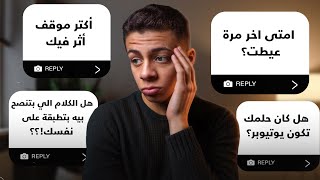
In this Q&A video, the creator, Shehab, answers a variety of personal and professional questions from his audience, covering topics such as his background, content creation journey, self-development, social media's impact on focus, and personal reflections. He shares insights into his education, early struggles with YouTube, and the importance of scripting for eloquence.
A taxi driver with 13 years of experience shares that the most important lesson is that sustenance comes from God and patience is key; work doesn't always pay off immediately, but God compensates.
Shehab is 23 years old, graduated from the Faculty of Arts, Ain Shams University, Department of European Civilization, which he chose due to grades but found it gave him time for other pursuits.
He has completed reciting the Quran once, during Ramadan, but has not memorized it.
Being good with people comes from interaction and socializing; isolating yourself leads to not knowing how to respond, which is a common mistake.
He plans to make a video about social phobia in a completely different way, as it's a highly requested topic.
Started content creation on the last day of February 2023, initially posting on Instagram and TikTok, then moved to YouTube after learning to upload to all platforms.
For 4-5 months, videos got only 3-5 views; the first comment came after three months, encouraging him to keep going.
The channel now has 1.7 million followers, approaching 1.8 million, which he never expected.
Content started with brand stories on TikTok, then shifted to news, then life-related content, and developed into detective series, always changing with his personality.
A best friend encouraged him at the start, but most friends didn't understand content creation, so it was all new to everyone.
Development comes from experience, focus, experimentation, and repetition; focusing on one thing daily is better than spreading energy across many.
He doesn't see it as advice but as carefully chosen words, because words are held against you when you're a public figure.
He admits to suffering from lack of focus, attributing it to social media, and recommends eliminating distractions, especially social media, to improve focus.
The series was unplanned, sparked while reading Surah Al-Baqarah and reflecting deeply on the verses, discovering deeper meanings.
Confidence and eloquence in content creators come from writing a script or having a roadmap for what they say.
He enjoys researching anything he doesn't know, believing he'll always discover something new.
His hobbies include recording videos without a script, playing football with friends, and going to the gym.
His childhood dream was to be a football player, but his small body size prevented him from being accepted into clubs; content creation was never a dream.
To stop comparing yourself to others, reduce social media use and focus on your own goals, leaving results to God.
He last cried 6-7 months ago at an event where he felt out of place and uncomfortable.
It's normal for grades to drop as difficulty increases; focus on studying and doing your best, not on the score.
An older woman recognized him and said, 'May God make my son like you,' which was the sweetest thing he's ever heard.
He worries about potential attacks on his videos but makes them anyway.
To make a study schedule, list all your daily activities; you'll find you waste time on purposeless things. Set simple, specific, and effective tasks.
He admires Dr. Mustafa Mahmoud and Professor Ahmed Al-Shukairi as influential figures in his life.
The video offers a personal glimpse into the creator's life, emphasizing the importance of patience, focus, and self-development, while also addressing common struggles like social comparison and lack of focus, ultimately encouraging viewers to reduce social media and focus on their own goals.
What is the most important lesson from the taxi driver?
Sustenance comes from God, and patience is key.
00:31
What did Shehab study in college?
European Civilization at the Faculty of Arts, Ain Shams University.
01:16
How many times has Shehab completed reciting the Quran?
Once, during Ramadan.
02:17
What is the key to becoming socially adept according to Shehab?
Interaction and socializing, not isolating yourself.
02:31
When did Shehab start creating content?
The last day of February 2023.
03:55
How many views did his early videos get?
Three to five views.
04:41
What are the three words Shehab uses for self-development?
Focus, experimentation, and repetition.
07:56
What is the main reason for lack of focus according to Shehab?
Social media.
09:38
How did the 'Miracles from the Quran' series start?
Spontaneously while reading Surah Al-Baqarah and reflecting deeply.
10:47
What is the secret to eloquence in content creators?
Writing a script or having a roadmap.
12:00
What was Shehab's childhood dream?
To be a football player.
13:30
What advice does Shehab give for dropping grades?
Focus on studying and doing your best, not on the score.
17:50
What is the 'biggest lie' people tell themselves about time?
I don't have free time.
19:47
Patience and Sustenance
A profound life lesson from an unexpected source, emphasizing faith and patience.
00:31Perseverance in Content Creation
Illustrates the reality of slow growth and the importance of persistence.
04:41Three Words for Self-Development
Concise, actionable advice: focus, experimentation, and repetition.
07:56Social Media as Distraction
Identifies a common modern problem and offers a clear solution.
09:38Scripting for Eloquence
Reveals a behind-the-scenes technique that demystifies perceived talent.
12:00The Lie of 'No Free Time'
Challenges a common excuse and encourages self-audit of time usage.
19:47[00:02] wanted to do it for a long time, but I don't know why I didn't take the step. I'm excited for two reasons. First, we'll get to talk and get to know each other better, and you'll get to know me better through your questions. Second, I'll get out of the studio. I want to get away from the atmosphere of
[00:16] the episodes and the studio. We'll go somewhere nice, and I'll sit and read your questions and answer them in a good mood. Let's go, man! It's
[00:31] Good, Thirteen years. Thirteen years working as a taxi driver. What's the most important thing Thirteen years working as a taxi driver. What's the most important thing you've learned from being a taxi driver? That sustenance comes from
[00:44] God. You can go out at any time, and God will provide for you. Patience means that work doesn't always pay off. He compensates you for everything. Patience is the most important thing, and sustenance comes from God. He gives as long as God, I'm telling you the truth, so I'm speaking clearly. I have,
[01:01] thank God, three children, a wife, and my mother lives with me because my father passed away. I try to provides for me. May God grant you good sustenance. Finally, everyone, here's the Q&A video I'm very excited to make. I'm
[01:16] very excited to answer the questions. The expected question, which most people ask, is: How old are you? I'm 23. People also ask: What college did you graduate from? I graduated from the Faculty of Arts, Ain Shams University, in a department called the Department of European Civilization. This department
[01:31] specializes in languages, studies, and Greek and other related topics. Did you enter this college because of your grades, or did you choose it because you liked it? Unfortunately, I got into this college because of my grades, but I didn't dislike it. I felt it was the college that
[01:47] would give me the time to do other things alongside my studies, which was exactly what I needed. I remember even now, when I was in high school, before the results came out, I was sitting with a friend and I told him I'd get 80%.
[02:02] I was on the old system, the booklet system, and I actually got 81%. I was in the science stream, and I hoped that if I got that score, I'd get into a less demanding college where I could do something else. Someone asked if I'd ever tried to complete the Quran, either by memorization or recitation, and how many times.
[02:17] Actually, yes, I did try to complete the Quran once, but I only recited it, not memorized it. I only recited it once, but I only recited it, not memorized it. I only recited it once, finish reading it again during Ramadan . A good question: How can I become a "Kalamangi" (a term used to describe someone who is always out of touch with others)
[02:31] and know how to deal with people and act appropriately in situations I'm never faced before? I think this comes from interaction and socializing. It's very unnatural, or even completely unnatural, to be a "Kalamangi" person. I don't really understand what that means,
[02:46] but let's put it simply: it means being someone who knows how to respond to people in general, even to those who say nice things to you and to those who say things that upset you. So, you isolate yourself and say, "No, I don't want to
[02:59] talk to them, you find you don't know how to speak and get upset. That's the biggest mistake we can make. Rehab Mohamed says it's not a question, it's a request: make a video series I had in mind about social phobia, how to know if you have it or not, and what the treatment is. I know social phobia is one of the most
[03:15] requested topics, and I want to make a video. Regarding this topic, I have an idea I want to use, but the opportunity hasn't presented itself yet because I'm currently working on several other things. I'm going to make a video about
[03:28] social phobia, and I'll do it in a completely different way. It will be a video that will truly benefit you in this area. So, I'm going to make this video. (The following appears to be unrelated and possibly nonsensical: "Wait for the wedding, Adi, the wedding! Clap,
[03:41] bride, everyone! We came to film and found weddings!") I have a nice question for all of you: how did you decide to open a YouTube channel and how did you choose the content you present? Did anyone encourage you? The day I started content, I'll never
[03:55] forget that day. It was the last day of February and the first day of March in 2023. I remember the first video I made; I was talking about a specific story related to Bitcoin, and I posted it on Instagram and TikTok, but not on YouTube. At that point,
[04:10] the video wasn't doing anything, so I started uploading the second video, then the third, and then from a content creator I follow that if you want to grow on all platforms, you have to upload your content or videos to all of them. So I decided to
[04:25] start with YouTube. I spent a very long time, about four or five months, and I swear to God, without exaggeration, the videos I uploaded would get four, three, or five views. I even remember the first comment I received.
[04:41] Someone wrote it on a short video after I started uploading videos to YouTube three months ago, telling me to keep going. It was just one comment on one video. After that, I started to continue uploading content to YouTube until it started to take off. But I didn't
[04:53] start with long content or long videos. That's when I decided to move into long content. I started presenting my ideas differently in longer content, and thank God, the channel now has 1.7 million followers, approaching
[05:06] 1.8 million. I never expected it to reach this number. I chose the content carefully. For those who have been following me for a long time, I started with one thing, and now I present something very different. However, it's all within the context of what they call
[05:23] useful or educational content. I started with a series on TikTok where I told the stories of well-known brands. Then I started to change the content to news-related content, and then to content related to
[05:36] the content to news-related content, and then to content related to life. We started the detective series, then another series that came to mind, and then the series that came to mind, and then the detective series began to develop. So, I see that the content has
[05:50] n't been static since I started. The content changes as my personality changes, so the content is always in a constant state of change and will continue to change as long as I grow up and my personality changes. Is there anyone who encourages you or not? Yeah, well, I mean, there was this friend of mine at the beginning, and he's still my best friend,
[06:05] at the beginning, and he's still my best friend, but when I first started, when I went to him and told him I was going to upload my first video, he told me to upload it. But because the group of people around me, or my friends, none of them were content creators or YouTubers, no one understood the
[06:19] concept. Like, "I'm going to make videos, okay, what kind of videos are you going to make? What are you going to talk about?" So, it was all new to my friends, new to me personally. I didn't know what to present or the camera, and I told him, "You have to do different things." What do
[06:34] you guys think? I feel like he's trying to make different things, like it would be fun to make So, guys, what did you hear from Mahmoud? If you really think there's something different, let me know. What would be fun if I uploaded it? Write your thoughts below. In
[06:48] Sit down somewhere, sit down, sit down somewhere. Let's get back to our question: how were you able to develop yourself, and how would you get back to our question: how were you able to develop yourself, and how would you advise us on how to develop ourselves? I developed myself. The question is very broad; I don't know exactly what I developed myself in,
[07:01] but we'll talk about the point of personality, or the point of knowing how to speak, how to communicate, how to stand in front of the camera and speak comfortably. These things came with experience. Self- development, my friends, always comes from experience, whether it's developing my
[07:15] personality, my way of dealing with people, my way of speaking, or my studies. No development will come without experience, and the first experience is never the best. The first experience can always be a failure, and that's perfectly normal. I swear to
[07:29] God, this point is very important, even though... We focus on one thing, and we keep We focus on one thing, and we keep developing ourselves in that thing every day. Even if it's not developing ourselves in that thing every day. Even if it's not 1%, even a quarter, that's much better than
[07:42] focusing on a million things. And those million things, I don't mean I love them all, and I don't distribute my unknown energy across them all. So, I find that the result of all my efforts in the end is zero. I believe that development comes from focus, experimentation, and repetition. These are probably the three most
[07:56] expressive words for self-development. That's a great question, Shehab. What's the one piece of advice you most regret giving people and then discovered was wrong? I think that before I give any advice, or before I say anything at all, it's not so much about giving advice as it is about being in the middle of talking to people. What makes me
[08:12] happiest when making a video, or what motivates me most to make a video, is feeling like I'm talking to people, feeling like I'm connecting with a group of people. That's how I like it. This is the thing that makes me happiest. So, the advice is wrong. I don't think that the first thing
[08:26] I do is advise. I say the words that I feel, but I choose my words as much as possible. Why? Because my words are held against me. Anyone who's well -known on social media, someone you might follow, someone who's popular and seen by a large audience, has to be very careful with their words
[08:38] in every video they make, whether it's in their vlogs or interviews. Your words are held against you, so I don't think it's really advice; it's just words I say, but I choose them very carefully. So, what's the one piece of advice I'd most
[08:52] regret giving people? There isn't one. I mean, there's no advice I'd ever regret giving people. Because, as I said, it's not about giving advice as much as it is about
[09:08] Moaz Mohamed. Hey guys, I have a really bad lack of focus, and whenever I try to do something, my mind wanders to something completely different. I do n't know why, but how, Moaz? But honestly, I'm suffering from the same thing lately. I've had an unbelievable lack of focus these days, to the point that I might be
[09:21] recording a video or an episode in front of the camera and forget what I'm saying. This shows that my focus is completely lost. When I thought about it, I realized that our focus system is severely affected, and I think the main reason for this lack of focus is social
[09:38] media. Social media, guys, is truly exhausting and one of the biggest distractions in life. This lack of focus isn't something you're experiencing, Muath; it's something we all experience. Maybe everyone watching this video has some kind of
[09:52] lack of focus. But you really need to try to eliminate distractions. We did a great episode about focus in "Kat Fiki" (a TV show), which you can check out. In it, I talked about how, in order to start focusing, you first need to eliminate distractions, and the first distraction is... You have to
[10:07] stop him. As long as he's around, you'll never be able to focus on anything. Amr Ahmed is asking me how many brothers I have. I have to focus on anything. Amr Ahmed is asking me how many brothers I have. I have second wedding is about to happen, guys. The second wedding is about to happen right behind me.
[10:22] boats that are about to pass by. The wedding is about to happen, guys. The sound will still be there, so we're going to record it despite the circumstances. My dear, sit down,
[10:34] Dad. Sit down, Dad. Sit down. Sit down. May God guide you. Sit down. A nice question from Rory TS. She's asking me how I came up with the idea for the series " Miracles from the Quran" and how I chose the verses that were revealed about it. I really hope you continue with it because I really liked it. First of all, thank you for your kind opinion, and
[10:47] I'm happy that people like this series. And honestly, I really didn't plan it at all. This series came about very spontaneously. I mean, I didn't plan to create content about the miracles of the Quran at all. The idea
[11:03] came about when I was reading the Quran and something came to mind. I'm the type of person who always thinks and reflects on things when they're said. I'm not the type of person who just listens and passes by. I listen, I think, and I let my mind wander a bit. That's where
[11:19] the series started. I was reading Surah Al-Baqarah and I started to delve deeper into the reading, to scrutinize every word in the verses. When I started to focus, I found that
[11:31] meanings were emerging. I realized that these verses have a much deeper meaning than I these verses have a much deeper meaning than I knew. When I started to research and listen to more, and when I started reading more, I realized that these are truly miracles. From Jana Sobhi,
[11:45] miracles. From Jana Sobhi, how are you able to speak with such eloquence and First of all, thank you, Jana. Secondly, the confidence and eloquence of any content creator you follow, not just El Shehab, stems from the fact that they write a
[12:00] script. Any content they create, they deliver good content that you like. You feel a certain order in it, and you feel that they are an eloquent person who always speaks correctly and whose words resonate with you. This is always written beforehand in a script, or at least they have a
[12:16] roadmap for what they will say in the episode. So, the eloquence and confidence in their speech come from having a script. (A question from Black SK: What's the story that made you love researching information, and what are your hobbies? I'm a person who, by nature, is open to anything that
[12:33] might be said in front of me that I don't know, or I might know about it, but my information is limited. I like to research it, and I always believe that when I research anything in the world, I'll discover something new. I'll learn something new about it. Thank you, may God bless you. And
[12:47] Thank you, may God bless you. And what's this "Jannah Lemon Mint" from Bushinki? Look, lemon what's this "Jannah Lemon Mint" from Bushinki? Look, lemon mint on the Nile, it's absolutely stunning! What are my hobbies? I honestly don't know. I might not even know what my hobbies are,
[12:59] but I can mention the things that help me unwind. For example, when I'm recording a video, like right now, without a script (and it's not necessary for me to make a 100% perfect video), or when I'm talking to you while relaxed and completely natural, that could be a
[13:15] hobby of mine, or something that makes me happy or relaxes me. Playing football with my friends might relax me. Going to the gym is another nice question. What does Moaz Ahmed say? What was your childhood dream, or what was your dream in general? Was it to be a YouTuber? If not, what was it? What was my childhood
[13:30] dream? When I was young, like any young Egyptian man, my dream was to be a football player, and I actually took steps towards that. There's something about me that I love and am I actually took steps towards that. There's something about me that I love and am very grateful to God for: when I love something,
[13:45] very grateful to God for: when I love something, I strive for it intensely. I give it all my time and all my energy to try and achieve something. When I was young, my dream was to be a football player, but I had a problem. I was born in 2002, so I'm
[13:57] 23 years old now. A while back when I was playing football, the problem I had was that my body was small compared to people my age. So, when I went for trials at any club, age. So, when I went for trials at any club, even though I played well, knew how to shoot, I knew how to dribble, I knew how to
[14:10] tackle, I knew how to do everything, my body was small, and that was a major reason that made me... I wasn't accepted into most of the clubs I go to when I applied based on my age ( born in 2002). So, this was my dream when I was little, but an important point: it wasn't my dream at all to be a
[14:24] YouTuber. The whole content creation thing came about by chance. I mean, it was n't my ambition from a young age to pick up a camera, make vlogs, get together for lemonade, gather my friends, and make videos. Like I said,
[14:39] everyone around me wasn't interested in that. But, by some miracle, it was want to tell you, it was completely outside my thinking. I remember a
[14:51] friend of mine in university, and I remember him saying he was going to start making content. I was making fun of him at the time, thinking, " What nonsense! What's the point of making content?" This question from Omar Mustafa is truly one of the most touching questions I've ever heard. I'm constantly preoccupied with the people
[15:03] around me and their personalities, neglecting myself. I'm mentally confused all the time, and this has become my lifestyle. I'm easily influenced by what others say, and it's really bothering me. I wish I had a solution. Look, Omar, first of all, the problem you're experiencing is something everyone is dealing with. As a person, I
[15:18] dealing with. As a person, I
[15:36] solution is for you, as much as possible—I mean, this might be related to my work on social media—to reduce your social media use. Reduce how much you spend obsessing over other people's lives. In the past, people were more successful,
[15:50] more successful, and now, of course, we're achieving more. Success means great things, but people used to achieve more successes because there was no social media. People didn't compare themselves to their surroundings, their neighborhood, their street, or their circle of friends. But
[16:04] now, we compare ourselves to thousands of people we see every day as we scroll through our feeds. We compare our personality to that person's, our circumstances to theirs, our financial situation to theirs, our achievements to theirs.
[16:22] comparison. So what's the solution? The solution is to reduce our social media use a bit and try to focus on our goals and ambitions. We should concentrate on our efforts and leave the results to God. We should surrender to God and leave everything to Him. When was the last time you cried? I do n't know. Lately, I've been feeling
[16:38] n't know. Lately, I've been feeling pressured by more than one thing. The thing is, this pressure isn't so much due to external factors as it is due to internal factors—things I want to change about myself, things I don't accept about myself. Amidst all
[16:52] these things, I find myself under pressure against my will, and I feel like crying, but I don't know why I can't. I really want to cry, but maybe the last time I cried was six or seven months ago. I went to an event, and I wasn't
[17:07] comfortable. When I went, I remember that day, I cried to myself. Because I felt that I was in the wrong place and with the wrong people, and I felt that I was not comfortable that day. A question from Reda Ahmed 96: What advice do you have for someone who's high-achieving
[17:21] but whose grades have started to drop a bit? First of all, this is normal. I don't know why, but I feel it's normal. When we were young, we were all top of our elementary school, then in middle school, our grades started to drop a bit, and we became second or third. Then, when we entered
[17:35] high school, some bright students started failing subjects, so this is normal. And why is it normal? Because it's obvious that as you progress through the grades, the difficulty of each grade increases, so it's natural that your grades or GPA will decrease. This is normal. My advice to you is to
[17:50] try to do your best in studying and don't focus on the results. Focus on studying as much as possible, not on the overall score. Honestly, if you study and do your best and don't get the score you want in the end, I think that's much better than not
[18:03] think that's much better than not studying at all. And then you get upset about the results. A question from Awad S. Bag: Tell us about a situation that affected you and you couldn't forget. It's in my mind now, I mean, several situations, but the one I remember most right now is from exactly
[18:18] two months ago. I was... I mean, if was standing there waiting for a friend. While I was standing there, an older woman,
[18:31] around 60 years old, came up to me. As soon as she saw me, she ran up to me and said, "Are you Professor Shehab?" I said yes, and she said, "I follow you and I like you very much." I couldn't believe it. I mean, I couldn't believe it. You're old enough to be my mother! You're happy? As soon as
[18:46] the woman saw me, she said, "I like you very much," and I don't know what else. She was so happy, I swear to God, she kept praying for me. I was happy the first day, and then she said this sentence to me as she was in my life. She said to me, "May God make my son like you." I have never, ever, ever, ever heard a
[19:02] sweet word in my life as much as this sentence. A question from Nada C. She says to me, "I want to make a video, but I feel that it might be attacked or that you won't be able to convey its idea to us." I swear to God, this question is really nice. Any video in which I want to discuss a certain idea, from my point of view, I am a
[19:18] certain idea, from my point of view, I am a little worried while I am making it. A question from user N8SH1: "I love you so much and you changed my life 180 degrees, thank you. But I want to know how to make an organized study schedule, but I'm trying to make it not time-based because I'm not free most of the day. This is the first
[19:33] trick you mentioned in your comment, that you're not free most of the day. What are you not free of during your day? If you start by listing the things you do in your day and writing them down on love most in my life is writing. Write down everything you do in your day on paper
[19:47] and pen, and you'll find that you waste three-quarters of your day on things that have no purpose. So the phrase 'I don't have free time' is one of the biggest lies we tell ourselves. How to make yourself an organized study schedule is by setting
[20:02] simple, specific, and effective tasks." I already mentioned this in the episode about focus. This episode is very important, guys, watch it, it will help you a lot with focus and studying in particular. A question from Ahmed Samir: He asks me who my role model is in content creation. The word "role model" is a big one for me, I mean, the
[20:16] word "role model" scares me. Who is my favorite content creator? If we're talking about people from the older generation, they weren't content creators, they were presenters. I really admire Dr. Mustafa
[20:29] Mahmoud. He's one of the people who influenced me the most, and his writings and videos have impacted my life. And someone who's influencing me now is Professor Ahmed Al-Shukairi. He's one of the most influential people for me. But guys, we'll stop the questions here. I don't
[20:45] know, there are many more questions I want to answer, but because it's getting late, I don't know if I'll answer them tomorrow and put them in the same video, or if we'll answer them later. In a separate video, but let's consider this a one-off, and hopefully we'll meet again in the next Q&A session.
[20:59] and hopefully we'll meet again in the next Q&A session.



⚡ Saved you 0h 21m reading this? Transcribe any YouTube video for free — no signup needed.