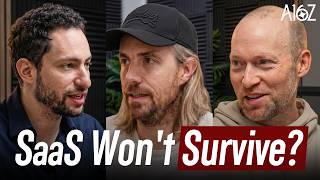

Is the SaaS Apocalypse Real?
39sControversial take on software industry's future sparks debate about valuation and disruption.
▶ Play Clip"Delivers on the title with deep analysis, though the podcast format includes some tangential discussion."
The Atlassian CEO and other experts discuss the so-called SaaS apocalypse, the impact of AI agents on software pricing and business models, and how companies should adapt. They argue that while some SaaS companies face existential threats from AI, others will thrive by becoming platforms for custom AI extensions.
From 1960 to 2022, software merely digitized filing cabinets into databases, but did not fundamentally change efficiency. AI now enables the 'filing cabinet' to perform work autonomously.
1) Seats tied to outcomes (e.g., Zendesk) – vulnerable to AI replacement. 2) Seats not tied to outcomes (e.g., Workday) – safer, pricing feels fair. 3) Mixed (e.g., Adobe) – in the middle.
Dan Ariely's book explains that humans pay more for incompetence (locksmith example). SaaS per-seat pricing feels fair even if costs are near zero.
AI agents like Sierra Decagon can reduce seat needs to zero, threatening Zendesk's revenue. The default path is to zero unless they shift to outcome-based pricing.
Workday charges per employee even though employees don't directly use it. This pricing feels fair and is stable, but the stock is down 45% due to market fears.
David Ricardo's theory: even if you can build your own software (vibe code), you shouldn't because you have a comparative advantage elsewhere. Edge cases learned through experience make DIY risky.
The 'system of record' concept is outdated. Businesses are a set of coordinated processes, both input-constrained (e.g., legal) and output-constrained (e.g., marketing).
Only worth it if the software is a large cost (e.g., 99% of expenses). For small costs, the comparative advantage of using a vendor outweighs the DIY effort.
Vibe coding for extensions (e.g., custom apps on Workday) increases stickiness and value, rather than replacing the core system. It lets customers build tailored solutions without a full IT team.
If the front end is divorced from the back end (e.g., Salesforce), pricing is more susceptible to change. Tightly coupled systems (e.g., QuickBooks) are more stable.
Usage-based pricing (e.g., AI credits) is disliked because customers can't control consumption. Seat-based pricing offers predictability and fairness.
Focus on improving existing workflows (e.g., summarizing tickets) rather than reinventing everything. AI features must be embedded in familiar tools to build trust.
Users fear AI because they don't understand it. Good design (e.g., transparency, iteration loops) is essential to build trust and make AI useful.
The SaaS industry faces disruption from AI, but the outcome is not uniformly dire. Companies that understand their pricing model, focus on process over records, and invest in design and trust will thrive in the new era.
What was the main change software brought from 1960 to 2022?
It digitized filing cabinets into databases, but didn't fundamentally improve efficiency.
00:13
List the three types of SaaS companies based on seat pricing.
1) Seats tied to outcomes (e.g., Zendesk), 2) Seats not tied to outcomes (e.g., Workday), 3) Mixed (e.g., Adobe).
06:47
According to Dan Ariely, why do humans pay more for an incompetent locksmith?
Because pricing is about fairness: the incompetent locksmith spent more time and effort, so the payment feels fair.
07:13
What is the 'default path' for Zendesk's revenue according to the discussion?
It's going to zero unless they change pricing, because AI can reduce seat needs to zero.
09:01
Why is Workday's per-employee pricing considered safe?
Because the pricing is not tied to any outcome; employees don't use Workday to produce work, so AI doesn't threaten seats.
09:55
What is the theory of comparative advantage in the context of vibe coding?
Even if you can build your own software, you should specialize in what you're best at because of comparative advantage.
11:21
What are the two types of business processes mentioned?
Input-constrained processes (e.g., legal) and output-constrained processes (e.g., marketing).
15:20
When is it worth 'vibe coding' your own software?
When the software represents a very large cost (e.g., 99% of expenses), otherwise the comparative advantage of using a vendor is better.
20:53
How does vibe coding improve SaaS stickiness?
It allows customers to build custom extensions on top of the platform, making the core system more valuable and harder to replace.
23:17
Why do customers dislike usage-based pricing like AI credits?
Because they cannot control consumption, and vendors can add features that consume credits unpredictably.
30:19
AI Makes Filing Cabinets Work
Key insight that AI transforms passive data stores into active agents.
02:25Pricing Fairness Paradox
Illustrates how human psychology affects software pricing models.
07:13Businesses Are Processes
Challenges the common 'system of record' metaphor, emphasizing process coordination over data storage.
13:42Extensibility Over Replacement
Shows that AI can make existing software more valuable rather than obsolete.
23:17Design and Trust Are the Real Challenges
Highlights that the biggest hurdles in AI adoption are user experience and trust, not technology.
41:47[00:01] unlimited power and they're like tell me a dad joke. In the technology world, the underutilized capabilities are so big. It's almost trit now to say the models delivering. >> The whole history of software from 1960
[00:13] until 2022 was you would take a filing cabinet and you turn it into a database. happening in AI land is that the filing cabinet can do work. >> The idea I would vibe code my own workday and then run it is terrifying.
[00:25] However, there is a great gain we are seeing internally in extensibility of software using things like V coding. Everyone has been talking about the SAS catastrophe. Why is there too much fear about this?
[00:38] going to thrive through the next decade. We're not here to defend all of We're not here to defend all of software.
[00:51] until 2022 was you would take a filing cabinet and you turn it into a database. So the first example of this is a company called Saber Systems which was started in 1960 by IBM and American Airlines because it took the reservation
[01:06] system which literally was stored in like vaults of filing cabinets manned or womaned by by lots of lots of secretaries um in like the 1950s and 1940s. Airlines have been around for a long time and then it put them in a in
[01:19] an early SQL database um or an early database back when you know 10 megaby hard drive probably cost like hund00 million um and then that's what happened with electronic health records and the first one was called MOPS it was built
[01:31] by Mass General Hospital were the first you know Sei systems predating Salesforce or actually the first CRM was called axe systems in 1987 so basically every single filing cabinet became a database and there were benefits to that
[01:43] but it didn't actually make the world that much more efficient. man because whereas before you would have a a human go fetch you the HR file for Eric like oh go to the HR filing cabinet get me that file now it's in workday but now
[01:57] that your workday doesn't get hacked you need to have IT people to provision need to have IT people to provision accounts in your SSO to to workday so efficient it did if you have multiple offices now people can collaborate you
[02:10] could do complex joins on a database much much harder to do that on pieces of paper but that was kind of software from 1960 to 2022 because the the the filing cabinet couldn't think for itself. Um, and now this is like the cool thing
[02:25] in AI land is that you know the filing cabinet can do work. like QuickBooks can actually accomplish a task by itself versus just relying on a human to retrieve the file from QuickBooks in the same way that the human in 1500 would
[02:40] retrieve a file from you know ye old filing cabinet um from the you know ye interesting. >> It's actually a great segue into of right now the or has been talking about the SAS apocalypse. Some people call it
[02:55] the catastrophe of you know obviously what's happening in the in the public markets. Um and a lot of people have you know different perspectives of how you know significant it is or or or what it means. I want to hear from both of you
[03:07] going on and and and and more importantly you know what it means or why is there too much fear about this or how should we make sense of this? Look, I think um the world is trying to work out how to
[03:22] the world is trying to work out how to rate or value software businesses in a highly disruptive stage, right? And everyone h has hot takes about what the future's going to look like, right? And depending on the takes, you get a
[03:34] version of the future that's either really good or really bad for all of categories in software. It's a really interesting thing. Um there's no doubt in my mind that the risk level has gone up. So if you think
[03:49] you're like this used to be a very stable category. Now it's a more risky category, hence I'm going to step away and watch. And as I always say, investors are trying to work out not necessarily the DCF cash flow model of a
[04:03] They're really trying to work out what are other investors going to do, right? other people think that that other people think they're going to do. And right now that it sort of logically makes sense. You have a interesting
[04:17] world where no one can everyone has a version of what future is likely to look like and it seems likely to them. It's pretty disconnected from the reality on the ground. But the answer is always what if AI can do that in two years or 3
[04:30] what if AI can do that in two years or 3 years? What does that mean? And I think it comes from a very static viewpoint, right? like that people won't adapt. The is going to change and everything else is going to remain static. Um so you
[04:44] moment where businesses like ours are doing very well, right? We've had three great quarters in a row and everybody what's you know that's used to equate to
[04:56] some value and it's our job to prove that that's not the case for our business, right? We're not here to defend all of software obviously um but for our business we feel very good about the opportunities we have the data we
[05:08] keep showing the results we keep showing um and that doesn't mean I always say don't have to adapt it's this weird world that like we are changing how we work radically and quickly
[05:22] as we always have as we've been doing for a number of years some part of that I think assumes that we won't be able to change right there are strategic vectors change right there are strategic vectors for Sure. But um and look, the reality
[05:34] is, as I've said, not every SAS company is going to thrive through the next decade, right? Just like a bunch didn't make it to the cloud, a bunch didn't Windows to to the internet era or whatever, whichever era you want to say,
[05:48] 100red out of 100 SAS companies are going to make it through um and be Also, we we have this version that software kind of dies. A lot of it just ends up, you know, uh, as a as a as a cash revenue stream.
[06:04] I I don't I can speak for us. This is the best right? We're in a knowledge world. We have tools to play with that knowledge, sorts of other things to solve the jobs our customers have always hired us for.
[06:19] This logically is very good, but it's up to us to execute that through that think we're doing really well, but again, we have to prove that to people over time. The the patience part is hard for markets.
[06:33] react to to what's what's been happening or how do you make sense of what's going long run, which is all this stuff is crazy. Um, I think I I I tweeted about
[06:47] cursory glance is that there were three different types of SAS companies and the public markets couldn't tell the difference between the three. difference between the three. And one is where seats are tied to
[07:00] outcomes. So seat seats are being used by people who use kind of going back to the filing cabinet metaphor, right? Like if I'm Zenesk, I'm using Zenesk and and clever pricing model. Um, which by the way, like maybe I can take a step back
[07:13] before I even answer your question, which is there's this great book by Dan And I used to give it to all my product managers at my company. It's like study this to figure out how we charge people for stuff. Um because it turns out like
[07:26] gives is like imagine you're locked out of your your apartment. It's midnight. You hire a locksmith comes one minute later lets you in in 30 seconds says What the f? Like you just did like 90 seconds of work. You leave him a
[07:40] one-star Yelp review, you know, no tip, you know, protest the charge on your credit card. Now imagine parallel universe light, you know, locksmith comes um spends nine hours trying to let you in. um goes back to his office to
[07:53] get more tools, finally by like, you know, 9:30 in the morning, finally lets grateful that he spent nine and a half hours helping you get into your apartment that you give him a $200 tip, leave him a fivestar rating on Yelp.
[08:06] in the book. And it basically means humans are kind of capable and willing to pay for incompetence. Like it's like a lot of pricing is about fairness. like money even though he's completely incompetent than his counterpart who's
[08:21] he overcharged me and it doesn't make any sense but like it feels fair and if you think about how we got to SAS like per seat per month like when you're giving away in many cases it's like the the additional cost of provisioning a
[08:35] seat digitally is like close to zero not for everything but for some things like it just feels fair it's like oh you have 500 seats you pay more money than if you the same thing going on in the background. So the three types of SAS
[08:47] companies that I think of, you know, great great oversimplification here, but category one is like you have seats, the seats are being used to produce some element of work, but now uhoh, like you don't need the seats anymore to produce
[09:01] would be like patient one there where it's like how many seats does a Zenesk customer need today if they're using Sierra Decagon or you know roll their Sierra Decagon or you know roll their own? It's like potentially zero. So
[09:14] value of future cash flows. It's like they're imp peril because the per seat going to charge you per seat per month for the current thing, you know, never pricing, that revenue stream is 100% going to zero. On the other hand, it
[09:29] could triple or quadruple because they might just move to outcome based pricing subject to the laws of fairness and predictable irrationality that we talked about. But you know something like Zenesk it could go up it could go down
[09:42] but like the default path unless it changes going to zero. On the complete other side of that is you might have per seat pricing because it feels fair but the seats are not tied to an outcome. So like workday has this great pricing
[09:55] 340,000 employees. Yeah I'm going to charge you per employee per month. Why? I don't know. It just feels fair. But those employees that work at GE are not using workday to produce an outcome. So workday I think is fine. In fact, if
[10:11] anything, and this kind of goes into like what can you do with AI tools, well, when you hire somebody at GE, they need to do a reference check and make companies that you claimed you worked at. An HR person has to go look at the
[10:24] three companies. Workday can call those three companies. Like an AI tool can do record. So, you know, something like Workday or like in it, it's down 45% in the first like, you know, it's February 26th or 27th today, down 45%. Nobody's
[10:40] going to get rid of QuickBooks. Um, so, you know, these are the two tent poles is like, you know, per like seats are charged per month or per whatever and it's tied to some kind of work and then seats just happen to be a clever pricing
[10:54] And then there are things that are in the middle like Adobe like yeah it's maybe you need more seats maybe you need fewer seats but it's not as stark as the Zenesk example nor the workday example and then against that you have this kind
[11:07] of undercurrent of oh I'm going to v code everything which I think is just developer for a very very long time because uh the the person that I like to cite as my counter example here is my my second favorite economist um David
[11:21] second favorite economist um David Ricardo um and in 1817 uh has been ago. But it's like this is where the theory of comparative advantage comes own food. You could weld your own aluminum. But even those are bad
[11:33] examples because it's very simple to grow food or weld aluminum. It's just I have a comparative advantage filming podcast with you. I could do that too, but I can earn more doing this even though I might be more productive than
[11:46] the plumber, but I should still do the podcast. that's actually less important than the what I like to call like all the edge cases that lie beneath, right? So like I could theoretically vibe code me some workday, but what happens in
[12:01] Indiana if the person leaves and they're on maternity leave like all these edge cases where it's just you don't know about them unless you've encountered them in the wild. So uh a lot of software is just a set of deterministic
[12:15] rules that have been learned from like in many cases decades of experience and the rules are not exposed. The rules are they're kind of embedded and you can't just replicate them. You replicate them through experience. So I think it's like
[12:29] SAS in my oversimplistic view of the world and then there is this like uh oh because everybody's going to vibe code their own thing and I think on maybe for certain subcategories if it's a very simple task with no edge cases or maybe
[12:46] have been built in I think software is going to do great because it's the true systems of record that have sticky software that people rely on that have all of these embedded edge cases is they're going to start adding AI uh
[13:01] where AI does the work right it's like you know workday will say do you want us to do a background check into it will say do you want us to go collect on your outstanding accounts receivable you don't have to go hire humans to do that
[13:14] you go hire your software to do these tasks that is starting to happen but of future cash flow like that's going to go up a lot like the the the future c going to go up a lot and I I just it's it's astonishing to me that a lot of
[13:28] the difference between these different buckets and they're not giving any kind like they're very excited about AI, but how do you deploy the AI? You have to system of record. I think it's a fascinating time for everyone getting to
[13:42] first principles of what a business really does. So like you have all these the system of record thing because it sounds like, oh, a system of record is very static. I put stuff into it and I pull it out and that's it. And that
[13:56] cabinets in a very sort of industrial era kind of world. Right now that was very different than the pre-industrial era of a business. So totally it had a a system of record but it feels a little bit like we why we have a floppy disc
[14:11] icon as the save button, right? Where my kids like what's that? And I'm like that? And I'm like oh you've never actually physically seen a disc but you save button does. And the reason it's questioning this is to me businesses are
[14:27] a set of processes. They're not a system of record. Like these are all process-based systems, right? Everything Alex has just said is totally true, but checking or other things. And your ability to coordinate a set of processes
[14:40] to happen as cheaply and efficiently and quickly as possible is actually in a era business, but a knowledge era business, your entire business. Right? I
[14:52] have 10,000 plus people who walk into buildings every day and bring their brains with them and that's it. I don't have any atoms. I don't have any bits. I don't stamp any steel. I don't even have any filing cabinets, I don't think.
[15:06] Right. And I am all about coordinating the sets of processes, which I think Right. When you get to how does that relate to Alex's commentary? I think types of processes within a business. There are what I like to call input
[15:20] processes. The customer service example with Zenesk, that's input constraint. Your customers ask a certain amount of questions. How quickly you process those is about your efficiency, cost, speed, quality of running that queue. If you do
[15:35] it 10 times as fast, you don't get 10 times as many questions, right? Like they that you have so many customers, there's a there's a relationship or a ratio. For every customer, they ask five questions. How can I make them ask less
[15:47] Right? There's actually a lot in a business that is an input constrained kind of a process. Uh I always use our legal team as an example, right? Their to answer it. So how many leases do we have? How many NDAs? How many contracts?
[16:03] that work, I'm trying to do it as efficiently as possible. And you have one entire vector for that set of processes. But then I have kind of output constrained work. If I think about anything creative, marketing, I
[16:16] would argue software development, technology, where I can theoretically do an unlimited amount of tasks, right? I'm constrained by my creativity if you like and how many things I can think of to do, how much value I can deliver for my
[16:28] Those are actually where I'll take the efficiency gain and probably do more output rather than limit input within the bounds of making my company profitable and all these sorts of things. Um the challenge is to look at a
[16:41] business and try to make this analysis from the outside because all of your constrained processes actually work together to make a business and they all interesting ways and that's why you see weird pieces of software that are just
[16:56] coordinating quote unquote humans are running processes and what you're saying about Indiana is totally true because some of those processes have outside rules. We call them laws, governance, compliance that I have to do. In
[17:09] Indiana, I have to do a certain thing for employees. So, the processes are both how I want my business to run and how it has to run. And the business is saying it's it's a totally different view from the sort of we have a system
[17:22] of record and a system of action or whatever. And I'm like, that's not how I it's often how we think about it. So, >> I totally I think that's a great >> I totally I think that's a great framing. Um, like despite the fact that
[17:35] I love I love into it, it's like Turboax. Well, like the tax code is of these rules. It's highly deterministic and then your files are in deterministic and then your files are in your your like messy downloads folder
[17:49] that case, it's like one of these bizarre situations where everything is actually transparent in terms of the processes. I think it's actually a quite rare situation where the edge cases are published in like maybe one place or
[18:04] maybe 50 places, but it's like, oh, you just there are 50 states in the United tax code. There's the federal tax download that stuff and make it work. And there probably are still are edge
[18:17] versus like the real world normally isn't as neat as that. It's just like you learn by doing. And a business has value. I mean there are a lot of this is where it's like you would say like all the assets leave every night
[18:30] they go home like that's that's like more knowledge economy type things but actually these businesses do have value like you know does McKenzie have value outside of all of the employees that work there because that's a knowledge
[18:43] economy business where they produce outcomes and you know it's tied to labor they're they're probably they probably have some top secret handbook that they use around how do they hire people how do they fire people how do they produce
[18:56] uh outcomes for clients and so on and so forth. I haven't seen it and that's because I can't replicate it and it's probably been built over a hundred years. Um and like you know what is it that non-digital non-software products
[19:10] do? What is their product? Their product is the is the accumulated knowledge from potentially centuries or decades. I mean I I love going to Japan and you see like since like 1587 and it's like yeah there's probably something going on
[19:24] there. It's like this accumulated set of uh kind of culture and knowledge and and knowhow besides, you know, here's the recipe list for for making noodles. noodles is a little bit easier. Probably not as many edge cases. I don't know.
[19:36] happens if you're if you run out of flour? What do you do? What how did the noodle shop survive the great flower shortage of 1623? you know, they they like accumulated in this like secret book of knowhow as opposed to I'm just
[19:49] going to replicate something where all of the rules are published to the public >> or maybe like in it. Again, this is where I think it's so fascinating. It forces us to rethink our businesses, right? Is intu
[20:01] filling out the tax code for you or does intuit know the tax code as well as anyone else can? What they're helping is you to take your life data, your the right questions into it's almost more like a McKenzie. It can be
[20:15] considered that way. It's their process and their special ability is how to ask tax code rather than the filling out of the tax code. >> Right. And all these businesses are having to look at maybe I have 50
[20:28] processes internally that I think are my secret source and unique. Maybe only 20 of them are, but now I have to really consider which of those processes are actually unique and which which are not because we haven't had to think about it
[20:40] in that in that manner before. >> I think it's also kind of a question of probably of like is it worth doing yourself versus not like if you take this kind of like third not third rail but kind of this independent variable of
[20:53] should I now claude code myself cla code myself some X. Well, if it's like 99% of my cost and like my business is going to fail because this evil company is
[21:05] overcharging me for software, it might make sense. If it's like a dollar a year, it probably doesn't make sense. And then not all systems of record are think of a system of record as like the atomic unit of something for a business.
[21:18] Like it could be uh calendars are a system of record for time. Um or I don't inventory. like you have all these different systems of record, but um like
[21:30] somebody is if I have an office in Miami there's a system of record for record for conference rooms. It's like Google calendar. Like am I willing to
[21:43] because it's like my Miami office, they only go once a year. Like who cares? Um versus like this is something that touches my revenue. It's not that touches my revenue. It's not that expensive. Um, am I really going to grow
[21:57] my own food for something where I mean actually this is the cool thing about like farming, right? If you kind of take that metaphor, it's actually a lot cheaper to go to a restaurant. If I just want like one hamburger versus like get
[22:10] myself a cow and feed the cow and wait, it's just a lot of food is actually cheaper if you consume it in a restaurant because of comparative there probably are systems of record where it's like there's some where
[22:24] talking about, they're more susceptible just because they overpriced or they're just not as valuable in terms of what it is that they're storing and keeping records for. I mean like Carta keeps track of cap tables for a lot of
[22:37] companies. How often do you access your cap table? Not very often, but it's super valuable. You can't f that up, right? Like it's I'd probably rather use they don't charge me that much money. like sure I'll use Carta. Um, and it's
[22:51] product. So, it's not even like that dimension. fascinating to me because yeah, so someone in software like oh people are replacements to tools. I'm like the idea I would vibe code my own workday and
[23:04] I would vibe code my own workday and then run it is terrifying like have some other stuff for them to do. Secondly, I'm like wait I feel like that has way more downside than upside for me. However, and so that's the sort of
[23:17] replacement theory. There is a great gain we are seeing There is a great gain we are seeing internally in extensibility of software using things like VI coding. So most of these applications are highly
[23:30] configurable, customizable, you know, in our case all the way through to true extensibility. You can write pieces of software, apps that run on top of our different areas, and lots of customers do, but those customers need to put a
[23:44] technology team on doing that job. Their ability to quote unquote vibe code extensions, customizations, very tailored applications to their very specific use case of something. I want an app for the Miami team to do
[24:00] some weird HR policy. So that app needs to look at workday and this and that. It's used by 20 people. I probably wouldn't have been able to afford to put the IT team internally on building that because the bill would have been too
[24:12] big. But now maybe I can build that, right? But that uses workday's data and rules around the world underneath. But it it just gives me a very custom the front desk in Miami to do something very specific to what they need. That is
[24:26] super powerful, but it's not a replacement for work. Poor workday. I feel like Anneil is like the the butt of a lot of these conceptual examples. That's really powerful, right? That actually makes
[24:39] >> workday stickier in the enterprise and more valuable because you can build all these applications on top, which is the power of AI and vibe coding and creativity to make it more tailored for what I need. But we're going to have to
[24:52] be really careful about these sort of layers of stability and rules and process versus customization, right? And you could argue, I don't know, open cllor and stuff is an example of building very personal apps just for me.
[25:05] developers. They're building apps that work just for them on top of their Gmail uses Gmail as a Rails. They still go to email, but they build some specific thing for themselves to solve a problem
[25:19] they have and probably only they have. A couple of them maybe turn into some stuff that they needed themselves. That's it. And that's great. That's >> That's why I'm curious about um maybe I'd call it my bucket too of this
[25:34] pricing fairness where the back end is not the front end. So if you think of Salesforce, they charge for licenses. Like I think we have 600 people at our firm. We might have 600 Salesforce licenses. I'd never logged into
[25:47] Salesforce, but I bet we pay for me. But I I use the actually is the system of record. Not to overuse that term, but it stores like all of our relationships, but I am like part of a table in a relational database
[26:03] of it's like, you know, I'm user ID number 422 here and then whenever I meet with a company, like, oh well, like user ID 422 is matched in this other database, but we really just want to pay for a database. So, like in a world
[26:18] I mean, that's that's the thing. It's like for workday, I kind of think pricing trick. Um, trick trick undersells it. I mean, I think it's a it's a it's a powerful pricing paradigm that feels fair. It's like the more
[26:32] fair? Because GE has more profits than a 10 person company. G is going to pay in the bucket. It's totally within the Goldilock zone of pricing. And I don't They're going to add all this AI revenue, but most importantly, their
[26:46] pricing feels fair. Whereas for these things where it's like the front end is somewhat divorced from the back end. that that that one is I I I don't know what's the fair what's the fair format for pricing like what will happen to
[26:59] software pricing and and obviously like if nobody's going to vibe code their own competition then pricing will stay unchanged but you can imagine a world where people are building things on top to read from the database right because
[27:12] I mean a system of record has a database represent that that's like the the abstraction layer beneath everything will the pricing will there be any categories And I for me I think it's like if the
[27:24] front end is not the back end there's more susceptibility than if they're like very very tightly tw like intertwined like QuickBooks is used by small businesses they don't have seats it's like the owner of the business just logs
[27:36] into QuickBooks. Um so the front end kind of is the back end versus you know Salesforce where you can imagine like nobody gets rid of Salesforce but maybe they have fewer seats because they need fewer frontends but they really still
[27:48] not going to go, you know, they're not going to eliminate or do anything with the back end. >> It depends on always like I I think your really really important. People understanding what they pay for and feel
[28:02] like what they pay for is uh relates to their usage in some broad way. Right? I I would say that a 10,000 person company paying for workday, the 20,000 person company probably plays
[28:16] they're buying more because they're generally have twice as much complexity That's what you mean by like it seems reasonable that I would pay by employee reasonable that I would pay by employee for my HR system. Um I think the
[28:29] question with a lot of these things is you know what what processes when we talk about front end and back end as an example it's not a database it's a database plus a set of processes we used to call it business logic when I was
[28:42] growing up that those business logics are not irrelevant so in the world of runs as a collection of processes and they want standardization of process to
[28:54] some level right so that two teams work the same way so someone can manage them, understand them, track output. You know, I don't know if I have a bunch of car amount of cars in and out consistently across them. um the business logic where
[29:09] it gets baked in is somewhat where the value is because you may need and again value is because you may need and again maybe A16Z is not a great uh example of a Salesforce customer right that that actually has a huge amount of sales
[29:23] going on in terms of traditionally um the processes you bake into that for your sales teams are totally valuable to you and you would think that's a fair way to pay the question is your sales adjacent teams, the sort of collaborator
[29:38] rather than the core user. How much do they need those processes and how much do they not? So, I don't know. I assume Salesforce Sales Cloud I guess we're talking about SalesCloud has an MCP server. That MCP server doesn't go to
[29:51] the database. It probably involves your processes and the rules on the way through. So, the question is someone sells adjacent, I don't know, they're in marketing or they're in customer success or something like this. if they need
[30:04] those processes and governance and controls and rules and you know hey we for customers in this area that sort of stuff even their MCP server is going to thinks that's fair that's a different question right it's just the challenge
[30:19] tell you because we get this all the time talking about consumption based pricing usage based pricing outcome based pricing there are a lot of categories where that makes sense I definitely do not believe that it will
[30:32] be the majority priority pricing manner for all software or all SASbased software because when you talk to customers they hate it. They really hate customers they hate it. They really hate it where asterisk it is not related to
[30:44] the value they consider that they put in. So I have usage based pricing for Splunk. If I send them twice as many logs I pay more money. I get it. But the logging is up to me, right? I can log more or I can log less. I can yell at
[30:57] you're logging so much? This is expensive." And you know, are you using these logs? I can control the amount of data I put in. Same with storage and S3 or something canonically. I put in a gigabyte, I put in two gigabytes. Fine.
[31:10] relatively transferable and controllable by me as a customer. A lot of the examples people give of either outcome or consumption based pricing are not in control by me as a customer and not exchangeable. So the AI token world, the
[31:27] AI credit world is really, really difficult for customers because they're this casino token you've given, casino chip you've given me is, right? I can in Azure and I know how much they're going to charge me because the gigabyte
[31:41] is kind of constant. When I have these AI credits, I'm like, I I don't know if the same as yours. And by the way, you which chew up my credits because my
[31:54] don't know what they're doing with those credits. Like, it's not the company choosing to use them. It's the vendor adding like features that make the software better that seem to just happen, right? I can 10x my customers
[32:09] bunch of stuff like, "Hey, I built these great summaries for you." And they're like, "Wait, I didn't do that." So I think the outcome based usage when you talk to customers they want seats probably because today they understand
[32:21] it and secondly they've been burned by a lot of this consumption base that the like wait how do I control this >> right will take some adjustment >> it will be certainly present in a lot of categories you know we have a bunch of
[32:35] are you would argue consumption based pricing or literally just consumption areas where customers do twice as much stuff they get twice as much value they pay twice twice as much money and it's in their control. A lot of these other
[32:49] things aren't in their control. And the last example of outcome based pricing is those outcomes are also dynamic. So the problem with say customer service where I've saved you, you know, you used to spend $20 on customer service. With our
[33:02] tool, you'll only spend 10. That's a great sales pitch in year one. In year two, the customer goes, "But I only spent 10. Now I want to spend five. value." And the vendor goes, "Well, if you took me out, you'd be spending 20."
[33:14] And it's like, wait, but I don't spend 20, I spend 10. So like my ability to save you money each year is difficult from an outcome basis, right? I'm >> I think also like from a sales perspective, um I I've started two
[33:28] payment companies and it was really I used to this is why I know Workday is I envied them and I would talk to my sales team about workday because they know from the outside in how much money they make from GE. They're like, "Okay, GE
[33:41] make from GE. They're like, "Okay, GE uses Peopleoft. They have 330,000 employees. Maybe we charge them $4 a month, but probably $5 per employee per month. This is how much money you make from that account. And it's so it's so
[33:54] much easier to scale a sales team if you're selling a software product or anything. By the way, if you know that company will pay us $3 million versus company will pay us $3 million versus like, you know, we when we were starting
[34:06] a firm, we signed up 1800 Flowers. We have no idea how much we're gonna make know what really made the business work? Casper the mattress company. It's like what? Like this stupid m like but it's like you just don't know and you think
[34:19] Walmart didn't really work out that well in the beginning we get Casper the mattress company. Oh my god incredible. workday has the pred it's predictability in both directions right it's predictability for the spender of the
[34:32] also the predictability for the management team knowing that you should spend your time trying to sign up GE and not sign up a 10person company because GE is bigger than the 10erson company whereas it's crazy in internet land
[34:47] where it's like Stripe might make more money from a 10erson company than GE and levels of predictability there but like when you have outcome based pricing or I mean consumption based pricing is not bad per se but if you don't know from
[35:03] from an account it just becomes exponentially harder to scale a sales because you just as an entrepreneur one thing I want to go back to sort of dealt with how you guys are adapting in this era c can you share more about the the
[35:19] biggest ways in which that's manifested for you and you know h how it's made you >> look I think the way that we think about it is um We look, we sell collaboration tools that solve human collaboration problems,
[35:33] right? In lots of different areas, service teams, software teams, like lots of different types of teams by different sets of apps from us, collections and sets of apps. Fundamentally, they're all collaboration
[35:49] this is really good for us. What are those people doing is probably the important part, right? The technology world often runs to we're going to reinvent everything and that's the way of the future. And that generally is
[36:03] true in the medium to long arc of time. Our challenge is always we have a lot of customers that work in today's manner today's workflows in today's set of apps want to get to tomorrow but they also have to move a lot of people. So when
[36:17] we're building AI features and I can give examples of any of these um we need to understand what that technology is, how it can help us. That's how we think about it firstly. Secondly, what fundamental platform componentry do we
[36:29] will be because this stuff's accelerating so fast, right? So that's how we got to our AI gateway and the teamwork graph and the enterprise separate that out from the features you're building for customers in a given
[36:42] customers that they use, right? So where do you put those features? What are those features? A whole bunch of them are in existing workflows to help the customer do that existing workflow faster, better, higher quality, more
[36:56] efficiently. Those tend to be very unexciting from a Those tend to be very unexciting from a magic point of view in terms of what sells a, you know, a 30-cond animated GIF on on X, but they're incredibly
[37:10] can use them today. Like their existing way of working just got better. They're like, "This is amazing." like they rave about that stuff and in the AI world and it's like but it actually helps them today in a massive way. I tell people
[37:25] internally though and you can give an example in service that's not enough because you also need to use their existing workflows with new apps or look that as well right so we have to do all of these things so if you look at you
[37:38] know Jira is a cononical example you know in the service collection in our in our uh HR and IT service management products summarizing a ticket we ever could because there's a lot of existing workflows we have in enterprise
[37:53] ticket internally to try to resolve a problem. The fourth person that shows up, there are a whole lot of attached files. There's a lot of conversation. on. They would normally have taken 30 minutes to like read it all and
[38:07] can bring their expertise to bear on the problem. Literally just summarizing that and it's not a simple stick it into, you know, an LLM and get back summary. You context is so powerful for them. But
[38:20] iota. It's still Alex saying, "Hey, Eric, can you come help me with this ticket?" Eric shows up, Eric has to bootload his brain with all the things. where we can use LMS just to make that customer way better. And they love it,
[38:33] of features, but they're very simple. They're usually not agentic. Uh then we can say, "Cool, but that service workflow, we need to put agents in at various spots, right?" And most people are taking a workflow
[38:47] trips us up a lot. This costs us a lot of time. Can we make this step faster? have to provide agent frameworks ourselves. We have a pretty great agent and all the context you have. It's pretty simple. It's pretty very
[39:02] affordable. Um or you bring your own agent framework, right? Most businesses I think will have three to five large scale agent platforms running internally and they say, "Hey, I use agent force for this or I use Gemini for this."
[39:14] in the workflow here and we'll make that work, right? We have to be able to do existing workflow world. you're just doing the old task and then doing kind existing workflow. Then you get people like what if the service ticket didn't
[39:28] reimagining whole categories of software to new workflows and we have to help our customers make it across that gap because they don't generally have one
[39:41] service team. They have hundreds, right? And if they have hundreds of different these 20 are going to work in this new way these but they have to manage them way these but they have to manage them all. So, I guess we're trying to bring
[39:53] data in the teamwork graph together with this and also from a customer-driven lens. I think that often gets left out here, into the future. It's our job to actually get them one year and two years
[40:06] simultaneously, which we we're trying to do. And the last thing I'd say is we're investing a lot in design. And I think that always in any conversation gets left out because there's a lot of foundational design to do in how this
[40:22] elements of this, but if I look at the mobile era, the first set of apps were or web things and sticking them in a phone. And then we evolved new patterns of interaction and experience, right? Not even the visuals. How do we use
[40:38] notifications for? They didn't exist at the start, right? drag to refresh is that's a pretty canonical design pattern that generally it's successful here and it gets moved across but the whole like how do I use my mobile and my desktop
[40:52] together how do I move back and forth we have so many design challenges to solve have so many design challenges to solve um that actually help people to understand what's there the average customer we have the average user they
[41:05] don't want to understand if if AI doesn't exist for them that's fine They don't need to know all of the technical detail. It's our job to hide they're looking for or make a task more effective or efficient. I feel like in
[41:20] obsessed by like model quality. You know, it's it's almost trit now to say actual value they're delivering now that the underutilized capabilities are so big. A part of that equation is actually design and experience, right? How do I
[41:34] get this? give people a chat box that can do unlimited power and they're like, can do unlimited power and they're like, "Uh, tell me a dad joke." Like, it's like unlimited power, but it does it's very hard to help them utilize that
[41:47] power, which is where a huge amount of our challenge goes in terms of bringing agents and all the the power of them into workflows and collaborative loops and and having humans and agents work together. I I I love the skuorphic point
[42:00] on well you know it's first it's like you had pieces of paper the early web called a web page it's like eight and a half by 11 right and then mobile oh we'll make it a tiny web page and then it turns out if you don't just go into
[42:13] the skuorphic world but you just think from first principles and take advantage sorts of other things it's like you know the the the scroll to refresh right like that was a new concept that came for mobile right so um I was thinking about
[42:28] >> Yes. >> It's really good. Right. So, uh, one of my colleagues just said, "Hey, uh, for an American tourist visiting Japan, make to do." And it's like it oneshots something that's amazing. How do you
[42:44] edit that output? Right? And that's where it's like, you know, it feels very it's well, you could edit the text, you could edit the graphics, you could just oneshot something new or, you know, what what is the state? I guess this is my
[42:58] think the state-of-the-art is or should be? And how have you been thinking about this just because you mentioned design for editing the output of the AI output, they're the classic. It's like, oh, I'll use a guey and click here and change
[43:14] that. But it feels like that's very skumorphic. >> I would I would I would zoom out two levels from that to answer that question levels from that to answer that question because it's a great question. First is
[43:28] customer trust is really hard in these areas, right? When you go talk to users, you sit, you ask them questions, you ask the five W's, they're very scared of AI, not because of its power, because it does stuff and they're like, "Hey, how
[43:41] do I know that was right and what did it do?" Right? It's like the idea that oh 15 emails and managed your inbox your inbox is empty and you're like okay did it I don't trust it yet like so I have a trust question on generally AI doing
[43:56] things really quickly to gain trust it has to come back to you and say here's want me to do this without being annoying that like just effing go and do question how often does it how do you build trust with any of these tools the
[44:12] second is does it have enough data, right? So much of AI is oneshotting things. Sit on X, you'll see a thousand like, hey, this is the magical prompt incarnation Harry Potter spell that does this like runs you a oneperson billion
[44:24] dollar business. Just put this prompt in and paste it. And like that's like kind of ridiculous because the reality is you also have a lot of iteration on the data side, right? oneshotting things is really useful, but you often need to go
[44:38] really useful, but you often need to go back and edit the output and the input, example for a while where you say, "Hey, go write me an essay for my homework." It'll spit out an essay and you're like, "Wait, no, no, it's a history class."
[44:51] deliver an essay." And like you're actually changing the input. And somewhat this is chat like iterations. But if you've ever tried to do that image editing with chat iterations, it's super frustrating where it's like, oh
[45:04] you to change and you come back, you're like, so like there's an input design and experience problem. Part of that is how do I have the right amount of context and then there's an output and iteration problems. Our teamwork graph
[45:19] organizational knowledge. It's insanely accurate. It's got great search. It's got amazing relevance. And you're like, "Sweet. I have full organizational memory." Now, the teamwork graph knows that I used to write code in 2002.
[45:35] insane memory. And I'm like, it's actually not useful. Don't use that to answer any query I give you other than one thing. Mike used to be a developer. Maybe a bad one, right? It wouldn't get hired nowadays anywhere. But maybe that
[45:52] way that, oh, you have a computer science degree. I can help explain it to know all that information. Why is that an input challenge? You kind of see all these boxes at the moment where it's like search the web, don't search the
[46:06] search my organ, like you're asking the user make all these choices they don't quite understand. That's not in a design flow, right? Where it says, hey, this question, I suspect you want me to do this and that. Is that correct? You see
[46:20] that a little bit in deep research, but it's a bit frustrating. And it leads to different agents running off and doing stuff. And I'm like, it's like the the problem of having a lot of interns where like the problem with having 50 interns
[46:34] problem with having 50 interns is they ask you 50 questions a minute and you're like, all you're doing is answering questions for interns. Um, so there's an really need to solve. Then you get to the iteration problem which in a
[46:48] corporation is much more difficult right because um we gave this great example of you know brainstorming where it's not usually one person brainstorming so in our in our whiteboard and confluence you can bring in agents and say hey I want
[47:03] to brainstorm about this topic they are really good at going off and getting all knowledge to the teamwork graph and coming back with a really good at drawing it and putting the cards in the right places and everything else. If
[47:18] you just take that randomly and say go, you lose human input and trust. So, we've got a bunch of data. We're going to have a meeting. We're going to get people together. We're going to go and say what do we all think? Add our
[47:30] intuition that the the the brain matter. Which of these are useful or not useful? And then that information has to go back into some other agentic loop to say, cool. Now, we've kind of voted although the voting is like the output of a of a
[47:42] then you're going to go and do something and then we're going to work out what to all these things. It's as you said it's very non-deterministic in the quality of output but it requires I think this
[47:55] human agent loop right and and getting that right is a design problem too many loops it's frustrating not enough loops you lose trust and it just it just happens and so we see that we just shipped you know agents in Jira in a lot
[48:10] of ways so you can like assign work to an agent and it goes off and does stuff like what's it doing like do you want to give us a thousand steps they're like I'm like wait cuz you said you didn't know what it was doing and so there are
[48:22] lots of design challenges with just bringing them into workflows and back to the business processes like the I don't know the security team accounting team the finance team there's lots of places like even in sales
[48:36] finance usually has sign off on a deal or someone in finance does how do you do or someone in finance does how do you do that and make that workflow better where to be very careful about the experience how does it come back? When does it come
[48:49] back? Is it frustrating? Does it come back in a new way? Can I interrogate what it's doing right now? Like our agent uh first or third party agents doing a task, you can chat to them while they're doing the task and say, "What
[49:04] are you doing?" Which helps you build trust in the short term, we believe, but in the long term, if you trust it, this particular agent doing this task, man, odds are right. It's it's good. I'm just going to ignore it. These are all, I
[49:17] would argue, a fundamental foundational design and experience problem. They're not a technology problem, right? They're getting millions of people who use our apps every day to trust this and the gains they get and removing the blank
[49:31] box. I can do unlimited things for you, which just leads to paralysis. I think >> it's it's it's an open question, right? It's like because it's clearly like it's not the yesterday version of like click your mouse here and it's not the today
[49:45] like both. It's like the it's it actually is like a as long as humans are which I firmly believe they will be because these tools serve humans. You because these tools serve humans. You need to be able to get your head into
[49:59] perspective and from an iteration perspective. And it's it's a design problem. And I don't think any any nobody's quite nailed it yet or I don't know maybe they have but it feels like we're at the very very beginning of this
[50:12] process of coming up with a better design for modulating not even modulated but just kind of editing the the oneshots which impressive as they are today. It's just like that's not going to be I I just don't believe it's just
[50:25] I'm going to steal that phrase. That's a good one. Uh I think I think one thing one interesting example is just writing documents is something we all do so naturally and there is a huge design challenge and
[50:39] describe with AI document writing but secondly there's also a huge like people learning challenge so like we sometimes forget pretty much people in technology and what the LM's doing in the background. You go to people in the
[50:55] probably know what CHBT is. They don't quite know how it's working. And the reason it's a design challenge of document creation is um we have a whole with Rovo, which instead of writing a document by giving you a blank page and
[51:10] heading, I put some text in, I put another heading, I put some text in, I been trained for decades in knowledge worker to write a document that way. With create with rovo, you can literally say start with a prompt, right? Hey, I
[51:24] or looks like this shape. Give me a template and I'll spit out a template. you go off and research this, that, and the other? And bring it back. But most of those documents, the research is actually a small category of tasks. It's
[51:39] like, help me get started with my document in some way. Teaching users that they should start that way is really, really hard. Once they're running though, they now have two panes, right? They have
[51:52] 75% of the screen is the document itself and 25% is a chat window. Think of Microsoft Word without a toolbar but with chat only. Now I can type text in. comfortable change everything on the left." But you can do operations on the
[52:09] new section that goes and researches this other stuff and put it after like the summary." And it'll go and do that. trying to watch power users are like this is amazing and they're like moving back and forth and they're getting the
[52:22] things and they can write commands like you know what make every heading blue like bang it's all blue and they're like this is cool I can kind of give it commands across the document and I can go get more information and I can like
[52:36] hey can you resummize it quicker or man how do you think they can ask questions like how do you think the board is going to read this document as a board member is it simple enough and it'll give you information in chat that you may say
[52:48] completely different paradigm to writing a simple document which is just at the and bullets and text and stuff and when you watch power users they love it. Normal people like regular business users who are very smart they're like
[53:03] so I just type on the left that's all I do. I'm like well yes it's it's a whole paradigm shift. I suspect as we get more of these tools and experiences just like two years from now and five years from now that'll be very standard. They'll
[53:16] Right? Maybe the first time someone looked at Excel, they were like, "Wait, something and you're like, "Oh, no." You have to think differently about it. Now it's just like, "Oh, yeah, I get Excel. I know how it works." Um, that's the
[53:29] to take all this power and put it into something as simple as writing a knowledge. Like, okay, I get the maths of why that's possible, but now help me amount of challenge there. Massive amount of excitement, right? It's a when
[53:45] they get it, they're like, "This thing is amazing." Um, but it's going to take us a lot of time to get get the experiences correct for people to learn. thank you so much for for coming on the podcast. It's been an excellent
[53:57] >> Yeah, no worries, guys. Hope it was >> It was great meeting you, Mike.
⚡ Saved you 0h 54m reading this? Transcribe any YouTube video for free — no signup needed.