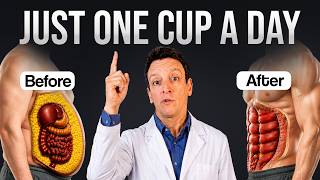

The Most Dangerous Fat You Can't See
45sOpens with a shocking health fact about hidden fat, immediately grabbing attention.
▶ Play Clip"Delivers exactly what the title promises—science-backed drinks with clear evidence tiers. No fluff, just solid content."
This video explains that visceral fat—the fat wrapped around internal organs—is the most dangerous type of fat, linked to serious health risks. However, it's also the easiest to lose, and certain drinks can significantly boost fat loss without cutting calories. The video reviews nine drinks, ranking them by scientific evidence, from green tea and protein shakes to less-proven options like clove seed and high-chlorogenic-acid coffee.
Visceral fat is fat wrapped around organs like the liver, pancreas, and intestines. It increases risk of insulin resistance, diabetes, heart disease, and cancer.
The DIRECT-PLUS trial: participants on a Mediterranean diet plus exercise lost 20% liver fat; adding a green tea and duckweed cocktail doubled that to 40% liver fat loss, with matched calories.
Polyphenols are plant compounds with antioxidant effects that help the liver burn more fat and store less.
Duckweed (Wolfia globosa) powder: about 5 grams (a heaping teaspoon) daily approximates the trial's 100g whole-plant dose.
Green tea is rich in catechins, which activate fat waves that shut down fat production in the liver. Meta-analyses show benefits for visceral fat, waist circumference, and blood pressure.
Matcha uses the whole leaf, making it more concentrated in catechins than regular green tea. Brands like Ito En report catechin content (400mg per bottle).
Cloves are one of the most concentrated sources of polyphenols, but no trials have proven they reduce visceral fat—an educated guess.
A trial with 44 athletes (BMI 21) who drank cocoa with 400mg flavonols daily lost 9% visceral fat in 10 weeks, but the difference vs control wasn't significant.
Coffee rich in chlorogenic acids showed an 8% visceral fat reduction in one double-blind trial, but results haven't been replicated. Light roasts have more chlorogenic acids.
High-protein diets (30% of calories) led to over 40% liver fat loss vs low-protein (10%) with matched calories. Protein also helps satiety and muscle retention.
Resistant starch (type 2) resists digestion and feeds the microbiome. A trial with 200 participants using 40g daily lost almost half their liver fat in four months.
Resistant maltodextrin is a soluble fiber that can lower visceral fat by 5-20%. Start with small doses to avoid bloating.
Ranking: Top tier—green tea, protein shake, resistant starch. Mid tier—duckweed, cocoa, resistant maltodextrin. Lower tier—matcha, clove seed, high-chlorogenic-acid coffee.
Visceral fat is the most dangerous type of fat, but it's also the easiest to lose. By swapping sugary drinks for polyphenol-rich options like green tea, protein shakes, or resistant starch, you can significantly reduce liver and visceral fat without cutting calories or exercising more.
What is visceral fat?
Visceral fat is fat wrapped around organs like the liver, pancreas, and intestines.
What was the key finding of the DIRECT-PLUS trial?
The DIRECT-PLUS trial found that adding a green tea and duckweed cocktail doubled liver fat loss (from 20% to 40%) compared to diet and exercise alone.
02:22
What are polyphenols and how do they affect the liver?
Polyphenols are natural plant compounds with antioxidant effects that help the liver burn more fat and store less.
03:38
How much duckweed powder is recommended to match the trial's dose?
About 5 grams (a heaping teaspoon) of duckweed powder per day.
04:36
What are catechins and how do they work?
Catechins are a type of polyphenol that activate fat waves that shut down fat production in the liver.
05:45
Why is matcha more concentrated in catechins than regular green tea?
Matcha uses the entire leaf ground to a powder, making it more concentrated in beneficial compounds like catechins.
06:57
What is the advantage of cloves, and what is the caveat?
Cloves are one of the most concentrated sources of polyphenols, but they haven't been proven in trials to reduce visceral fat.
07:54
What did the cocoa trial show, and what was the limitation?
A trial with 44 athletes (BMI 21) who drank cocoa with 400mg of flavonols daily lost 9% of visceral fat in 10 weeks, but the difference vs control wasn't significant.
09:09
Why are light roasts better for chlorogenic acid content?
Light roasts are more concentrated in chlorogenic acids because dark roasting destroys polyphenols.
12:37
What was the effect of high protein on liver fat in the gastric bypass trial?
High-protein diets (30% of calories) led to over 40% liver fat loss, while low-protein (10%) lost none, with matched calories.
13:56
What is resistant starch?
Resistant starch is a carbohydrate that resists digestion in the small intestine and feeds the microbiome in the colon.
16:14
What was the result of the resistant starch trial with 200 participants?
A trial with 200 participants using 40g of resistant starch daily lost almost half of their liver fat in four months.
16:39
What type of resistant starch is used in trials and where can you find it?
RS2 (resistant starch type 2), often from high amylose corn starch, green banana powder, or raw potato starch.
17:38
What is resistant maltodextrin and what effect does it have?
Resistant maltodextrin is a soluble fiber that resists digestion and can lower visceral fat by 5-20%.
18:33
Visceral fat is the most dangerous type
Establishes the health stakes: visceral fat increases risk of insulin resistance, diabetes, heart disease, and cancer.
Cocktail doubles liver fat loss
Shows that adding green tea and duckweed to a diet can double liver fat loss without extra calories or exercise.
02:22Duckweed powder dosage
Provides a practical, actionable dose (5g daily) for using duckweed powder at home.
04:36Catechins shut down liver fat production
Explains the mechanism behind green tea's benefit, making it easier to choose effective products.
05:45High protein loses 40% liver fat
Demonstrates that protein quality matters even with matched calories, offering a simple dietary lever.
13:56Resistant starch cuts liver fat by half
Highlights a powerful, low-effort intervention that doesn't require calorie cutting.
16:39[00:00] The most dangerous type of fat you carry is not the fat that you can see. It's tucked deep inside your belly, wrapped around organs like your liver, your pancreas, and your intestines.
[00:12] This is what we call visceral fat. And people who have more of it have a higher risk of developing insulin resistance, diabetes, heart disease, even cancer. So half of the internet will try to sell you a crash diet or an expensive pill or a detox to try to get rid of it.
[00:31] But scientists have actually found that visceral fat is the easiest kind of fat to lose. You can do it without spending much money and even without cutting calories or starving yourself. In fact, a number of drinks can help you cut visceral fat quickly with little to no effort.
[00:49] And most people have no idea. For example, some studies we're going to be looking at find that introducing specific drinks to your diet can double your visceral fat loss. So this is kind of crazy that people are not being told about this.
[01:02] So in this video, we'll go over the nine top drinks for visceral fat loss, and we'll separate the scientific evidence from the hype. One of the most interesting studies in this area is the DIRECT-PLUS trial.
[01:15] Scientists took hundreds of very overweight participants, and they put them all on a healthy diet, a so-called Mediterranean diet, fruits and vegetables and walnuts and some exercise as well.
[01:27] And they lost weight and they lost some liver fat as expected, but the surprising part came next. Half of the participants also got a cocktail to drink in addition to the diet and exercise.
[01:39] And this cocktail consisted of two drinks. The first was green tea. They had about three to four cups a day. And the second drink was a shake with a plant known as duckweed, also sometimes called mankai.
[01:53] And that shake contains calories, so in order to keep calories matched, they removed some of their solid food. So the corresponding amount of calories from their food was replaced with this mankai shake.
[02:05] And this group getting the cocktail lost twice the liver fat as the group that just got the diet and exercise, and more than twice the visceral fat. The group that got the diet and exercise lost about 20% of their liver fat, which is quite respectable.
[02:22] The group that also got the cocktail lost almost 40% of their liver fat. So this is a pretty incredible result. They ate the same total number of calories. They didn't exercise more or anything.
[02:35] Just adding that cocktail instead of some of the solid food, but leaving total calories constant, was as effective for liver fat loss as the diet and exercise combined, right? Diet and exercise, 20% loss of liver fat, and then the cocktail added in another 20%.
[02:53] By the way, when we talk about visceral fat, fat that is inside the organs, inside the liver, inside the pancreas, is technically not considered visceral fat. Visceral fat refers to fat that is wrapped around the organs.
[03:08] But the fat that's inside that's excessive is at least as problematic for your health, for your metabolism. So in this video, we're tackling both of those. Any solutions, any drinks that have been shown to help you lose fat around or inside those organs,
[03:24] we're covering all of it. So, why is this swap with these two drinks having this remarkable effect? One possibility offered by the authors of that study is that those two drinks are very high in polyphenols.
[03:38] Polyphenols are natural plant compounds that have a powerful antioxidant effect. They also influence your liver metabolism. They help the liver burn more fat and make less of it, store less of it.
[03:52] Okay, what is this Mankai? Where do we even find this? You can find it for sale online, usually as a powder. It's sometimes called Wolfia globosa, which is the scientific name for mankind. It might be easier to find it that way.
[04:05] Now, in the trial, they gave them 100 grams of this Wolfia globosa, this mankind, or duckweed, per day. But that was a whole plant frozen. The powder is dehydrated, so it's more concentrated.
[04:18] So I tried to calculate how much powder this would amount to. And the best information I found points to about 5 grams a day of this powder of Wolfia globosa or duckweed to get to a similar range as what they were getting from the 100 grams of the actual plant.
[04:36] And 5 grams would be about a heaping teaspoon. So one way to do this would be to mix a heaping teaspoon of that powder in water and drink that once a day. This is one thing I might try if I was trying to cut down on liver fat.
[04:49] Bearing in mind the trial used both green tea and duckweed, so I might try both of them at the same time. Now, the biggest bang for your buck is going to be if these drinks that we're covering replace drinks that are nastier for your liver fat and your visceral fat.
[05:03] So sugary drinks, for example, like soda or alcohol, those are pretty bad for the liver. So if you can replace some of that with the duckweed shake or any of the drinks we're going to cover, that's a dynamite swap.
[05:15] Now for green tea we actually have more evidence This is not the only trial that has shown this effect There an analysis taking six separate randomized trials and they found that green tea can help people lose total body weight and visceral fat and waist circumference
[05:32] And even their blood work, their blood sugar, and their blood pressure came down a bit. So those are pretty impressive results just for drinking some tea. Now, here's a caveat. Green tea is very rich in catechins.
[05:45] Catechins are a specific type of polyphenols, and catechins have been shown to activate fat waves that shut down fat production in the liver. So this is one way that green tea might be having this beneficial effect.
[05:59] These trials reporting a benefit of green tea, they usually use brands of green tea that have a pretty substantial concentration of catechins. So it might not necessarily get the same result with run-of-the-mill green tea that you buy at the corner store.
[06:14] There are a couple ways around this. One is the green tea brand that reports their content of catechins. So we looked around, we found this brand, Ito N. I have no connection with any of the brands mentioned in this video,
[06:27] just kind of reporting, sharing with you what we found. And they boast a minimum of 400 milligrams of catechins per bottle, which is quite respectable. Another option is green tea extract, which is more concentrated in catechins than most of the run-of-the-mill green teas,
[06:44] and that will always report the content of catechins in the back. So this one we found from Now Foods. Again, I have no connection. It says it's 80% catechins. Yet another option is matcha, which is related to green tea,
[06:57] but instead of just being an infusion, instead of just putting the leaf in water and letting a little bit of the contents seep out, matcha actually uses the entire leaf, grinds it to a powder,
[07:09] so it's more concentrated in these beneficial compounds like catechins. So there are a couple of brands of matcha that report the content of catechins. We've covered that before, and I'll link that video in the description,
[07:22] as well as some of those brands that we found as well for your convenience. So this is another thing I probably would try if I was trying to lose some visceral fat or liver fat. I would have a couple of cups of either green tea rich in catechins or matcha or a similar product,
[07:39] especially if I can get that to replace a sugary drink or a sugary snack or alcohol or something like that. But if it's a competition for polyphenol content, there is something that beats even matcha, and that's cloves.
[07:54] Cloves are one of the most concentrated, if not the most concentrated source of polyphenols. And the other advantage of cloves is they're easy to find. They're a standard supermarket spice, and they're really cheap, especially compared to some of the other products we're looking at.
[08:10] So this is another thing I might try, having some clove seed over the course of the day, or adding cloves to my food as a spice. Quick caveat that this is an educated guess based on the content of polyphenols.
[08:22] They haven't actually demonstrated in trials that cloves or clove seed reduces visceral fat. So just bear that in mind. We said we're going to separate the science from the hype, right, for accuracy. But yeah, this is probably still something I would try because there's no downside that I know of with clove seed.
[08:40] Okay, if you're thinking, man, these drinks are all weird. Matcha, clove seed, duckweed, who drinks that stuff? Here's a couple much more common drinks that might help you shed some potential fat,
[08:52] although bear in mind the evidence on these is less conclusive. Cocoa, for example, is a great source of specific polyphenols called flavonols. A randomized trial looked at 44 participants, and this trial, really interestingly, they were not overweight.
[09:09] In fact, they were athletes. Their BMI average was 21, so pretty fit people. And they gave half of them a cocoa powder that was low in fat, a 5-gram dose containing about 400 milligrams of fravenols.
[09:25] So they mixed that powder in milk, and they drank that once a day. And after 10 weeks of doing that, they had lost 9% of their visceral fat. So on one hand, this result is impressive because these people were not overweight to begin with,
[09:41] so there's less fat to lose in the first place. On the other hand, there's a kink to this trial that lowers my excitement. They did lose significant visceral fat compared to before the trial. However, at the end, the difference to the control group was not significant.
[09:56] The control group also trended down. and it seemed like they also lost a little bit of visceral fat. So at the end, they weren't significantly different from each other, so it's a little bit murky. So another option to bear in mind,
[10:08] cocoa made with flavonoid-rich cocoa powder might help you lose some visceral fat, although we're not entirely sure. We're going to look at one more common drink that is also concentrated in polyphenols,
[10:20] and then we'll move on to other strategies that have stronger evidence. So one of the most common drinks, and that actually has a quite substantial content of polyphenols is coffee. And there's some evidence that coffee might help lose liver fat or visceral fat,
[10:35] at least some types of coffee So here the truth on that One trial found that participants drinking one cup of coffee a day lost significantly more visceral fat than the control group And this was a very
[10:48] interesting trial because he was double blind, so the participants and the investigators didn't know which group each participant was in. So what they did was they gave everybody a cup of coffee, But one group got coffee rich in chlorogenic acid.
[11:04] The other group got coffee with a lot less chlorogenic acid in it. So chlorogenic acid is another type, another category of polyphenols that are pretty concentrated in coffee beans.
[11:16] A lot of people don't realize coffee beans are a concentrated source of some of these polyphenols. And that's actually thought to explain some of the benefits of drinking coffee. So this trial looks very striking at first glance.
[11:31] Now, a couple of reasons I'm more cautious. One, the drop is modest, so it was an 8% reduction in visceral fat over 12 weeks. Another thing is, besides a couple of trials from this team, I've never seen this result replicated by anyone else.
[11:47] And there are studies by other people looking not at coffee specifically, but other products that are concentrated in these chlorogenic acids. and you don't really see a reduction in liver fat with those.
[11:59] So I'm pretty cautious about this. So it's possible that coffee high in chlorogenic acids might help, but I think our confidence for green tea, for example, is higher. Now, coffee still has a number of other benefits,
[12:12] and chlorogenic acids have been shown to deliver other perks like modest reductions in blood pressure, and they can help a little bit with total weight loss. Specifically for visceral fat, I think the jury's out.
[12:24] If you do want to try drinking coffee high in chlorogenic acids, here's a couple tips. Light roasts usually are much more concentrated because the intensity of the roast tends to destroy some of these polyphenols.
[12:37] So dark roasts have a much lower concentration. There are also some brands of coffee that purport the concentration of chlorogenic acids. So that's another way to go. And the trial gave them 360, in that ballpark, milligrams of chlorogenic acids per day.
[12:54] in that cup of coffee. So you have that reference range. And then there are supplements like green coffee extracts that are generally more concentrated in chlorogenic acids. And like we said, those have shown other benefits, although for visceral fat specifically or liver fat specifically,
[13:10] the results are not very convincing. All right, let's switch gears to something else that can help you lose some visceral fat. A randomized trial took a population of obese adults that were about to get gastric bypass surgery. And they put them on a calorie-restricted diet,
[13:26] about 1,500 calories a day for three weeks. And this is pretty standard before gastric bypass. You normally go on a calorie-restricted diet. But what they did that was very interesting is they split those people into two groups. One ate a low-protein diet. The other ate a higher-protein
[13:44] diet. 10% versus 30% of their calories coming from protein, but total calories were matched, were the same in both groups. And both groups lost weight, total body weight, but the folks
[13:56] on low protein didn't lose any significant liver fat specifically, whereas the folks on high protein lost more than 40% of their liver fat. And remember, same calories in both groups. Pretty
[14:11] striking result. One caveat of this trial is that it was smaller. We do have a larger trial with over 100 people, and the intervention was similar. Everybody was cutting calories, and then half were
[14:23] on a low-protein diet, half were on a higher-protein diet, and they both lost visceral fat, but the folks on higher protein lost more visceral fat. So, protein is something that has substantial
[14:35] evidence documenting its ability to help you lose some visceral fat. And another advantage of protein is it can have a satiating effect, helps you not overeat. And it can also help you hold on to your muscle mass as you lose weight. So this is another strategy I would absolutely use in my
[14:52] visceral fat losing journey. And one way to get an easy 20 or 30 grams of protein is a protein shake. So having a protein shake for breakfast or after a workout or as a snack. Now bear in mind, these
[15:04] trials were isocaloric, right? So they were increasing the protein, but they weren't increasing calories. So you want to make sure that your protein shake replaces something else so that
[15:16] your overall calories don't go overboard, because that could ruin things. So a protein shake might have 30 grams of protein, that's 120 calories. So you want to remove something else around the
[15:28] same range. Ideally, if you have soda, for example, a can of soda replaced with a protein shake, or a sweet snack that you might have in the middle of the afternoon, replacing that with a protein shake, great dynamite swap.
[15:40] And obviously, I would avoid adding refined sugar to the protein shake. If you need to add some sweetness, stevia and monk fruit are two options of sweeteners that have zero calories. Food works too, works perfectly well as a source of protein, and some people prefer that.
[15:57] The shake has the advantage of being fast and the water fills you up as well Now if you think this protein hack makes sense here another strategy to lose visceral fat that surprises most people This is a specific carbohydrate that resists digestion in your small intestine
[16:14] and makes it all the way into your colon where it can feed your microbiome. And this carbohydrate helps optimize your energy metabolism, your appetite, and your insulin sensitivity.
[16:27] It's called resistant starch. And a number of randomized trials have found that it helps reduce visceral fat. One trial that was quite impressive looked at 200 participants with liver fat
[16:39] and gave half of them 40 grams of a resistant starch in a powder form mixed in water to drink once a day. And after four months, they had lost almost half of their liver fat without cutting calories overall, without exercising more, without doing anything radical.
[16:58] The control group got regular starch to mix in water, and they lost no significant liver fat. So this was a really impressive result. There are other trials that have also found resistant starch can help reduce visceral fat.
[17:12] Not every trial has been positive. There is one or two other trials that found little to no fat, so this probably depends on the individual. For example, how much liver fat you have to lose in the first place.
[17:25] Another thing to bear in mind is there are different types of resistant starch. The one they normally use in these trials is called RS2, or resistant starch type 2. And usually the powder they use is extracted from corn.
[17:38] It's called high amylose corn starch. But there are some forms of resistant starch type 2 that are easier to find in the market, like green banana powder, which is about 30 to 55% resistant starch.
[17:51] And then there's also raw, unmodified potato starch, which is even higher, 50 to 75% resistant starch. So this is probably what I would use if I was going to give this approach a shot.
[18:03] And you want to start with small doses and slowly ramp it up, because introducing a big amount of resistant starch all of a sudden can cause abdominal discomfort and bloating. We're going to look at one last tool, and this is something that has some similarities to resistant starch
[18:19] that has also been shown to help nudge visceral fat in the right direction, and that's resistant maltodextrin. So this isn't a starch technically, it's a type of fiber, but it also resists, hence the name,
[18:33] digestion in the small intestine and reaches your large intestine, your colon, where you can feed your microbiome. And it can also influence your satiety and your blood sugar levels. And the advantage of this is this is a soluble type of fiber, so it mixes very easily in water and you
[18:49] can basically have it as a drink, very convenient. And a couple trials have found resistant maltodextrin helps lower visceral fat, between 5 and 20 percent ballpark of visceral fat lost, depending how much
[19:01] you have to begin with. The more visceral fat you have in the first place, the more you tend to lose. And you can buy resistant maltodextrin in a powder form. One example we found is this product has 12 grams of resistant maltodextrin per serving. As an example, the trial that found
[19:16] the strongest reduction in visceral fat, about a 20% drop, they used 9 grams of resistant maltodextrin three times a day, so 27 grams total. So it would be two to three servings of this
[19:28] powder, you want to bear in mind you're looking for resistant maltodextrin, not any maltodextrin. That's a little different, so make sure the label says resistant maltodextrin. So I would say this one is a nudge by itself. It's not going to revolutionize your visceral fat loss, but for a
[19:44] cup of water with some powder mixed in, it's not a bad add-on. Same caveat here, start with smaller doses, slowly ramp it up because of bloating and discomfort. So when we're talking about drinks and visceral fat loss or liver fat loss, here's how I would rank the nine drinks we covered.
[20:01] At the top, I would put three drinks. Green tea, rich in catechins. Protein shake, bearing in mind it's isocaloric, it's not added on top of a diet, it's replacing something else. And the resistant starch type 2 drink.
[20:14] Those three have several studies showing an effect, and the magnitude of the effect is respectable. A bit lower, lower level, I would put the Mankei shake or duckweed and also the cocoa and the resistant maltodextrin.
[20:30] These have fewer trials than the top level and some limitations in the evidence. I would say lower confidence overall. So this category, I would say, might help you nudge, but we're not as sure. And then at the lowest level, I would put the matcha, the clove seed, and the high chlorogenic acid coffee.
[20:48] These are educated guesses. They might work, but they haven't been demonstrated in studies. So I would pick one or two that you like, and if they replace a worse drink, then phenomenal. These drinks are not going to fix a horrendous diet by themselves.
[21:02] It's not magic, but they can help you move the needle and achieve great results with little to no additional effort. And if you're looking for a method to measure, to estimate how much visceral fat you're carrying that's completely free,
[21:15] you don't spend anything, you can do it at home right now, We covered that in this previous video. So check that out, and I'll see you in there.


⚡ Saved you 0h 21m reading this? Transcribe any YouTube video for free — no signup needed.