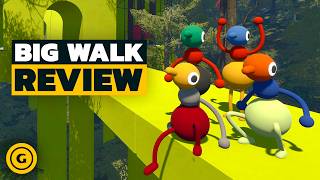

This Game Redefines Co-op Walking Sims
60sThe reviewer's struggle to define the game and the unique concept of 'walking and talking with friends' sparks curiosity and debate.
▶ Play Clip"Delivers on the promise of a glowing review with specific, heartfelt praise, though it's a subjective opinion piece."
Big Walk is a co-op walking and puzzle adventure game by House House, set on a handcrafted island in the Australian Outback. It strips down gaming to its essential verbs—discover, experiment, prevail—and invites players to build their own story together. The review highlights its unique design, diegetic UI, and the importance of proximity chat, culminating in a deeply rewarding experience that the reviewer calls unforgettable.
Big Walk is hard to define; it's been called a co-op walking sim, puzzle adventure, and friend slot. It's unlike anything else, stripping down the medium to essential parts and inviting players to build it back up.
Players walk and talk with friends in groups of 2-12, trekking across a vast island full of puzzles. The basic setup belies depth discovered over time.
The island is handcrafted, not procedurally generated. Every inch feels intentional, from switchbacks hinting at landmarks to radio stations playing unique songs.
Puzzles change slightly based on group size (2, 3, or 4+). The host maintains save data, allowing players to join or drop. Some puzzles are easier with more people, others more chaotic.
There's remarkable clarity in the visual language. No quest markers, on-screen prompts, stamina, or health bars. Everything is diegetic, and discoveries are of your own making.
No lore dump or explainer. House House trusts each group to carve out their own adventure, building on shared learning. Players create their own vocabulary (e.g., 'eggy things', 'Walklings').
Some puzzles require close teamwork, others require splitting up. Finding each other afterward is its own puzzle. Some puzzles inhibit communication, like one with soundproof glass.
Only about 6-8 core concepts, but each returns with clever new wrinkles. Puzzles can be daunting but not frustrating. Some take minutes, others 20+ minutes.
The reviewer played with two kids for about 2 weeks, nightly. They developed their own glossary and celebrated successes together. The game has a defined ending.
Major rewards like a train and a map room become available. Missable shortcuts reinforce that triumphs are yours to celebrate, not based on HUD arrows.
Handheld items like walkie-talkies, flashlights, and megaphones make puzzles easier but are rarely required. Inventory is limited; you need a buddy to access your backpack.
Conceived during COVID, House House wanted to get people talking and having meaningful interactions. The design encourages communication.
The loop is universal: discover, experiment, prevail. It's deep but never leaves players behind. It's not a 'friend slot' game; the highlight is shared joy.
Using external chat like Steam or Discord circumvents the game's friction and makes it worse. Proximity chat is crucial; refusing it is like playing a horror game with lights on.
The final puzzles encapsulate everything learned, with slight adjustments that are awesomely rewarding. The last scene is bittersweet and left the reviewer glossy-eyed.
Big Walk takes the basic building blocks of video games and shapes them into a singularly rewarding, mysterious, and unforgettable co-op experience. It's a game of few words, giving players a massive canvas to create their own story together.
What is the player count range for Big Walk?
Groups of 2 to 12 players.
00:45
How does the game handle save data?
The host maintains the save data across sessions, allowing players to join or drop.
01:44
What is the core gameplay loop of Big Walk?
Discover, experiment, prevail.
07:03
Why is proximity chat considered essential?
Using external chat like Steam or Discord circumvents the game's intentional friction and makes the experience worse.
08:13
What inspired House House to create Big Walk?
The COVID pandemic, to get people talking and having meaningful interactions.
06:51
How many core concepts does the game focus on?
About six to eight core concepts.
03:59
Diegetic UI
The game has no quest markers or health bars, making every discovery feel earned and personal.
02:12Origin Story
The game was designed during COVID to foster meaningful interactions, explaining its focus on communication.
06:51Proximity Chat as Core Mechanic
The reviewer emphasizes that using external chat ruins the experience, highlighting the importance of the game's design.
08:13Emotional Finale
The final puzzles and scene are described as mind-blowing and bittersweet, cementing the game as a GOTY contender.
09:07[00:02] announced, I've heard it referred to as a co-op walking sim, a puzzle adventure a co-op walking sim, a puzzle adventure game, and most recently, friend slot. After spending 20 [music] plus hours in the world of the Australian Outback
[00:15] inspired game, it's no easier to succinctly define it because it's not actually like anything else. By inventively stripping down the medium to its most essential parts, it invites novices and experts alike to build it
[00:28] back up from scratch, coloring in its mysterious world with their friends by their side. We need a new word for whatever kind of game Big Walk really is, but here's one for now. Unforgettable.
[00:45] >> Big Walk is a game about walking and talking with friends. In groups of two to 12 players, you'll trek across a vast and open island full of puzzles and This intentionally basic setup belies the depth you'll discover the more time
[01:00] you spend in its world. After a tutorial area teaches you the basics, you'll unlock virtually the entire world, and from there, your path ahead won't be the from there, your path ahead won't be the same as any other.
[01:17] generated every day, Big Walk's island is handcrafted and it shows. Every inch of the world feels intentional, from the switchbacks down the mountainsides meant to give you the hint of a far-off landmark to the radio stations you can
[01:31] come across, each of them playing their own special song that you can carry with you if you're in the mood for some music on your journey. Sometimes you'll even take pieces from one puzzle to solve others. In small ways, puzzles change
[01:44] depending on your group size. The host maintains the save data across sessions, allowing players to join or drop when they may need to, but different versions of the island exist [music] for parties of two, three, or four plus with slight
[01:58] [music] the number of people in a group. Some puzzles will be a bit easier with together, while others will be much more chaotic. But through it all, there's a remarkable clarity to the visual language of Big Walk.
[02:12] You'll quickly understand what's most vital to navigating its world, but everything else there is to know will be built on a foundation you make together with your friends, establishing your own vocabulary and body language in such an
[02:25] effortlessly cool, intuitive way that so many other games seem afraid of. Playing with two of my kids, we took to calling the dozens of McGuffins eggy things because of their somewhat egg-like shape. And we called our characters
[02:39] Walklings. As the hazy semblance of a story unfolded, we made sense of it in our own words. Big Walk clearly hopes each group does this. That's why it fills its world with fundamental video game objects and objectives, like
[02:52] puzzles and their rewards, [music] but adds nothing definitive beyond that. [music] There are no quest markers or on-screen prompts, and no stamina or health bars to manage. Every aspect of the game is
[03:07] diegetic, and every discovery is of your own making. There's no lore dump or explainer [music] as to who you are or why you're solving puzzles on an island that only your group seems to inhabit. Developer
[03:20] House House trust each friend group to carve out their own adventure through the world, letting their curiosity guide them and building on shared learning hour after hour. Some puzzles demand you work closely together side by side,
[03:33] [music] timing your actions just right or fidgeting with buttons and points of view, while others demand you split up, sometimes for long stretches at a time and across great distances. In those instances, finding each other afterward
[03:46] is its own sort of puzzle to solve. Many puzzles will inhibit your ability to communicate, like one where a player is locked behind [music] soundproof glass and must relay information to the others that only the lone [music] Walkling has.
[03:59] There are probably only about six to eight core concepts the game focuses on, but each time House House returns to an idea, it adds clever new wrinkles. I can think of a few puzzles that were particularly daunting, especially with a
[04:12] 7-year-old in the group, but none frustrated me. Often we'd climb to a mountaintop to get a lay of the land, head off toward some vibrant structure in the middle of a wooded area, and fidget with its movable parts until we
[04:24] got a sense of what we needed to do. Through clear collaboration and our own glossary, we'd achieve success. Sometimes quickly in just a few minutes, but other times after much more head scratching for puzzles that took us 20
[04:38] or more minutes to solve. Though the game is light on traditional story, it feels like describing many of its amazing puzzles is a type of spoiler. The ritual of discovery followed by cooperative experimentation and finally
[04:52] >> [music] >> is the magic of Big Walk. Doled out with the completion of each puzzle, but even more often in the in-between moments when you're just chatting as you explore the outback. For
[05:05] a few hours every night for about 2 weeks, this was our beloved ceremony bearings, found each other when we'd gotten lost and separated, and commended each other when one of us would crack the solution
[05:18] to a puzzle wide open. Big Walk has a defined ending and [music] isn't meant to be played forever. Though with a different group of friends, it does When we weren't playing it, we were talking about it, trying to solve some
[05:31] puzzles we'd set aside if they'd stumped [music] us for too long, or crafting theories about the massive black orb that waited beyond a wall we couldn't seem to access. It's a game of few words, opting instead to give players a
[05:44] massive canvas [music] on which to create their own story together. For a handful of special evenings, the island was our home away from home. With every few puzzles, major new rewards become available, like a train that
[05:56] moves around the island or a giant map room to help plot your travels. You may also stumble upon totally missable shortcuts, reinforcing that your triumphs are yours to celebrate and not based on any HUD arrow you followed.
[06:10] You'll come upon helpful handheld items like walkie-talkies, flashlights, and megaphones. But as best I can recall, such items tend to make some puzzles easier, but they're rarely required. So, it becomes a question of, for example,
[06:24] leaving the puzzle to find a pair of walkie-talkies or solving a puzzle without them, even if they would clearly help a lot. Inventory space is limited to what you can carry on your person, and [music] simply packing something for
[06:37] You'll need a buddy to take that backpack off of you if you want to consult the paper map you may have stashed inside of it. This seemingly small design decision really speaks to Big Walk's main idea.
[06:51] First imagined during the COVID pandemic, House House sought to make a another, to get them talking and [music] having meaningful interactions. For me, it worked wonders.
[07:03] Big Walk offers a gameplay loop that feels universal in its appeal. It deconstructs video games into their most foundational verbs: [music] discover, experiment, prevail. The context of a mysterious island and the silly-looking
[07:18] characters you play as surely enhance the experience, but it's the simplistic gameplay loop taken to a depth that is exciting but never so involved as to leave some players behind that makes it [music] so easily beloved. Though it
[07:32] leaves room for goofing off, Big Walk doesn't have the cadence of a friend slob game, where the purposely janky sabotage of your friends' best intentions is much of the fun. Some failures can be amusing, and the
[07:46] game as a whole definitely has an understated comedic tone befitting of its Australian dev studio. But the true highlight is the shared joys of exploring the world and overcoming its obstacles through
[07:58] [music] There's a lot more stopping and thinking in Big Walk than perhaps its title suggests. You'll do plenty of walking, And if you're playing with friends or family you love and appreciate, it's
[08:13] bound to be a deeply rewarding experience. The only noticeable knock on the game is one that demands some self-policing. Without using Big Walk's proximity chat, you'd turn its magic off like flipping a switch. Using Steam or
[08:27] Discord chat, for example, would act like a cheat code, circumventing a puzzle's intentional [music] friction, such as when proximity chat isn't meant easily talking to your group. So, it's really on you to choose not to do that,
[08:41] or else accept that you've opted to make the game worse for yourself. The element of proximity chat does a lot of heavy lifting to make Big Walk shine brightly. >> So, refusing to engage with that feature would be like playing a horror game with
[08:54] the lights [music] on. You can still enjoy it, but you'll be of its powers. While I won't spoil them in this video, Big Walk's incredible focus culminates in a final stretch of puzzles that [music] encapsulates
[09:07] everything you'll have seen and done until that point in a genuinely mind-blowing way. My kids and I spent over a dozen hours together solving many difficult puzzles and inventing a language which we often relied on,
[09:20] only for [music] the final iteration of the game's core concepts to be so slight in its adjustments, yet so awesomely rewarding [music] in its execution. It we've taught each other, recalling our entire journey. [music] I was utterly
[09:35] floored by the way this area masterfully fuses the game's repeated actions of experimenting [music] and exploring with the undercurrent of its emotional beats that purposely rise to the surface [music] toward the very end of the game.
[09:48] I loved every second of Big Walk and this final act cemented it as one of the best co-op games I've played [music] in years. As if that weren't enough to land Big Walk as an obvious game of the year contender, the very last scene of the
[10:02] surprisingly bittersweet [music] moment that left me glossy-eyed. I wouldn't dare spoil this part for you, but I'm sure it'll have a similar effect [music] even if you're not playing with your kids. Big Walk takes the basic
[10:15] building blocks of video games, obstacles and incentives for clearing >> and through an intensely focused co-op experience shapes them into something singularly rewarding, supremely mysterious, and totally [music]
[10:30] mysterious, and totally [music] unforgettable.



⚡ Saved you 0h 10m reading this? Transcribe any YouTube video for free — no signup needed.