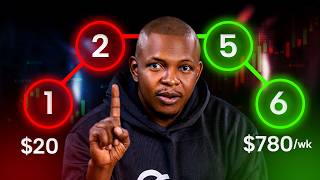

Bitcoin Wipeout: $2 Trillion Gone
30sExtreme market crash stats create urgency and fear, driving clicks and shares.
▶ Play Clip"Delivers a solid breakdown of the crash and strategies, but the title's binary question is only partially answered and the promo for Copy Me Crypto feels like a soft sell."
The video analyzes the severe crypto market crash of early 2025, where over $2 trillion was erased from total market cap and Bitcoin lost more than 50% of its value from its highs. The creator breaks down the five major drivers of the crash, examines what big players like MicroStrategy and Binance are doing, and outlines three realistic strategies for investors to consider. The core message is that crashes transfer wealth rather than destroy it, and that panic selling at the bottom is the real danger.
Over $2 trillion erased from total crypto market cap, with ~$800 billion vanishing in the last 30 days. Bitcoin lost over 50% of its value from the highs. Solana is trading at a level not seen in over 2 years. Market sentiment is at extreme fear.
The creator previously made a video when Bitcoin was around $98,000, stating he was not buying there and would start paying attention again around $70,000. The question now is whether this crash is part of the plan or if something fundamentally changed.
Crashes like this don't destroy wealth, they transfer it. The problem is not the crash itself, but that people don't understand why markets crash, so they don't know what to do when it happens.
Donald Trump's selection of Kevin Walsh as the next Fed chair has spooked the market. Walsh is viewed as a hawk likely to aggressively shrink the Fed's balance sheet. Even before confirmation, liquidity is already leaving the market, leading to tighter financial conditions and less speculative capital.
In January alone, over $3 billion flowed out of US spot Bitcoin ETFs. In just 48 hours, BlackRock and Fidelity recorded over $800 million in withdrawals.
Over $1 billion in Bitcoin positions were liquidated in a single 24-hour window. This was forced selling, not fear selling. When big leverage players get margin calls, exchanges sell their Bitcoin regardless of price, further pushing down the asset's price.
Crypto is correlated with high beta tech, so as AI and tech stocks price, crypto does the same. Additionally, uncertainty around the US and Iran leads people to pull money from risk-on assets into risk-off assets like the US dollar and gold.
MicroStrategy's average Bitcoin purchase is $76,000, and with Bitcoin near $63,000, they sit on an unrealized loss of over $8 billion. Yet in the last week of January, they bought another 855 Bitcoin (~$75 million). Michael Saylor is effectively trying to buy the floor. Meanwhile, BlackRock and Fidelity show ETF outflows, and Binance converted 100% of its $1 billion stable fund from stablecoins into Bitcoin.
Every cycle looks the same: Bitcoin runs, crashes 50% or more, headlines declare it dead, and it recovers every single time. People lose money not because Bitcoin crashes, but because they panic sell at the bottom and quit before recovery. However, not every coin will recover; most altcoins from previous cycles never made a new high.
Option 1: Wait for confirmation - wait for structure change and momentum before getting in, avoiding catching the bottom but also avoiding destroying capital. Option 2: DCA - be selective (Bitcoin, Ethereum, BNB, Solana), focusing on discipline and long-term game. Option 3: Risk-advanced futures - profit from both up and down markets, which is why the creator is building Copy Me Crypto, a platform to automatically copy vetted pro traders with enforced risk management.
The crash is driven by multiple forces—Fed hawkishness, institutional outflows, forced liquidations, tech correlation, and geopolitical uncertainty—but historical cycles suggest recovery is likely for major assets. The key is to avoid panic selling and choose a strategy (confirmation, DCA, or advanced futures) that aligns with your risk tolerance.
How much was erased from the total crypto market cap during this crash?
Over $2 trillion was erased, with ~$800 billion vanishing in the last 30 days.
00:15
What percentage of value did Bitcoin lose from its highs?
Bitcoin lost over 50% of its value from the highs.
00:15
Who did Donald Trump select as the next Fed chair, and why did this spook the market?
Kevin Walsh, viewed as a hawk likely to aggressively shrink the Fed's balance sheet, leading to tighter financial conditions.
02:21
How much flowed out of US spot Bitcoin ETFs in January, and how much did BlackRock and Fidelity see in withdrawals in 48 hours?
Over $3 billion flowed out in January; BlackRock and Fidelity recorded over $800 million in withdrawals in 48 hours.
02:49
What is the 'liquidation dynamo' and how does it work?
Over $1 billion in Bitcoin positions were liquidated in 24 hours. When big leverage players get margin calls, exchanges sell their Bitcoin regardless of price, pushing the price down further.
03:05
What is MicroStrategy's average Bitcoin purchase price and their unrealized loss?
Average purchase is $76,000; with Bitcoin near $63,000, they sit on an unrealized loss of over $8 billion.
04:05
What did Binance do with its $1 billion stable fund during the crash?
Binance converted 100% of its $1 billion stable fund from stablecoins into Bitcoin.
04:43
What are the three realistic options for getting back into the market?
1) Wait for confirmation, 2) DCA (selective: Bitcoin, Ethereum, BNB, Solana), 3) Risk-advanced futures.
05:59
Crashes transfer wealth
Reframes the crash as a transfer of wealth rather than destruction, a key psychological insight for investors.
01:20Fed hawk spooks market
Explains how a single political appointment can trigger liquidity withdrawal even before confirmation, showing the market's sensitivity to policy signals.
02:21Liquidation cascade mechanics
Clarifies the difference between fear selling and forced selling, a crucial concept for understanding crash dynamics.
03:05MicroStrategy buys the floor
Shows a major player doubling down during a crash, illustrating contrarian institutional behavior.
04:05Historical cycle pattern
Provides evidence that Bitcoin has recovered from 50%+ crashes every cycle, countering panic narratives.
05:15[00:02] one of its most brutal stretches since late 2024. This is not a pullback. This late 2024. This is not a pullback. This is not a dip. This is a wipe out.
[00:15] Over $2 trillion has been erased from the total crypto market cap and roughly the total crypto market cap and roughly $800 billion of that [music] vanished in just the last 30 days. Bitcoin has lost over 50% of its value from the highs.
[00:32] Solana is trading at a level we haven't seen in over 2 years. And right now, the market is sitting at [music] extreme fear. And this is usually the
[00:46] point where people panic, sell at the bottom, or completely freeze. But if you've been following me for a while, you remember something. When Bitcoin was trading around $98,000, I made a video saying clearly I was not
[01:04] buying there, I said I'll start paying attention again when the price is around $70,000. So the question now is simple. So the question now is simple. Is this part of the plan or has
[01:20] something fundamentally changed? Because here is a truth most people miss. here is a truth most people miss. Crashes like this don't destroy wealth, they transfer it. The problem is not the crash. The problem is people don't
[01:34] [music] understand why market crashes. So they don't know what to do [music] when this happens. So in this video, we're going to do four things. Break down exactly why this crash happened. Look at what the big players are doing
[01:49] right now. Zoom out and remember what Bitcoin has done in the past cycle. And finally [music] talk about what you can realistically do from here. I won't give you opium in this video. I'll just give you clarity.
[02:04] So why is the market crashing? This crash is not caused by one thing. It's multiple forces hitting the market at the same time until something broke. Let me walk you through the five major drivers. One is the wash effect. Donald
[02:21] Trump's selection of Kevin Walsh as the next Fed share has spooked the market. Walsh is viewed as a hawk, someone likely to aggressively shrink the Fed's balance sheet. Even though Walsh needs [music] to be confirmed first for him to
[02:37] assume office, liquidity is already leaving the market. This means tighter financial conditions, less speculative capital, and fewer dollar flowing into
[02:49] crypto. Number two is institutions are quietly leaving. [music] In January alone, over $3 billion flowed [music] out of US sports Bitcoin ETF. And in just 48 hours, Black Rockck and
[03:05] Fidelity recorded over $800 million in withdrawal. Three is the liquidation dynamo. This here is the real killer. In leverage trading, over $1 billion in
[03:17] Bitcoin positions [music] were liquidated in a single 24-hour window. This wasn't fear selling. This was forced selling. When big [music] leverage players get margin calls, the exchange sells their Bitcoin regardless
[03:33] of the price and this further pushes down the price of the asset. And number four is cryptocorrelation with [music] high beta tech. So as AI and tech stocks price, [music] crypto is also doing the same thing. And the last reason is a
[03:48] the US and Iran. [music] When there's uncertainty in the world, people usually pull out their money from high risk assets or risk on assets and put it into risk off asset like the US dollars and the gold. So what should you
[04:05] do? Let's start with what the big players are doing. Micro Strategy's average Bitcoin purchase [music] is $76,000. Bitcoin currently is trading near $63,000.
[04:17] That means they are sitting on an unrealized loss of over $8 billion. Yet unrealized loss of over $8 billion. Yet in the last week of January, they bought
[04:29] in the last week of January, they bought another $855 Bitcoin, roughly around $75 million. Michael Sillo is effectively trying to buy the floor. On the other hand, institutions like the Black Rockck and Fidelity are pulling out ETF outflow
[04:43] shows fund managers are removing money from crypto and putting it into cash, from crypto and putting it into cash, gold, and the US dollars. Binance just gold, and the US dollars. Binance just converted 100% of its $1 billion staple
[04:58] fund [music] from stable coins into Bitcoin. This is their emergency fund, their insurance, and they move it into Bitcoin during this particular crash. will actually [music] put more money in to rebalance it and make it up to a
[05:15] billion dollars. Now, before we talk about what you can do, let's zoom out. This is not the first time people have said that Bitcoin [music] is dead. Every cycle looks the same. Bitcoin runs, crashes 50% or more.
[05:31] Headline [music] declared it finished and somehow it recovers every single time. People don't lose money because Bitcoin crashes. They lose money because they panic, sell at the bottom, and quit before recovery.
[05:46] before recovery. But not every coin will [music] recover. Most altcoins from previous circle never made a new high, never recovered, and some of them even disappeared completely. [music] A coin being down
[05:59] does not mean it is cheap. There are three realistic parts to getting back three realistic parts to getting back into the market. Option number one is wait for confirmation. So [music] you wait less structure change. You see the
[06:14] momentum before you get in again. In this case, you don't catch the bottom, but you avoid destroying your capital. Sometimes patience is the trade. Option number two is DCA. If you're going to DCA, you have to be selective. For me,
[06:31] DCA, you have to be selective. For me, that means Bitcoin, Ethereum, BNB, Solana. So, DCA is about discipline and not excitement because you have to play a long-term game. And option number three is risk advanced futures. It lets
[06:49] you profit from the market when it's going up and also let you profit from the market when it's going down. That is exactly why I am building copy me exactly why I am building copy me crypto. Copy me crypto allows you to
[07:02] automatically copy vetted pro traders with enforced risk management. So one bad trade cannot destroy your account. It is not gambling. It is structured It is not gambling. It is structured exposure.
⚡ Saved you 0h 07m reading this? Transcribe any YouTube video for free — no signup needed.