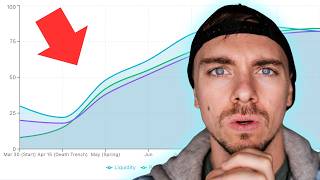

World Uncertainty Just Hit 2x COVID Levels
40sIt reveals a 40-year pattern where ATH uncertainty leads to massive bull runs in both stocks and crypto.
▶ Play Clip"Delivers on the April-timeline thesis with historical data and clear policy levers, though heavy speculation and repetition dilute the punch."
The video argues that the current market weakness is temporary and that a major Bitcoin and stock rally could begin after April. It uses the World Uncertainty Index to show that record uncertainty has historically been followed by bull markets, and it outlines the political and policy catalysts — from midterm pressure on Trump to TGA drawdowns — that could drive liquidity back into the market. The main risk is surviving the window of weakness until April 15.
The current window of market weakness is temporary; after April, liquidity returns, policy pressure ramps up, and the market may shift from survival to expansion.
Index tracks global uncertainty since 1990; prior peaks in 2003, 2012, 2016, and 2020 were followed by significant bull markets in stocks and/or crypto.
Q3 2025 World Uncertainty Index hit a new all-time high nearly double the 2020 peak, making 2020 look small by comparison.
Every time the index has hit a new all-time high since 1990, a bull run in stocks and crypto followed; larger uncertainty peaks appear tied to larger bull runs.
High uncertainty pressures policymakers to stimulate the economy and reduce uncertainty, which is the mechanism believed to connect uncertainty peaks to subsequent bull markets.
The world is going through the greatest energy crisis of all time, and energy crises historically break the global financial system.
After the Iran conflict, Senate odds shifted from favoring Republicans to favoring Democrats for the 2026 midterms; Democrats are also expected to take the House.
Trump has the most on the line; losing Congress could bring impeachment attempts and roadblock his agenda, so he is highly motivated to boost the economy.
Deregulation is disinflationary, spurs business activity, and can take effect within months; applies to oil/gas drilling, housing permits, and bureaucracy.
Releasing oil from the emergency reserve (as Biden did) can lower gas prices within about a month.
Trump wants the Fed to cut rates via new chair Kevin Warsh, but Warsh can't unilaterally decide; difficult given current setup.
Tax cuts putting money into pockets faster is already happening and will continue through May, functioning like stimulus checks.
The Treasury General Account, which will peak over $1 trillion, can be drawn down before midterms to inject liquidity without Congressional approval.
Assuming markets clear weakness by April 15: April-June see TGA drawdown, oil release, red-tape cuts, and Iran resolution; summer sees peak juice with aggressive liquidity; October sees four-year-cycle sellers; then a Q4 rally into midterms.
The video argues that despite a dangerous near-term window, historical uncertainty peaks and political incentives point to a significant liquidity-driven rally after April; the main risk is whether markets can survive the current energy and Iran shock until mid-April.
According to the video, what historically follows every new all-time high in the World Uncertainty Index?
A bull run in both stocks and crypto.
02:57
When was the first crypto bull market according to the World Uncertainty Index pattern?
In 2013, after the Q4 2012 all-time high in world uncertainty.
01:07
How does the Q3 2025 World Uncertainty Index compare to the 2020 peak?
It is almost double, making 2020 look small by comparison.
02:44
What is the proposed reason for bull runs following world uncertainty all-time highs?
Policymakers are pressured to stimulate the economy and reduce uncertainty, leading to policy responses that boost markets.
03:22
What political shift occurred after the conflict in Iran according to betting odds?
Senate odds flipped from favoring Republicans to favoring Democrats for the 2026 midterms.
05:10
Who are the two candidates neck-and-neck for the 2028 presidential election?
Gavin Newsom and JD Vance.
06:47
Name the first policy card Trump is likely to play that can take effect before midterms.
Cutting red tape / deregulation, which is disinflationary and spurs economic activity.
07:37
What effect does cutting red tape have on prices?
Red tape is inflationary; cutting it is disinflationary and drives prices down.
07:51
How can gas prices be lowered quickly according to the video?
Releasing oil from the emergency reserve, as Biden did, which can lower gas prices within about a month.
08:42
What is the TGA and what role does it play?
The Treasury General Account; a TGA build-up removes liquidity, while a drawdown injects liquidity into the economy.
10:15
When does the video suggest the market could see the most aggressive TGA drawdown?
In summer, the 'peak juice phase' after April.
12:04
What date does the video identify as the end of the current window of weakness?
April 15th.
11:13
According to the video, what typically happens in October due to four-year-cycle believers?
They throw in the towel and sell, injecting crypto-specific liquidity into the market.
13:13
World uncertainty at record high
The index nearly doubled its previous 2020 peak, setting up a historically extreme environment.
02:44Uncertainty ATHs precede bull markets
A 35-year pattern that has held through every major market cycle.
02:57Policy response is the mechanism
Explains why bad news can eventually become bullish for markets.
03:35Midterm pressure on Trump
Connects political survival to economic stimulus, giving a clear timeframe for policy action.
05:37Post-April timeline
Provides an actionable calendar for when liquidity injections and market moves could occur.
11:13[00:01] worst possible setup for markets and honestly for the short term that might >> that that might actually be true. But the part that nobody's talking about at least I don't see anyone talking about is that this window of weakness doesn't
[00:13] last forever. In fact, things meaningfully shift post April if we can clear this gap. Liquidity starts flowing back, policy pressure starts ramping up and the entire market suddenly goes from survival mode into expansion. And so in
[00:26] this video I'm going to be laying out the post April roadmap. April bull case assuming we can clear this window of weakness between now and April 15th. What happens to the market and where do we end up by the end of the year? This
[00:39] is the world uncertainty index. It measures the amount of uncertainty in the world at any given time. And this index has been trying to measure this since the 1990s. And you can see between the year 1990 and 2008 world uncertainty
[00:53] hit a peak in Q2 of 2003. And although Bitcoin and crypto didn't exist back then, you can see what came after this uncertainty was a multi-year bull market in stocks. Fast forward to the next peak in 2012. You can see there was two peaks
[01:07] in 2012. You can see there was two peaks Q2 2012 and Q4 2012. And obviously we already know after this in 2013 was the first crypto bull market. The first crypto bull run was in 2013. But alongside of this this also kicked off a
[01:20] 10-year bull market in stocks that came immediately after this all-time high in uncertainty on the world uncertainty index. Fast forward to 2016 when we hit our next peak. And although it wasn't a new all-time high, it did just barely
[01:34] peak above this line and we do know after 2016 we had the 2017 crypto bull market. This is a little bit of a weaker example but it was technically a peak during this time period. The next all-time high however didn't come until
[01:48] Q1 of 2020. This is of course during COVID where we saw the world uncertainty index hit a new all-time high. And of course what followed in 2021 was the single biggest bull market we've ever seen in crypto. And obviously stocks
[02:01] crushed it as well. It was in general a really big bubble, a really big bull hopefully you're starting to see a pattern at this point. Post the Q2 2003 all-time high in world uncertainty we saw a multi-year bull market in stocks.
[02:15] Post the next all-time high in world uncertainty in Q4 2012 we saw both a in stocks. And then of course post this monstrous all-time high in world uncertainty in Q1 2020 we saw one of the greatest bull markets in just about
[02:31] everything of all time. This is the world uncertainty index today. This was world uncertainty index today. This was 2020. This is Q3 2025. Not only have we hit a new all-time high in world uncertainty but we've like hit it out of
[02:44] the stratosphere, okay? It makes 2020 look small by comparison. And that's hard to do because remember 2020 was a monster of an all-time high and the all-time high in Q3 of 2025 is literally almost double. And we know
[02:57] historically going all the way back to 1990, this is almost 40 years of data. Historically every single time the world uncertainty index, every single time the world uncertainty index hits a new all-time high, what follows is a bull
[03:10] run in both stocks and crypto. And at least historically there is some evidence to suggest that the magnitude of the all-time high, like how large the all-time high is, seems to relate to how big the bull run is that ends up
[03:22] have this connection between world uncertainty at all-time high and a bull run that follows after is because of policy response. Typically people don't like to be uncertain. Typically the world, the markets, etc. doesn't like
[03:35] want some sort of foundation. They want to be standing on solid ground. And when world uncertainty is at an all-time high, this really puts a fire under policy makers to do something about it. To try to make that uncertainty go down.
[03:50] To try to make people's lives easier. And usually the way they do that is some sort of policy response that involves stimulating the economy, getting people housing and all the things that people really want. And right now obviously
[04:03] uncertainty and we're at historical levels of people really wanting change, really wanting something different, really angry about the way the world is, the state of the world, etc. And wanting
[04:15] to see something done about it. And I believe we're headed for a liquidity the right, I really don't think it matters. I think both sides are going to be highly motivated to respond in terms of stimulating the economy. And let me
[04:28] show you why I think we may be just about to hit that breaking point where Right now as I've been talking about over the last couple of weeks we're going through the greatest energy crisis of all time. And when it comes to crises
[04:41] around energy, they have a habit of breaking the global financial system. In needle that breaks the camel's back. And you can see that disturbance most clearly when it comes to the Senate odds for midterms in 2026. And I swear that
[04:55] because this really all does come back to policy. There's a reason after typically see bull runs, it comes back to policy. So you need to know the policy levers that are being flipped right now or likely to be flipped and
[05:10] what those things are going to cost. You can see before the conflict in Iran the odds heavily favored the Republican party to win the Senate. But after the conflict in Iran the odds now favor the Democratic party to win the Senate in
[05:24] the 2026 midterms. And it's not only the Senate that the Democrats are expected to win but they're also expected to take the house. So in terms of where the fire term, the biggest fire has been lit under the Republicans in the short term
[05:37] and especially Donald Trump. And I think nobody nobody has more on the line than Trump when it comes to the midterm elections. This is like his legacy. Not only is this his legacy but very very high odds. This isn't even something
[05:50] the Democrats take the house and they take the Senate, they're likely going to try to bring some sort of impeachment or you know all kinds of just headaches and craziness into Donald Trump's life. Not only that but they will basically
[06:04] roadblock any further plans he has for just about anything. The stakes are maximally high for Trump to win these midterms. And so that means Trump is very likely to take extreme measures in order to do everything in his power to
[06:19] try to win those midterms. And the midterms really come down to the anyone cares about. They care about you know what are gas prices? Can I get a home? Can I get a job? How much am I making? Can I afford things? That's what
[06:32] people care about. That's what everyone is going to be voting on. And so if economy then he's going to lose the midterms in terms of the Republican midterms. And not only that but they're likely lose the 2028 election. What you
[06:47] can see the favorite was JD Vance but those odds have come down quite a lot. We're now Gavin Newsom and JD Vance are like neck and neck for the 2028 presidential election. And if you bring all of this together, the conflict in
[06:59] Iran, world uncertainty at an all-time high, Trump's motivations, his legacy, going into the midterms and then the 2028 election which I think all these are going to be like max max people manic rooting for their side, you know,
[07:13] it's like the end of the world if their side doesn't win. I think all this tells a really compelling story about what's about to happen with the economy, with liquidity and with stimulus. First off, let's examine the cards that Trump has
[07:25] to play. There's a certain set of cards that Trump has to play that can take effect before midterms and there's kind of a tried and true playbook that into midterms. Now you can expect Trump to put his own unique twist on it and
[07:37] Trump doesn't do things small, he does things big. And the first card Trump is likely to play that can take effect fast enough before midterms to really have an impact is to cut red tape everywhere. Red tape is inflationary and it drives
[07:51] up prices. Cutting the red tape or deregulation is disinflationary and it the economy, it spurs people to get going when they have less red tape, when they can move faster, when there's less bureaucratic process. Businesses and
[08:04] companies and small businesses, etc. are more likely to act, they're more likely to act quick to start doing things. So that means cutting red tape around drilling oil and gas, letting people build housing faster, skipping all the
[08:16] slow permits, etc. And this is something Trump is already doing pretty process of doing this. We've already been seeing him do this. And usually the effects take place a couple months later, like you start actually seeing
[08:28] those headlines. You start seeing those headlines over and over and over. And see change. But in terms of what we're talking about, businesses like to see cutting and they start preemptively ramping up spending to start to expand
[08:42] is cut. The second thing you can do directly to combat high gas prices is release oil from the emergency reserve. As you guys remember Biden did this of oil to drive down gas prices to try to win the election. There's no reason
[08:57] that Trump wouldn't do the exact same thing given the conflict in Iran. This gas prices within like literally a month. You can see gas prices start to another card that Trump is likely to play. The third card that Trump has to
[09:10] play comes down to the Fed and trying to get the Fed to cut rates. Obviously he's is going to be the next Fed chair. Jerome Powell is out but Kevin Warsh can only do so much. He can't unilaterally make decisions for the Fed. There's a
[09:24] Warsh is planning on cutting rates down to zero or you know whatever Trump the Fed governors to do that same thing which is no easy task. So this one is a ends up resolving out. I think before this conflict in Iran it was a little
[09:38] that Trump definitely installed somebody that's going to push the Fed toward what he wants. But given the current setup that makes it that a lot more difficult. But still that is a card that Trump has to play. The fourth card is bigger tax
[09:50] getting into people's pockets faster. This is already been happening and it's going to continue to happen all the way basically through May. So this is like a They're not stimmy checks, but they're the same kind of thing where it's just
[10:02] money in people's pockets and then that money goes directly into the economy as vacations, and all the kind of like bonus spending things that people spend card, which is actually a pretty big one, is the Treasury General Account.
[10:15] The same TGA that's building up right now can be drawn down into midterms. There's a lot that Bessent is allowed to do without having to go to Congress in banking system and getting that liquidity into the economy. And like I
[10:30] said, the TGA is going to hit over a trillion dollars at its peak after this capital and a lot of liquidity they can inject into the economy, especially in we're going into with this midterm election. And so, you can expect some
[10:45] sort of TGA drawdown. And for it to likely be a meaningful TGA drawdown that the economy. And if you guys remember how big of an impact the TGA rebuild had September and how it just absolutely just crippled the markets. That was
[11:01] basically a couple hundred billion dollars in TGA rebuild. TGA, obviously they're not going to draw it down to zero, but they have a lot of with when it comes to that drawdown. And so,
[11:13] here's my timeline assuming we can clear the like the hurdle of the period of weakness in the market between now and April 15th. That is a very real period of weakness. We could definitely see a leg lower and some catastrophic damage
[11:25] done to the economy if something goes wrong during that period of weakness. Like we're we are not out of the forest not of the woods yet. But assuming we do for how things could play out. All right, first off, April 16th through
[11:38] June, we start to see a slight drawdown in the TGA where they start injecting that liquidity into the economy. We also start to see maybe some strategic release of oil as they try to get gas prices lower. We see a really strong
[11:50] acceleration of Trump trying to cut red tape in this in in housing and all the Trump really tries to wrap up this conflict in Iran to try to get something, you know, whatever it it is to get this thing over and ended. And if
[12:04] we can clear this hurdle, we start to see the market move higher post April would be summer, which would be like the peak juice phase for would be when we see the most aggressive TGA drawdown to really inject that
[12:20] of different headlines and different things about Trump doing this thing, Trump doing that thing to cut more red tape to really accelerate the economy to average American. And this is when we could see a really meaningful move up in
[12:33] in prices, especially in relation to crypto, would be this kind of summer of these things start to compound. A lot of these things start to come together, uncertainty when it comes to the midterm elections. And so, you see a lot of up
[12:47] the moment when you see, you know, maybe prices are doing their thing where next day depending on the odds of who's going to win and, you know, the narratives being spread about the election. And especially with crypto if
[13:00] and the Senate, there'll be probably a lot of fud about, oh, you know, when know, obliterate crypto because it was Trump's thing. And so, so I would comes to crypto and just a lot of craziness. But alongside that, around
[13:13] October is when you have all the people that believe in the four-year cycle jump hey, regardless of where prices at, if whatever in October, that's when they kind of throw in the towel and say,
[13:25] the market. And so, you get crypto specific liquidity getting injected into the market. And then typically from there on, things just kind of juice up election. Everyone tries to kind of put on their best face and and do the best
[13:38] job possible so that they can be like, hey, look look at what we did for you see a lot of spending. The markets do good, the economy does good, etc. And where we should see really meaningful
[13:51] uncertain things are today. We should see a lot of that uncertainty really compress down, which is typically when you see those bull run bull market type picture is really, really bullish if we can clear this hurdle. If we can get
[14:04] think the picture gets really meaningfully bullish. But obviously that's a big if because this window of weakness is no joke. The conflict in Iran is no joke when it comes to oil and energy crisis.
[14:16] keep a really close eye on it. But wouldn't it be funny and ironic if at the moment people were the max bearish, the most ready to give up on the market, that was the exact moment that everything ended up turning around.
[14:30] portfolio or you want to see every time I buy and sell various tokens as well as uh currently the Obsidian Council is closed to new members, but you can sign not investment advice. Know this is me
[14:44] advisor. If this video is helpful, make sure you hit that like button. And if and the little bell next to it to be notified each time I release a new video. Thanks for watching and I'll see you next week.




⚡ Saved you 0h 14m reading this? Transcribe any YouTube video for free — no signup needed.