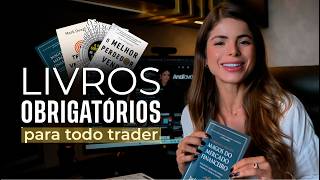

Mindset Over Strategy: The Real Key to Trading
43sChallenges the common obsession with trading techniques, offering a contrarian view that mindset is the true path to profitability.
▶ Play Clip"Title accurately promises book recommendations for trader mindset, and the video delivers exactly that."
In this video, trader Ana Tavares discusses four essential books that transformed her trading mindset and emotional management. She emphasizes that while technique is important, developing the right mindset is crucial for profitability. The books cover topics like probability thinking, risk management, subconscious reprogramming, and accepting losses.
Many traders focus solely on technique, but the most important factor for profitability is developing the right mindset and managing emotions.
Mark Douglas compares the market to a game of probabilities. A strategy with high probability of success must be executed rigorously without emotional attachment to small daily results.
Amateur traders need to feel right; professionals focus on following the plan correctly, knowing that long-term profitability comes from consistent execution.
There is no single right way to trade. Successful traders share impeccable risk management, emotional control, and standardized operations. Choose one strategy and master it through repetition.
Joseph Murphy's book teaches that subconscious beliefs about money and success shape reality. Reprogramming negative beliefs is essential for achieving results in trading and life.
Tom Hogard's book emphasizes accepting small losses and maximizing winning trades. The key is to lose little and win big, developing discipline in both losing and winning scenarios.
Developing a trader's mindset through these four books can significantly improve emotional management and consistency, leading to long-term profitability. Ana encourages traders to focus on mental aspects as much as technique.
What is the central idea of Mark Douglas's book?
The market is a game of probabilities; a high-probability strategy must be executed rigorously without emotional attachment to short-term results.
02:07
What distinguishes an amateur trader from a professional trader?
Amateurs need to feel right; professionals focus on following the plan correctly, knowing long-term profitability comes from consistent execution.
05:46
What common traits do successful traders share according to the Little Book of Market Wizards?
Impeccable risk management, exceptional emotional management, and standardized operations.
07:11
Why is it detrimental to frequently change trading strategies?
Each change resets progress, delaying the consistency that comes from repetition and specialization.
08:08
What is the main lesson from 'The Power of the Subconscious Mind' for traders?
Subconscious beliefs about money and success shape reality; reprogramming negative beliefs is essential for achieving results.
09:05
What does 'The Best Loser Wins' teach traders?
To accept small losses and maximize winning trades; the key is to lose little and win big.
11:24
Market as Probability Game
Fundamental shift in perspective: trading is about probabilities, not certainties, which reduces emotional attachment.
02:07Amateur vs Professional Mindset
Clear distinction between needing to be right vs. following the plan, a key principle for consistency.
05:46Common Traits of Successful Traders
Highlights that risk management and emotional control are more important than specific strategies.
07:11Subconscious Reprogramming
Introduces the concept that deep-seated beliefs about money can block success, even with good strategies.
09:05Losing Well to Win
Counterintuitive idea that accepting losses is a skill that leads to profitability.
11:24[00:02] relentless quest to find the perfect strategy to finally become profitable. What many unfortunately don't understand is that, however important technique may be, it alone is not enough to
[00:16] bring you results. The most important thing you need to develop, if you truly want to become profitable, is your mindset; it's learning to manage your emotions. In this video, I want to show you four
[00:31] books that I read on my journey as a trader and that completely changed the way I trade, but especially the way I see myself, the way I behave in front of the chart. Come with me.
[00:45] Welcome to another video on this channel. My name is Ana, I'm a trader, and I decided to create this content because I always receive many questions from people asking for recommendations on which books I recommend for working on this
[01:00] mental and emotional aspect, which is so challenging. So, I want to start by congratulating you for being here, for being here looking for this content, because whenever I post videos on this channel, most people want
[01:14] technique, technique, technique, technique. And that's always when the views go up. And when I talk about mindset, few people pay it the attention it deserves . This somewhat explains the fact that, unfortunately, only a minority achieve
[01:27] results through their operations. So, just by being here, you can be sure that you 're already a winner, right? And he's really determined and focused on developing what's most important, which is his emotional well-being. But of course, first of all, if you
[01:41] 're not subscribed to the channel, subscribe now and leave a like, it's very important to me. Yes, turn on notifications so you don't miss any news, and also follow me on Instagram @euanatavares. Follow me, I'd be very happy to
[01:55] connect with you. The first book I want to talk to you about is "The Winning Trader," which is basically the same as the classic "Trading Zone," right? The
[02:07] mindset of a successful trader. Yes, the two books are basically the same, by the same author, and have the same content. So, it doesn't matter whether you buy one or the other. What is the central idea of this book by Mark Douglas? He
[02:23] compares the market to a game of probabilities, and says that when a trader begins to understand this, the scenario changes completely. Because what do you need to understand? Because anything can happen in the market, right? right? The market
[02:36] is happening right there, going up and down all the time. If, just by thinking about it, you know that you have a 50% chance of being right in a certain direction, for example, when you have a standardized operational strategy, you increase those probabilities.
[02:52] So, I already have it there, the market can only go up or it can only go down. If I have a strategy that has, for example, an 80% chance of being successful based on the repetition of those patterns, why is it that most
[03:06] people fail to progress and become profitable? Because, unfortunately, most people are unable to strictly follow the plan they themselves have determined. So, what is he saying here? If you have a plan, if you have
[03:19] a strategy, you need to take that strategy and execute it rigorously and coldly, without clinging to small daily results. Why? If a strategy has a high probability of success, it doesn't
[03:34] matter if you were stopped out for one day, two days, three days, or five days. If you follow that operational strategy, in the long run, you will be profitable. Why? Because it's a game of probability. And then he talks a lot about how patterns
[03:49] repeat themselves, right, that we have countless ways to actually reproduce these patterns in the chart. The only thing you need to do is stop focusing on a small result and start thinking about the bigger picture. What I always tell
[04:04] you is to focus on the long term, because if you understand that you already have a 50% chance of winning, even if you close your eyes and just keep clicking up and down, fine, you already have 50%. Now, when I combine that with a strategy
[04:18] that gives me a higher probability, I just need to follow the blessed operational plan, because in the long run, it doesn't matter if I 'm being stopped out today, or if I'm going to be stopped out tomorrow, I'll be profitable. So, when you do that and start
[04:33] thinking about this game of probability, you release your emotions that are attached there, perhaps devastated by a day of losses, and you start thinking: "No, wait a minute, it's okay to lose today, it's okay to be stopped out now." What's
[04:47] important to me is that I know rationally that in the long run, if I continue to follow and execute
[05:00] thinking this way allows you to remove some of the emotional aspect from your execution and start simply following and executing what you have to do in a very rational way, and this automatically brings you much better
[05:14] results. This makes you more accepting of risk, you're not attached to the result, even a small result, and most importantly, you don't need to feel, to sense whether you're right or wrong based on the chart. You just
[05:30] need to follow your plan tirelessly because you understand that that operation there, that day there, is a small sample of the final result, which will be positive from the moment you follow the plan correctly.
[05:46] And the final insight is that the amateur trader has this need to feel that he's right, to feel that he got the trade right. As a professional trader, the only thing he's concerned about is whether he's following the plan
[05:58] correctly, because he knows that by following the plan correctly, whether he 's right or not, he'll be profitable. So, thinking of the market as this game of probability, when you have a good operational strategy, allows you to remove the
[06:13] emotional aspect from the game and start operating rationally, simply doing what needs to be done. The second book is this one here, the little book by the wizards of the financial market, which, when I received it a few years ago,
[06:27] sat on my shelf for months. I didn't pay it enough attention. Until one day another colleague who is a trader recommended it to me, I picked it up to read and I liked it so much that I even made a reading challenge for myself. So, basically, what's the central idea
[06:40] of this book? Basically, the author argues that there is no single right way to trade, that there are many professional traders in the world, each operating in their own way. Some are trend followers,
[06:55] others like indicators, others like technical analysis, others fundamental analysis, and they all get results. Sometimes someone will look at is a good time to buy." The other person will look and say, "This is a good place to sell." But in the end,
[07:11] everyone will get results. Why? What do they have in common? They have impeccable risk management, exceptional emotional management, and standardized operations. And what does he say? What does he stand for?
[07:26] Instead of trying to shoot in all directions, operating a different strategy every hour – something I often tell you – choose an operational strategy that you identify with and follow it
[07:40] for as long as necessary to make it work. Because in the end, what really makes you consistent is the process of repetition. The more you repeat a certain pattern, the better you become at executing
[07:55] it. The more specialized you become in it, the more you become. I know it's often tempting, right? We hear from a different person every time . Sometimes influencer X or influencer Y wants to talk about a trading strategy, or you see that friend of yours
[08:08] who's a trader, who's making a lot of money with a certain strategy, with a certain indicator, and then you get tempted, you want to switch. But understand this: every time you change your strategy, it's like you're
[08:21] regressing, like you're going back to square one and starting all over again, completely delaying your consistency process. So, understand this: choose your strategy, the one you like, the one that makes
[08:35] the one you like, the one that makes sense to you, and focus on becoming very good at executing it, understanding that if you become an expert with sharp risk management, exceptional emotional management, and this
[08:50] standardized operational strategy, you will also be profitable, just like another trader who operates a completely different strategy. It's repetition that will bring you the consistency you need. " The third book is this one here, which I absolutely
[09:05] The third book is this one here, which I absolutely love, The Power of the Subconscious Mind," says Joseph Murphy. Here we move away from the graphic aspect and delve much deeper into the mental aspect, very deeply into what our subconscious has
[09:19] programmed into it. And then he says, right, that if you believe that making money is difficult, that money is something bad, that money is something negative, if your capacity to achieve that particular goal, you probably
[09:35] won't be able to achieve results in anything in your life. Why? The subconscious operates automatically. So, if you don't work on what 's deepest in your mind, you'll most likely
[09:48] keep repeating patterns. Regardless of the profession you want to pursue, you won't be able to be profitable or truly earn and prosper in the way you might expect. And even though it 's not a book specifically for traders,
[10:03] it greatly changed how I saw myself, how I believed in certain things, and in certain beliefs about money. And then he delves into something very profound, especially how you can reprogram those
[10:17] beliefs. Why? When you understand that your reality, your results, are merely a reflection of what's programmed into your subconscious, you realize that no matter how much effort you put in, it's pointless.
[10:31] Sometimes a person is there studying and money, they can't prosper. Why? Because her mental programming, which is in her subconscious, consists of negative beliefs about
[10:45] money and prosperity. So, if she doesn't change that, she'll hardly be able to move forward in life. So, this book provides practical lessons and tasks on how you can reprogram your
[10:58] subconscious to actually begin evolving and achieving the results you want in any area of your life. For me, this was essential in my journey in trading, learning to visualize the
[11:11] results I wanted, learning to visualize where I wanted to be in the I truly believe that this will make a lot of sense for you as well, on this journey towards consistency. And the last book is this
[11:24] wonderful one here, The Better Loser Wins by Tom Hogard, which, by the way, while I'm recording this video, I'm reading the last pages of, and this book, guys, it really captivated me. Because, as the name itself suggests, it
[11:38] basically teaches you, as a trader, how to better manage stop-loss orders and losses. And he says, you know, that the best loser wins. Because what is the central idea? If you truly want to become profitable, if you want to become
[11:53] consistent in day trading, you need to accept small losses, you need to learn to lose a lot, and you also need to learn to win, because unfortunately many people fail to progress, either because they exit a
[12:09] profitable trade too early, or because when they lose, they lose a lot, and when they win, they win little, right? The famous lettuce hand. So here he presents several strategies for when you're in a losing trade, to accept that stop loss so
[12:23] you lose little, and when you 're in a winning trade, to maximize those results even further , among many other lessons on technique and discipline. Wonderful book. I also wanted to say that
[12:37] I want to do a reading challenge next April 2026. I don't know when you'll read it or watch this video, but if you watch it before the start of 2026, you're very welcome to participate. The challenge will be either here on the channel or
[12:51] on my official Instagram, me, Ana Tavares. Follow along there, I'll read that book. We're going to discuss all the most important lessons, and I'm sure it will be wonderful. Well, to wrap things up, a lot of people will
[13:05] want to know where to find these books to buy, in any bookstore buy all my books on Amazon. all of them for anyone who wants to buy them. So, uh, that's
[13:19] it. That's it for today's video. These books are all These books are all essential gems that every trader should read if they truly want to achieve positive results in day trading. Did you enjoy this
[13:32] video format, but chatting here? Did you enjoy this content? So don't forget to leave your like, leave your comment, and I'll see you in the next your comment, and I'll see you in the next video. Kisses, thank you.

⚡ Saved you 0h 13m reading this? Transcribe any YouTube video for free — no signup needed.