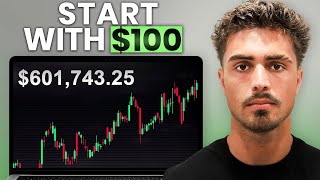

Start Day Trading with Just $100?
45sThe promise of starting trading with only $100 challenges common misconceptions and hooks viewers interested in low-capital trading.
▶ Play Clip"Delivers exactly what the title promises—a practical guide to starting with $100, though it includes some promotional content for a specific prop firm."
This video challenges the common belief that day trading requires a large starting capital, showing how to begin with just $100. The host introduces a student, Sri, who will be guided through the process of scaling to his first $10,000 month. The video covers trading basics, candlestick reading, time frames, and the use of prop firms to leverage small capital.
The host challenges the misconception that you need a large amount of capital to start trading, and introduces a student, Sri, who will be guided to scale from $100 to a $10,000 month.
Sri shares his journey, starting from watching reels to learning trading basics, and mentions the psychological stress of trading with money that is significant relative to his family's income in India.
The host explains that trading is an exchange: buying low and selling high, or selling high and buying back lower. He emphasizes the importance of understanding this fundamental before using tools.
The host introduces TradingView, a charting platform, and explains that candlesticks show the open, close, high, and low of price movements within a specific time frame.
The host explains how to read candlesticks, using examples of up and down candles, and labels the open, close, high, and low for each.
The host explains how time frames work on TradingView, showing that a 4-hour candle represents 4 hours of price action, and switching to 1-hour or 1-minute gives more detail.
The host introduces prop firms, explaining that they let you trade with their money after passing a challenge, which involves hitting a profit target without exceeding a loss limit.
The host selects a $25,000 Lucid Daily account for the challenge, with an end-of-day drawdown and no daily loss limit, costing $100.40.
The host explains the challenge requirements: make $3,000 without losing $2,000, with a 50% consistency rule (split profit across two days).
The host explains the funded stage rules, including a max loss limit of $1,000, no daily loss limit, and daily payouts, allowing for a potential 10x return in 3 days.
The host emphasizes that even if it takes multiple attempts to pass the challenge, the ROI is still high, and encourages viewers to set big goals, as Sri does with his dream of owning a Koenigsegg and retiring his parents.
What is the basic definition of trading?
Trading is an exchange where you buy low and sell high, or sell high and buy back lower.
05:28
What four pieces of information does a candlestick show?
Open, close, high, and low.
09:09
On a 4-hour time frame, what does each candlestick represent?
It represents 4 hours worth of price action.
14:53
What is a prop firm and how does it work?
A prop firm lets you trade with their money after you pass a challenge, which involves hitting a profit target without exceeding a loss limit.
18:18
What are the challenge requirements for the 50K account mentioned?
Make $3,000 without losing $2,000, with a 50% consistency rule.
21:26
What does the 50% consistency rule mean?
It means your total profit must be split 50% across at least two days.
21:53
What is the difference between end of day and intraday drawdown?
End of day drawdown resets your max loss limit daily, while intraday drawdown moves with your account balance in real time.
23:38
What is a key benefit of the funded stage in the Lucid Daily account?
Daily payouts, meaning you can request a payout immediately after a profitable day.
25:47
What is the potential return on investment mentioned for a $100 challenge?
You could potentially turn $100 into over $1,000 in 3 days.
26:20
Start with $100
Challenges the common misconception that trading requires large capital, making it accessible to beginners.
00:01Candlestick Anatomy
Provides a clear, foundational explanation of how to read candlesticks, essential for any trader.
09:09Time Frames
Explains how different time frames affect chart interpretation, a key skill for technical analysis.
14:53Prop Firms Explained
Demystifies prop firms and shows how they can leverage small capital for larger trading opportunities.
18:1810x Return Potential
Illustrates the high ROI potential of prop firm challenges, motivating low-capital traders.
26:20[00:01] can start day trading with just $100. The biggest misconception with trading start with a massive amount of capital in order to make any money, but the goal wrong. And I'm not just going to show
[00:15] you guys and tell you how to do it, but I'm also going to prove it by having a student come on here who only has $100 to start, and the goal throughout this entire series is to help him scale to his first $10,000 month with trade.
[00:28] absolute basic So if you guys are a complete beginner or just need a little refresher, let's get straight into it. Okay, guys, so this is our student, Sri. He is from India and he's still currently living there. So Sri, I want
[00:43] you to introduce yourself and kind of explain how your trading journey has been, have you found any sort of success yet, and what you're looking to do in you along the way. >> Yo, guys. This is Mr. I'm from India and
[00:59] >> Yo, guys. This is Mr. I'm from India and I'm 18 years old. And my journey started like I was when I was trading 11th standard. So at that time I was I was just scrolling reels and that's why I found TJ like laughing
[01:14] there. >> [laughter] >> I was like, "Yeah, what is this?" Then only I started to >> know about trading. Then I searched about trading and tried
[01:27] to learn from different sources. Then only I knew that TJ itself has his own boot camp videos. From that videos I started to learn trading from basics like I used to come into open you and buy and sell like uh I will see
[01:44] sell. If it goes up, I will just buy. Then only I started to learn like what the market actually wants to do in the in the moment. That's how I started to learn about trading. And so
[01:59] all the boot camps video, that's how I learned how to watch the market. It's how the market reacts to the newses. And that's all. For the past 6 months 7 months I have been consistent in
[02:12] trading. Like I have been journaling every trade I have been taking. And I do have the note of taking the trades. I can show you guys later. >> I know that cuz we've talked before. It's difficult to be able to buy funded
[02:26] accounts in India cuz obviously the currency exchange it's like a lot of money. So have you been able to get a payout from a prop firm before? >> Yeah, man. I need to talk about this
[02:40] also. If you are living in India and you are coming from an a family which is not stable you will take at least one or two months to save the money and buy a funded account. And you will be so stressed
[02:54] about trading with that money. While placing every trades you will be so stressed because I have feel that thing and because of that I have lost So yeah, this is the thing.
[03:08] yeah, this is the thing. >> So based on what I'm hearing we have some psychological issues because obviously you know, it's a lot of money to be trading on the on the fundeds and what I want to kind of cover today
[03:23] is go over some of the basic the simple stuff. I know you've gone through my boot camp, which is great. But I also want to cover for some people watching, you know, like just basic
[03:38] started on TradingView and then also cover what a funded account is and pretty much what funded account we are going to get you started up on. So that first ever payout. And explain to explain to us and the viewers what a
[03:55] singular payout from a prop firm of maybe a thousand or three thousand India? >> In India, the average salary is around
[04:07] 30,000 or 40,000. It's rupees I'm telling. If we convert that into USD, [clears throat] it will be around 700 or 800 bucks. >> [gasps] >> really so much in India. So, if I can
[04:20] get then one kill payout or something, it will be really awesome and I will be so lucky to do many things with that thing. I want to buy thing. I want to buy watches and phone to my dad. And
[04:33] >> [clears throat] >> the main thing getting into trading was happy. That's the thing. our goal. That's our goal with this entire series is to be able to make that
[04:47] possible for you. That is a really awesome goal and I'm sure that everybody else watching has a similar goal where whether they want to benefit their own starts with just getting your first ever payout so that you can end up
[05:01] compounding that money. So, in order to do that, we need to figure out first of all, how to even trade, how to have the skill of trading, and then also how we can actually scale our money through prop firms to be able to make a whole
[05:14] lot more. Make like our hundred dollars turn into a thousand dollars or make our dollars and that's exactly what we're going to explain in today's video. First thing we need to explain is what even trading is in the first place. So,
[05:28] obviously trading is going to be an exchange. We want to be able to buy for a lower price than when we sell. And obviously, that's easier said than done. And the nice thing about trading is not only can we make money on price going up
[05:44] when we buy low and then sell high, we can also be able to make money by selling high and buying back our position lower for a profit. And that's really all we're trying to do within trading. If you guys remember back when
[05:59] you were in high school or back during maybe an economics class, you will know that it is an exchange. So, if I want to buy, I need to find someone that is willing to sell to me for that price. And then same thing, when I'm looking to
[06:13] sell, I need somebody that is willing to buy at that price. Now, obviously, sourcing all of that yourself, but we have awesome technology nowadays with
[06:25] brokerages, with prop firms, with all of this new age tech that makes all of these things a whole lot easier, but we need to understand the basic fundamentals of what trading is before we get into the markets and before we
[06:37] just start pressing buy or sell, because if we don't know the basic fundamentals of we want to buy for a lower price and sell for a higher price, then how are we supposed to make money? So, that's really all trading is is our goal is to
[06:50] buy low, sell high or sell high, buy low. And like I said before, that's easier said than done, but we have a whole bunch of tools and a whole bunch of confluences that help us understand this and that actually helps us build
[07:04] out a strategy to be able to predict market movements. And that's what we're going to teach you guys throughout this entire series, teach you guys confluences that help us understand where the market's going to go, when to
[07:16] buy, when to sell, all of that good stuff to help us make money within the explain to you guys how you guys can start with just $100 and turn that into a much larger cap it
[07:30] and turn that into much larger capital to be able to trade with in the future through prop firms. But first, before we do that, we need to see where the price even is in the first place. So, I'm about to jump on the charts and show you
[07:43] guys really quick a really awesome tool called TradingView. This is where we're that we're going to be trading, and I'll give you guys a little brief introduction here. So, this is TradingView. This is the website that we
[07:57] are able to see all of the prices that we were just talking about, how we want to buy low and be able to sell high. Now, obviously, this all looks super super overwhelming right now. So, if I were to show you
[08:11] this chart, you know, most beginner traders, they would look at this and they would say, "What am I even seeing? Like, what what what does this mean?" Like, what what what does this mean?" So, my goal with this video is to one,
[08:24] help you understand what these little things are, which are candlesticks, and then two, help you understand what these candlesticks mean on the chart, and then get into how we can leverage our money to be able to make a whole lot more
[08:39] our next videos, we're going to get into all of our confluences that explain how >> Yeah. >> Sweet. Okay. So, on TradingView, when
[08:53] we're looking at the chart, you'll see that there are two different colored that there are two different colored boxes, okay? For these things are called candlesticks. So, I'm going to quickly explain what a candlestick is and how
[09:09] we're able to identify its anatomy, because every single candlestick shows us four different things, okay? It shows us the open, the close, the high, and us the open, the close, the high, and the low of every of pretty much the
[09:24] entire price movement that was made within a certain time frame. Okay? So, before we look at all of these super scary, intimidating-looking candles, we'll draw we'll draw one out, so it's a lot easier. So, let's have this one be
[09:40] our up candle. Boom. And then let's have this one be our down candle. So, cool. This is our up candle. Up candles This is our up candle. Up candles obviously start and open lower, okay,
[09:56] than where they close. So, the nice thing about TradingView is it will automatically label the color of the candlestick so that we don't have to do too much thinking about what color the candle is or what direction the candle
[10:09] candle is or what direction the candle went, okay? So, for this is our bullish candlestick or our up candle. So, let's go ahead and let's label all four attributes that these candlesticks tell us about what happened with price. So,
[10:25] this line right here, where the shaded >> Yeah. >> is the open, okay? So, this is our candlestick open. Let me make this bigger.
[10:38] open. Let me make this bigger. So, this is where price started when the >> Okay. >> And then at some point in time, it came down here. So, this is going to be our low.
[10:51] This is where price came down to at some point in time. And then also at some point in time when this candle was being made, it came all the way up here. This is the high. And then because we know this was a up
[11:04] candle because of the color that TradingView made, we know that the close was right here at the end of the box. So, what did we just learn by
[11:18] all of this? We have four different things that each one of these candlesticks tells us. We can see that price opened right here. It at some point in time, it came up here to this price. At some point in
[11:32] time, it came down here to this price, but when the candlestick closed, where did it close? Right up here. So, do me a favor and do the same thing, but with candlestick, it's going down, right? So, there's
[11:48] going to be some things that are a little bit different. So, I'll hover my mouse over certain points and you just tell me what they are of the candlestick. So, I'll hover my mouse right over here. What is this?
[12:02] >> Yep, because at some point in time, price came up here. >> Now, what about this? >> That will be the open. As it is selling, right? So, that will be the open. >> Yes, correct. So, this is where price
[12:16] opened. How does he know that? Because price went down. Okay, we know that it's a downwards candlestick. Okay, so, what about this? >> That will be the low that according to the time frame.
[12:31] >> Yep. And then, what about this right here? Obviously, the close. >> That will That will be the close. Yeah. >> Right. So, we have the open. This is where price opened up at. This is where the candlestick started.
[12:45] At some point in time, it pushed up to this price right here, which is the high of the candlestick. And then down here, at some point in time, okay, this was the low of the candlestick, but once the candlestick finished, where did it
[12:58] close? Right here. Now, why are all of these things very important for us to know and very important for us to understand? Because these tell us very important things about what price did. So, if we remove
[13:14] these drawings and we go down, now we single one of these candlesticks. If we see these blue candlesticks, these up candlesticks, we know that price is moving up and we can see
[13:28] on this candlestick right here that this was the open, this down here was the low of this candlestick wick, and then this right here was the high.
[13:42] Okay? And we can do the same thing with our bearish candlesticks. We know where did this bearish candlestick open? Right here. Where was the high? Right here. Where was the low? Right
[13:54] Boom. Right here. Right here. Perfect. So, you're probably wondering, okay, so how does that how does that help us? Well, these candlesticks
[14:08] about price, but they can also show certain confluences that help us We're not necessarily going to get into that today. That's going to be in the next video that we do together, but understanding that all of these
[14:22] candlesticks help us understand where price where price wants to go is super important. The next thing that I want to explain to you is time frames. So, up here we can see that this right here says 4 hours, right? So, when I click
[14:39] down to where it says 1 hour, what happens? Boom, we get way more candlesticks on the chart. Why is that the case? Because up here these time the case? Because up here these time frames dictate how much time each
[14:53] candlestick represents. So, when we're when we're on the 4-hours time frame, what does each candlestick represent? It represents 4 hours worth of price
[15:05] action. So, we know that this candlestick across the 4 hours that it was formed, where did it open? Right here. Where was the lowest point during those 4 hours that it went? Down here. Where
[15:18] was the highest point during those 4 hours that it went? Up here. And after those 4 hours were done, where did it close? Right here. So, now we're understanding a little bit more about candlesticks and how time frames work on
[15:31] TradingView. So, what happens when I click on this 1-hour time frame? Now, instead of seeing every single candle printed for 4 hours, we see a candle representing 1 hour's worth of price action. And we can do this all the
[15:48] way down to the very minute. Now, we can see a super detailed view of what price did over every single minute. We're on the 1-minute time frame right now, so every single one of these candlesticks
[16:02] single one of these candlesticks represents 1 minute's worth of what price did. As we can see on the right-hand side, it's showing when the next candle's going to close. We have 15 seconds left. So, if we look at each one
[16:14] of these candlesticks, we're able to see, okay, during this minute, let's use this down candle really quick. During this minute, where did it open when the minute started? Right here. Where was the highest point that price got to
[16:26] during that 1 minute? Up here. Where was the lowest point that price got to during that minute? Right here. And after that minute ended, where did price close? Right here. So,
[16:38] obviously, this might be a little bit overwhelming, but that is a brief introduction of how to read candlesticks and how to use TradingView to be able to
[16:51] understand where price wants to go. Now, obviously, we haven't gone over any confluences of how to be able to understand and predict where the market wants to move because we're going to take things slow and obviously going to
[17:04] want to get you used to using these platforms and all of that. How do you feel so far with understanding candlesticks, understanding TradingView, understanding different time frames? >> From the topics you have covered now, I
[17:17] can understand from where I can see the markets and how I can read the markets. Like the 4-hour time frame, 1-hour time frame and the minute time frame. From frame and the minute time frame. From there, we can actually get the details
[17:31] >> Okay. Perfect. That's That's literally all I wanted to cover today is just understanding that each one of these candlesticks shows us a little bit of insight of what price did during
[17:46] whatever period of time that we click on TradingView up here. Okay? So, that's a TradingView is actually where we're going to be trading on your funded to get into next is how we're going to be able to leverage your money so that
[18:02] be able to leverage your money so that you can turn $100 into, let's say, $1,000 or maybe $2,000 so that you can be well on your way with what we're going to talk about next. This is a prop firm. Before we get into
[18:18] what all of these crazy numbers mean and what all of this entails, I'm going to give you a little overview of what these are, why these are beneficial, and why it's probably the best tool that you can use when you are just starting out with
[18:33] trading. Imagine you, a up-and-coming trader, say, "Hey, I know how to trade. I just don't have enough money to start." Then a company comes to you and says, "Hey, we'll let you trade with our money, but all you have to do is prove
[18:50] that you're actually good at trading first. So, what you're going to do is we're going to put you through a challenge. But, we can't give you our money to trade with unless you send us some money in the first place. So, in
[19:04] order to even take that challenge, you need to give us or pay the challenge fee. And if you're able to pass this challenge, then we will give you money for you to be able to trade with so that you can make a whole lot more. Sound
[19:20] >> Sounds like Sounds like a pretty freaking good deal, right? Sounds almost too good to be true. And the reason why it sounds too good to be true is because some people think that they're really good at trading, but they actually are
[19:35] not and they end up trying to pass these accounts and what happens they end up losing. So, what happens when you lose these accounts? You lose the money that you invested into it, which obviously freaking sucks. If you are good at
[19:49] trading and if you can prove yourself to these prop firms, then there's going to be a massive reward that you can get from these things because you're able to be able to trade with dollar amounts like $50,000 or $100,000 or $150,000
[20:06] and that is obviously going to help you to be able to make $1,000 or $2,000 or $3,000 when you're trading with their capital. So, again, if you have little to no capital, then this is going to be a
[20:21] great place for you guys to start. You guys can go to a prop firm. This is Lucid Trading. You guys can use code TJR for 40% off when you guys are signing up to these guys, but these accounts are super super useful because if we are
[20:35] good at trading, if we know exactly what we're doing, then we're able to buy a challenge to be able to prove that we're good at trading and then be able to trade with a whole lot more money. So, the accounts that I have loaded up here
[20:47] are the Lucid Daily accounts and I think these are the ones that we should be trading on. These are new accounts that Lucid actually made and in my opinion, they're some of the the best accounts that you can trade with right now. I
[21:01] don't know how they were able to do this, but honestly, it's a it's a a this, but honestly, it's a it's a a crazy deal. So, these daily accounts are really awesome because within the challenge phase, so like I said before,
[21:13] challenge. Within the challenge phase, all you need to do is make a certain amount of money without losing a certain amount of money. The account that we're probably going to use is going to be a 50K
[21:26] account. Okay? So, that means if we're able to pass the account challenge, then you will be able to trade with $50,000. Our challenge is that we need to make Our challenge is that we need to make $3,000 without losing $2,000.
[21:41] There's one other catch here, which is the consistency rule, which is a 50% consistency rule. A consistency rule just means that our total profit amount
[21:53] just means that our total profit amount needs to be split up 50% in order for us to be able to pass this account. So, what does that mean? That means we need what does that mean? That means we need to trade two times, once on the first
[22:05] day, and then another time on the second day to be able to split our profit evenly 50% in order to pass this challenge. That's just That's the bare minimum. Okay? So, realistically, what does that mean for us? If we have a
[22:17] profit target of $3,000, we need to make $1,500 on the first day, and then $1,500 on the second day, all while not going down $2,000 total.
[22:30] Seem pretty easy? >> Yeah, it's pretty easy and awesome. >> Yeah, pretty pretty easy until it's not, until it gets really difficult, right? So, another cool thing about these accounts
[22:42] is they let you choose if you have a intraday drawdown or an end of day drawdown, and also if you have a daily loss limit. So, this also dictates the total price of this account. Obviously, for this challenge, we want to start
[22:56] for this challenge, we want to start with just $100. So, the goal is to make sure that our challenge costs less than 100 bucks. So, our I'll set it up for the most favorable. So, the most favorable is over
[23:10] 100 bucks. Let's see what this gives us to $100.40. you're pretty much right there at 100 and $100.40.
[23:24] So, we're going to be doing a $25,000 daily account. Now, I selected an end of day drawdown, which means our max loss limit gets rebooted back up at the end
[23:38] of every single day instead of intraday because obviously intraday makes it harder for us to pass the challenge because if our drawdown is intraday, then that means our drawdown keeps moving up as our account balance goes up
[23:52] in profit and goes down in profit. So, we're going to go with an end of day drawdown because it makes the challenge a little bit easier to pass. We are also not going to have a daily loss limit because we're going to be trying to hit
[24:05] this profit target as quick as possible and with a daily loss limit, it makes it difficult to be able to hit this profit target as quick as possible. Sound like >> Yeah. >> Sweet. So, before we jump into getting
[24:21] on this account, what I also want to go over is what happens when we pass the account and how we can actually benefit from just spending $100 to be able to get a really awesome payout that is potentially a 10x return on our money.
[24:37] So, if we click on the funded rules, we can see that there is can see that there is a max loss limit of $1,000. So, if we end up hitting this, if we end up losing $1,000 total on the account, what
[24:52] happens? We end up losing the account and we're we're to have to take another challenge. Obviously, we're going to try to avoid this at all costs. This stands for daily loss limit. There is no daily loss limit on the funded stage, which is
[25:05] loss limit on the funded stage, which is amazing. And then we have a intraday drawdown on the funded stage, um which is a little bit annoying, but it's not too bad if we're quickly in and out of our trades. And as long as we're
[25:19] be all good. And you know, that's going to be our goal is to take lower risk to reward trades, which I'll explain a little bit later how we're even going to be taking those trades as a whole. But this shouldn't be much of an issue. And
[25:32] then the nice thing about once we're on the funded account, once we're on the stage where we can actually make money, is that there's a no consistency rule. And another nice thing about this funded is that we are able to get daily
[25:47] payouts, which is absolutely insane. So, technically, if we hit a big trade on the very first day, we could be eligible to be able to request a payout immediately. So, what does that mean? That means that we could hypothetically
[26:03] pass this account in 2 days by hitting this consistency rule, and then hit one banger trade the very next day and get a payout from it, which is really, really crazy. So, we could hypothetically turn your $100
[26:20] into potentially over $1,000 and 10x your money in the span of 3 days. Sounds pretty cool, right? >> turning the money into three times. >> Literally. So, this is how and this is
[26:35] literally the best way for you to take just a couple hundred bucks to be able to literally 10x your money, like I said, in as little as 3 days. You can take $100 right here, pay for this account challenge, pass the account
[26:49] challenge in 2 days by making sure you're within this consistency rule. And then once you get onto the funded stage, you could technically hit a trade that makes you $1,000 total and request that as a payout that same exact day because
[27:04] it offers daily payouts. That means that you could 10x your money that you put into that challenge over the course of 3 days. And that's why prop firms are so days. And that's why prop firms are so valuable and so important to younger and
[27:17] just low-capital individuals that are trying to start out with trading. So, that is our entire goal with this series is to be able to help you start with $100. Now, obviously, I don't expect us to be able to pass this account in one
[27:31] try. So, it might take a couple tries for us to be able to pass this account, which is okay. If we're able to pass this, let's say it takes us three tries, right? That's $300 that we spend on challenges. But, if we get a $1,000
[27:45] payout, that's $700 in total profit. That's still a really good ROI on our money, right? I really don't know any other anything else within the the trading space that could give you pretty
[27:59] much an instant 10x on your money like funded accounts can, especially in today's day and age to be able to capitalize on something like this. It's that you have on funded accounts, on TradingView, what trading is before we
[28:15] go into our next video within the series? I don't know. I have learned >> that I can see the market and how I can use the TradingView actually, what are the time frames, and what the candle actually explain to me. And now I have
[28:29] learned that what the prop firm is and how they support individual traders So, yeah, it's pretty awesome. >> Okay, sweet. Now, before we wrap up this video, I want I know you talked about it a little bit,
[28:44] but I want you to talk about right now because right now you don't necessarily have anything. You haven't made any money from trading. So, I want to for
[28:57] you to use this moment as a second to like give a little message to yourself in the future and say, you know, like what is your life going to be looking like over the next couple months once you're able to start getting payouts
[29:10] consistently and once you're able to actually, Like where do you see yourself in the future once we can actually get all of manifest it, right? Cuz that's that's our entire goal here is to get you to
[29:25] $10,000 months with trading which I know in India, you know, like that would make you pretty much be living in a crazy crazy life, but all of it is possible and it starts right here. So, >> I do have some plans in my mind. Like I
[29:40] do have before 2030, I will be owning a Koenigsegg and I've been manifesting like the couple of months and I've been writing in my note actually.
[29:52] Yeah, my manifestation is really true and everybody should do that thing. Be delusional about your dreams. It will be at one at one about that thing and I can see within
[30:07] two or three years, I will be in some point where I will be helping the help them and retire my parents actually. That's the main goal. >> And And how how much money would it take to
[30:22] be able to like, let's say, retire your parents or help your parents be able to retire? >> If I'm able to make around 2K or 3K, it's pretty much more than enough to retire my parents.
[30:36] But my goal is to scale up to 10K a month, then in Yeah. >> Awesome. We got some big goals and big Um you know, it's good. You always want to set big and massive goals for
[30:50] yourself because, you know, if somebody else was able to do it, why can't you? So, if you guys made it this far, make sure you guys drop a like, drop drop a next video. Make sure you guys subscribe so you guys can stay along with this
[31:03] entire challenge and with this entire journey that me and Sri are going to take on together. Everybody drop a W in W Sri in the comment section. >> Um you guys are going to be seeing him a lot more on the channel as we keep going
[31:15] appreciate you guys. I'll catch you guys in the next one. Peace out.
⚡ Saved you 0h 31m reading this? Transcribe any YouTube video for free — no signup needed.