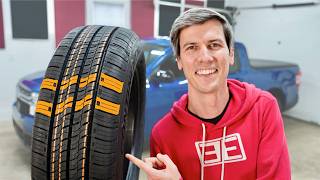

Tires Aren't Even Top 5 for Tire Wear!
57sReveals the counterintuitive ranking of factors affecting tire wear, making viewers question their assumptions.
▶ Play Clip"Title is a bit sensational but content delivers a thorough explanation with concrete data and testing insights."
This video explores the science of tire wear, using Continental's longest-lasting tire (TrueContact Tour 54) as an example. It covers how wear occurs, the factors that influence it (with driving style being the most important), and how tires are designed to maximize mileage. The video also explains how Continental determines tire warranties and whether a tire could theoretically last 100,000 miles.
Sponsored by Continental; aims to clarify tire wear using their longest-lasting tire as an example.
What is tire wear? What are main factors? Which vehicle minimizes wear? How to design a long-lasting tire? How is warranty determined? Can a tire last 100,000 miles?
Continental TrueContact Tour 54 has up to 80,000-mile warranty, longer than most engine warranties.
Wear is removal of material due to friction. Each rotation involves a force-slip cycle: leading edge contacts, rubber stretches, then slides as it leaves pavement, generating friction and wear.
1. Driving style (most important). 2. Road curviness/topology. 3. Road surface. 4. Vehicle. 5. Tire design. 6. Temperature. 7. Wet/dry conditions.
Small, light, zero toe and camber, even weight distribution, all-wheel drive (splits torque among four tires, reducing wear per tire).
Large vehicles often have larger tires with more mass, so mileage can be similar despite higher volume wear.
More tread depth gives more volume to wear through, increasing mileage.
Lower glass transition temperature (softer compound) reduces wear but may reduce grip. Summer tires have higher T_g and more grip but wear faster.
Less void (gaps) reduces wear and increases material to wear, but compromises wet/snow grip. Tread design balances grip and wear.
Flatter profile spreads forces evenly, minimizing wear. Contoured tires better for hydroplaning but may wear center faster.
Belt angles, number of belts, materials affect stiffness and wear rate.
Up to 80,000 miles for T/H speed ratings, 70,000 for V rating. Conditions: within 72 months, even wear to 2/32nds, regular rotation every 6-8k miles, proper alignment.
Continental runs 180 vehicles on a 719 km route (60% highway, 40% country roads). Wear initially faster, then becomes linear, allowing mileage prediction.
Yes, theoretically, with gentle driving on straight flat roads, light vehicle, and long-lasting tires. However, tires have a shelf life (replace after 10 years).
Maximizing longevity sacrifices wet grip and other performance aspects. Tire engineering is about balancing compromises.
Tire wear is a complex trade-off between mileage, grip, and safety. While a 100,000-mile tire is possible under ideal conditions, real-world factors like driving style and environment dominate. Continental's 80,000-mile warranty reflects extensive testing and engineering compromises.
What is the most important factor influencing tire wear?
Driving style.
02:55
Explain the force-slip cycle that causes tire wear.
As the tire rotates, the leading edge contacts the road, the tread stretches under force, then slides as it leaves the pavement, generating friction and removing material.
01:45
Why does all-wheel drive reduce tire wear?
Torque has a quadratic impact on wear; all-wheel drive distributes torque across four tires instead of two, reducing the force per tire.
04:22
How does tread depth affect tire mileage?
More tread depth provides more volume to wear through, increasing mileage, despite potentially higher wear rate.
06:29
What is the glass transition temperature and how does it relate to tire wear?
The temperature at which the compound changes from rubbery to glass-like; lower T_g reduces wear but often reduces grip.
07:01
What are the conditions for Continental's 80,000-mile warranty?
Tire within 72 months of purchase, even wear to 2/32nds tread, regular rotation every 6-8k miles, proper alignment.
11:02
How does Continental estimate tire mileage for warranty?
By testing on a 719 km route with 180 vehicles, observing that wear becomes linear after initial break-in, then extrapolating.
11:30
Driving Style is #1 Factor
Counterintuitively, the tire itself is only the fifth most important factor; driver behavior dominates wear.
02:55Quadratic Impact of Torque on Wear
Explains mathematically why AWD reduces wear significantly compared to FWD or RWD.
04:22Tread Depth Paradox
More tread depth means more volume to wear, but also higher wear rate; net effect is increased mileage.
06:29Glass Transition Temperature Trade-off
Lower T_g reduces wear but sacrifices grip — a key engineering compromise.
07:01Warranty Testing Methodology
Continental's real-world testing on public roads with multiple drivers ensures accurate mileage predictions.
11:30[00:02] triggers one of the most complex interactions that occurs in the realm of Automotive Engineering not only how a tire generates grip but even more so how it wears is a wildly complicated and equally fascinating subject in this
[00:17] video sponsored by Continental I aim to provide Clarity on the subject of tire wear using their longest lasting Tire as an example which will differ quite a bit from say an ultra high performance Tire I spent time at multiple Continental
[00:32] Proving Grounds on various test tracks and had discussions with quite a few Engineers all in hopes of getting a grasp on the subject of tire wear specifically I wanted to answer the following questions what is tire wear
[00:45] and how does it work what are the main contributing factors to tire wear the tire itself does not top this list and it's not even close what is the ideal vehicle for minimizing tire wear how can you design a tire to last a long time
[01:00] how do you determine how long a tire lasts and thus its warranty and finally could a tire last 100,000 Mi so the tire I'm going to use to help answer these questions is the true contact tour 54
[01:14] and as mentioned it is continental's longest lasting Tire with up to an 80,000 Mi warranty and that alone is pretty wild because we're talking about a wear item that has a longer warranty than most combustion engines which
[01:29] typically are warranteed for 60,000 Mi not to mention plenty of vehicle warranties are only 36,000 Mi so they're quite confident it will have low wear so what is wear and how does it occur tire wear is the removal of material from the
[01:45] tire and it occurs due to the friction generated between the tire and the road it is not nearly as simple as it sounds but will provide a very basic overview every time the tire rotates the surface of the tire under goes a Force slip
[02:00] cycle it all starts with the Leading Edge of the tire contacting the ground as the tire continues to rotate that initial contact of the tire tread starts to stretch out as you apply a force with the tire to accelerate the vehicle
[02:14] eventually this stretched rubber must return to its initial State as it begins to leave the pavement while the tire rotates this causes the rubber to slide the force applied to the rubber in conjunction with the amount it slides
[02:28] generates friction and wears the tire as it scrapes along the road the greater the forces involved whether that be accelerating or breaking or cornering and the greater the sliding that occurs the more frictional energy you generate
[02:41] and thus the more wear you will have now what you might be surprised to learn is that the tire is only the fifth most important factor when it comes to tire wear leading to our second question what's the most influential Factor on A
[02:55] tire's wear rate it probably won't shock anyone that driving Style is the most important factor when it comes to tire wear after all if you do a burnout you can ruin a tire in a matter of minutes if not seconds the more aggressively you
[03:10] drive the faster your tires will wear simple as that but what did surprise me is how far down the list Tire design is in terms of impact after driving style is Road curviness and topology basically twisty roads with lots of undulations
[03:25] you'll have more wear versus a flat straight line You'll have less wear next is the road surface a rough road surface will cause more wear than a smooth surface though a rough surface also tends to offer better grip especially in
[03:39] wet conditions fourth most important is the vehicle selected which is slightly more important than the tire selection followed by temperature and finally whether the road is wet or dry now that led me to a very interesting question
[03:53] what is the ideal vehicle if you wanted to minimize tire wear Continental says you'd want a car that's small and light minimizing the vertical load on the tires and thus the amount of frictional energy the tires will see you want zero
[04:07] tow angle and you want zero camber while there are very good reasons why you want to use toe angles and Camber angles from a wear perspective both can eat up tires and cause uneven wear finally you'd want the vehicle's weight to be evenly
[04:22] distributed and you'd want all-wheel drive you might be curious why all-wheel drive is beneficial well torque and in other words the force you apply with the other words the force you apply with the tires has a quadratic impact on wear so
[04:35] as you apply a greater force to the tires it's not a linear impact on how much wear you have it's much greater so with front-wheel drive or rear wheel drive even if you regularly rotated your tires you'd still have more wear versus
[04:49] all-wheel drive that's because you're putting all of the driving torque on two tires instead of four significantly increasing those two tires wear rate now there's kind of an interesting real world Paradox that occurs when it comes
[05:03] to vehicle selection because if you're used to driving large Vehicles you might have found that your tires end up lasting just as many miles as some of the smaller Vehicles you've driven so why is that well larger Vehicles tend to
[05:16] have larger tires and these larger tires have more Tire Mass right because a larger diameter tire and a larger width tire is simply going to have more Tire volume to wear through so while a large vehicle and a small vehicle May both get
[05:32] 50,000 Mi out of the same model of a tire if you were to take all of the worn-off tire particles of both vehicles the larger vehicle would have more tire wear by volume but it's all relative since you start with more Tire to begin
[05:47] with so typically you'll find that even if you drive a larger vehicle from a mileage standpoint your tires can last just as long this leads us to the meat of this video the big question how do you design design a tire to last a long
[06:01] time this is a complicated question because like all great engineering problems there is a compromise at work okay so your goal of course is to maximize how many miles a tire can travel you might think then obviously
[06:14] your goal is to reduce the tire's wear rate as much as possible which is true most of the time okay but take for example the tread patterns depth which is an exception to the rule so here we have an allseason touring Tire
[06:29] continental's longest lasting Tire with plenty of tread depth and here we have a summer Performance Tire which has less tread depth as it turns out lower tread pattern depth results in less tire wear but more tread depth means you have more
[06:46] tread volume to wear through so generally speaking if you have less tread depth you get less mileage okay so tread depth with more being better is our first of five ways we're going to increase a Tire's mileage of course the
[07:01] tire compound is critically important if you reduce the wear rate you improve the mileage generally speaking when it comes to the compound the strategy is to lower the glass transition temperature this is the temperature where the compound goes
[07:15] from a softer rubbery like state to a much harder glass-like state so again typically a compound with a lower glass transition temperature will have less wear and as a result better mileage this is because the more elas plastic you
[07:29] keep the compound the more it's able to stretch and deform with the road without breaking apart under normal driving conditions now this is typically at odds with grip so for example summer Tires have higher glass transition
[07:44] temperatures and they have more grip but they also tend to wear faster all right third let's look at void volume so tread void is the gaps of space between the raised tread blocks of the tires if you had a slick tire so no no grooves or
[08:00] cypes at all well not only does that mean you reduce your wear rate but it also means you have more material to wear through so you can really improve how many miles a tire lasts by decreasing the void volume as much as
[08:13] possible but of course there's a compromise at work because these tread grooves like these main grooves are critical for water evacuation and thus wet grip cypes are also important for wet grip as well as snow grip as you can
[08:28] imagine if you start to add lots of cuts and pypes these tread blocks become less rigid and so they're more likely to wear so tread design is all about optimizing for grip in the tire's intended conditions while balancing wear concerns
[08:43] fourth we have the tire's Contour basically the profile of the tire when looked at from the front so whether that's flat or more rounded minimizing tire wear is all about spreading out all of the forces so as you can imagine a
[08:57] flatter profile does this this better minimizing wear and maximizing mileage also even wear is important so if you have a highly contoured Tire you might wear out the center first so even if you have remaining tread on the sides of the
[09:11] tire well you have to replace it because you've worn out that Center too quickly there are benefits to a contoured tire though as it tends to do a better job in wet conditions especially when it comes to avoiding hydroplaning as the Contour
[09:25] forces water out to the sides of the tire finally the tire's intern construction can also be optimized for both wear and mileage so the angle of the belts you use the number of belts the materials selected all of this
[09:39] impacts the tire stiffness and consequently how quickly it wears what remains obvious when looking at these five different factors is that everything is a compromise and making tires is hard you can't make one tire
[09:53] that does absolutely everything perfectly that's why there's such a variety of tires out there now when Continental makes all of these different optimization choices when creating their longest lasting tires sold today that
[10:06] still manages solid grip in dry wet and even light snow they end up offering up to an 880,000 MI warranty on it so how do they get to this number and what are the conditions to meet the warranty well first of all the reason why I say up to
[10:21] first of all the reason why I say up to 880,000 Mi is because not all variants of this tire are warrantied to 880,000 Mi if it has a t or an H speed rating like this tire here which fits my truck it's rated for 880,000 Mi but if it has
[10:36] a v speed rating meaning it can handle higher speeds then the warranty is higher speeds then the warranty is 70,000 Mi each tire size really is unique so tires with higher speed ratings are designed with that Speed and
[10:48] Performance in mind sacrificing mileage to improve high-speed handling a tire will have numerous design changes many of which conflict with mileage okay but let's just stick to to this tire here with its 80k warranty what do you
[11:02] actually have to do to remain within the terms of the warranty pretty straightforward the tires need to be within 72 months from the date of purchase evenly worn down to 230 seconds of the tread remaining and with records
[11:15] of the tread remaining and with records of regular rotation every 6 to 8,000 Mi need to ensure your wheels are properly aligned since alignment issues will cause uneven tire wear as far as how Continental reaches that 80,000 number
[11:30] it all comes down to testing I visited their Proving Grounds in Uvaldi Texas where they currently had 180 vehicles running wear testing these vehicles would drive on a repeated 719 km test route on normal roads comprised of 60%
[11:45] Highway and 40% country roads with various test drivers to accumulate Miles when a tire is new it starts to wear a bit faster and then eventually that wear starts to flatten out and you have linear wear of the remaining tread life
[12:00] so once Continental has seen okay we've hit linear wear they can then estimate how long that tire is going to last if you do this enough times with enough Vehicles over enough miles with enough drivers you can get really accurate
[12:14] mileage predictions so that's what goes into building this 880,000 Mi warranty okay but when I heard about a tire that could last 80k I couldn't help but could last 80k I couldn't help but Wonder Could a tire last a 100,000 mil
[12:27] based on everything we've learned from this video I think the obvious answer is yes after all tires aren't even the most important factor in tire wear the driver important factor in tire wear the driver is so if you had a long Highway commute
[12:40] that was basically just a straight flat line with few curves and you drove gently and you had a relatively lightweight vehicle with long lasting tires on it I mean why not now part of this would of course be how quickly you
[12:54] accumulate these miles as tires have a shelf life Continental recommends that all tires including spare tires that were manufactured more than 10 years ago should be replaced with new tires and just as a personal anecdote I've
[13:07] attended high performance driving events where they won't even let you drive if your tires are more than 5 years old now it's also worth mentioning that just because this tire has an 880,000 MI warranty doesn't mean that's where Tire
[13:20] technology tops out at you could build a tire that lasts longer but of course that comes with sacrifices for example this tire still has an a traction rating meaning good wet grip the most important factor for wet grip is the compound you
[13:35] select but if you create a compound that maximizes wet grip well then you're sacrificing the tire's longevity grip and mileage are always battling so you have to make a conscious decision of where you want the tire to end up to me
[13:50] it's part of why I'm so fascinated by tires because everything about them is an engineering challenge and the name of the game is to figure out how to best optimize them for all the different scenarios in terms of performance
[14:03] nothing is more important for your car and I'm going to have a really cool video soon to demonstrate exactly that huge thanks to Continental for partnering on this video and providing so much access to their expertise if you
[14:16] have any questions or comments feel free to leave them below thanks for watching



⚡ Saved you 0h 14m reading this? Transcribe any YouTube video for free — no signup needed.