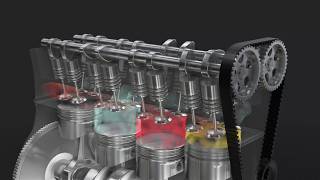

The Four Stroke Cycle Explained
53sThis is a fundamental, visual explanation of how car engines generate power, satisfying curiosity and often misunderstood.
▶ Play Clip"Title is accurate; the video delivers a thorough, clear explanation of how a car engine works."
This video by Jake O'Neal of Animagraffs explains the fundamental operation of a car engine, starting with a single piston and the four-stroke cycle, then expanding to the full engine and its supporting systems.
The engine operates on a four-stroke cycle: intake (piston descends, draws in air-fuel mixture), compression (piston rises, compresses mixture), power (spark ignites, forcing piston down), and exhaust (piston rises, expels spent gases).
Multiple pistons fire in a specific order (e.g., 1-3-4-2) for smooth power delivery. Camshafts, cam gears, and a timing belt/chain synchronize valve operation with the crankshaft.
The engine relies on air intake (filter, manifold), fuel system (pump, filter, injectors), cooling (coolant channels, radiator, thermostat), electrical (spark plugs, coil pack, ECM, alternator, battery), oil (lubrication, pump, filter), and exhaust (manifold, catalytic converter, muffler).
The video provides a clear, visual explanation of how a car engine works, from the four-stroke cycle to the supporting systems that keep it running.
What are the four strokes of a car engine cycle?
Intake, compression, power, exhaust.
0:17
What is the firing order for the engine shown in the video?
1-3-4-2.
1:32
What component translates piston power out of the engine?
The crankshaft.
1:56
What does RPM stand for?
Revolutions per minute – the number of full crankshaft revolutions per minute.
2:07
What is the function of the ECM (engine control module)?
It directs core engine functions like spark timing, valve timing, and air-to-fuel ratio.
5:36
What is the purpose of the alternator?
It converts mechanical energy into electricity to charge the battery and run electrical systems.
5:45
What does the thermostat do in the cooling system?
It regulates coolant temperature by routing coolant back through the engine or to the radiator.
4:51
What is the role of the oil filter?
It keeps oil clean from contaminants.
6:45
What does the catalytic converter do?
It captures toxic chemicals in engine exhaust.
7:17
What is the function of the muffler?
It reduces exhaust noise.
7:23
Four-Stroke Cycle Explained
Clear, step-by-step breakdown of the fundamental operating cycle of a car engine.
0:17Crankshaft and RPM
Explains how piston power is translated and what RPM measures.
1:56Supporting Systems Overview
Comprehensive look at air, fuel, cooling, electrical, oil, and exhaust systems that enable combustion.
2:55[00:00] I'm Jake O'Neal, creator of Animagraffs.
[00:07] Let's start at a single piston, the powerhouse
[00:14] The four stroke cycle
[00:17] When a piston travels to the end of its
[00:24] Car engines use a four stroke
[00:30] First, intake. The piston descends, sucking
[00:36] through the intake port,
[00:42] Next, compression. With all valves
[00:48] compressing the fuel and air mixture
[00:54] Then, the power stroke. An electrical spark
[01:02] and the resulting combustion forces the
[01:07] A connecting rod transfers
[01:12] Finally, exhaust. The piston comes back up,
[01:17] pushing the spent mixture out through
[01:23] Connecting multiple pistons
[01:26] For smooth power delivery, pistons take turns
[01:32] is 1-3-4-2. Camshafts with specially shaped
[01:45] Cam gears and a timing belt or chain
[01:51] and it all spins together.
[01:56] The crankshaft translates
[02:00] It has counterweights to balance against the
[02:07] This is what RPM means -- we're counting the
[02:16] The engine block holds the crankshaft
[02:21] head holds valves, ports, cams, etc.
[02:28] crankshaft for connection to a transmission. It's
[02:36] This engine has four cylinders
[02:40] But there are many other possible configurations,
[02:46] in a V shape. Or eight. Despite different design
[02:55] Now let's look at the other systems
[03:03] Air intake
[03:10] and then into the intake manifold where
[03:15] into individual cylinders through intake ports.
[03:25] Fuel
[03:36] through a fuel filter, to the engine
[03:39] where fuel injectors emit a precisely
[03:54] Cooling
[03:58] and require a cooling system. Coolant channels
[04:05] heads carry a special liquid called "anti-freeze"
[04:12] (It's called anti-freeze because
[04:18] After cooling hot engine parts, coolant
[04:23] The radiator has a network of small tubes and
[04:30] air (pulled in by the radiator fan) flows by the
[04:44] A water pump keeps the coolant system
[04:51] The thermostat regulates coolant
[04:55] through the engine or to the
[05:02] Electrical
[05:05] The spark plug delivers the electrical spark
[05:11] The metal core is insulated from the
[05:15] The spark jumps between these conductive surfaces.
[05:27] spark plugs as directed by the ECM (engine
[05:36] directs many core engine functions like spark
[05:45] The alternator works like a power generator,
[05:50] electricity to charge the battery or run other
[05:59] The battery provides power to
[06:07] Oil
[06:11] clean, prevent corrosion, improve sealing, and
[06:16] parts. Rings around the top of the piston head
[06:25] otherwise allowing the cylinder to be lubricated.
[06:30] engine block and cylinder head that
[06:38] Oil flows through the engine and back
[06:41] The oil pump keeps oil properly
[06:45] Oil rests in the oil pan when not in circulation.
[07:04] Exhaust
[07:10] The exhaust manifold collects gases
[07:17] Exhaust flows through the catalytic converter,
[07:23] And then out through a muffler
[07:29] Full model
[07:31] here's the full functioning engine with
⚡ Saved you 0h 07m reading this? Transcribe any YouTube video for free — no signup needed.