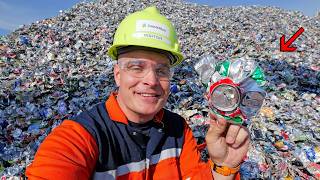

Why water in aluminum furnaces explodes!
50sThe dramatic warning about liquid water expanding 1000x into steam creating explosive silvery lava bubbles is visually shocking and highly shareable.
▶ Play Clip"The title promises a surprising truth, and the video delivers with impressive stats and a full tour of the recycling process."
This video takes you inside Constellium, one of the largest aluminum can recycling facilities in the world, to show the entire process from bales of used cans to finished coils of aluminum. It highlights the energy savings, the importance of proper recycling, and the surprising fact that aluminum is infinitely recyclable.
Constellium in Alabama has been recycling aluminum for 90 years and is one of the largest used beverage can recyclers globally.
Aluminum is infinitely recyclable; 75% of all aluminum ever mined is still in circulation.
Each bale weighs about 1,000 lb and contains about 30,000 cans. Americans consume about 100 billion cans per year.
A grapple excavator shreds bales, then a front loader drops cans onto a vibratory conveyor. Shredding ensures no liquid remains, which could cause explosions in furnaces.
A tumbler delaminates cans, stripping paint and enamel before they fall into the furnace. Stomping feet press scrap into molten metal.
Aluminum melts at about 1,220°F. Workers wear aluminumized suits to reflect heat and protect from splashes. Liquid water in furnaces expands 1,000 times, causing explosions.
Recycling aluminum uses 95% less energy than mining new aluminum, with 95% fewer emissions.
Manganese is added to maintain alloy consistency; pink salt acts as a flux to collect contaminants that are scraped off.
Constellium recycles about 1 billion pounds of aluminum per year, operating 24/7.
USA recycles only 43% of aluminum cans, compared to Canada 71%, UK 80%, and Brazil nearly 100%. About 60 billion cans go to US landfills yearly.
Molten aluminum is poured into a rectangle in the ground, cooled by misters, and solidified into 40,000 lb ingots without molds, using electromagnetic fields for smooth finish.
Ingots are reheated and hot-rolled with a 10,000-ton rolling mill, flattening and lengthening the aluminum into coils.
After hot rolling, the aluminum is cold-rolled into thin sheets and coiled. Constellium produces about 3 million pounds of finished coils daily.
A recycled can can be back on the shelf as a new can in about 60 days if properly recycled.
Recycling aluminum cans is highly efficient and environmentally beneficial, but the low US recycling rate means we miss out on significant energy savings and domestic supply security. Proper recycling is crucial for sustainability.
What percentage of all aluminum ever mined is still in circulation?
75%
00:38
How many aluminum cans does the average American consume per year?
About 100 billion cans per year.
01:04
Why is it important to remove all liquid from cans before melting?
Liquid water expands about 1,000 times in volume when turning to steam, which can cause explosions in the furnace.
03:28
How much less energy does recycling aluminum use compared to mining new aluminum?
95% less energy.
04:10
What is the US aluminum can recycling rate?
43%
06:02
Which country has the highest aluminum can recycling rate?
Brazil, with nearly 100%.
06:19
How much does each aluminum ingot weigh?
40,000 lb (about 18,000 kg).
06:37
What is electromagnetic casting?
A process where molten aluminum is poured into a rectangle in the ground and solidified using magnetic fields without touching mold walls, giving a smooth finish.
06:57
How long does it take for a recycled can to become a new can on the shelf?
About 60 days.
09:49
How many pounds of finished coils does Constellium produce daily?
About 3 million pounds.
09:43
Infinite Recyclability
Highlights the sustainability of aluminum as a material.
00:3895% Energy Savings
Quantifies the environmental benefit of recycling over mining.
04:10US Recycling Rate Disappointment
Reveals a stark contrast between US and other countries' recycling efforts.
05:53Electromagnetic Casting Innovation
Demonstrates advanced manufacturing technology.
06:57[00:12] Today we're going to find out what
[00:15] really happens to recycled aluminum
[00:17] cans. It's probably a little different
[00:20] than you might think.
[00:23] It all starts right here in Alabama with
[00:25] Constellium and an aluminum recycling
[00:27] facility that's been here in the USA
[00:30] recycling aluminum for the past 90
[00:32] years. They are currently one of the
[00:33] largest used beverage can recycling
[00:36] facilities on the planet. Since aluminum
[00:38] is infinitely recyclable and 75% of all
[00:42] aluminum ever mined is still in
[00:43] circulation today, there's a very good
[00:45] chance that the cans you see here in
[00:47] these bales have already been through
[00:49] these fiery furnaces more than once. And
[00:52] it's time for them to ride the roller
[00:53] coaster of rebirth yet again. Behind me,
[00:56] each of these bales weighs about 1,000
[00:58] lb and contains about 30,000 aluminum
[01:02] drinking cans. Here in the United
[01:04] States, Americans consume about 100
[01:07] billion cans a year, and they need to be
[01:10] recycled somewhere. The big bales of
[01:12] cans are offloaded from semi-truckss and
[01:14] stacked neatly, positioned in rows,
[01:17] ready for their turn to be grabbed by
[01:19] the claw.
[01:25] The claw is really a grapple excavator
[01:28] that shreds full bales of cans to get
[01:30] them ready for processing. Thumbs up for
[01:32] that cool machine. Once the bales are
[01:34] broken open, the big front loader can
[01:36] then scoop up the loose cans and drop
[01:38] them onto a vibratory conveyor belt.
[01:57] The vibrations help sift the cans down
[01:59] onto the conveyor uniformally, so the
[02:02] facility inside has a steady stream of
[02:04] aluminum scrap to work with. Shredding
[02:06] the cans accomplishes multiple things.
[02:08] One, the smaller scraps are easier to
[02:10] work with. And two, shredding makes sure
[02:13] that there is no liquid remaining in any
[02:14] of the cans since liquid could be
[02:17] catastrophic to the furnaces, as we'll
[02:19] talk about later.
[02:20] >> So, the crush cans come in from outside
[02:22] inside this tumbler right here where
[02:24] they get delaminated and then thrown
[02:26] down into the furnace right here where
[02:28] everything gets melted up. This
[02:31] deacering process strips away the paint
[02:33] and enamel on the outside of the cans to
[02:35] get the aluminum cleaner before it falls
[02:37] into the furnace.
[02:44] And curiously, the best way to mix the
[02:46] new can scraps in with the already hot
[02:48] molten metal is with two mechanically
[02:50] stomping feet. like some kind of
[02:52] steampunk wine press. The oversized
[02:55] aluminum boot stompers help press the
[02:57] top layers of scrap down into the molten
[02:59] aluminum underneath. Aluminum melts at
[03:01] about 1,220°
[03:03] F. So, these furnaces are cooking quite
[03:06] literally. I had to put on some special
[03:08] PPE to keep me safe. This aluminumized
[03:11] jacket and gloves do two things. They
[03:14] reflect a lot of the radiant heat coming
[03:16] from inside the furnace while at the
[03:18] same time they're made with aluminum
[03:19] themselves. So, if there is any
[03:21] accidental splashes, the aluminum would
[03:23] beat up and roll off of my suit, keeping
[03:25] me safe underneath, hopefully. Speaking
[03:28] of splashes, one of the biggest concerns
[03:30] here at the factory is liquid getting
[03:32] inside of the furnace or the crucible,
[03:34] since liquid water expands about 1,000
[03:36] times in volume when it turns to steam.
[03:39] Any cans with liquid still inside of
[03:40] them would create an explosive silvery
[03:43] lava bubble, which is why the shredding
[03:45] and drying process is so important. Now
[03:47] that we have the molten aluminum lava
[03:49] all melted up inside of the furnace,
[03:51] it's time to collect it all in the
[03:52] largest crucible I've ever seen. The
[03:54] crucible is a specially built cup that
[03:56] can collect the silvery liquid aluminum
[03:58] for transport. Since the casting
[04:00] building is about a/4 mile away, we have
[04:02] to drive the liquid over to the next
[04:04] building. And a remotec controlled
[04:06] overhead crane does all the heavy
[04:08] lifting for us. Recycling aluminum uses
[04:10] 95% less energy than mining new aluminum
[04:13] from the ground. Which also means
[04:15] recycled aluminum has 95% fewer
[04:18] emissions while at the same time
[04:20] decreasing our dependence on foreign
[04:22] mines since we can just recirculate our
[04:24] own supply forever.
[04:41] as long of course as you're putting your
[04:43] cans in the right bin. It's also at this
[04:45] point that can constellium can add
[04:46] manganesees to the trough to keep the
[04:48] aluminum alloy consistent as well as
[04:51] some pink salt which helps acts as a
[04:53] flux. The salt helps collect
[04:54] contaminants that can be scraped off the
[04:56] top of the crucible. The slack that's
[04:58] getting scraped off is just the
[04:59] impurities and non-aluminum metals that
[05:02] have floated up to the surface. Yeah,
[05:04] it's pretty warm in here. Pretty warm.
[05:06] Pretty warm.
[05:08] >> After the top is scraped off, the whole
[05:10] crucible is hoisted back onto the
[05:12] awaiting truck to be driven off to the
[05:13] casting portion of the factory, which is
[05:16] another fun process to watch. If the
[05:18] trucks aren't able to leave right away,
[05:20] they can park under some torches to help
[05:22] keep the aluminum from solidifying since
[05:24] that would become a very large and heavy
[05:26] problem. Constellium recycles about 1
[05:28] billion pounds worth of aluminum every
[05:30] single year. And this factory operates
[05:32] all day long 24/7 since the furnaces can
[05:36] never be allowed to go cold. Once the
[05:38] trucks arrive at the casting machine,
[05:40] the easiest way to get the aluminum out
[05:41] of the crucible is with a giant straw.
[05:44] The straw sucks up the aluminum like a
[05:46] forbidden slurpee cup. You can see how
[05:48] fast it drains the molten aluminum in
[05:50] real time. Even though aluminum can be
[05:53] infinitely recycled, it's estimated here
[05:55] in the USA that about 60 billion cans
[05:58] are thrown into landfills every year
[06:00] where they can't be recycled. The United
[06:02] States has an aluminum can recycling
[06:04] rate of about only 43%.
[06:07] Which is pretty bad compared to Canada's
[06:09] 71% aluminum can recycling rate. I guess
[06:12] that's why they call it Canada.
[06:15] And the UK is sitting at around 80%. But
[06:17] it's actually Brazil that beats everyone
[06:19] with a nearly 100% aluminum can
[06:22] recycling rate. Nice work, Brazil. But
[06:25] you're probably like, "Hey, Jerry, how
[06:26] do we get the liquid aluminum into a
[06:28] usable format?" And I'm very glad you
[06:30] asked. The coolest part of this whole
[06:32] process is the casting and the rolling.
[06:34] The aluminum we just hoovered out of the
[06:36] crucible is poured into massive 40,000
[06:39] lb ingots, six at a time, without using
[06:42] any molds. Constellium pours the molten
[06:45] aluminum into a rectangle in the ground.
[06:47] And then as the aluminum cools down,
[06:49] thanks to the misters and flowing water,
[06:51] it can solidify into free space below
[06:54] the rectangle, creating an aluminum
[06:56] obelisk. This is called electromagnetic
[06:58] casting. A magnetic field helps the
[07:00] metal solidify without physically
[07:02] touching the walls of the mold, giving
[07:04] the slabs a uniform smooth finish on the
[07:06] hardened exterior, which will come in
[07:09] handy later. Constellium's ingots are
[07:11] about 2 meters wide and 5 meters long
[07:13] and weigh more than your mom's minivan.
[07:16] It's as dense as 12 minivans to be
[07:18] exact. The crazy part though is that
[07:20] even though they look hard and finished
[07:22] from the outside, they can retain their
[07:24] heat and be too hot for humans to touch
[07:26] for 2 or three more days as they sit on
[07:28] the factory floor. Once they are fully
[07:30] formed, the only thing that can move
[07:32] them around here at the factory is the
[07:34] overhead crane. These use large pencers
[07:36] to grab each ingot. It's rather
[07:38] impressive seeing a crane that can
[07:39] easily hoist these massive slabs of
[07:41] aluminum. Remember, each one of these
[07:43] weighs as much as a school bus.
[07:45] Constellium takes safety very seriously
[07:47] and blocks off all traffic underneath
[07:49] the crane's path while it's in motion.
[07:51] And while giant rectangles are fun and
[07:53] everything, to get the aluminum into a
[07:55] more usable form factor, we need to
[07:57] smash it a lot over and over again until
[08:00] it is 7 mi long. The chosen ingot is
[08:04] reheated in a furnace to make it
[08:05] malleable and then hot rolled with a
[08:08] 10,000 ton rolling mill. 10,000 tons is
[08:11] about the equivalent weight of 3,000
[08:13] elephants, all stampeding very neatly in
[08:15] the same spot. The ingot rolls back and
[08:18] forth through the mill, getting flatter
[08:19] and longer with each pass. You can see
[08:22] the liquid emulsion floating on top of
[08:24] our casting. This oil and water mixture
[08:26] accomplishes two things. The oil helps
[08:28] lubricate the metal as it gets rolled,
[08:30] and the water helps distribute the heat
[08:32] of the metal as it gets worked to keep
[08:34] it from warping and cracking. I also
[08:36] thought it was cool to see each of the
[08:37] electric motors attached to the rollers,
[08:39] since rolling and stopping and changing
[08:42] directions of a 40,000lb block of
[08:44] aluminum requires a lot of horsepower.
[09:01] Once our ingot is no longer a block and
[09:03] sits at about half an inch thick is
[09:05] rolled up into a coil to be passed on to
[09:07] the cold rolling mills. See most
[09:09] industrial facilities like automobile
[09:11] factories or appliance factories. They
[09:13] get their aluminum in rolls because the
[09:15] rolled up sheet metal form factor is
[09:17] easier to feed into their body panel
[09:19] stamping equipment. Or the rolls can be
[09:21] reincarnated back into aluminum drinking
[09:24] cans. We've seen these giant coils quite
[09:26] a few times in my other factory tour
[09:28] videos here on my channel. Thank you for
[09:30] subscribing by the way. To roll a
[09:32] complete 7m long strip of aluminum,
[09:34] constellium has to go vertical with
[09:36] accumulator towers since just like pizza
[09:39] dough, the more it gets squished, the
[09:40] longer it gets. And constellium makes
[09:43] about 3 million pounds worth of these
[09:45] finished coils every single day. All
[09:47] this to say that your recycled aluminum
[09:49] can can be back on the store shelf as a
[09:51] new can in about 60 days, but only if it
[09:54] goes into the recycling bin and not the
[09:56] trash bin. The nice thing about
[09:58] recycling aluminum cans, though, is that
[10:00] most recycling places will pay you for
[10:01] the metal, or you can always throw them
[10:03] in your streetide recycling bin if
[10:05] that's easier. At the USA's current 43%
[10:08] recycling rate, we aren't even
[10:10] replenishing our own domestic supply,
[10:12] which from a supply chain and national
[10:14] security perspective is a little bit
[10:16] unnerving. Do you recycle your aluminum?
[10:18] Let me know down in the comments. 40 of
[10:20] those bales of cans were turned into the
[10:22] massive ingot, which was then rolled
[10:24] into this huge coil behind me. So, make
[10:27] sure you put your next beverage can in
[10:29] the recycling bin so it can turn into
[10:31] your next vehicle, your next airplane,
[10:33] or back into a can you can drink from
[10:36] again. Hit that subscribe button if you
[10:38] haven't already, and thanks a ton for
[10:39] watching. I'll see you around.




⚡ Saved you 0h 10m reading this? Transcribe any YouTube video for free — no signup needed.