
Sony still makes phones?!
45sShocks viewers by revealing Sony's hidden dominance in smartphone camera sensors, sparking curiosity about a forgotten brand.
▶ Play Clip"The title is slightly exaggerated but the phone does survive extreme bending, so it's mostly accurate."
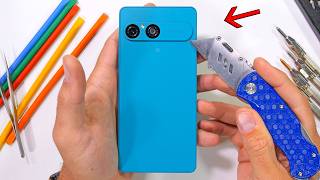
Sony continues to make mid-range smartphones, and the Xperia 10 VI (Mark 7) is a $500 device that combines Sony's renowned camera sensors with a plastic build, headphone jack, and SD card slot. This video tests its durability through scratch, burn, and bend tests, followed by a teardown to examine its internal construction.
Sony sensors are used in iPhones, Google, Vivo, Oppo, and Xiaomi phones, making Sony a leader in camera technology.
The Xperia 10 VI has a plastic back and frame, Gorilla Glass Victus 2 screen, and a turquoise color. It includes a headphone jack, SD card slot, and dedicated camera button.
The screen scratches at level 6 with deeper grooves at level 7 on the Mohs scale, typical for Gorilla Glass.
The OLED screen shows a white burn mark after 20 seconds but mostly recovers.
The phone survives multiple bend attempts with cracks in the frame but remains functional, showing surprising durability.
Removing 17 screws reveals a plastic back with NFC, LED flash, and loudspeaker but no wireless charging coil or speaker balls.
The 5000 mAh battery is glued in place, requiring alcohol and prying to remove, which is risky for safety.
The 50 MP main camera has OIS and a Sony sensor; the 13 MP ultrawide lacks OIS. No thermal paste or pads are present.
The Sony Xperia 10 VI offers impressive durability for a mid-range phone, with a plastic build that aids drop survival. However, the glued battery and lack of wireless charging are drawbacks.
What type of glass does the Sony Xperia 10 VI use?
Gorilla Glass Victus 2
01:30
At what Mohs hardness level does the screen scratch?
Level 6 with deeper grooves at level 7
02:30
Does the Xperia 10 VI have wireless charging?
No
06:00
What is the battery capacity of the Xperia 10 VI?
5000 mAh
07:30
How many screws are removed to open the phone?
17 black Phillips head screws
05:30
Does the main camera have optical image stabilization?
Yes, the 50 MP main camera has OIS
07:00
Phone survives multiple bends
Despite cracks in the frame, the phone remains functional after four bend attempts, surprising the tester.
03:30No balls inside speaker
The tester humorously notes the lack of 'balls' (metal balls for sound) in the speaker, contrasting with premium phones.
05:30Battery glued in place
The battery is permanently glued, making removal difficult and risky, which the tester criticizes as anti-repair.
07:30[00:00] Believe it or not, Sony is still making smartphones. What you might not have realized though over the years is that even if you don't own a Sony phone, you're probably taking pictures with the Sony camera sensor. Every iPhone has Sony image sensors. Google has Sony sensors. Even Vivo, Oppo, and Xiaomi use Sony sensors. So, here we are at the source of the Sony sensors, Sony. We know Sony is literally the best at building cameras, but today
[00:26] we're going to find out how good they are at building the rest of the phone with this mid-range $500 Sony Xperia 10VI or 10 Mark 7, depending on how often you think about the Roman Empire. The color is rather exquisite. Instant thumbs up from me. It's like a flattened Smurf or maybe the color of horseshoe crab blood, which is worth like $60,000 per gallon. Scientists use it for medical safety testing. Sony just calls this color turquoise,
[00:51] but crab guts or roadkill smurf is way cooler. But I digress. Sony is using Gorilla Glass Victus 2 for the screen, which scratches at a level six with deeper grooves at a level seven. Not bad. The front-facing 8 megapixel selfie camera is tucked up into the rather large top bezel. We also have an earpiece grill. Not a dealbreaker. It's just really hard to keep clean. And the blue frame plastic. It's hard to describe, but the plastic
[01:17] is so smooth and soft, it's almost like velvet. The dedicated camera button instantly opens the camera app, so you have quick access to those epic Sony camera sensors. The black power button is also a fingerprint scanner, and the volume rocker is right above that. The buttons are not removable, unlike on Samsung's premium phones. Up top, we have a what's this? A headphone jack. Blast from the past. The only thing that would make this better is an
[01:43] SD card slot, which if we pull out this little door on the side, an IP68 watertight and removable expandable SD card tray. True innovation. Someone tag Apple. You might be like, "Hey, Jerry, why is it that when this video started, you didn't have a band-aid on your finger, but now you do?" Let's just say that for the first time in 15 years worth of durability testing smartphones, I probably have to give my toteen chip back to
[02:08] my Scoutmaster. Down at the bottom, we have our 30W fast charging USBC 2.0 port. And making our way back to the back, we have our main 50 megapixel normal camera on the left. And on the right, we have our secondary 13 megapixel ultrawide camera also positioned on that plateau with a single color single LED flash placed right between the two glass circles. The plateau is made from plastic. The Sony logo is very neatly debossed into the
[02:34] surface of the plastic plateau. Just like the Xperia logo is debossed or recessed into the side of the frame. Embossed would be if the letters were raised up or protruding out of the frame. Speaking of debossing, the back panel of the Sony Xperia 10 MarkV double hockey sticks is definitely made from plastic, which I'm totally okay with. Plastic makes repairs a whole lot easier. And the whole phone is a whole lot more likely to survive a
[02:59] drop or a fall. Instead of oh biscuits, you get to save your dollar bucks and avoid difficult repairs, if you know what I mean. I think every phone should have a plastic back, even the premium ones. On the front, we have a smaller 6.1 in 1080p 120 Hz 10bit billion color OLED that lasts for about 20 seconds before going white and mostly recovering. Not too shabby. But now it's time to find out how durable this lightweight
[03:25] Sony phone really is. With a bin from the front, instantly we have problems. A wild crack appears in the frame between the power button and the volume rocker. We are not off to a good start. Flipping the phone around a bin from the back, it's a little less eventful. So far, the Xperia 10 Mark 7 is still alive. The third bend gives us another hefty cracking noise and the front glass is unnaturally distorted, but the VI
[03:51] is a fighter. Finally, after the fourth and final bend, we have another crack appear in the far side of the frame, but I cannot get the phone to break. I don't know if the blue healer spirit animal added healing hit points or if the Sony Xperia 10 Mark 7 just had the heart of a hero, but despite my best efforts, it survives. And now it's time to find out how and why. with the tear down. Obviously,
[04:16] buying a mid-range smartphone is just smart for your wallet. But what you might not know yet is that it's possible to pay just five bucks a month for a smartphone plan with my channel sponsor T. And I'll explain as we commence the autopsy. T is able to take unlocked phones like this Xperia 10 Mark 7 and add them to the least expensive smartphone plans I've ever seen. Literally just $5 a month. Or if you want unlimited
[04:42] everything, it's just 25 bucks a month. 50 gigs of which are high speed. That includes 10 gigs worth of hotspotting, free Wi-Fi calling, and free international calls to 60 countries and even international roaming. It's kind of wild. Getting four and 5G coverage without a soul crushing price tag is kind of amazing. It looks like Sony has milled down their plastic back panel to keep it totally flat. Kind of interesting. Plus, with T, you can usually even
[05:08] keep your own phone if it's unlocked and your same phone number when you switch over. T has no long-term commitments or contracts, just how we like it. and I'll keep the link down in the description. With 17 black Phillips head screws removed, we can start pulling up on the back plastics. The top portion has the NFC pad and rear LED flash, but no wireless charging coil. And of course, the lower plastics have our loudspeaker and reddish
[05:33] red rubber ring and waterproofing mesh over the opening. But alas, there does not appear to be any balls inside. Most premium smartphones have balls inside the speaker to give the sound waves more surface area to reverberate off of. And this Xperia 10Voublei does not have any balls. I'll uncip the two signal wires from the charging port board. This guy looks pretty standard with a nice little red rubber ring around the USBC port and a golden rectangular
[05:59] microphone in the middle. Inside the phone, we see a white waterproofing membrane off to the side of the microphone shaft and the cutest little coin style vibrator you ever did see. I imagine the vibrations on this thing are rather lackluster. I'll unplug the battery next. I probably should have done that earlier. and then I'll try to pull it out. Sony, however, has rather rudely glued it into place. Not cool. I can, of course, use some alcohol
[06:25] to dissolve the adhesive, but this is a messy, sticky process that still involves prying. I'll let it soak in for a second while I pop off the front-facing camera with this Lego style connector along with the 13 megapixel wide-angle camera, which does not have OIS. The 50 megapixel normal camera pops off next, and this does have optical image stabilization and of course a Sony camera sensor inside. The battery is still very solidly stuck to the frame,
[06:50] which is a shame. There are a million other cool ways to not permanently glue batteries into phones, like magic pull tabs, regular pull tabs, or even electrically releasing adhesives like the iPhones use. Lithium batteries are 95% recyclable, but not if they are permanently adhered into a phone. Yeah, the extra adhesive probably helps slightly with durability this time around, but there still are other ways of adhering the battery. Sony stuck a don't puncture sign on the battery
[07:16] while making you pry with a tool that could easily puncture all 5,000 mAh. I'll pop out our glorious SD card tray friend. Stop that. And then the motherboard is free to come out of the phone. Our first main crack appeared at the joint right between the motherboard and the battery. There's not a whole lot else going on in here. There's no thermal paste or thermal pads to speak of. Extra cooling never hurts to have, of course,
[07:41] but Sony decided we don't need any. Fingers crossed it still works when we put it all back together again. It's a pretty cool little phone, and I do appreciate Sony still giving us a headphone jack and SD card slot, but you'll have to let me know down in the comments if you think that it really passed the durability test or not. I mean, it did technically survive, but is surviving actually living? What is life anyway? And
[08:07] will there ever be a time when the weekend is forever? I'm curious to know what you think. But for now, the Xperia 10 Mark 7 is not in heaven and it's awake enough to say goodbye. Don't forget to make your phone plan a whole lot cheaper with TE and thanks a ton for watching. I'll see you

⚡ Saved you 0h 08m reading this? Transcribe any YouTube video for free — no signup needed.