
LEGO's New Smart Brick: Is It Worth It?
45sOpens with a bold claim and a hint of controversy (Geneva Convention) that hooks viewers immediately.
▶ Play Clip"The title is accurate; the video thoroughly tests and tears down the Smart Brick, confirming its smart features."
This video explores LEGO's new Smart Brick, part of the BrickNet system, which integrates sensors, speakers, and wireless charging into a single brick. The creator tests its compatibility with vintage LEGO bricks from 1985, demonstrates its interactive features with Star Wars sets, and performs a teardown to reveal the internal electronics.
LEGO's new Smart Brick is the core of the BrickNet system, featuring internal power, gyros, accelerometers, a light sensor, speaker, and microphone, all without external wires.
The creator tests if a 2026 Smart Brick connects with a 1985 LEGO brick. The stud-and-tube coupling still works perfectly, demonstrating LEGO's commitment to backward compatibility.
The Smart Brick wirelessly charges on a yellow pad, taking 2 hours for 45 minutes of play. The system includes the Smart Brick, smart minifigures, and smart tags.
When placed on a smart tag, the brick generates X-Wing sounds. Color detection triggers refueling (blue), repair (green), and blaster sounds (red). The brick can multitask.
The Smart Brick uses an onboard synthesizer to generate sounds, future-proofing it for new sets without updates.
The 1985 set cost $3.99, while the Smart Play system costs $90. The vintage minifigures have less detail, but the bricks still connect.
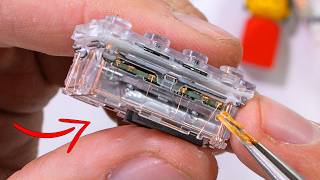
The Smart Brick is glued shut. Inside, copper coils enable wireless charging and reverse wireless charging to power smart tags and minifigures via BrickNet (Bluetooth mesh).
The motherboard includes a speaker, microphone, processor, accelerometer, and color sensor. The battery is 45 mAh, providing 45 minutes of play.
Leia's torso contains two copper coils. The smart minifigures are glued shut, but the internal hardware could be used in any minifigure.
LEGO's Smart Brick is an impressive screen-free interactive system that maintains backward compatibility with classic bricks. The teardown reveals sophisticated wireless charging and Bluetooth mesh technology, though the glued construction limits repairability.
What is the name of LEGO's new intelligent brick system?
BrickNet
00:54
How long does it take to fully charge the Smart Brick?
2 hours
01:10
What is the playtime of the Smart Brick on a full charge?
45 minutes
01:10
What type of plastic are LEGO bricks made of?
ABS plastic
03:17
How does the Smart Brick generate sounds?
It uses an onboard synthesizer to generate sounds, not pre-recorded audio.
03:49
What is the battery capacity of the Smart Brick?
45 mAh
09:15
How many tires does LEGO produce annually?
400 million
06:33
What technology does BrickNet use to communicate?
Low-energy Bluetooth mesh network
07:30
How does the Smart Brick detect minifigures?
It uses individual coils to directionally detect minifigures via magnetic fields.
08:17
What is the purpose of the microphone in the Smart Brick?
It acts as a virtual button to detect noises like blowing or tapping, and does not record audio.
08:47
Backward Compatibility
Demonstrates LEGO's commitment to compatibility across decades, a key selling point.
00:25Onboard Synthesizer
Future-proofs the brick by generating sounds dynamically instead of storing them.
03:49LEGO Tire Production
LEGO produces twice as many tires as Michelin, an interesting industry fact.
06:33BrickNet Technology
Explains the underlying Bluetooth mesh network that powers interactions.
07:30Microphone Privacy
Addresses privacy concerns by clarifying the microphone does not record audio.
08:47[00:00] Sometimes we find the most interesting bits of technology in the most unusualist of places. Inside this box is LEGO's new intelligent Smart Play Smart Brick. This video is not sponsored.
[00:12] We also might violate the Geneva Convention a little bit, but we'll get to that in a second. What's really cool is that LEGO says all of their new bricks are still compatible with every brick they've ever made, which is incredible. Backwards compatibility is
[00:25] very much appreciated. I have an unopened box of LEGO bricks here from 1985—41 years ago—and we'll see if that's actually still the case. These LEGOs have been wanting to be played with for decades, and we're here to make that happen. Thumbs up for that.
[00:40] But first, let's take a look at the Smart Brick. With the new Star Wars Red 5 X-Wing box opened, except for this guy propped up in the corner. This single, inconspicuous brick
[00:54] is the brains of LEGO's BrickNet system. It's got internal power, gyros, accelerometers, a light sensor, and even an internal speaker and microphone—all without any plugs or wires.
[01:10] The brick itself is wirelessly charged on top of this yellow pad. Just like a smartphone or Apple Watch, a two-hour charge gives it enough juice for about 45 minutes worth of playtime. I don't need 45 minutes, though; just 45 nanoseconds. There are
[01:25] three main components of the Smart Play system: the Smart Brick itself, a smart minifigure (noted by the expert designs on the back), and smart tags. It's interesting that the minifigures have their own voices, all without
[01:41] saying any words. The regular, non-intelligent minifigs do not interact with the Smart Brick. It's interesting as well that you can rip the legs off of a regular minifigure, but the intelligent minifigures have their legs glued on—"Craggled," if you
[01:55] Anyway, taking the Smart Brick and plugging it into an X-Wing, the Smart Brick sits on top of a smart tag, so the brick now knows to generate X-Wing-style sounds. There's a light sensor
[02:10] in the side of the brick, and when it detects the color blue, we'll hear an audible refueling sound. And when I pick up the X-Wing, it starts making flying noises and refueling at the same time.
[02:31] The Smart Brick can multitask. If I press the trigger on the back, it can also shoot its blasters. When the color green is placed next to the color sensor, it activates some repair audio.
[02:46] With Luke in the cockpit, he will even scream when I flip the X-Wing over. Leia, who is Luke's girlfriend, also screams in her own little unique voice when the X-Wing flips over. It's
[03:02] pretty impressive that one brick with no plugs or buttons can accomplish all of these things. Now, the only way for us to see how Luke works from the inside is with a bath of acetone. Since LEGO bricks are made of ABS plastic, the acetone should dissolve
[03:17] the plastic and leave behind whatever copper or electronics Luke has in his body. Like father, like son; the bionics in his body will soon be revealed. As you can see,
[03:30] Luke's face is completely melting off. It's kind of like the opposite of a bacta tank. We'll come back to Luke in a minute. Making our way back to the Smart Brick and smart tags: it starts making an entirely new set of sounds. The Smart Brick has an onboard synthesizer,
[03:49] so instead of storing a library of pre-recorded sounds, it can generate its own, future-proofing it for additional LEGO sets without ever needing an update. You can see that the blaster noise
[04:01] gets triggered when the red LEGO piece covers the color-detecting sensor on the side of the Smart Brick. Again, pretty impressive. And of course, the Empire did nothing wrong. If we put Leia, who is Luke’s sister, into her command station and plop the Smart Brick onto
[04:15] the smart tile, we can hear a totally new set of sounds as the gyros detect rotation. And again,
[04:27] we get a whole new library when the Smart Brick is placed onto the smart tag of the tug. Unfortunately, there is only one Smart Brick included in this whole set, Taking a closer look at the smart tag, at first, I thought that the sticker might have something
[04:43] to do with the conveyance of information, but after scratching the sticker completely off, the tag still works great. So, there must be something else going on that's deeper
[04:55] embedded into the plastic. We can't see any hardware inside when shining a light from the bottom or the top of the tag. But when we shine a flashlight from the side of the tag, we get a glimpse of some mysterious loops inside the plastic, which means into the acid bath we go.
[05:11] Before we open up and tear down the Smart Brick, let's see if a LEGO from 2026 can still connect to a LEGO from 1985. You can see that back then, this LEGO set was on closeout for about $3.99,
[05:24] while the Smart Play system of today costs around $90. But let's not ruin the moment. It's wild that this package of LEGOs has been sitting undisturbed and unopened for longer than I've been alive. The nostalgia is palpable, and it feels like Christmas morning all over again.
[05:39] And take a look at these minifigures. Injection molding has come a long way in the past 40 years, and our minifigures of today have quite a bit more detail. The instruction book is also a little advertisement magazine with a mail-in order form,
[05:52] since the internet didn't exist back then. Four to six weeks for delivery is quite a bit different than today's two-day Prime. Kids these days have it easy. But look at this: an ancient red LEGO brick with "LEGO" still printed on all the
[06:05] studs. It's almost like it time-traveled from 1985 to 2026 to rest next to its futuristic, more intelligent counterpart. But does it connect? Indeed, it does. The smart LEGOs of
[06:17] today will still connect to the LEGO sets of your youth; the "stud-and-tube coupling friction-grip click" is just as strong now as it was 40 years ago. Also, surprisingly, the rubber is still in good condition. LEGO is actually the largest tire manufacturer in the world, producing about 400
[06:33] million of these tires every single year, while Michelin only makes about 200 million. Amateurs. let's pop open the Smart Brick and see how it works from the inside. We'll check on
[06:46] Luke here in a second. I'm sure everything is awesome. The Smart Brick is "Craggled" shut, Keep in mind that the Smart Bricks are also not watertight, so keep them away from liquids.
[06:59] With the transparent plastic pulled away from the black outer casing, we discover something fascinating. Theres copper wires everywhere. And this explains everything. See, there's an internal battery down at the bottom, and these copper wires are able to wirelessly charge the
[07:14] battery on the yellow dock that we saw earlier through inductance. But when the Smart Brick is ready to interact with a smart tag or smart minifigure, it uses the same battery and same coils to energize other objects through reverse wireless charging. Then, the smart tags or smart
[07:30] minifigures have enough power inside of them from that magnetic field to power BrickNet. BrickNet is the low-energy Bluetooth mesh network—not to be confused, of course, with Skynet. of Luke and the red smart tag. Where's Luke at? He is quite a bit more squishy
[07:49] than usual. He looks kind of like his dad did on Mustafar. They grow up so Popping the studs off the smart LEGO brick, we get our first glimpse of the motherboard. We
[08:02] also see the top loudspeaker, very similar to the speakers we find inside of a smartphone earpiece, as well as a little hole for the microphone. It's interesting that each of the coils on top of the sides has their own loop. The individual coils help the Smart Brick directionally detect
[08:17] where the minifigs are located, and it can detect more than one minifigure or smart tag at a time. I'll pull back the clips that are holding the motherboard in place so I can pop it out. It looks like the battery is welded to the motherboard, so there are no LEGO-style connections
[08:31] inside of the LEGO. Ironic. The light-sensing, color-detecting prism is located on the left side, and it redirects the light onto the sensor that's laying flat on the motherboard. The motherboard also has the processor, the accelerometer, and on the backside, we have the microphone.
[08:47] but LEGO says that this microphone is acting as a virtual button to detect noises like blowing or tapping, and it does not record, store, or transmit any audio. And In the manual,
[09:01] it does say a microphone is included, but that it is not currently active. Time will tell, but keep tabs on that consent form if you're nervous about Skynet—I mean BrickNet. Yoinking out the battery, we see that it is a tiny 45-milliamp-hour tiny little guy. And
[09:15] since it can operate for about 45 minutes of play, we can deduce that it uses about 1 milliamp per minute of operation. Making our way back to Luke, he has seen better days. All of his ABS is now pretty soft and gooey, but I think I miscalculated a bit on just how
[09:31] messy he was going to get. I do apologize, Luke. I was unprepared for this disaster. The red smart tag, though, dissolved quite nicely. You can very clearly see the copper coils inside that receive the induction from the primary coils in the Smart Brick. I think that ya know Luke is
[09:46] a little too far gone for us to autopsy cleanly. My bad. Luckily for us, though, Luke does have a twin, and she's right here. We can pop off her head and her arms. A little quartering never hurt nobody. The legs come off individually, but unlike regular minifigs, the smart minifig torso
[10:03] is still sealed up tight. I don't think the Cragle is going to be able to fix this one. And look at that. With the lower half removed, we finally see the insides. Leia has two copper coils, one on the front and one on the back. I imagine with how universal these minifigs
[10:19] are shaped, LEGO could turn any minifig into a smart minifig with the same internal hardware. Once the coil inside of Leia is energized by the inductance from the Smart Brick, as they interact with each other inside of the magnetic field.
[10:35] I'm rather impressed. It's screen-free, interactable technology, and LEGO gets in the comments, and thanks a ton for watching. I'll see you around.


⚡ Saved you 0h 10m reading this? Transcribe any YouTube video for free — no signup needed.