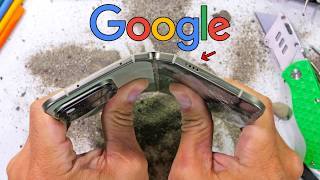

Google's Folding Phone Curse Continues
55sHigh controversy as it highlights a repeated design flaw in Google's foldable phones, sparking debate among tech enthusiasts.
▶ Play Clip"The title 'GOOGLE MADE A MISTAKE' is somewhat vague but the content delivers a clear critique of a design flaw, though it includes a sponsor segment that pads the video."
The video is a durability teardown of the Google Pixel 11 Pro Fold, conducted by JerryRigEverything. It highlights a recurring design flaw—antenna lines placed near the hinge—that has caused the phone to snap in half for four consecutive generations. The host performs scratch, burn, dust, and bend tests, ultimately concluding that Google has failed to address a known structural weakness.
The Pixel 11 Pro Fold breaks at the antenna line next to the hinge, a pattern seen in previous Google folding phones, including the Nexus 6P and Pixel 9 Pro Fold.
Google claims the hinge is three times stronger and can withstand 83 million open/close cycles in lab tests, but the host notes real-world conditions differ.
The exterior display scratches at level 6 with deeper grooves at level 7, while the inner folding display scratches at level 2 with deeper grooves at level 3, typical for plastic-based screens.
The frame is made from recycled aluminum, and the volume rocker is removable, but the fingerprint-scanning power button is not.
The back is made from 'composite glass fiber,' which is essentially plastic, though the host appreciates its shatterproof nature.
The inner screen survived 20 seconds of flame before permanent damage, while the front display lasted 13 seconds.
Despite IP68 rating, dust entered the hinge mechanism, revealing metallic particles and magnet outlines for wireless charging.
The phone snapped along both antenna lines, and the front glass popped off entirely, a new failure mode not seen before.
The hinge design differs from Samsung's, and the phone includes an internal cooling system (copper vapor chamber) for the Tensor G6, which the Fold Ultra lacks.
The Pixel 11 Pro Fold suffers from a predictable structural failure due to antenna line placement near the hinge, a flaw Google has ignored for years. Despite some improvements like recycled aluminum and a cooling system, the phone's durability remains questionable, especially for its $1,900 price point.
What is the recurring design flaw in Google's folding phones?
Antenna lines placed next to the hinge, causing the phone to snap in half.
00:02
How many open/close cycles does Google claim the hinge can withstand?
83 million times in a laboratory environment.
00:57
At what level does the inner folding display scratch?
Level 2 with deeper grooves at level 3.
01:50
What material is the back panel made of?
Composite glass fiber, which is essentially plastic.
03:30
How long did the inner screen survive the burn test?
20 seconds before permanent damage.
05:59
What happened during the bend test?
The phone snapped along both antenna lines, and the front glass popped off.
07:09
What internal cooling system does the Pixel 11 Pro Fold have?
A copper vapor chamber for the Tensor G6.
09:14
Recurring hinge breakage
Highlights a four-year-old design flaw that Google has failed to fix.
00:02Lab vs. real-world durability
Contrasts Google's marketing claims with actual performance.
00:57Bend test failure
Demonstrates the structural weakness in a dramatic way.
07:09Hinge design differences
Shows how Google's approach differs from Samsung's, affecting durability.
08:46[00:02] rather notorious for snapping in half. Sometimes it gets a little too exciting over here, if you catch my drift. From the Nexus 6P cracking in half 11 years ago to every single folding phone that Google has ever made. The original Pixel
[00:17] right at the antenna line next to the hinge. And again on the Pixel 9 Pro Fold breaking right at that antenna line next to the hinge. and last year's Pixel 10 Pro Fold breaking at that antenna line right next to the hinge.
[00:43] a row, Google has put the antenna line right next to the hinge. Again, I'm sure it's fine. Google said during their launch event that they re-engineered the phone to be three times stronger and that now in their testing a hinge can
[00:57] withstand 83 million times opening and closing in a pristine laboratory environment. But none of us are living in a laboratory. Not yet. >> And out here in the real world, the rules are different. And I'm still super
[01:10] surprised Google spent all that big Google money on a redesign while leaving the antenna lines in exactly the same spot. That's like Achilles wearing flip-flops into battle or the wicked witch of the west going water skiing or
[01:23] Dracula getting a tan on the beach. The weak point is glaringly obvious. So why is it still here? I've got a bad feeling that this $1,900 folding smartphone is about to go up in flames because Google can't be bothered with hardware. Google
[01:38] says the exterior 6.6 in Pro display is twice as scratch resistant as last year. But here we are again with scratches at a level six with deeper grooves at a level seven and the large 8- in
[01:50] superactua flex display in the middle screen with this cute little boat floating across the ocean. I'll grab my level two pick and yep, the Google Pixel 11 Pro Fold scratches at a level two with deeper grooves at a level
[02:04] fingernail, which is to be expected. Samsung most likely makes the folding displays for Google and probably everybody else. I would bet that Samsung will also make the flexible screen for Apple's new folding phone as well, but
[02:16] we'll find that out here in another month or so. Make sure you're subscribed for that one. Up here in the corner, we have our 10 megapixel visible hole punch selfie camera tucked under the soft plastic, as well as the underscreen
[02:28] sensor array in the soft circle right next to that camera. The sensors under the pixels are probably for focus, measuring a light. We saw the same thing last year. There's another 10 megapixel hole punch camera on the front cover
[02:40] screen sitting right below an earpiece lid. This side is protected with glass, though. One cool thing about the Google Pixel 11 Pro Fold is that the whole frame is made from recycled aluminum. Google is obviously great at recycling
[02:52] since the design hasn't changed in 4 years, but the volume rocker is removable. The fingerprint scanning power button is not, and the top of the phone has a loudspeaker opening and some noise cancellation microphone holes.
[03:06] The super shiny unbranded center spine also feels like more of that aluminum. And the bottom of the phone has our 45 watt USBC 3.2 port, same as Samsung, a
[03:18] loudspeaker, and a SIM card tray, which does have a black rubber ring to help with that IP68 water resistant rating. Knowing Google, we'll probably get to see more of that internal waterproofing here in a few seconds. Turns out the
[03:30] back of the phone is made from some shatterproof plastic. Big fan of this, actually. I think every smartphone needs more of this. Google calls it a composite glass fiber, which like whatever calling it composite glass
[03:42] fiber might sound more premium, but just like carrot cake doesn't count as a vegetable, composite glass is mostly just plastic. I tried to draw a bigger G, but it turned more into a really sick looking Pac-Man. Get better soon, dude.
[03:56] You won't. The camera plateau is made from metal. Unlike the new Samsungs, material is better than the other. But I'm just pointing out the differences. In the top left is a blinking LED light that may or may not be used for
[04:10] notifications. Honestly, I have no idea what that thing does. Then we have the 10.8 five times telephoto camera up top. In the bottom left, we have the 10.5 ultrawide camera and the main 48 megapixel camera to the right of that,
[04:23] all protected with glass. And yeah, cameras are cool and all, but the most useful and coolest camera hack I've come across recently is an app called Macroactor, who I've partnered with to show you this trick. I have three French
[04:36] about how many calories I'm going to consume with just the click of a button. Look at that. Three French fries are 46 calories. For me, the hardest part of being healthy and staying strong, aside from my daily workout of bending phones,
[04:50] is keeping track of my calories and what I eat. But since this app can literally take a picture of my food and track what I eat for me instantly, it's way less work on my end. Like the chicken nugget, which is 62 calories and 3 g of protein.
[05:05] Three chicken nuggets is three chicken nuggets and it's 10 g of protein. Macro Factor doesn't even actually need the food itself. Even just taking a picture of the receipt logs the whole meal, including my macros. And forgive me if
[05:18] shocked at how good this is. But you can also take a picture of a recipe, like my little sister's cookie recipe, and it will calculate the calories per serving for you. It even titled the recipe for me in the MacAractor app. Thank you,
[05:32] and get healthier by tracking what you MacroActor with the discount code JerryRrigg. No pills, no frills, just technology doing something actually useful. You can search macroactor in
[05:46] your app store and use the code jerryrig for that 14-day trial. Where was I? Oh yeah, a funeral. I'll make my own little Super El Nino here in front of this boat. If you don't know what a Super El Nino is, you should probably familiarize
[05:59] yourself with the situation pretty quick, cuz this one's a doozy. The flame surprisingly lasted for 20 seconds this time around before the screen got permanently damaged. Flipping around to the front display, the flame lasted 13
[06:11] seconds here before getting permanently disfigured. OLED pixels typically do not recover from the burn test. Now, you might be like, "Hey, Jerry, if Google's got the IP68 rating on this Google Pixel 11 Pro Fold, that means it's dust tight,
[06:26] right?" And no, not really. On paper, IP68 might sound nice, but in reality, it sounds kind of like there's dust inside.
[06:41] inside the hinge mechanism and wreck havoc on the internals. To be fair, the phone is probably still watertight since water is easy to seal against than dust, at least on these phones with moving parts. It is cool that some of the dust
[06:54] is metallic, and we can see the outlines of the magnets that Google uses to mount wireless chargers, which can now charge at 25 watts this year. Finally, the bin test. The ultimate test of structural durability that most phones survive
[07:09] durability that most phones survive unless the manufacturer is Google. Okay, so there's a lot going on here. Let's watch that again one more time.
[07:27] along both antenna lines at the same time, just like it has for the past four years. But this time around, the front screen also yeets itself off of the phone, which is wild. No wires, no nothing. Just the front glass popped
[07:40] clean off. Normally, it's a real struggle to remove that piece of glass. quality, if you catch my drift. And you also might be like, "Hey, Jerry, why would it do that?" Let's find out. The back composite glass panel is still
[07:55] intact. Nice work on that one, Google. I think that's the only thing on the whole phone that's still salvageable. I do got to be careful at this point since we already know batteries can explode and I'd rather not have to
[08:07] activate my fire extinguisher. But when you put the weakest link near the point where the phone needs to be the strongest, we get what you see here. If Google ever builds a car, a bridge, or a house, or you know, something that
[08:20] out. I know it's kind of a running joke care about hardware, but if there's ever proof of that, it's these four years of knowing where and how a phone could break and doing nothing to fix it. I'll
[08:34] very much dead at this point. You can see the ultra thin Samsung glass layer see the ultra thin Samsung glass layer under the plastic
[08:46] reinforcements that Samsung adds to the underside of the crease for extra supports. Thumbs up for that. The hinge definitely looks different, though. Google is not using the same modular hinge segments that Samsung uses on
[08:59] their own Fold 8, which did survive this same test, by the way. And as a plus one for Google, they do have an internal cooling system for that Tensor G6. Yeah, the Tensor is super dead, but if it was alive, it would have been super chilled
[09:14] on that copper vapor chamber, which is something that the Folate Ultra does not have. Anyway, let me know what you think down in the comments. And hey Google, let's do this again next year. Thanks a ton for watching. I'll see you around.

⚡ Saved you 0h 09m reading this? Transcribe any YouTube video for free — no signup needed.