
Recycling 100 Billion Cans a Year
45sThe staggering scale of 100 billion cans consumed annually in the US is a shocking stat that hooks viewers immediately.
▶ Play Clip"Delivers a solid, informative tour of the recycling process, though the title's promise of 'secrets' is a bit overstated."
This video takes viewers inside a large-scale aluminum can recycling facility, showing the entire process from bales of crushed cans to molten metal. It highlights key machinery, safety measures, and the critical importance of removing liquid from cans before melting.
Americans consume about 100 billion aluminum cans per year, each bale weighing ~1,000 pounds and containing ~30,000 cans.
A grapple excavator shreds whole bales of cans to prepare them for processing.
Vibrations help distribute loose cans evenly on the conveyor, ensuring a steady feed of scrap into the facility.
Strips paint and enamel from cans to purify the aluminum before melting.
Mechanical 'stomping feet' press scrap into molten aluminum, like a steampunk wine press.
Aluminum melts at ~1,220°F, requiring specialized PPE for safety.
Aluminized jacket and gloves reflect radiant heat and cause splashes to bead off, protecting the worker.
Liquid water expands ~1,000x when turning to steam, so any liquid in cans can cause explosive eruptions in the furnace.
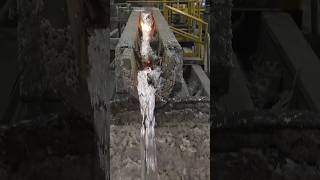
Molten aluminum is collected in a large crucible for further processing.
The video provides an inside look at industrial aluminum recycling, emphasizing the importance of safety and the technical steps required to transform used cans into reusable metal.
How many aluminum cans does the average American consume per year?
About 100 billion cans per year.
What is the approximate weight of a single bale of aluminum cans?
About 1,000 pounds.
Why is shredding important before melting the cans?
To ensure no liquid remains inside, as liquid water expands ~1,000x when turning to steam and can cause explosions.
02:08
What is the melting point of aluminum?
Approximately 1,220 degrees Fahrenheit.
01:42
What is the purpose of the delacquering process?
To strip away paint and enamel from the outside of the cans to get the aluminum cleaner before melting.
01:13
Massive Scale of Recycling
Provides a concrete sense of the volume of aluminum cans recycled annually.
Innovative Mixing Technique
Shows a unique mechanical solution for mixing scrap into molten metal.
01:30Explosion Risk from Water
Explains a critical safety hazard in metal recycling with a clear scientific reason.
02:08[00:07] около 1000 фунтов и содержит примерно 30 000 алюминиевых банок для напитков. В Соединенных Штатах американцы потребляют около 100 миллиардов банок в год, и их
[00:19] нужно где-то перерабатывать. Большие тюки с банками выгружаются из грузовиков и аккуратно складываются в ряды, готовые к тому, чтобы их в ряды, готовые к тому, чтобы их захватил клешнёй.
[00:36] который измельчает целые тюки банок, подготавливая их к переработке. Отличная машина! После того как тюки будут вскрыты, большой фронтальный погрузчик сможет зачерпнуть незакрепленные банки и сбросить их на вибрационный конвейер.
[01:00] по конвейеру, обеспечивая постоянный поток гарантирует отсутствие жидкости в банках, поскольку жидкие отходы могут представлять серьезную опасность для печей, о чем мы поговорим позже. В
[01:15] процессе удаления лака с внешней поверхности банок снимается краска и эмаль, чтобы очистить алюминий перед тем, как он попадет в печь. способ перемешать свежие обрезки банок с уже раскаленным расплавленным металлом — это [музыка]
[01:30] двумя механически топающими ногами, как в каком-то стимпанковском винном прессе. Увеличенные алюминиевые прижимные устройства помогают вдавливать верхние слои лома в расплавленный алюминий под ними. Алюминий плавится при температуре около 1220°
[01:44] поэтому в этих печах происходит настоящий перегрев, в самом прямом смысле этого слова. Мне пришлось надеть специальные средства индивидуальной защиты, чтобы обезопасить себя. Эта куртка и перчатки с алюминиевым покрытием выполняют две функции. Они изнутри печи, и в то же время сами изготовлены из алюминия
[02:00] . Таким образом, если произойдет случайное попадание брызг, алюминий соберется в капли и скатится с моего гидрокостюма, обеспечив мне безопасность под ним, будем надеяться. Кстати, о брызгах: одна из самых больших проблем на нашем заводе — попадание жидкости
[02:13] внутрь печи или тигля. Поскольку жидкая вода расширяется примерно в 1000 раз при превращении в пар, любые банки с жидкостью внутри могут образовать взрывоопасный серебристый пузырь, похожий на лаву, поэтому
[02:26] процесс измельчения и сушки так важен. Теперь, когда у нас есть расплавленная алюминиевая лава, It's time to collect it all in the largest crucible I've ever seen.



⚡ Saved you 0h 02m reading this? Transcribe any YouTube video for free — no signup needed.