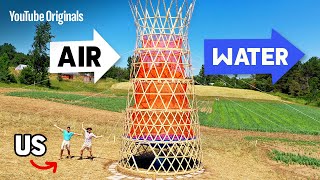

Water Out of Thin Air?!
60sThe dramatic opening with water being shut off and the promise of harvesting water from air hooks viewers immediately.
▶ Play Clip"Delivers exactly what the title promises—a hands-on experiment in harvesting water from the air, with real results and science."
The AsapSCIENCE team embarks on a challenge to live off the grid by shutting off their water supply. They build a dew harvester and a rainwater collection system, using science and biomimicry to source water. The video explores the science behind these technologies and the broader implications for water conservation.
The team sets a survival goal of 2.5 liters for drinking, 3 liters for cooking, and 2 liters for bathing, a stark contrast to the 329 liters Canadians use daily.
A dew harvester can collect 10-100 liters of water from the air through condensation, even when it's not raining.
The dew harvester works on the principle that warm air holds more moisture than cold air; when warm air hits a cold surface at the dew point, water condenses.
The design is inspired by the Namib beetle, which collects water from microscopic bumps on its back in dry conditions—an example of biomimicry.
The team installs eavestroughs slanted toward a collection tank to channel rainwater into a 170-liter barrel.
The carbon filter allows anything smaller than 0.2 microns through, trapping pathogens like giardia lamblia.
The global population needs 2.6 trillion liters of water to survive, but only 1.2% of Earth's freshwater is surface water; 69% is locked in ice and permafrost.
An average-sized house in rainy southern Ontario receives over 25,000 gallons of rainwater on its roof each year, covering 20-25% of a household's annual water needs.
The rainwater system collected 170 liters from the first rainstorm, enough to cover all their needs.
The experience made the team hyper-aware of water's importance, contrasting with the 'magic tap' mentality.
The team successfully demonstrated that with a bit of science and ingenuity, it's possible to source water sustainably, highlighting the importance of water conservation and the potential of biomimicry.
Canadians use 329 liters of water a day
This statistic provides a stark baseline for the team's survival goal of just 7.5 liters, highlighting the scale of typical water consumption.
01:44Biomimicry in design
The dew harvester is inspired by the Namib beetle, demonstrating how nature's solutions can be applied to human engineering challenges.
05:58Only 1.2% of Earth's freshwater is surface water
This fact underscores the scarcity of accessible fresh water, making the team's harvesting efforts more meaningful.
13:08Connecting with your water source
The team notes that harvesting water makes you hyper-aware of its importance, contrasting with the 'magic tap' mentality.
21:32[00:02] Production has shut off our water. - Water out of thin air. - It's, like, monstrous. - Aah! What the ( bleep )? - It smells like shit.
[00:20] and I can ( bleep ) do this. It is going in here. You can really feel it. - Pretty much a shower. - ( yelps )
[00:32] and it's not just our sexy good looks. Greg: And through our YouTube channel AsapSCIENCE, We're going to go to the farm.
[00:46] and scientific know-how out of the classroom Greg: We are going off the grid. Mitch: One by one, we'll shut off our basic necessities...
[00:59] I'm freaking out. with everything from new technology, to find solutions that promote sustainability.
[01:12] we will use science... Yes! It works! Both: This is "Shut It Off Asap."
[01:29] Which means we got to find a source of water to survive, basically. There's actually no organism on this planet that we know of - Even the famous tardigrade which we're all obsessed-- - Famous tardigrade.
[01:44] ...doesn't need food or air, and Canadians use 329 liters of water a day. Its even more water being used than Americans,
[01:59] More than most of the world, honestly. we can supply ourselves with enough water to survive. And if we can't do that, at least this is a gorgeous place to die.
[02:17] Going to the corner store to pick up some water is not an option. The very first things I do every single day involve a lot of water.
[02:29] is going to be a complete lifestyle shift. In less than 20 years, the world's demand But only if we continue to extract and consume water the way we do right now.
[02:46] Most of the world relies on groundwater or aquifers that are running out fast, the rain, and nearby streams And who knows? In the future, these concepts may save our lives.
[03:02] Our water goal for survival is 2.5 liters of water for drinking, 3 liters for cooking, and only 2 liters for bathing our pits and bodies. Which is hundreds less than we would typically use, right?
[03:15] - Have you heard of a dew harvester before? - No. So these are actually used in certain regions in the world where water is scarce They can collect anywhere between 10 to 100 liters
[03:32] This is just a model, but the real thing will be built 10 meters tall. And the premise of it is to try and extract water out of the air
[03:45] even when it's not raining through condensation and dew. Mine is a rainwater collection system that we're actually going to install onto our cabin. - Cool. Okay, okay. - I'm going to drill.
[03:58] I'm going to make eavestroughs, slant them all towards a specific collection tank, and using a tube and the force of gravity. so that we can use the water to wash our dishes, wash our hands.
[04:13] And I'm also hoping that we can get a pump system to create a shower. - I've been wondering. I was going to wonder. - Key, key, key. - This is thine hope. - These are both fun, big ideas,
[04:27] it's about making sure we're able to collect enough water to survive, and I'm getting thirsty. So let's begin the build starting with the dew tower.
[04:45] because I don't know what the hell I'm doing. Here's a perfect little experiment to help understand You know when you get a nice ice water
[05:00] It's because warm air actually holds more moisture than cold air. So as the warm air blows past this nice cold water, and hits something called the dew point,
[05:15] It's the reason this glass with no ice has no wetness That's actually the same principle as our dew tower. and at night, this plastic is going to cool down more than the air.
[05:33] where the air can't hold the water anymore. and that's how we're going to get water. Dripping, the force of gravity forcing it down.
[05:46] - Oh, my gosh. - And then how we have the bucket at the bottom. How did you think of this?
[05:58] something called biomimicry.
[06:11] that look like two cobra heads. by visual predators such as birds. actively seek out advantageous traits of other species to make our lives better.
[06:29] Namib beetles live in dry conditions to collect water from microscopic bumps on their back, Studying these animals has led
[06:44] like in Morocco, where people in the Sahara Desert use mesh I love that with scientific design. Just look to nature and you'll find the answers.
[06:58] Yeah. and I do obviously need help.
[07:12] who is going to help me with some self-relying. - of what we're about to do? - Yes, this is the eave trough. - It's not heavy. - Oh, my God. Look how--
[07:26] - Seriously, get this. Say that it's heavy. - It's heavy. Kevin and I are going to install the eavestrough on the bunky to collect the rainwater in a barrel.
[07:39] but we can use it to wash our dishes and our bodies. is used for showering, washing clothes,
[07:51] I avoid drills. I avoid building things. now that I'm saying all of this out loud. and I can do ( bleep ) do this.
[08:07] - Okay. - Uh, so ( bleeping ) we need to make sure that each section is slanted toward the end points
[08:19] and drain into our rain barrel. Okay, so this cut to the right angle is going to go into... So we're about to do some math, my friend.
[08:34] - 43. - 43 and a quarter, sir, coming right up. Now we're going to cut this. That's so scary to me. You can pull it and as long as it's-- oh, there you go.
[08:47] - Oh! - You're just going to plunge cut. Okay, okay! I swear I can do it. - There you go. - Aah!
[09:01] Oh, my God! I want to do that for the rest of the day.
[09:13] All right, special delivery, boys. We have all the lattice put together. as sort of the final piece to this segment.
[09:27] because the larger the surface area of plastic netting, We've got the first section done, but hopefully the first one was the hardest one.
[09:42] and then eventually stack them one on top of the other. But we also still need to figure out what we're doing now Yeah, 'tis essential.
[09:55] It's over 30 degrees out, and all this work is making me a sweaty mess. Oh, wow.
[10:08] We've been told that there's some stream or body of water And to be honest, there needs to be, Mitch: Please tell me there's not ticks here.
[10:20] They looked cute. I thought they were cute. I'm scared. Wait for me! This is not what I was picturing at all.
[10:35] - Aah! What the-- - It's a gorgeous butterfly. Okay, okay, there's a lot of spider webs around here! OMG.
[10:51] Um, this is our-- are you going to bathe in that? I have to, but I'm like-- to be honest, But I am pleasantly surprised.
[11:04] We're so lucky to be in Canada and to even have this. is that we're actually going to be filtering this stream
[11:16] through different carbon filters in order to hydrate ourselves. especially with places that don't have access to clean water. to seek out drinking water
[11:30] from new sources that we interact with more. from animals near our drinking water The carbon filter works by allowing anything smaller than 0.2 microns--
[11:48] Clean water can get through the actual filter inside here. or giardia lamblia, which I've gotten twice from drinking from a stream-- Those will not get through. They'll actually get stuck.
[12:02] Maybe 2035's hottest new accessory - Oh, my God. It smells like shit. - Oh, my God.
[12:15] And here we are, like, trying to lick the ground. Save some for the fish!
[12:29] - Okay, it is beautifully cold. - Yes. that it's not necessarily filtering out chemicals, so if you have pollutants in the water or different toxic chemicals,
[12:43] for the world in many places. Our entire population needs around 2.6 trillion liters of water to survive,
[12:55] so surely we have enough on the planet, right? Not exactly. representing all the water on Earth. 500 milliliters, shown here--
[13:08] But of that 2.5%, only 1.2% of it is available as surface water, about 69% is locked away in ground ice and permafrost,
[13:22] leaving only around 30% of it available to us. that doesn't mean that it's drinkable. And so make it so, it costs billions of dollars in Canada alone.
[13:38] 485,000 deaths per year from things like diarrhea, And it's estimated that by 2025, is going to be living in water-stressed areas.
[13:55] We are going to bathe in this water, Mitchell, You're gon' smell like B.O. Aah! It's too cold. It's freezing cold and muddy. Fun.
[14:12] Okay. So...
[14:24] I never want to go there again. I honestly could do this every day. Mitch? Come on! And in fact, now I've got a fire under my butt
[14:39] to make these projects we're trying to build. The coolest thing about this mesh that we're using
[14:52] which will allow the air to pass through and condense on all these areas. The science behind it is so cool.
[15:04] Going to hopefully fill a 170 liter barrel and wash ourselves and have a shower. so I better get back to work.
[15:19] Rain barrel systems are great, but here in central Canada Water naturally expands when it freezes, you best drain out the water before winter comes.
[15:35] to actually collect your rainwater in order to use it. and then, realizing, wait, we should be doing this on our home in the city. In rainy southern Ontario where we live,
[15:52] an average-sized house would have over 25,000 gallons, of rainwater landing on its roof each year. That's around 20 to 25% of a household's annual water needs.
[16:06] That would take a huge amount of stress off of our water supply. - Oh. Nut driver? - Have a nut driver.
[16:18] I was like, what is happening here? How long does my pipe need to be? It's weird, but, like, I like it.
[16:32] Whew. Oh, my gosh. I can wash dishes. I can water flowers. I want to be able to shower.
[16:44] - Absolutely. Treat it like a pool. - Treat it like a pool. Kevin: All you got to do is wait for the rain now. Greg: I know! I want it to rain so bad!
[16:59] We're going to put all of those onto the final piece to finish the dew harvester. Exhilarated, terrified, and excited?
[17:11] I'm happy I was the eavestrough guy. Down? Are we high enough?
[17:24] - Man: You can lower it. - Ready? - Whoo! - Good job, everyone!
[17:38] I was like, "Oh!" Put this in MoMA, people. This is art. So we want it to be cold tonight.
[17:50] that it hits its dew point, drips down water, Greg: This is so cool.
[18:03] But we're going to go check the dew harvester, night one. so not super optimistic, but let's go see. There she is. It's looking pretty dry.
[18:19] Back to our regular pumping water, Greg: I can't believe the conditions are just so incredible. I'm so excited because it's raining, so my practical build is being shown off.
[18:37] You can see the water is being collected in our eavestrough. And I've just sadly realized that we have an issue.
[18:50] Hopefully it rains again. So the first water that comes through Because the eavestrough itself will have had sediment,
[19:04] If this was sealed, it's going to actually fill with the dirty water, Once it gets to the top. going through to our collection tank.
[19:17] But if you listen, it is filling, It is going in here. You can really feel it. It doesn't really feel like it's raining that much.
[19:32] Makes you realize the surface area of a roof is actually so useful. That's very cool. of all rain in the bucket because it's probably full of rain water.
[19:46] we can see-- the water that appears, if any, we know is from dew Ugh. There's so many bugs on the edges.
[19:59] Supposed to be a clear night, so hopefully we'll get some dew water here tomorrow.
[20:15] So as you can see, the structure has actually moved a couple of feet. but we finally had a really clear night last night. The temperatures dropped. how much has landed in the bucket.
[20:30] - Oh! Oh, my God. - Oh, my God. It's not 100 liters like I might've hoped for. No, it was in case this was going to move or whatever.
[20:46] Okay, fine, it was because of overflow. of the right conditions, we'll get even more. Greg: 170 liters we got from that first rainstorm.
[20:59] doing everything we need to do with the rainwater. from going to that creek. we have much more easy access to water.
[21:15] I know it's not as impressive, but this part-- This whole experience of shutting off our water and then having to chase it During this experience, I really noticed how much I drink.
[21:32] but I was just hyper aware of the importance of water. I personally think that we should put a gray water collection system on our home, Something as simple as a rain harvester just connects you more,
[21:48] why you should conserve it, and why it's important, versus a magic tap that just turns on and it's infinite. because I don't really know what this experience would've been without that.
[22:00] But the real reason we built these experiments to leave these assets and builds and to educate ourselves on how to help
[22:14] In Jordan, they are working on refugee tents that harvest fog in the desert. and cotton are now stopping virus-contaminated water.
[22:28] And Green New Deal style regulations that provide rebates and tax benefits Water is a human right, so we need to insure that governments respect this
[22:40] or even selling it for profit. and how it relates to our fresh water,
[22:52] the most important molecule on Earth. I'm hot, I'm sweaty, and I'm ready to take a shower. - I know I need to shower. - Oh. Yeah, we got a leak.
[23:08] You have to show you can do it. I'll pump the pump. Aah! It spit on me over here. Oh, my God. I hate this so much.
[23:22] Aah! Oh! Oh, no, no. all while being absolutely freezing. - I actually hate this. - It's working though. Do you feel clean?
[23:36] I feel very proud.

⚡ Saved you 0h 23m reading this? Transcribe any YouTube video for free — no signup needed.