
Can Pee Power Your Phone?
48sThe shocking and humorous premise of using urine to generate electricity immediately grabs attention and sparks curiosity.
▶ Play Clip"Title promises "generating *all* our electricity from bike power" but the video is a series of experiments with urine fuel cells and biking, achieving only partial off-grid success."
In this episode of 'Shut It Off ASAP', Greg and Mitch attempt to live off the grid in a cabin, exploring unconventional methods to generate electricity. Greg tries to charge his phone using a microbial fuel cell powered by urine, while Mitch attempts to power their home by pedaling a bicycle connected to a generator.
Greg and Mitch set the challenge to generate electricity for their devices using urine and bike power.
They choose to explore unique energy options, focusing on leaving fossil fuels in the ground.
They aim to produce a portion of the 73% of electricity emissions through their experiments.
Explains how electron movement creates electricity, with a brief intro to atoms.
They collect anaerobic bacteria from mud to fuel cells, feeding on urine to release electrons.
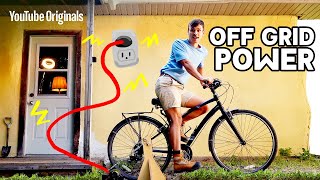
They set up a bike with a skateboard wheel to turn a generator, wanting to charge batteries.
First attempt yields 2 volts, enough to light early tests.
After 24 hours voltage is only 0.2 volts, showing difficulty in charging phones with microbial fuel cells.
Uses carbon mesh larger electrode surface area for fuel cells.Gets 0.25-0.3 volts per cell, aims for 5 volts with 20 cells.
Connects all 20 fuel cells in series to increase voltage from 0.2 to ~5 volts.
With 5 volts, does not charge the phone but powers a small green light as proof of concept.
Explains that in series voltage adds, but current is limited, which is a fundamental flaw for charging handsets.
After 2 hours of team pedaling, the batteries are full, lighting up the cabin and charging laptops.
Emphasizes using voting power to push for renewable energypolicies and scale up green generation.
Phone Charging Validation vs Real-world Result
Marks the moment Greg realizes theoretical 5 volts is proof of concept and not practical charging.
17:20Improving Fuel Cells
Using carbon mesh and larger electrodes improves output, highlighting iterative design.
14:08Failing as Learning Success
Stresses that failures lead to problem understanding, a core lesson for science hacking.
18:17Series vs Parallel Trade-off
Explains fundamental electrical engineering trade-offs, applicable beyond off-grid experiments.
19:12Bike Power Works
Shows that human power can work but requires endurance and teamwork.
20:23[00:03] Greg: Today we are going to try and charge our cell phones using human urine. Mitch: And we'll be working up a sweat as we try to bike enough to make our entire home off-grid.
[00:19] and it's so dark outside. Greg: Strobe light. Mitch: We're feeling the heat,
[00:31] - It's climate change. - Oh. out of the classroom and into the country. Mitch: One by one, we'll shut off our basic necessities.
[00:48] Greg: And with help from our team, we will use science... Yes! It works! Mitchell and Greg: This is "Shut It Off Asap!"
[01:03] Mitch: Our power has officially been shut off. We're off the grid now, which means that we can't use our lights in this cabin, I am also gonna go on airplane mode.
[01:16] Honestly, I'm a little nervous, 'cause I don't think we realize just how much we use electricity in everyday devices around us. That's enough energy to wash 13 1/2 loads of laundry.
[01:32] We're hoping to power our cabin and the devices that we're using in it. and Greg has an addiction to his phone. It is my escape from the existential dread that is life on this planet.
[01:48] Mitch: At this point, everybody knows that wind and solar are failsafe ways but we want to explore some more unique options first. #LeaveFossilFuelsintheGround.
[02:03] We are in our absolutely pitch black cabin. We have our flashlight, but sadly it's in here somewhere, We literally can't find our flashlight.
[02:18] for the vast majority of emissions. produce 73% of electricity emissions, is the first step towards impacting the bigger picture,
[02:34] Plus, it can be fun. I'm doing something real bonkers. And the way I'm gonna do that
[02:47] using my urine as a fuel source. Now in here we have anaerobic bacteria Yes, and if we can feed it our urine...
[03:02] for bacteria in this mud-- anaerobic bacteria. like the glucose and the potassium, will release electrons.
[03:14] I think I could power my phone. It just seems really disgusting right now, Now my project is something I have been dreaming of doing for a long time.
[03:31] So my dream is hook in some bicycles and use that as a power source. into a generator, and collecting that power as you can see here.
[03:47] Before we get started on our projects, we need to talk about what electricity actually is. is understanding atoms.
[04:00] and in fact, you are only just a complex conglomeration of atoms. In simple terms, every atom has a nucleus that contains positively charged protons and neutral neutrons
[04:15] These electrons "orbit" the protons and neutrons but we're gonna keep it quite simple for now
[04:27] Now electrons, in particular the outer electrons, Generally that movement is in all directions, that becomes an electric current.
[04:44] Like, over your back? So we're on our way to get some anaerobic bacteria. Greg: We're looking for Geobacter bacteria
[04:57] as well Shewanella bacteria. where there is no oxygen, we're gonna dig down under the stream, pull up a bunch of that mud,
[05:11] and hopefully we'll be finding anaerobic bacteria. Or treasure of sorts. microorganisms like bacteria need energy to live.
[05:25] in this case supplied by our urine. go through aerobic respiration. as an electronic accepter, ultimately creating ATP,
[05:42] some special anaerobic bacteria to other substances like metals or even graphite If we can provide them with that metal
[05:57] then we might be able to create our own bioelectricity. I really hope that you guys are in there. Totally kidding.
[06:13] until we start our experiment if we got them. it's time for me to start my experiment. 30 kilowatt hours of electricity per day.
[06:27] We only have a few light bulbs and a laptop in our bunky though. about 0.6 kilowatt hours with my bike generator experiment. But to pull it off, I need help from our buildmaster Paul.
[06:42] For our bike experiment, we have built this rig here and we have it connected down here to a little skateboard wheel, Generators use magnetic fields to move electrons through metals such as copper.
[07:00] which states that when you move or change a magnetic field it induces an electrical current in that wire.
[07:12] 'cause there's only one little measly electron That's why copper wire is so good at having electrons and having electricity flow, and we'll be using it today.
[07:29] Few people in the world have successfully built a fuel cell with microbes that can charge a mobile phone. is Professor Yannis Ieropoulos.
[07:42] I'm attempting to do it in less than a week. I thought you were just trying to figure out how to charge your phone with pee. So in this first urinal is funnel where you will pee.
[07:59] Your pee will come through down here into this jar. - And then you get on here. - What is this? - What? - You get off.
[08:13] - Boom! We're watering our kale, first of all. - Beautiful. - to come down into our fuel cell. - Oh, my gosh. how the fuel cells harness the electrons
[08:26] We'll do this chamber with two electrodes. where electricity can enter or exit. from the negative electrode to the positive one,
[08:41] Well, I'm so excited. Like, when do we put the pee in? 'Tis a coffee pee. Don't judge any coloration. So I'm in here.
[08:56] Oh, it's not too yellow. Boom, boom, boom. Pee. Greg: Here we go! We're filling her up.
[09:11] Okay, so we got some leakage. passing through our direct circuit, And you're gonna see that it went from zero to two volts.
[09:26] Yes, and hopefully the bacteria's gonna go absolutely ham The pee construction is really cool. Hopefully we can pull it off,
[09:39] and hopefully we'll get some phone power. Mitch: It actually looks way scarier in here Mitch: This is what we have to live with.
[09:53] But I am actually excited to go to bed, like, out here. Like, it's cozy. Like, it's horror vibes, but it's cozy. Mitch: He looks like just a pure ghost.
[10:06] ( wolf howls ) was just how much I personally would have to bike.
[10:20] Greg's gonna charge a phone, but I'm tasked with all the light bulbs, the laptops, As it's spinning, we're generating electrons that come through these wires and enter into a rectifier,
[10:34] And then they hit our charger or regulator, 'Cause I might be pedaling slow when I'm lazy... Or fast when I have a lot of energy.
[10:49] So what this little device does So the voltage comes out of the regulator we can turn on our inverter,
[11:05] or direct current, into alternating current, So we can plug in our devices, and we'll have electricity Greg: It's been 24 hours, and the bacteria have been feasting on our pee.
[11:23] What I thought was 2 volts, I have now learned is only 0.2 volts, ( blows raspberry )
[11:35] and microscopic organisms you cannot see There's a lot of intense science here, but I'm having a hard time applying it.
[11:49] This is my first attempt at a microbial fuel cell. If you were hoping to charge a mobile phone
[12:02] that is going to be very difficult, if not impossible. is this business of stacking multiple microbial fuel cells together, much like batteries.
[12:16] and tends to have a better kick. That's disgusting but amazing. We're gonna mix streams, if you know what I mean,
[12:31] and it's now time for us all to add our pee. Rejeanne's here to let me know how legit my bike setup is.
[12:44] about electricity and power generation. whether it's in somebody's home or in a gym?
[12:56] then absolutely there's a place for this. Think about all that energy that could be stored Is this a million dollar business idea that we need to go shop around now?
[13:11] Could be, Mitch. Typically, we humans generate the electrical power that charges our lives by transforming kinetic moving energy into electrical power.
[13:24] you can see how it directly turns turbine generators. is used to make steam Mitch: The movement generated by the turbines
[13:38] turns large coils of wire past large magnets. The voltage and consequent power produced and the rotational speed of the coil wire rotating.
[13:53] and here I am scavenging for voltage. I discovered that the most basic microbial fuel cells of 0.25 to 0.3 volts.
[14:08] So hopefully 20 of them should get us to five volts. This time I used pure carbon mesh and tried to make a larger electrode surface area to volume ratio
[14:21] Clearly this is a very unique way to get power, - which is all you can ask for, folks. - That's for sure. the pee power Rube Goldberg machine.
[14:38] it was definitely fun while it lasted, my friends. a bunch of urine at the wall and seeing what sticks. Do you feel like renewable energy is the future?
[14:52] Okay, what does that mean? So instead of just being able to get power from the electric grid, wind energy, things like biogas, biomass.
[15:09] Mitch: Having all these different energy sources is important. and we'll need to scale them up a lot. All right, let's see what you're at.
[15:21] That's pretty awesome. which means one hour of pedaling or an hour of laptop charging.
[15:39] Mitch: We're learning that after two hours of pedaling, - I'm getting eaten alive. - Me, too. - Mitch: Ah, there's a mosquito. - Greg: Aah!
[15:58] have fed on our fresh urine all night, Our 20 microbial fuel cells are now hung up.
[16:10] So we're gonna measure the voltage. Wouldn't that be such a good sign? Okay, so with our reading, we have 0.2 volts,
[16:23] which is too low to charge a cell phone, for sure. So I'm freaking out a little bit. One thing we can do is hook all of these up in series.
[16:37] Theoretically, the voltage should go up, Fuel cells are essentially batteries, and there are two ways that you can hook up multiple batteries.
[16:51] where each cell is like a rung on a ladder. So we'll try them the other way in series In theory, this will increase our voltage.
[17:06] These are all now hooked up in series. It's, like, my wedding night. I'm excited, but of course very nervous.
[17:20] Okay, so we are at a little over five volts, I'm just gonna plug in the phone. ( moans )
[17:34] Oh, God, I have to go tell Mitch. All this aside, it might seem that my experiment is a fail, I still have something to show proof of concept.
[17:48] But we weren't quite able to charge a phone. We need to show at least that we were able to, you know, create some sort of charge.
[18:01] - Greg: Do you see it? - Okay! So it's not quite a phone. I would've felt so freaking bad-ass.
[18:17] Fails in science are so common and so important. so you realize what you did wrong, This green light, I mean, in a really, really dark room
[18:31] could be a gorgeous little mood light. I was constantly thinking about how we need to get the voltage up you also need to have the current high enough to charge the phone.
[18:46] Sorry, current. Wasn't thinking about you. The voltage is the water pressure.
[18:58] And the resistance is the size of the pipe. and the amount that is flowing. but if we wire them together,
[19:12] In parallel, the current of each fuel cell is added together, In series, the voltage of each fuel cell is added together,
[19:25] And I think is our fundamental problem. means we have to compromise on the current, Mitch: Pedaling for hours every day sucks.
[19:40] So to help me fully charge the batteries, I've enlisted some help, Listen up, folks. You have an hour to go to fill our batteries.
[19:56] - Up, up. - Through this experience, we've learned how difficult it is to make power. Oh, boy. Okay. Oh, wow.
[20:10] and why conservation is so important. In five, four, three, two, one.
[20:23] But now I need to brag, because in the end, and the batteries are full. Well, I couldn't see. I guess I need my second light!
[20:39] for some extra lights now. - Okay, what about our laptops that have both been charged? - What a rush!
[20:51] That's me in a YouTube onesie. You're welcome. Whoop-ah! and so this has been an amazing experience.
[21:05] is an electricity crisis. and how we get it is what's creating a large part of our CO2 emissions. so the best thing we can do is think about how to supply that energy
[21:22] Greg: To mitigate the worst of climate change, we must rapidly increase the use of wind, solar, and hydroelectric energy generation.
[21:37] will help to ensure a reliable flow of power. until we achieve 100% green power.
[21:49] And who knows? Maybe even one day pee power can help, too. and environmentalists but politicians, we can change that. the better chance that we have at making them more efficient
[22:04] Greg: Voting power may be the best way to create policies and tax polluting industries. - Mitch! - Every episode, we're gonna shut something off,
[22:18] We don't know what we're gonna be doing And we're gonna have to use science and live off-grid. That is a bit of a gorgeous meatball.
[22:34] Herbs, salt, pepper, and oil. Oh, that one was bad.



⚡ Saved you 0h 22m reading this? Transcribe any YouTube video for free — no signup needed.