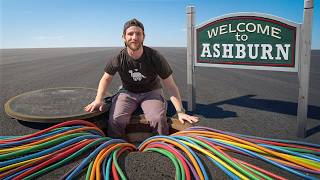

The Internet's Secret Backyard
45sReveals the surprising physical infrastructure behind wireless internet, creating a wow factor for viewers.
▶ Play Clip"Title accurately reflects the video's tour of Ashburn's data center hub, the literal cradle of internet infrastructure."
This video takes viewers inside Equinix's data center in Ashburn, Virginia, the 'cradle of the internet,' showcasing the physical infrastructure that powers global connectivity. It explores fiber optic networks, cooling innovations, security measures, and the massive scale of data traffic.
Ashburn, Virginia, chosen for proximity to Europe and North America, has the highest density of dark fiber globally. Equinix acts as a neutral connector for ISPs and online services.
Despite wireless connectivity, every data packet ultimately travels through physical fiber optic cables underground.
Above the speaker are layers of optical fiber cables, all occupied, representing the most crowded intersection on the internet.
An older system from Zootacore uses a T-stage refrigerant and rack-mounted compressor, offering better cooling efficiency than water and easier heat reuse.
Equinix's Amsterdam data center heats a college dorm, and an experimental deployment heated a swimming pool during the Olympics.
A 1 MW deployment 10 years ago took 100+ cabinets; now 80-100 kW is common, with cutting-edge up to 300 kW. Jensen predicts 600 kW cabinets soon.
Special cabinets block electromagnetic signals to prevent data leakage, used by financial institutions and military, costing $30,000 for the box alone.
Ashburn campus has 1,000-300,000 fiber strands, each capable of ~1 Tbps, converging massive amounts of internet traffic.
Equinix operates at 96% renewable energy and explores nuclear power partnerships to address growing power demands.
Fuel cells convert hydrogen or natural gas into electricity at 60% efficiency (double internal combustion), producing concentrated CO2 for capture.
Equinix's Ashburn facility is a critical hub where the physical internet lives, showcasing innovations in cooling, security, and power to meet ever-growing demands.
Why was Ashburn, Virginia chosen as a major data center hub?
Reasonable proximity to both Europe and North America.
What is the 'funny saying' at Equinix about wireless networking?
There sure are a lot of wires in wireless networking.
00:43
What cooling technology does the Zootacore system use?
A T-stage refrigerant and rack-mounted compressor.
03:10
How does Equinix reuse waste heat?
Heats a college dorm in Amsterdam and heated a swimming pool during the Olympics.
03:57
What is the current power density range for AI build-outs?
80,000 to 100,000+ watts, with cutting-edge up to 200,000-300,000 watts.
05:05
What is the purpose of the $30,000 server cabinet?
Blocks electromagnetic signals to prevent data leakage.
05:44
How many fiber strands go into Equinix's Ashburn campus?
Between 1,000 and 300,000 strands.
06:52
What is the efficiency of balloon fuel cells compared to internal combustion?
60% efficiency, about double that of internal combustion engines.
08:22
Internet Carrier Grand Central Station
Visual impact of layers of fiber cables above, showing the physical scale of internet traffic.
01:50$30,000 EMF-Blocking Cabinet
Surprising cost and purpose of blocking electromagnetic signals for security.
05:44Balloon Fuel Cells
Novel technology converting fuel to electricity at 60% efficiency with CO2 capture.
08:09[00:00] If UCLA was the birthplace of the Internet, then Aspirin, Virginia is the backyard where it grew up into the marvel it is today and continues to grow. Chosen for its reasonable proximity to both Europe and North America, Aspirin has the highest density of dark fiber in the world,
[00:18] and Equinix launched our trip here to show you their role as a connector of clouds, if you will, providing neutral grounds where every internet service provider and online service can connect to exchange data.
[00:31] Without further ado then, let's head into the belly of the beast. Well, not all the way inside. Apparently I need a confined space certification in order to crawl in here. Yeah, I'm getting them though. But I still wanted to show this to you guys
[00:43] because it's so easy to fire up Netflix on your TV or load up YouTube on your phone and go, I'm shooting a video over the air. But there's a funny saying at Equinix, that goes, you know, there sure are a lot of wires in wireless networking,
[00:58] because to get that YouTube video from what you're watching right now, your phone is going to connect to a cellular access point on a tower somewhere, which might have a high-speed wireless backhaul to another tower,
[01:10] but if you trace it back, every packet has to have come from fiber, just like this, here in the ground. And eventually, if you keep going, an internet exchange like DCT here,
[01:23] where Equinix looses cages, large and small, to everyone from AI and cloud providers to financial institutions to three-letter agencies. Each of these is hundreds or even thousands of strands.
[01:37] Like, wow, look at it all. Since we're here, Equinix asked if I'd like to see what is probably the most crowded intersection on the entire internet, to which I replied,
[01:50] are, yeah, above me is basically internet carrier grand central station. All of these are completely occupied by optical fiber, including the layer above and the layer above that.
[02:06] I'm in your data right now. Now, we can't look too closely at any paid deployment because that's when it takes customer privacy extremely seriously. Like I talking biometric authentication up the wazoo which Oh sorry no it not in the wazoo It just your fingers Okay That actually really good to know Thank you Anyway there a lot of customizability
[02:30] depending on your needs. Hot exhaust, error management and venting, dual redundant 240 or 450 in volt power. Oh, the fiber you can shake a stick at!
[02:42] Of course, if you watch the video that we did with AcmeNix a couple of years ago, then you'll probably know a lot of this. Why don't we go look at something a little different? This case is specifically set aside for Equinix themselves
[02:55] to test experimental technologies and deployments and kill them off to potential customers. And there are a few choice relics in here that really stood out to me. Okay, you guys have seen a liquid-cooled server before, of course, right?
[03:10] But have you ever seen a fluid-cooled server that's not all liquid? This right here is an older system from Zootacore. Do you see how tiny these coolant tubes are?
[03:22] That's because instead of using water, it's actually using a T-stage refrigerant and a rack-mounted compressor to increase its cooling efficiency compared to water. I don't know how it happened, but this paradigm totally escaped my notice over the last 4 or 5 years since they started building them.
[03:41] These things are super cool because just like with water, you get dramatically better heat mobility, which makes it way easier to reuse that thermal energy for good. Equinix has aggressive environmental and community stewardship goals that are made much easier
[03:57] by waste heat capture. They have a data center in Amsterdam, for instance, that kicks heat into a college dorm for heating, and they showed off an experimental deployment during the past Olympic Games that heated a swimming pool. That's a pretty good idea.
[04:09] I wonder where they got it. Also in this room is a newer generation of two-phase tooling from Excelsior. And you might have noticed the tubes are a lot thicker. You know, one of the biggest pressures in the data center states right now
[04:24] is skyrocketing power requirements, and especially increases in density that are making the old paradigms for building these spaces, and especially for managing thermals, obsolete.
[04:37] The red and blue cabinets those are in the 20 to 30 watt range These ones more like 80 watts And what really crazy is that not even the cutting edge
[04:49] Okay, this is a bit of an aside, but I couldn't shoot it because it was a customer's space, but that's when it showed me a one megawatt deployment from about 10 years ago. It took up at least 1,000 square feet and was well over 100 cabinets full of servers.
[05:05] Now, this is 80,000 watts And 100,000 plus watts is commonplace in an AI build-out With a cutting edge closer to 200,000 to 300,000 watts
[05:18] Also, if Jensen's to be believed, and he would know 600,000 watt cabinets are on the horizon That would consolidate that old megawatt deployment with 100 plus racks down to Lexington 2
[05:32] Clearly, the innovation is needed Moving on, this one is super cool. On first glance, it just kind of looks like a more rugged server cabinet, doesn't it?
[05:44] I mean, what could it cost, Michael? $10? Try $30,000. And that's just for the box. Why? Well, remember how I said that security was a big deal in this industry?
[05:59] Well, depending on who the customer is, sometimes it's an even bigger deal. These bad boys right here are for your financial institutions, your military, your three-letter agencies.
[06:12] What does it do? It blocks EMS. And not like mostly blocks, but like the IO field on the back of your PC. I'm talking about it blocks the trace electromagnetic signals that can be emitted by computing devices
[06:26] that can maybe be souped to collect sensitive data. Overkill when you're already in a facility that uses airlock-style access? Maybe. Two? Absolutely.
[06:38] And Equinix says that interest in solutions like this is only growing. Coming back to scale, it's hard to accurately say just how much traffic flows through Equinix here in Aspirin, but they did give me some rough numbers that I could show with you.
[06:52] There are between 1,000 and 300,000 strands of fiber going into their Aspirin campus buildings. With current switching technology each of them can be somewhere in the neighborhood of 1 terabits per second Now obviously not all of them are doing that all the time but the point is that the amount of traffic that converges here is unfathomable and providing that
[07:13] kind of connectivity is a uniquely Ashburn challenge that kind of makes sense if you look at the history here. XMX's first data center was built here in the early days of the internet to
[07:25] provide fair, managed communication across disparate networks. That incentivized more growth here during the cloud era, which pushed Equinix to keep up and so on and so forth until you ended up with the snowball effect that turns this
[07:38] place into data center heaven. But especially lately, there's a dark side to the data center that has been thrust into the limelight, power consumption. Now, Equinix currently sits at 96% renewable energy sources, according to them, which is
[07:51] pretty cool. But hey, life isn't as simple as, well, we did our part, and they're always looking for new innovations, including nuclear power partnerships, which we won't be looking at one of those today, but hint, hint, equinix, nuclear plant.
[08:09] Anyway, what we can look at today is something I've never heard of before. Check these out. These are called balloon fuel cells. And while I would need a post-graduate chemistry degree to fully understand everything that's going on here,
[08:22] I can give you the basics. In goes some kind of fuel, like hydrogen or natural gas. And then out comes electricity with somewhere in the neighborhood of 60% efficiency,
[08:34] which, okay, doesn't actually sound that impressive, except that it's just about double of what you would expect from the internal combustion engine in your car. How? Well, it's because these depend on a chemical reaction rather than the combustion of that gas, releasing heat and a concentrated CO2 stream.
[08:55] It can be used for either situations where grain power isn't sufficient or as a backup. And now this is just a test to join me, but they have a much larger one on the order of over 14 megawatts in California
[09:10] that Patrick from Third to Home actually looked at fairly recently. That's worth checking out if you guys have a few minutes now that you're done watching this video. If you enjoyed it, I don't know, buy something on lpdstore.com. You've got the hoodie.
[09:23] You've got this hat. I hope one of these is still in stock. Otherwise, there's all these screwdrivers.



⚡ Saved you 0h 09m reading this? Transcribe any YouTube video for free — no signup needed.