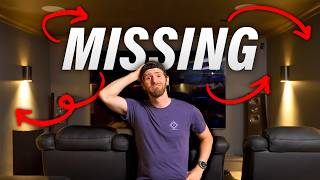

My $500 Home Theater Fix
43sReveals a high-end setup has a cheap, crucial flaw, creating curiosity and relatability.
▶ Play Clip"Title accurately reflects the video's focus on an affordable upgrade that delivers big results."
This video follows the host as he sound treats his home theater on a budget, with expert help from Dan and DMS. They demonstrate affordable DIY acoustic panels and calibration techniques to dramatically improve audio quality without expensive equipment.
The host's home theater has never been sound treated, despite having high-end components like Valencia seating and Dolby Atmos.
DIY acoustic panels made from rockwool and sauna panels cost about $22 each, offering an affordable way to improve sound.
Speakers should not be placed in corners; moving them out into the room improves sound, but the host's setup uses corner placement to advantage due to room layout.
A mirror is used to find first reflection points: place mirror on wall, move until listener sees speaker, then place acoustic panel at that spot.
Room size and shape create standing waves causing bass peaks and nulls. Long, thin rooms are easier to manage than square ones.
A clap test reveals some echo and airiness in the room, indicating need for treatment.
A tiny microphone (like a stealth fighter jet) is used with Room EQ Wizard (free software) to measure frequency response.
Pink noise is played while moving the microphone to average measurements across listening positions, revealing a dip in ear gain and peaks/troughs affecting dialogue.
Acoustic panels must be installed before calibration; otherwise, calibration would need to be redone.
Panels use rockwool, sauna panels, 1x4 wood frame, and acoustically transparent fabric (duvatine or velvet). Mounted with French cleats.
Sound treatment (panels) improves room acoustics; sound isolation (insulation) prevents sound from leaving the room. They are different.
It's possible to over-treat a room, making it sound dead like an anechoic chamber.
After treatment, decay time dropped from ~500ms to ~300ms, reducing muddiness and improving clarity.
Untuned, the room already showed improved stereo separation after treatment. Bass became cleaner without bass traps.
Using an amp with Dirac Live (like the Eno amp) further fine-tunes the system. Room treatment + calibration yields dramatic improvement.
Sound is sharper, tighter, with more controlled bass and smoother treble. Directionality is stronger, and bass is no longer one-note.
Affordable DIY acoustic panels and proper calibration can transform a home theater's sound quality without expensive upgrades. The combination of physical treatment and digital tuning delivers a dramatic improvement.
What is the mirror trick used for in room acoustics?
To find first reflection points: place mirror on wall, move until listener sees speaker, then place acoustic panel at that spot.
02:33
What is the difference between sound treatment and sound isolation?
Sound treatment improves room acoustics (e.g., panels to reduce reflections), while sound isolation prevents sound from leaving the room (e.g., insulation).
15:13
What is the approximate cost of one DIY acoustic panel as shown in the video?
About $22 (Canadian) for rockwool and sauna panel, plus wood frame and fabric.
13:04
What free software is recommended for measuring room frequency response?
Room EQ Wizard.
10:13
Why should acoustic panels be installed before calibration?
Because if you calibrate first and then add panels, the calibration would need to be redone as the room acoustics change.
12:37
What is the typical decay time improvement seen after treatment in the video?
From around 500ms to around 300ms.
18:41
What is the risk of putting too much sound treatment in a room?
It can make the room sound dead, like an anechoic chamber.
18:00
What is the recommended alternative to Dirac Live for PC/Mac users?
Sound ID Reference.
22:00
Mirror Trick for Reflection Points
Simple, low-cost technique to identify where to place acoustic panels for maximum effect.
02:33DIY Acoustic Panels for $22
Demonstrates that effective sound treatment can be built cheaply with basic materials.
13:04Treatment vs Isolation Clarified
Clears up a common misconception about acoustic treatment and soundproofing.
15:13Decay Time Halved
Quantifiable improvement from ~500ms to ~300ms shows significant reduction in muddiness.
18:41Dramatic Improvement Without New Speakers
Highlights that treatment and calibration can transform sound quality without expensive hardware upgrades.
22:56[00:02] dream home theater setup. Leather Valencia seating, 7.2.4 Dolby Atmos sound, a giant 115in TV. I mean, this thing is perfect except for one small thing is perfect except for one small problem. I never sound treated it. I
[00:17] KNOW. I KNOW. I'm sorry. I'm sorry. It just got to the point where it was good enough and I just plain didn't bother. I'm basically the mechanic with the broken down car. To be clear, it's not broken down, but we've talked many times
[00:31] in the past how with audio products, it's important which ones you choose, but in some ways, the calibration and the setup are actually more important and shockingly one of the most affordable parts of a well-tuned setup.
[00:45] Which is why I brought these two gentlemen with me. Hi Dan. Hi DMS. Hey, how's it going? who are going to be helping me sound treat this room on a budget in a way that you guys can follow along with at home. We're going to start
[00:58] by going around the room and finding things that may or may not be wrong and especially finding a way to maybe help you if you're looking for a space to put in a theater or even just a pair of speakers. Lionus already has his room
[01:10] though. So, if like his space, yours is not optimal, we're going to show you some tricks to step it up. And for my part, I'm really excited about the DIY acoustic panels that we've built for grand total treating [music] the entire
[01:22] space less than 500 Canadian rubles. I always love saving a dollar. What about too? Like with our sponsor. >> Nice. Ug. Keep all your photos and files backed up on their DXP 4800 GT NAS. It works like a cloud, but it stores all
[01:38] your data locally safely in your own hard drives. Get started with our link hard drives. Get started with our link below.
[01:52] things done really right in here. You have a carpet. Nice. But you have a reflective surfaces in the room? Your floor and your ceiling. And that's a have to do something about that. >> Right. I thought you were going to tell
[02:06] >> Can I show you something you did kind of like wrong right >> again? Yes. Normally, you don't want to put your speakers in the corner. The farther out in the room, the better, >> right? But in this case, I think it's
[02:20] actually going to work to our advantage because you have this. what does this have to do with the speaker positioning? >> That's actually a really good question. If that speaker was where it should be,
[02:33] here. >> Oh, brilliant. But how does he know that? using a technique called the mirror trick with our listener over the speaker. >> Right. This is about where you'd want me
[02:46] >> Okay. >> What we do is we put the mirror along the wall and we slowly move it until our listener can see [music] >> Okay. >> There's your first reflection point. So,
[02:59] it would have to go here. So, we got to rip this out. No. But because our move back a bit or get out of the way. I'm going to move this slowly against the wall. Right there. That's where our panel goes. So, we got to knock this
[03:13] right? >> That should be all right. All right. We're good. Can we still knock out? No. >> Now, we've solved for our first reflections? >> That's where it's going to get a little
[03:25] promise. >> Question for you. Does it matter that much, though? What's our goal? I would say the goal is to have a good more >> And then dealing with the first reflections you think will kind of 8020
[03:40] rule get us most of the way there. >> It'll make a big difference. The biggest nodes. >> The size and shape of your room is also pretty important even with reflections because sound waves have distance
[03:54] between them and you can create standing waves from the left and the right and backward. And it creates these volume troughs and peaks where they cancel and collide and get bigger and smaller. So you could be sitting here at the front
[04:09] and hear like no bass at all. And then you move to the seat just to the left of that and the bass is awful. It is so loud. It is terrible. That's often dictated by your room more than anything else. In my perfect world, we don't have
[04:24] an ideal listening position so much as we have two mostly ideal listening positions because right in the center would be right on this crack and nobody >> That can be where you have other problems because the nodes and the modes
[04:39] of the room are in the room. So, you might have to move the chair to get out of them or into different ones. Oh god, I hope not. Luckily for you though, this room is long but thin, which means that you have a better chance of avoiding a
[04:52] lot of the complicated ones. If it's square or if it's really weird, difficult to navigate around. >> Okay, let's see what we can do. have two subwoofers, it'll be a little bit easier to deal with those modes, at
[05:07] >> Enough chitchat, though. I think it's time for some concrete action. >> Yeah, I think before we move on though, we got to have some applause. we got to have some applause. >> [applause]
[05:19] >> Oh, our before test. Our clap test. >> Yeah. >> It's actually pretty decent. >> It's not bad, but you can hear that there's some air in here. >> And we got some some bouncing off the
[05:33] the air. >> Okay. I was going to say I I like it. >> Okay. >> Don't drop that. That's worth like at least half of my car. This is our microphone. And there's a reason why
[05:47] it's so tiny. It's so tiny because just like a stealth fighter jet, from the front, it's pretty hard to see. It's got a very small footprint. So, this gu is he's picking up. We're going to use this to measure the frequency response of the
[06:02] because you said you don't want it calibrated for just one spot, right? Yeah. And then we have the ADC. This is how we're getting the signal into the >> A camera battery. Yeah, I see that Vmount.
[06:14] >> this is going to power the microphone, which needs a very specific 28 volts. It needs this because it's a very sensitive piece of equipment and any weird voltage wild readings. >> And the other reason we're using this
[06:29] frequency response curve, right? >> Extremely. This microphone actually does not need a calibration file. It is a small enough, precise enough piece of calibration file for it. Maybe if you're doing, you know, a tenth of a decel, but
[06:43] change just by doing >> this, >> right? Speaking, by the way, of you and measuring things, is now a good time for us to tease that we have a product coming.
[06:55] >> Maybe now is a perfect time for you to experience the room beforehand because in audio there's measurements and then there's the experience. And both of them
[07:07] are very, very important. So, let's have the before experience before we change the before experience before we change anything. It does sound pretty good. I think there's a lull somewhere in the ear gain
[07:21] and I hear a little bit of a spike above that. That should be pretty easy to fix. be fixed just by doing the room treatment. Also, Lord of the Rings in theater. You have a second row. I think second row matters more than second
[07:36] the mirror trick for the first row. I'm going to let you in a secret. those guys. No one ever sits there. >> What if I said,
[07:49] offense to that." Now that we're in the back row, that guy was a dick. Don't >> Yeah, we have more reflections to worry about back here. Our first reflection point is in a completely different spot than those guys. So, I'd like to do the
[08:02] mirror trick again for people in this row and see where that lands. I'm willing to bet that it's not in that different of a spot. Again, doing myself favors by having those speakers so close to that back wall there. Like, I'm I'm
[08:17] >> It might not be that different. And if it is, our lives are a little bit >> The one spot where I do anticipate being different >> is up there, >> right? So, we might have to do two rows
[08:31] >> You're thinking what I'm thinking. So, what I want to know is [music] after we do this calibration, if I go and I put a giant bean bag there, did I just ruin
[08:43] >> That should be fine. >> Okay. And then if I put a big karaoke speaker there, presumably also fine. It's not going to have a massive impact. bigger impact. I mean, you're going to put people in here, too.
[08:55] >> Big bags of water. Apparently, not in the back row. >> Oh, what we call them in my industry is meat baffles. this microphone. Where do >> Uh, we're gonna move it around. So, we're going to do a few things. I'm
[09:08] gonna take a sweep. >> And then we're going to play pink noise. we're moving through different positions. I want to see what it's like your protests, I want to see what it's like in the back row, too.
[09:20] >> Okay. And Dan, question for you. He's obviously using a microphone to check the decibel level at all these various points. You were saying you would do >> Yeah, in general. Um, the thing is that that takes like a lot of practice and
[09:35] that takes like a lot of practice and often can't necessarily be as good. And measurement either. >> So, you would just go to the various "Yeah, it's a little louder. It's a little quieter."
[09:47] >> Kind of do one of these sometimes. >> Um, I'll move my head [music] and up and down, which is basically what we'd be kind of doing with a microphone, too. better than nothing whether you have practice or not?
[10:00] >> 100%. And that's kind of something that I think everybody should at least try. movements. If you've never done it before, take the bass to zero. Take the before, take the bass to zero. Take the bass to 50. Kind of hear and learn what
[10:13] it sounds like when there's no treble or no mid [music] and uh listen to >> And the software you're using is called >> Room EQ Wizard. It is free, >> so anyone can use it. Also, uh I need your head.
[10:26] >> Right there. >> Oh, yes. That was the only way to do that. >> No. Yeah, that's uh that's the industry >> But this is never where I would sit. >> Where would you sit?
[10:38] >> Oh. So, do you want to calibrate for reclining? >> be slightly different. Not massively, but slightly. >> Yeah. I rec do it for I would never watch sitting straight upright.
[10:50] >> Mhm. >> All right. I'm gonna start it. Start it. >> All right. I'm gonna start it. Start it. Hit the deck, Dan. moment, please. Now that the sweeps are done, we've got a mostly indecipherable
[11:06] graph. Uh DMS is going to work on making that a little bit easier for us to read. But before we do that, we need to make [music] some pink noise and do the thing mic. >> Sound changes a lot when you move
[11:18] around, and I want to pick up all of them. I'm taking an average over as much space as I can in the listening window to figure out what exactly is going on in here. Hey, look at that. It's actually pretty linear. You can see
[11:30] right here that lull I was talking about in the ear gain. We've got some upy bad start. >> As I was moving around, this was taking tons of individual measurements and
[11:43] averages. The red is the average of an entire roughly 30 seconds of information we collected. Every single second it's adding more and [music] more to that. bit of information it collected before I stopped the test. You'll notice this one
[11:58] has a big peak, but this one has a trough. That's because this one is actually your inseat versus this orange one here is the middle. >> That big of a difference? >> It's pretty substantial. What frequency
[12:10] is that at? It's at 1 kHzish. So anywhere from like 800 htz to 2 kHz, So that would really affect like dialogue. >> very much so. But this is also why we take a big average of all listening
[12:24] positions, which is what this purple line is here. And look at that. It has a little bit of a peak from this one and a little bit of a dip from this one. So we mitigate this in both directions. The next step is putting up our physical
[12:37] can start doing calibration. >> Cuz we could calibrate it now, but that stuff. >> Yeah. calibrate it, then change the >> Now, after we put those panels up, [music] would that wider window onto
[12:51] >> It should be. >> Okay, I guess we can have a look at panels. Now seems like a good time to take a look at the acoustic panels that we're going to be using. While we could have bought prefab ones, those tend to
[13:04] pretty expensive and [music] actually in some cases not all that effective, going more for looks and style rather than raw performance. [music] So instead, we made
[13:16] these. What you're looking at is about $22 worth of rockwool and sauna pan held together by this simple 1in x4 in wood frame that just about anyone could build frame that just about anyone could build in probably anywhere from 15 to 30
[13:30] minutes with basic hand tools. Stretched over the front of it, we've got options. Either duvatine, which is an acoustically transparent material, or if [music] more, we could cover it with velvet. Also, we just had a giant bag of
[13:45] velvet. So, the point is mounting these is as affordable as making them. All you got to do is throw one of these on the wall and French cleat style. You just hang the panel off of it. Cool, right? A last little touch is we made these
[13:59] little 3D printed things to kind of hold this on, but they kind of suck. You can out of the gate, I've noticed a problem. >> This looks stupid. Do you want it to good? >> I want it to sound good. Right. And also
[14:13] look, Dan? >> Well, I mean, you can kind of see why I saying that had to come down. If you just move it up a bit and then turn the light off, now it looks cool. Now it looks even stupider. Why are you so
[14:29] apprehensive about touching the sconce? >> Well, it's the light that is in the >> We go other way up. It's not going to be very difficult to rotate it up. What if sconce out and just mount it right here. >> Cuz then I won't have a sconce here.
[14:44] up. >> Let me go get my wife. We are treating >> Okay. >> Uh we have to put these on the walls. They stop sound reflections. It makes >> I thought you got special insulation in
[14:57] need these things. >> Oh, no, no, no. That insulation keeps other [music] rooms. It does nothing about making it so that the super accurate positional audio is as positional as possible. Okay. [laughter]
[15:13] okay. >> Actually, that's a very common misconception. There's audio treatment and audio isolation. >> We have isolation but not treatment. >> This has to go in that spot on the wall
[15:25] >> Okay. >> What if there was no sconce? >> I mean, it's already really dim in here. >> Right. >> Right. I have an alternative as well. Then we would go about here.
[15:38] >> And now we can't do that. >> Okay, the sconces are going. >> Woo! Everyone wins. >> The breakers stop automatically if you put your fingers in here. Something like
[15:51] >> I'll have to go a touch lower, I think. >> Okay, fine. Where do you want the next >> Dan's doing that one. >> No, no. Yeah, I I see that. Where do you want the next next one, then? Oh yeah. Okay.
[16:06] >> Which way? >> Me? >> Oh yeah, that's it. So it needs to be like right on this line. >> center of the panel long way right here. >> Right there. Okay. So you just stand
[16:20] there. Don't move. >> I said don't move. >> You're still moving a little. [laughter] They have the cleat thing on both ends so that we can slide them on. Reese is
[16:36] working on that. So in the meantime, uh DMS, you were thinking what? Like just >> Yeah. Back in here. I'm >> Are you sure you don't want it here? >> I now shut. No, I'm kidding. >> It's awfully tempting. [music]
[16:49] >> Yeah. I'm less concerned about the rear ones at this point. We're more just Most of our reflections are going to be taken care of by the guys in the front.
[17:02] >> Way less of a trailer. I can actually I can actually hear the missing panel. though. >> That's true. >> Yes.
[17:16] >> Okay. How does that look? >> That looks good to me from here. Look at be pretty good. >> Okay. Quickly then, come take the measuring tape near my penis. Okay. And let's get a measure to the
[17:29] wall. If I stand more like this, you can just measure from the wall to my penis. just measure from the wall to my penis. Good. That's great.
[17:45] >> Oh. Oh, buddy. [applause] Let's go. Now, hold on. Hold [applause] Let's go. Now, hold on. Hold on.
[18:00] anooic chamber. You can actually put too much sound treatment into a room. >> Oh, yeah. It's easy to go too far. >> With all the sound treatment applied, it for a test drive. >> Here's a question for you.
[18:13] >> Yes. >> If you're using a a gaming monitor, what latency? >> 15 20 milliseconds is a lot. much we've already shaved off in terms of milliseconds from the decay in this
[18:26] >> I'm going to say 50, >> 80, 85. >> In some spots, we've exceeded shaving off 200. This is time. This is Okay. >> You see there's some spots we're around
[18:41] that kind of stuff. >> Yeah. >> Wa. Look at that. >> And way more consistent. We're hovering right down around 300 versus before we were way on up there around 500.
[18:54] >> but you think about it, that's a pretty significant amount of latency, >> right? You might need to actually define what you mean by latency. Cuz in our >> the first signal. >> Yeah. So, this isn't the latency of the
[19:07] first signal. This is how long that sound is actually lingering in the room. >> Muddying up everything else that comes after it. >> Yeah. Remember when we did that clap? You hear the clap elsewhere in the room.
[19:19] >> Yeah. So that's the 250 milliseconds in the corner. screen when you're playing a game as long as that clap lingered in the room. >> Yeah. Yeah. Yeah. It's good. >> I don't know about you guys. I just want
[19:32] them to shut up so that I can listen to >> No, we have to talk for 35 minutes because if it's garbage and he hates it, just play the music. On the subject of music, we talked about this and we specifically made the call not to move
[19:45] the speakers out. While that would have been way better for music, DMS figured much. >> Yeah, I don't know about you, but I can already. >> I was about to say I noticed that most
[19:57] on the bass it sounds cleaner. And we didn't even put in a bass trap. >> I don't really think you need it too much in this room. The thing about bass truthfully absorb a lot of low frequency energy. Yeah. And you're quite large.
[20:12] >> Yeah. And this room is not muddy in the bass. This isn't like a super bad room for bass. If anything, everything else kind of needed to be tamed a bit more kind of needed to be tamed a bit more for your bass to shine.
[20:28] >> That was pretty good. >> We had pretty okay directionality to the audio in here. Pretty okay before. That was pretty good. And Lionus, this is untuned, >> right? So it gets even better. There is
[20:41] so much more stereo separation now. >> Yes, there is. Yeah. >> And so that was just from like, you know, everything kind of bouncing off of >> Mhm. This is also why people tend to move their speakers in. The speakers are
[20:54] from the walls. You're kind of dealing with that reflection a lot. >> Now it's time to take things to another level. This Eno amp is actually a lower-end one than the Denin one that I have now, but it has an important
[21:07] feature, and that's support for DRA. You guys saw this in action when we set it up in the firetruck, fine-tuning the most suboptimal of spaces to sound freaking amazing. I'm expecting even better results here
[21:30] It's time >> like 13 sets of 13 [music] sweeps. >> We've got everything in. Our tuning is done. We have our profile set and burned >> Okay. >> This is Crab Rave plus the tune that we
[21:46] Durac >> Mhm. >> or is there any other way to do it? >> If you are using a PC or a Mac as your brain for your home theater system, >> Yeah. I would highly advise using sound
[22:00] ID reference. It's a little bit easier to use and I think the results are a little more timeconuming, [music] >> but because I'm using an Nvidia Shield, >> we got to do it this way. >> I can't install that on my shield, so
[22:13] all of this fine tuning. All right, let's hear it. >> Wow. >> And then
[22:26] quite a bit different. Yeah, I would say the room treatment >> Mhm. >> And then the tuning is another half of the way there. And altogether, this is just a completely different level of
[22:40] setup without changing any speakers, which is kind of wild. >> You cannot pass. Get out. >> It's hard to pinpoint what part is more better arrest. Yeah, there's a lot of more better happening at the same time.
[22:56] >> Yeah, like everything's sharper, tighter, you know, every little sword clank >> just more metallic. The bass is so much more controlled and the directionality is way stronger for me. The primary
[23:11] things that have changed, I feel like the treble is genuinely just way more smooth across the board. I'm no longer hearing those big troughs or peaks, but bass. The subwoofers before were just kind [music] of a narrow bump. Now it's
[23:24] >> right? >> It's not just one note bass. It's full powerful. >> Remember that I was saying like it's Yeah, >> we finally turned off motion blur.
[23:38] >> Put on our glasses. >> Yeah, we turned on backlight strobing. And after a very long day, we turned on this segue to our sponsor, >> UG Green. If you've ever heard the word NAS, but don't know exactly what that
[23:52] means, you can kind of think of it as your own personal cloud, just more costefficient and your files are safer. It's a great solution if you're worried know how to back them up. Or if you're just running out of space on your
[24:05] laptop, phone, and computer. The UG Green DXP 4800 GT NAS supports four SATA Green DXP 4800 GT NAS supports four SATA drives and two M.2 SSDs for up to 144 terabytes of storage. In simple terms, that's tens of millions of photos or
[24:19] around 9800 movies. The hardware itself is built to be beginner friendly with the drives sliding in and out for installation or if you want to swap them to get you started after that. Check out the UG Green DXP 4800 GT NAS and more
[24:34] below. If you guys enjoyed this video, why not a blast from the past? You can watch the time that we [music] set it up. It was a long time ago, and man, a lot has changed since then. It looks and sounds so much
⚡ Saved you 0h 24m reading this? Transcribe any YouTube video for free — no signup needed.