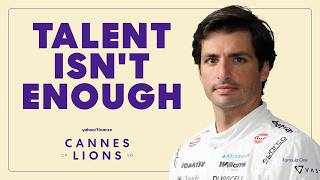

Why Carlos Sainz Picked Williams
60sSainz reveals his surprising team-switch mindset, betting on people over performance metrics, which is rare insight for fans.
▶ Play Clip"Genuine insights into winning habits, though interview pleasantries add some padding."
Carlos Sainz opens up about his move to Williams, the mindset behind elite performance, and the demands of modern Formula 1. He explains why he chose his team based on people rather than predictions, how new hybrid cars have changed driving, and the lessons from his father that shape his approach to racing.
Sainz treats event appearances as part of the job but still fits in a two-hour cycling session in Monaco after a few hours at the event, before flying to Austria for the next race.
He chose Williams based on the people leading the team, like James Vowles and Peter Kenyon, comparing trying to predict team development to predicting the stock market.
Last year was the team's most successful in years with several podiums; this year is a bump, but recoveries are not smooth lines and bumps force necessary change.
F1 teams are massive structures; Williams has over 1,300 people, and one or two tenths of a second make the difference between a good and bad year.
Regulation changes exposed who the true top teams are — Mercedes, Ferrari, Red Bull, McLaren — and Williams now understands exactly what it needs to change.
The new hybrid-era cars require drivers to manage battery usage, deciding where to push and where to save energy, which suits Sainz's over-thinker style.
At 31 he feels a veteran but sees Lewis at almost 40 still performing; the greats keep adapting and changing their approach every few years.
A driver can look like a legend in one car and struggle in another; performance depends on finding the bond between driver and machine.
His father, a four-time Dakar winner, taught him that world champions are champions because of attitude and adaptability, not just talent.
Commercial F1 demands balancing athlete, brand ambassador, and media commitments; good time management is essential to succeed.
For Sainz, winning in F1 comes down to adaptability, trusting the right people, and mastering time management — all in service of a single goal: becoming world champion with Williams.
Why did Carlos Sainz choose to sign with Williams?
Because of the people leading the team — figures like James Vowles and Peter Kenyon — rather than purely chasing performance numbers.
01:40
What does Carlos Sainz compare trying to predict car development in F1 to?
Trying to predict the stock market.
01:54
How many people make up the Williams F1 team?
More than 1,300 people.
03:16
What margin does Sainz say separates a good year from a bad year in F1?
One or two tenths of a second.
03:30
Which four teams does Sainz name as the current top F1 teams?
Mercedes, Ferrari, Red Bull, and McLaren.
04:38
How have the new hybrid-era cars changed what drivers do during a race?
They must manage battery usage, deciding where to push and where to save energy while driving.
05:45
What is the most important lesson Sainz learned from his father?
That attitude — not talent — is what makes champions, along with adaptability and building the team around you.
10:20
What is Carlos Sainz's stated goal five years from now?
To be world champion.
13:54
People over projections
Challenges the obsession with data by framing team choice as a human decision about who you want around you.
01:40Adaptability is the champion's edge
Explains why long F1 careers belong to those who constantly reinvent their driving and working style.
07:07Attitude makes champions
A memorable distillation of his father's career lesson: talent is secondary to mindset and work ethic.
10:20Time management is a modern F1 skill
Captures the new reality where drivers must be athlete, brand and ambassador simultaneously.
12:47[00:02] is pedal to the metal in his training and helping to turn the season around for Williams. Now finds his bright side as he had a chance to learn more on the as he had a chance to learn more on the F1 state of mind at Can.
[00:17] least in Williams have one thing, we have plenty of of partners, plenty of people that for sure it's important to meet here and and get to a bit of networking going and yeah, as a honestly even as an individual I find
[00:30] this place interesting to come to even if Williams wouldn't have uh asked me to come as um as part of obviously our our marketing days, well, I would have probably paid a visit here. So,
[00:43] >> How do you Is it hard to separate, you know, being here and being present and maybe perhaps wanting to practice or train or do what you do? >> No, I I think in the day has a lot of hours and you can spend those hours
[00:59] efficiently. I'm I'm I'm here for a two or three hours. Now I'm I'm I flew in uh here for two or three hours and then this afternoon I have a two-hour cycling session to do back in
[01:12] the mountains there in Monaco, so which is an hour away where where I live. So, I'll get everything done. Uh tomorrow I travel to Austria, next Formula 1 race. busy.
[01:25] >> I uh I'm a big fan of the show and I saw your thought process and how you arrived Take us a little more inside of that. Like what what made you pull that >> What made me pull that trigger a couple of years ago is in the end simply the I
[01:40] always say it's it's the people. I think in in Formula 1 is you're always constantly trying to look at performance numbers, metrics to see will uh win the next race, which car will be
[01:54] developed the most. Eventually I realized that it's bit like trying to predict the stock market. It's times you're going to be surprised with >> got stock tips for me? I'm I'm all ears.
[02:07] >> I I I try not to. Eventually, I realized that I had to pick based more on the on I was going to surround myself with. Uh the people leading that team, people like James Vowles, Peter Kenyon that are uh fundamental figures of of of the
[02:22] >> are >> Um in the end, I took the decision based >> Are you happy with your decision? >> Very happy. I think last year we proved we're here to to Yeah, we mean we mean business. I we
[02:37] we had uh our most successful Formula 1 season in in the last few years. We finished the year with a few podiums. not going to lie, the start of this year has been a bit of a struggle, and we've
[02:49] probably hit a bit of a bump in the road in in in that recovery. non-recoveries are smooth lines. Sometimes you you go up, a bit down, and then to go back up again. Uh this year we we're going through a
[03:03] little bit of a bump, but I'm very confident that this is going to help the team to change the necessary things that need to be changed to >> What do you think needs to be changed? Is the equipment?
[03:16] >> No, in the end it's Formula 1 teams are massive structure. We are more than 1,300 people. In order to extract the maximum and make a performing car, we're talking about tenths of a second. One or two tenths
[03:30] make the difference between a good year or a bad year, a good race or a bad Uh but yeah, you need to go back into the where there's inefficiencies, where there's places where
[03:44] Obviously, I'm not a team manager, I'm not a team principal, I'm not a businessman, I'm not a financial guy, but I know that Williams have realized that what we thought maybe was enough is
[03:59] still not enough. And we are changing the necessary things to to recover from that bump. And look, I see this as a good thing because probably if you don't good thing because probably if you don't hit the bump
[04:12] same kind of structure and the same way of doing things. And sometimes you need evolving and you need to keep challenging the organization to to >> How far is the gap in your estimation between Williams and all the great work
[04:25] you're doing and a and a company or brand like a Mercedes or Ferrari? >> Not as far as it seems. I think definitely this year has proven that the top teams
[04:38] are still the the top teams. We have Mercedes, Ferrari, Red Bull, and McLaren doing an exceptional job and they used the change of regulations as an opportunity to even pull a bit of a gap onto the let's
[04:51] say emerging teams like Audi, Aston Martin, and Williams, I Audi, Aston Martin, and Williams were all teams that we're trying to bridge that gap to the top teams. Now, in the process of doing that, there's been a
[05:04] And there needed to be so much change in the sport with these regulations that if anything that has exposed who is a top team and has the capacity of performing at a that
[05:18] level and who is not yet there. And thanks to that, in Williams we've understood why we're still not there. What's the gap? What's the real gap to And now what are the necessary changes to to bridge that gap?
[05:31] F1 CEO Stefano Domenicali. I've known him for for many years. And I got his from a driver perspective, how has it impacted how you drive? >> It's a different Formula 1. A Formula 1 that for sure has created some headaches
[05:45] for us drivers. Normally we are used to pushing flat out limit and see what lap time we can extract from the car. This year there's with the thing of them
[05:58] all the battery management that we have to do given the car is a lot more hybrid We're having to think a bit more while driving. Where are you pushing? Where are you not pushing? Where are you willing to take a bit more risk and
[06:11] where is more worth saving a bit of battery to spend in some other place. Personally, that suits me. Suits my way of I'm a bit of an over-thinker, so I optimize my driving. Um, at the same time
[06:28] I love pushing flat out and I think the sport has realized that we still need to keep the core values of the sport, which is make sure the drivers are pushing few changes, some tweaks to regulations to make sure we're not as hybrid and we
[06:42] >> Wow, this is I've always identified with you're one of the most intense guys on the grid. I love your attention to the grid. I love your attention to detail. How do you continue
[06:54] young guy, but you're a veteran at the same time. I'm I'm 31 and sometimes in F1 I feel a veteran, but then you see the likes of Lewis and Fernando and you feel young guy, you know? So,
[07:07] There is uh, guys at 19, 20 years old like Kimi that are doing great. But then you see Lewis at almost 40 year old doing great. So, the life of a Formula 1 driver is long. What I realize is that um, during
[07:24] you always keep getting better. Experience is in in our sport is experience if is a massive factor. So, every single race that you do, you learn something new. Um, the im- important bit for it or the way I see it
[07:39] you need to be open-minded to adapt and change. If you are not open-minded to adapt and change your driving style, your way of working every two or three years to challenge yourself as an athlete, you're probably
[07:52] going to stay behind. And I think the greats are the ones that are able to keep adapting, keep changing, and be humble enough to know that maybe what worked six years ago might not be the reason why it should be
[08:05] working now. And you might need to change your driving or the way to >> Have Maybe you could explain to me um how the these runs in motorsport happen. I see what Kimi's doing. I look at NASCAR with the what the likes of a
[08:18] Denny Hamlin is doing of late, too. How does that How does that zone happen? you cannot forget that uh in our sport you need we are a part of of the performance. We are not
[08:31] the only part, you know? We are um without a car, we cannot be successful, you know? We The machine probably goes all very very, very similar in terms of talent
[08:45] and speed. We need a car that first is quick enough to win, but then second, a car that suits us as a driver, you know? And you see it a lot with with completely different drivers. You see cars that
[08:59] they jump in, they're quick. Other Other drivers that for whatever reason the car doesn't suit their driving style, and you look like a god in one car, and then you look like you're struggling to
[09:14] understand that other car. There's a lot of It's a very, very complex sport. It's It's very difficult to explain in a conversation like this because it's so technical. And to feel at one with the car, you can be the best
[09:26] version of yourself, and you can look like a goat, like a legend, you know? You can be so, so fast. But then suddenly the car doesn't do exactly what and you're not that impressive anymore and it's all about
[09:40] car but also adapting the car to yourself and it's that constant battling of how much do I need to change for me to adapt to this car and how much me. And once you have find that
[09:54] And once you have find that bond with the car, you can go on to be a results. >> You have a real special relationship with your father who is a a champion in his own right. What did he
[10:06] you put what those teachings into every race you drive? >> I think my dad the most important lessons that I've learned from my dad is is more than driving or anything that to do with technical side
[10:20] is is about the attitude. Uh my dad being a double time world champion four time Dakar winner he was the one that Dakar with four different car manufacturers. Um so he's had to go through that
[10:34] process of changing teams, adapting, making the car competitive, making himself adaptable. I think the most important lesson is is is adaptability but also the attitude of how to build the team
[10:46] around you, how to extract the maximum out of the people you surround yourself uh even if he would have been a badminton, paddle, tennis player I think in the end world champions are
[11:00] champions because of the attitude, not because of the talent. And my dad I think had an incredible attitude towards motorsports in general. He's super passionate about what he does. And me I've I've grown seeing that,
[11:13] And me I've I've grown seeing that, watching that um at home, seeing him on phone calls, seeing him how he handles his things, his teams. And I only grow in admiration and and and looking up to I think a very good
[11:25] >> You've brought that legacy and your your winning mindset to Williams and I and you You as I follow the sport more in recent years but how long Lewis spent know, his team before changing teams. But still,
[11:38] um do you see yourself long-term with Williams? Is this where you retire and you're all in with them? >> In my ideal world, yes. My ideal world is I build a winning team with Williams. We
[11:52] years. We go and uh win the first world championship for Williams in in a long time. And why not? Stay here winning until it's time to call it a day. That would
[12:06] happier than achieving that goal. That's my my my ideal scenario that I want to um make sure we succeed together.
[12:18] the world of motorsport keeps changing every day, so I cannot put hand on paper that that will be the case, but in my head, in my ideal, that's what I'm >> One of the biggest changes is how commercial F1 has gotten. Uh the
[12:32] because of what Stefano was doing, but of course the amazing talents of you all Does that put more pressure on you as a driver? Like given all the sponsorship now have? >> Um it does. It does. The world of
[12:47] that comes a lot much bigger demands of your time to spend time with the partners, with sponsors, with media. Now, the F1 athlete is not only handling
[13:00] his um let's say his time around how do I become a better athlete, but also how do I find time to manage all of this? How do I am I an athlete,
[13:13] a brand, a team ambassador, brand ambassadors? How do I then go back to my bike and ride tonight for a couple hours? I think the management of time is a skill now in Formula 1 because if you have a good time management and a
[13:28] good organization of your schedule the world of Formula 1 has a potential for you to to become um and have a a great own brand but a a great Formula 1 team um
[13:41] and be an athlete. So, if you manage all of them together, I think you can put yeah, a very busy life but a an exciting one for sure. conversation again in 5 years right on this pier
[13:54] what will have you done in F1 that you haven't done today? world champion by then and um yeah, I'm not going to stop until I keep trying and keep believing in it and uh that's what I
[14:07] wake up every morning thinking about and what I go to sleep dreaming about. So, yeah, it's in it's in I'm wired to to now try and make that happen and I'm it and Williams is a big part of that.
[14:21] bike out of here. So, we'll let you go. Thank you for joining us.


⚡ Saved you 0h 14m reading this? Transcribe any YouTube video for free — no signup needed.