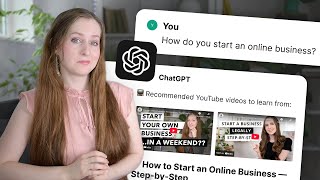

Are AI-Focused Titles a Myth? ChatGPT Weighs In
59sChallenges a widely believed SEO tip, making viewers question their entire title strategy.
▶ Play Clip"Useful reality check, but the title promises a simple 'here's how' when the video mostly says most AI hacks don't work — plus a course pitch."
This video examines a brand-provided checklist for getting YouTube videos ranked by AI and fact-checks each item with ChatGPT. It reveals that many common practices like keyword-matched titles, tags, and social media distribution are largely myths, while publishing transcripts on the open web and building genuine authority actually help. The creator concludes that solid YouTube SEO plus authoritative off-platform content is the most realistic route to being recommended by ChatGPT.
ChatGPT can include video results in its answers, so creators want to know how to get their videos recommended. A sponsor provided a checklist titled 'How to make sure your YouTube content gets ranked by AI,' which prompted a fact-check with ChatGPT.
ChatGPT's verdict: partly correct for YouTube, mostly a myth for ChatGPT. YouTube prefers titles that align with user intent, but ChatGPT understands intent rather than scanning for exact keyword matches.
This is a myth for AI and a minor benefit for YouTube only. It reinforces viewer expectations and improves retention, which indirectly helps ranking, but it's not a ranking signal for large language models.
Chapters are good for YouTube because they improve UX and act as semantic markers. Self-provided transcripts rarely add value on YouTube since auto captions are already indexed. For ChatGPT, transcripts only matter when published on the open web.
ChatGPT may know about a video only if its transcript is published on a publicly accessible web page that OpenAI models have crawled and that has significant authority or links. Putting the transcript in a YouTube description does not impact ChatGPT recall.
YouTube tags are extremely low-weight metadata and are only useful for clearing up common misspellings. ChatGPT does not see or use YouTube tags, so this is essentially a myth.
OpenAI does train on public Reddit, Quora, and Twitter data, but posting videos there does not guarantee incorporation into ChatGPT or surfacing in answers. It's good marketing, not a hack.
ChatGPT recommends high real-world authority signals, content that is well-known or cited across multiple sources, clear alignment with common question patterns, and accurate YouTube metadata.
The main path to ChatGPT suggestions is getting videos to rank well on YouTube, plus distributing content on authoritative platforms like your own website. The video ends by promoting the Creator Fastrack course.
In the end, chasing AI-specific hacks is less effective than simply making videos that rank well on YouTube and are discoverable on the open web. The most actionable strategy is to publish full transcripts on your own website and build authority signals around your content.
According to ChatGPT, is updating YouTube titles to match AI questions a reliable way to get suggested by ChatGPT?
It's partly correct for YouTube but mostly a myth for ChatGPT. YouTube likes intent-aligned titles, but ChatGPT doesn't index titles like Google search does.
02:50
What are YouTube tags' actual ranking impact per ChatGPT?
Minimal. Tags are extremely low-weight metadata, mostly outdated; useful only for common misspellings. ChatGPT ignores tags entirely.
09:39
Does ChatGPT index the auto-generated transcript directly from a YouTube video?
No. ChatGPT does not index the transcript directly; it may know the video only if the transcript is published on a publicly accessible web page crawled by OpenAI models.
08:25
What is the single most impactful way to help ChatGPT discover your video, according to the video?
Publish the full transcript in a blog post on your own website (with authority and links), making it publicly accessible on the web.
09:11
Why are YouTube chapters considered good practice for rankings?
YouTube prioritizes chapters for user experience, uses chapter titles as semantic markers, and chapters help viewers jump around, leading to higher retention and stronger ranking.
06:43
What is ChatGPT's verdict on posting videos to Reddit, Quora, and Twitter for AI visibility?
Overstated. OpenAI trains on public data, but posting does not guarantee model incorporation or surfacing; it's good marketing but not a hack for ChatGPT visibility.
10:38
What are the four types of signals ChatGPT says actually help videos get recommended?
High real-world authority signals; content well-known/cited across multiple sources; clear alignment with common question patterns; and metadata accuracy on YouTube.
12:34
What is the final big takeaway of the video for AI visibility?
Focus on ranking well on YouTube and distributing your content on authoritative platforms; strong YouTube ranking makes it more likely ChatGPT will find and suggest your video.
15:07
Retention is the real algorithm
Serves as a reminder that viewer experience and retention still outweigh keyword tricks for YouTube ranking.
05:05Transcripts are invisible to ChatGPT unless published on the open web
Corrects a common misconception about how LLMs retrieve video content from YouTube.
08:25Publish your transcript on your own blog
This is the most concrete, actionable tactic offered in the entire video.
09:11Tags are a myth for AI rankings
Confirms that YouTube tags carry almost no weight and are completely ignored by ChatGPT.
10:25Authority beats keyword tricks
Shifts the focus from surface-level hacks to building real authority signals across the web.
12:34[00:01] and ask JGBT something, it gives you not just a text response, but there are some video results that are part of the answer that it's giving to you. Sometimes these are helpful tutorials or sometimes they're just more information
[00:15] Well, have you ever wondered how you might be able to get your YouTube videos in those kind of recommendations that ChatGpt is giving people? If you could get more views on your YouTube videos and not just views from anybody, but
[00:32] views from people who are the most interested in that topic. Basically, like your target market for your videos. Well, I hadn't thought about this very much until I recently started working with a new brand, like a sponsor. And as
[00:46] out of the video and their specifications for it, they gave me this was very interesting. It says, "Checklist, how to make sure your "Checklist, how to make sure your YouTube content gets ranked by AI." And
[01:01] I thought, well, that's interesting. I would like my YouTube content to get ranked by AI. Whether that means actually getting suggested by ChatGBT or it just means getting ranked better on YouTube where the algorithm is more than
[01:14] ever powered by AI. The other thought that popped into my mind as soon as I would probably want to know this information too, right? But then that brought a question into my mind and that was where did this information actually
[01:28] come from and can we actually trust it? I mean yes it came from a particular I know it came from their marketing department but I don't know where they got these ideas. There's no sources or anything on this doc. So rather than
[01:41] going through this list with you just as it is. I thought let's go through it with chat GBT. Let's actually go to the source and see what chat GPT has to say about which of these things are best practices and things that will actually
[01:54] help your videos get ranked by AI and which of them are maybe myths or misconceptions or downright lies. Okay, so here's what I typed into chat GBT. I provided to me by a brand I'm working with. How accurate is it? Which
[02:08] recommendations are good practices for getting YouTube videos ranked by AI and or suggested by ChatGBT? and which are myths or mistakes. And then I gave it the checklist. So let's see what chat GBT had to say about this. First thing
[02:23] GBT had to say about this. First thing on the list was update titles to match AI questions. And then it gave some examples like instead of saying ultimate more like how to build a website for your business step by step. It says AIS
[02:40] your business step by step. It says AIS love clear direct question formats. Now, here's what Chad GBPT had to say about this verdict. Partly correct for this verdict. Partly correct for YouTube, mostly a myth for Chad GBT. Why
[02:52] it is good for YouTube. YouTube search does prefer titles that align clearly with user intent. Question-based titles often perform well because of how users search in howto format. So basically what it's saying here is on YouTube
[03:07] YouTube algorithm loves these kind of exact matches between somebody typed in how to wash my car and now we've got a video that is titled how to wash your car, right? But then Chad GPT goes on to say that this doesn't really matter for
[03:22] Chat GPT. It says that Chad GPT does not index YouTube titles the way Google search indexes web pages. So basically kind of read between the lines is that JPT is a little bit smarter and it's not
[03:38] keywords but it's actually kind of like it's thinking in a more big picture sort of way. It's more like it's understanding what you're actually looking for and he's able to find the content that will be a match even if
[03:53] there isn't this exact match with keywords. So it doesn't matter for chat GBT as much if you title your video in a way that's going to match like their exact inquiry. So for example, if someone is typing into chat GBT how to
[04:06] wash my car, your video doesn't need to be titled how to wash my car. It could be titled something like car wash beginners guide. So should you do this? Should you title your videos with AI questions, things that people are typing
[04:20] into Google or typing into YouTube or typing into chat GPT? And the answer is it's not going to hurt anything, but that alone is not going to get you suggested by chat GPT. So, let's keep going here. The next thing it says on
[04:33] this list is repeat the question in the video intro. Example, in this tutorial, professional website for your business using Hostinger step by step. And it says, this simple line increases matchability with AI queries. So, here's
[04:49] what Chad GBT had to say about this. The verdict is that it's a myth for AI and a minor benefit for YouTube only. So, is it worth doing for YouTube? Well, sort of, says Chad GBT, saying the topic in the intro reinforces viewers
[05:05] expectations and improves retention. And I love that Chad GBT highlighted that because I think that so often people do try to play to the algorithm um and just kind of the AI robotic side of the algorithm and they forget that the most
[05:18] important thing and the thing that the algorithm has actually been optimized for is the viewers response to your video. So, anything you can do in your video to give your viewers a better experience and get them to keep watching
[05:32] longer is going to improve your video's ranking and your video's suggestability over on YouTube. Now, for getting your video ranked on ChatGpt, ChatGBT says that you don't need to do this at all. It says that it's not going to be
[05:45] searching your transcript for matching phrases and then choosing the video and that repeating the question is not a known ranking signal for any large language model retrieval pipeline. Okay, so basically what it's saying here is
[05:59] the YouTube algorithm. It's not going to help you with chat GPT at all, but actually you should still do this and it's even admitting it here because it will improve your viewer retention. It's going to get people to understand that
[06:13] will keep on watching longer. So you should do it and it will actually help you on YouTube and even with Jed GBT just not directly. Next up number three is add full transcripts plus chapters. It says YouTube videos should include
[06:29] chapters with clear names and full transcript either in the description or on a connected blog. And here's what Chad GBT has to say about this. It says that it is a good practice for YouTube, but it's misunderstood for AI. Okay, so
[06:43] first of all, it says the chapters are very good, that YouTube prioritizes videos with chapters for user experience. It also says that YouTube uses chapter titles as semantic markers, and that chapters help viewers jump
[06:58] around, which means you'll have higher retention and stronger ranking. So according to chat GPT, not only does the algorithm itself like this and find it helpful for understanding what your video is about and considering that that
[07:13] video will provide the users with a better experience. So it's going to be got to admit, I'm a tiny bit skeptical of some of those points, but I totally agree with what it says here, that those chapters are going to help with the user
[07:28] experience and that that is going to lead to a stronger ranking. Okay. Now, here's what it says about adding a transcript to your video. Says you do because YouTube's autogenerated transcripts are already extremely
[07:43] accurate and fully indexed by search. Providing your own transcript only helps when you want perfect accuracy, your video uses jargon or accents that auto captions are going to misinterpret or you're publishing the transcript
[07:57] elsewhere for SEO. Now, keep in mind that everything it just said there about the transcript not being that important. That was for YouTube. Okay? But now listen very carefully about what it says about how transcripts can help with
[08:09] getting your video suggested by ChatGBT. And this is also going to impact how your video might get ranked by other AI powered search engines. Okay, so it says chat GBT does not index the transcript directly from your YouTube video. So in
[08:25] other words, chat GBT it can't see that transcript that YouTube automatically generated. However, ChatGpt may know about the video if the transcript is
[08:37] published on a publicly accessible web page that OpenAI models have crawled and the page has significant authority or links. So, simply putting the transcript in your YouTube description does not impact ChatGpt's recall or ranking. But
[08:55] later on is that if you have that transcript, whether you got it from YouTube or you generated it some other way, publishing it in a blog post on your website along with the video, that is like the number one thing that is
[09:11] going to help ChatGpt to notice your video and make it way more likely that ChatGpt will be suggesting your video to ChatGpt users. Okay, for right now though, let's zoom along with these last
[09:24] two points on here. The next one was tag videos with AI relevant phrases examples. Easy website builder, AI website builder tutorial. Okay, so it's just saying like popular keyword phrases here. Um, and what Chad GBT had to say
[09:39] about this was that it's mostly an outdated practice. Minimal ranking impact on YouTube tags are extremely lowweight metadata. Absolutely agree. YouTube really hardly uses tags at all anymore. H it's only as YouTube has
[09:54] publicly stated and chat GPT repeats here. They're helpful for clearing up common misspellings. So if something you're saying in the video um might be misspelled and that might therefore not match with what people are typing into
[10:09] YouTube, that can help out. But really, the tags on YouTube are practically when you are uploading your YouTube video and it really won't affect anything. Okay. Then when it comes to chat GPT, it says tags are irrelevant.
[10:25] Chat GPT does not see or use YouTube tags. So this is really totally a myth. You don't need to use tags on your videos. Now the last thing on this list is to distribute your videos on AI indexed platforms. Okay. It says, "Post
[10:38] authentically on Reddit, Kora, and Twitter." So, what does chat GBPt say about this one? The verdict here is that it is overstated. It's partially true, but it's misunderstood. The reality is that OpenAI does train on public Reddit,
[10:55] Kora, and Twitter data. However, posting your videos there does not guarantee incorporation into any CIGBT model. And even if it is included, LLMs do not
[11:07] magically surface your video just because it has a link that appears in that training data. And LLM outputs are dominated by authoritative patterns, not one-off posts from users. So posting on social media platforms, it says, is good
[11:22] marketing, but it's not a hack for chat GPT visibility. And that's really what I GPT visibility. And that's really what I would expect as well that if you are your blog or on one of these social media platforms, and there are authority
[11:38] markers, okay, that could be your website's domain authority or it could up votes or whatnot on these different platforms, then chat GBT will take notice. but just like publishing it on
[11:52] automatically get it suggested by chat disappointed by this list that was provided by this brand because it turned out that more than half the things on this list were myths or misconceptions.
[12:05] But fortunately, the video doesn't stop here because Chad GPT went on to tell us what actually helps videos be recommended by ChatGpt. Now, just like anything, Chad GPT tells us, take this with a grain of salt. Even when chat GPT
[12:19] is talking about itself, it doesn't know the truth necessarily. Uh it is hallucinating always. But clearly chat GPT does have some insights into what might help videos get ranked by AI. So let's take a look at what ChatGpt had to
[12:34] say about this. First one is high realworld authority signals. So videos from channels that are widely embedded across the web, are referenced frequently, have strong external backlinks, have substantial viewership
[12:47] and engagement. So this one is a little bit challenging, a little bit saying like if your channel is big and popular, then Chad GPT is going to be more likely to suggest your videos. And that seems really not surprising. It is
[13:01] good to know that, but there's not much you can do about that. So let's move on to the next thing. And that is number two content that is wellknown or cited across multiple sources. So if your video topic appears in blogs, help
[13:13] centers, Reddit discussions, tutorials, Chad GBT could recall it because it was represented in many public data sources. So this one you can impact a little bit. It's what I was talking about earlier. If you put your video onto your website
[13:29] in a blog post and you put the transcript of the video there, Chad GPD is going to be able to more easily access that information, that content than if it was only on YouTube. And now it's seeing that video on two different
[13:43] platforms essentially, your website and YouTube. And maybe you do also share it on some social media platforms. And now Chad GPT will be more likely to suggest it in its responses. Now the next recommendation on this list I find kind
[13:57] of funny because I feel like Chad GPT said it in the most confusing way it number three, clear alignment with common question patterns. If your content answers canonical questions, example, how do you build a website?
[14:11] JGBT is more likely to reason its way to your content as a recommended resource. Really what it's saying here is if your content answers common questions, ChatGpt is more likely to suggest it to people. No duh. So yes, make your
[14:26] content about popular topics, popular questions people have, popular it'll be more likely to be suggested. Okay. And then number four here is metadata accuracy on YouTube. Not for chat GPT, but for overall
[14:39] chat GPT, but for overall discoverability that feeds into LLM awareness. Okay. So here what it's saying is that you want to make sure that you give your video a clear title and description on YouTube so that it
[14:53] ranks well on YouTube so that Chad GPT is more likely to discover it. And I think that this actually is a really good kind of place to be ending this video because it kind of wraps up all of this information, which is to say that
[15:07] the most important thing for getting chat GBT to suggest your videos to people in its responses is actually just to get your videos to rank well on YouTube. Because then just like a YouTube user is more likely to find your
[15:20] video, Chad GBT also is more likely to find your video. Now, the other part of this, of course, is distributing your video on other platforms, especially authority, which hopefully your website does, but if it doesn't, that's another
[15:35] thing for you to work on that doesn't seem directly AI related, but will ultimately help your videos to get recommended by AI more. Now, if that all to put your head down and focus on getting your videos to rank well on
[15:50] YouTube so that they can get suggested by these AI systems, then I would love to tell you about Creator Fastrackk. This is perfect for you if you need a little bit of help with figuring out how to get your videos to rank well on
[16:02] YouTube. Creator Fastrackk is a YouTube training program that I started about 5 years ago now. We've been updating it every single year to make sure that we are staying on top of all the algorithm changes. In fact, I just finished
[16:15] recording a new series all about what's new on YouTube in 2026. And in it, I go through all of the feature changes that have happened on YouTube in 2025 and that are coming up here in 2026. I also talk about viewer trends and how they
[16:29] have changed a lot over these past 6 months or so. And we also get into specific like algorithm changes. What has YouTube done to the algorithm over the past year and what is that looking like as we move into this next year? And
[16:43] that's just one example of how we always keep Creator Fastrack updated with the latest information of how to rank well on YouTube. The whole point of Creator Fastrack, though, is to get your first thousand subscribers in just 3 months or
[16:58] less. So, if one of your goals this year is getting to 1,000 subscribers so you can get your channel monetized and be on your way to becoming a full-time perfect for you. Now, we only run Creator Fastrack a couple of times a
[17:13] year, but the next enrollment period is coming up here in just a week or two after this video will be published. So, make sure you check it out now if you're right here, and I'll also include that link down in the description to find out
[17:27] more about Creator Fastrack. And important, put your name on the wait list, type in your email so that I can shoot you a message when the doors open enrollment period because it's only going to be open for a few days. Next
[17:40] up, watch this video right here, handpicked for you by the YouTube handpicked for you by the YouTube algorithm.


⚡ Saved you 0h 17m reading this? Transcribe any YouTube video for free — no signup needed.