
Effortless Chicken Cutting Trick
30sDemonstrates a satisfying and useful kitchen skill that viewers love to learn and share.
▶ Play Clip"The title teases a surprising ingredient, and the video delivers exactly that with V8 juice—a legit twist on a classic."
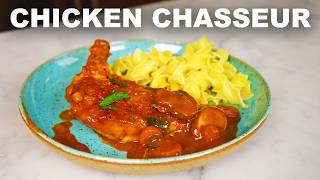
This video presents a detailed recipe for chicken chasseur, a French-style hunter's chicken, with a secret ingredient that adds complexity to the sauce. The chef demonstrates how to break down a whole chicken, prepare the dish, and achieve a rich, glossy finish.
The chef introduces chicken chasseur as an ideal fancy home-cooked meal and reveals a secret ingredient that might offend traditionalists.
The chef demonstrates how to cut a 4-pound chicken into pieces, including separating legs, deboning thighs, and preparing airline breasts with drumettes attached.
The chicken is seasoned with pepper and salt, then coated in flour to help thicken the sauce later.
The chicken is browned skin-side down in olive oil over high heat until golden, then set aside.
Mushrooms and shallots are cooked in the pan with extra flour, then deglazed with dry vermouth for added flavor.
The chef adds V8 juice (or equivalent) as the sauce base, praising its smooth texture and complex flavor. Demi-glace or concentrated stock is also added.
The chicken simmers for over an hour until tender. The sauce is seasoned with pepper, salt, butter, tarragon, and lemon juice.
The dish is served with noodles, showcasing the boneless thigh and lollypop leg. The sauce is rich and complex, complementing the white meat.
The chef successfully creates a restaurant-quality chicken chasseur at home using a surprising secret ingredient—V8 juice—which enhances the sauce's flavor and texture. The dish is both impressive and accessible for home cooks.
What is the secret ingredient used in this chicken chasseur recipe?
V8 juice (or equivalent tomato-vegetable juice).
05:48
Why does the chef use dry vermouth instead of white wine?
Dry vermouth has a lot more taste and provides an extra boost of flavor, especially sweetness.
05:33
What is an 'airline breast'?
A boneless skinless breast with the drumette (first wing joint) attached.
01:52
How does the chef remove the wishbone?
By making slits on each side, reaching in, and levering it out.
01:07
What herb does the chef associate with French bistro cooking?
Tarragon.
07:27
Why does the chef add butter at the end of the sauce?
To finish the sauce and make it 'frenchy' (rich and emulsified).
07:13
How long does the chicken simmer?
A little over an hour.
06:42
What does the chef use to thicken the sauce?
Flour from coating the chicken and an extra couple of tablespoons added with the vegetables.
04:34
Secret Ingredient Revealed
The chef uses V8 juice as a sauce base, a surprising twist that adds complexity and smoothness.
05:48Tarragon as Key Herb
Tarragon is highlighted as a signature herb in French bistro cooking, adding floral licorice flavor.
07:27Airline Breast Technique
Demonstrates a professional butchery technique for an elegant presentation.
01:52Lemon Juice Finish
A classic restaurant trick to brighten and freshen the dish.
07:42[00:00] but I've been making chicken chasseur a lot at home lately — French-style hunter's chicken — and I just think it's an almost ideal fancy home-cooked meal. Here's how I'm
[00:13] making it lately. I've got a secret ingredient that might offend the frogs, don't tell them. Traditionally you use skin-on chicken pieces. Buy them already cut up if you can, but I'm just gonna
[00:25] cut up this 4 pound, 2 kilo chicken myself. My way is neither quick nor elegant but it's easy. Cut that skin between the leg quarter and the body, and then I dangle the chicken by the drumstick. The tension opens up the hip joint and makes it easy to slice right through.
[00:41] Once it's off, I'll separate the drum from the thigh. Slice behind the knee there and then I pick it up and crack it open — dislocate the joint so you can slice the rest of the way. You could cook the thighs whole but I'm gonna debone them.
[00:55] Just go down the length of the femur to open everything up, get under the bone with your knife and it doesn't have to be pretty, just get that bone out of there. To make the breasts easier I'll make a couple slits on each side of the wish bone,
[01:07] reach in there, dig around and just lever the whole thing out like that. Start at the apex and peel the meat off a little at a time, following the rib cage with your knife. When I get down to the shoulder joint I just crack it open so I can get
[01:21] through with my knife and there's a breast with wing. Save the carcass. I'll need a heavier knife for this part. Just to fancy up the legs, I'll go straight down to the bone, just below the meaty part, circumnavigate the whole tibia
[01:34] there and then scrape down to the ankle which I will finally remove by just popping through the bone — a little smack on the spine of the knife gets you through. Those will cook up real pretty. so I dislocate the elbow and cut through. A boneless skinless breast
[01:52] with the drummette attached makes a very pretty presentation. They call it an "airline breast." There's the meat, but you could cut it much more crudely or buy pre-cut pieces. All these scraps I will freeze to make stock later because I am now one of those people.
[02:08] Enough pepper and salt to season both sides — I'm leaving extra on the board for the other side. And this is a good amount of flour — enough to coat the chicken AND thicken the sauce. Toss to coat everything. There we go, they look like little pillows, little clouds,
[02:22] like the cloud I sleep on — a premium mattress in a box from Helix Sleep, sponsor of this video. Hey, March is National Sleep Awareness Month.
[04:19] Anyway, a good coating of olive oil in my widest pan, or render some bacon in there if you want. I'll lay the chicken skin-side down. My heat is very high because there's a lot of mass here cooling it back down again. Real quick I can slice up some mushrooms.
[04:34] cooked and I want this extra couple tablespoons of flour for thickening. I'll do a real quick chop on a shallot. That's it. Is the chicken ready to flip?
[04:48] It releases real easy from the bottom of the pan, so probably. Man, look at that beautiful color from the flour, plus it’ll help the chicken kinda merge with the sauce later. Brown the other side. Don't worry about cooking the meat all the way through yet.
[05:03] Just stop before the stuff at the bottom of the pan starts to burn — that would ruin the sauce. Take the chicken out to a plate or something, and then I'm just gonna put all these veggies in at once, with the flour — it's amazing how well they all cook together, IF you give it some extra olive
[05:17] oil or butter or something. The mushrooms and flour will suck up a lot. Just get a little color, look for the mushrooms to shrink by about half and that's all the headstart this stuff needs. Time to deglaze, and lately I'm using dry vermouth for this. You could use normal white wine,
[05:33] but the fortified wine just has a lot more taste to it, and I think this dish can sometimes be a little bland — it just needs an extra boost the vermouth provides. Even the dry stuff is pretty sweet tasting, which brings a lot to the dish. That’s like a whole glass of vermouth.
[05:48] Once the bottom of the pan is clean I'll throw the chicken back in, and the rest of the liquid is gonna be my secret ingredient — V8 juice, or equivalent. Tomato juice with other vegetable flavors in it. This stuff makes a fantastic sauce base
[06:02] and I don't care if anyone thinks it's a cheat. Bring it like 2/3rds of the way up the chicken. but tomato juice has had the fibers strained out and I just love the smooth,
[06:14] glossy finish that gives you in the final sauce. Plus the flavor of the V8 is a lot more complex. I'ma throw in a few ice cubes of my homemade demi-glace. If I didn't have that, I'd use a concentrated stock product, like twice this much,
[06:29] but just be aware it’s very salty so you probably won't need any more salt in the sauce. done inside — maybe a half hour, or you could keep going and really soften it.
[06:42] I like it just a little soft these days, I don't want it falling apart. Flip the chicken a few times OR cover it with a lid to make sure the topside gets cooked. I think I simmered this chicken a little over an hour. When I poke the dark meat
[06:59] with my finger I can just start to feel the different muscles pulling apart from each other. That's the right softness for me. We'll still need a fork and knife, but not much. I'll taste the sauce — very intense because I did not use any water and I
[07:13] let it reduce the whole time with no lid. Needs a whole bunch of pepper, a little salt. Some butter to finish the sauce — this makes it frenchy. Tear in some parsley leaves or something, maybe a few sage leaves, thyme would be great but the
[07:27] big herb for me is tarragon, which tastes like floral liquorice. I really associate tarragon with French bistro cooking, probably because I almost never see it anywhere else. I'll just shake that in, get that butter melting gently to preserve its emulsion.
[07:42] And right at the end, if you have a lemon around, a squeeze of juice really freshens and brightens the whole dish. That's a classic restaurant trick for a reason. Works great, Noodles on the side, here's a boneless thigh,
[07:57] and then check how nice that lollypop leg looks. Spoon on a little sauce and that is a knockout of a dish that is just as good at home as it would be at the bistro. Sauce is super rich and complex, not bland at all, which is particularly important for the white meat,
[08:12] which doesn't taste like much. I do like the meaty texture you get from it, though, if you just barely start to soften it through braising, but my favorite part is probably the lolly-leg.


⚡ Saved you 0h 08m reading this? Transcribe any YouTube video for free — no signup needed.