
China's Biggest ETF Is Now Gold
45sReveals a shocking shift in China's retail investment from stocks to gold, sparking curiosity about global economic trends.
▶ Play Clip"The title accurately reflects the video's core thesis about China preparing for higher gold prices, though the $38,000 figure is presented as an analytical target, not a prediction."
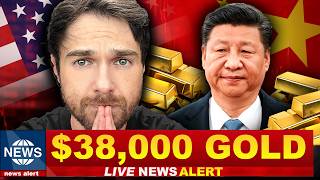
The video discusses the unprecedented shift in China where the largest ETF is now a gold fund, signaling a massive move by both retail investors and the central bank towards gold. This is tied to a broader global trend of de-dollarization and a potential return to a gold-backed monetary system, with analysts suggesting gold could reach $38,000 per ounce to balance global trade imbalances.
For the first time, China's largest ETF is a gold ETF (Guan Yu Gold ETF) with $13 billion, surpassing the stock ETF at $12 billion, indicating a shift in retail investor preference towards gold.
The People's Bank of China bought gold for the 20th consecutive month, the longest streak since 2015, and imported 700 tons of gold in the first five months of the year. Global central banks bought 41 tons net in May alone.
Treasury Secretary Scott Bessent published a Wall Street Journal op-ed outlining a return to Hamiltonian economics, which includes protective tariffs and subsidies to rebuild American industry.
Alexander Hamilton's 1791 plan used tariffs and subsidies to protect infant industries, enabling the US to become the world's leading industrial power over 150 years.
The US began de-industrializing after leaving the gold standard in 1971, leading to financialization where income comes from paper assets rather than manufacturing, hollowing out the economy.
The US aims to rebuild factories, protect Main Street, and keep the dollar strong, but only two can be achieved simultaneously. The likely sacrifice is the dollar, using gold as an escape valve.
Since 2009, China has been advocating for a neutral reserve asset, and has been accumulating gold, with the central bank buying for 20 straight months and importing 700 tons in early 2025.
Analysts calculate that to balance the US-China trade surplus, gold needs to reach $38,000 per ounce, based on dividing China's trade surplus by its gold imports.
Either the MAGA plan fails leading to a chaotic breakdown, or it succeeds with a managed transition to a gold-backed system. Both paths lead to higher gold prices.
A capital rotation from financial assets to real assets is expected, with gold outperforming. Since 2018, the S&P 500 is down 15% in gold terms, while gold miners are up over 200%.
The video concludes that regardless of the outcome, gold is poised to rise significantly, potentially to $38,000 per ounce, as the world moves towards a neutral reserve asset. However, this process may take over a decade, with major corrections along the way.
What event in 1971 is cited as the start of US de-industrialization?
The US leaving the gold standard.
09:41
What is the name of the economic system that Alexander Hamilton created?
Hamiltonian economics.
03:10
According to the video, what three things does the US want to achieve simultaneously?
Rebuild factories, protect Main Street, and keep the dollar strong.
15:06
What is the estimated gold price needed to balance the US-China trade surplus?
$38,000 per ounce.
22:42
How many consecutive months did the People's Bank of China buy gold as of the video?
20 months.
01:12
What was the name of the neutral international currency proposed by John Maynard Keynes?
The Bancor.
18:58
In what year did China's central bank governor publish a paper calling for reform of the international monetary system?
2009.
17:35
What is the term for the process where a country's income shifts from manufacturing to financial activities?
Financialization (or securitization).
10:11
According to the video, what is the only asset with thousands of years of experience as a neutral reserve asset?
Gold.
17:06
What did China's central bank governor propose in 2009 as a solution to the dollar system?
Create an international reserve currency disconnected from individual nations.
18:04
China's Gold ETF Surpasses Stock ETF
Demonstrates a historic shift in retail investor preference from stocks to gold in the world's second-largest economy.
00:02Hamiltonian Economics Explained
Provides historical context for current US trade policy, showing a return to protective tariffs and subsidies.
03:10The Impossible Trinity
Highlights the fundamental conflict in US economic goals, suggesting the dollar must be sacrificed.
15:06Gold Price Target of $38,000
Presents a specific, data-driven calculation for gold's potential price to balance global trade.
22:42Capital Rotation to Real Assets
Shows that since 2018, traditional safe assets have underperformed gold, indicating a trend shift.
27:40[00:02] that has never happened before. The biggest exchange traded fund in the whole country that ordinary Chinese people put their money into is now a gold ETF. So, let me explain. Here in the US, we have something called the S&P
[00:15] 500. That's where most people invest their money, represented by ETFs like their money, represented by ETFs like VO. Well, China has an equivalent of that fund as well. That's this fund right here. This is China's S&P 500. And
[00:29] right here. This is China's S&P 500. And just recently, another ETF surpassed it. That ETF is this one, Guan Yu Gold ETF. It's now $13 billion versus $12 billion
[00:41] in stocks. So, in the second biggest economy in the world, the biggest chunk of retail investor money is now sitting in gold. Now, what's interesting is that this is happening while gold prices are kind of crashing. Remember, gold peaked
[00:56] at around $5,600 an ounce earlier this year, and then it went down almost 30% below $4,000. And while that was happening, China was buying way more gold. And it's not just ordinary retail people from China. It's also the
[01:12] People's Bank of China. They just bought gold for the 20th month in a row, which is the longest streak going back to at least 2015. In June, they bought almost 15 tons of gold, which is also the biggest monthly buy since October 2023.
[01:29] biggest monthly buy since October 2023. China also imported roughly 700 tons of gold in just the first 5 months of this year and over 14,000 tons combined since 2015. And it's not just the People's Bank of China, it's also the world's
[01:46] central banks that are buying gold as well. 41 tons net in May alone. There's also countries buying gold. Countries like Poland, Usbekiststan, Kazakhstan,
[01:58] everyone's buying gold. And in a couple weeks on July 24th, four of China's biggest banks are shutting down retail gold trading. Which means if you're an ordinary Chinese citizen and you want to buy gold, China wants to make sure
[02:13] you're buying the real thing and not just the paper representation of gold. Now again, if this were just China, this would be a huge story. But two weeks ago, the Treasury Secretary of the United States was in New York and he
[02:28] published a Wall Street Journal op-ed. And that paper basically outlined what the US is planning to do. And what it's planning to do is a return to an
[02:40] economic system named after Alexander Hamilton. The treasurer has been to Fort Knox and I am happy to say all gold is present and accounted for. Uh the US has the largest pile of gold in the world, over a trillion dollars at current
[02:55] >> Scott Besson's plan for the US economy is what's referred to as Hamiltonian is what's referred to as Hamiltonian economics. And that paper explains every the things we'll talk about in this
[03:10] video, which is why China's buying, why central banks won't stop buying, and why some analysts calculate the math of the global economy only balances out when global economy only balances out when gold reaches $38,000
[03:25] per ounce. That's kind of crazy to think about. So, in this video, I want to explain what's going on, what this means for the price of gold in our portfolios in the future. So, with that said, this is going to be a very interesting video.
[03:38] Andre Jick. Hope you're doing well. Come for the finance and stay for the gold. So, I want to give credit to Luke Grman from FFTT. He put out a brilliant piece about this where he connected all these dots including Scott Besson's op-ed
[03:52] where he talked about Hamiltonian economics which is basically an outline for how a country becomes the richest and most powerful country in the world. It's how countries become superpowers and every country that ever got rich did
[04:07] and every country that ever got rich did it this same way. And how they do it is they cheat, right? They use protective policies and taxes. And after they win, they preach to the rest of the world that other countries should trade freely
[04:21] and not manipulate their prices. They're like, "Hey guys, I'm done cheating. I won. You can't cheat anymore." Okay, here's how it actually works. We have to go back to December 5th, 1791. That's when Alexander Hamilton,
[04:34] America's first Treasury Secretary, the guy on the $10 bill, basically goes to Congress and he creates this plan which is based on his report on manufacturers. Now, that report set the standard for how the US would operate for the next
[04:49] 150 years. Here's some background. By the way, at the time, the US was essentially a startup country. It had about 4 million people, most of which were farmers, and it had virtually no factories. Almost everything that was
[05:04] manufactured, like tools and weapons, that was imported from the British Empire. The same empire that the US just fought a war to get away from. So Hamilton creates this plan, and he says, "A nation that cannot make the things it
[05:18] needs is not actually an independent nation. It doesn't matter what your constitution says. If your economy depends on your adversary, then you're just a colony still with extra steps, right? So, his solution was a two-part
[05:32] plan. The first part of the plan was tariffs or taxes on foreign goods. The second part were subsidies for American industry. The idea was to protect young
[05:44] American companies which he called infant industries until they got big enough and efficient enough to compete with anyone in the world. This became the US operating system for about 150 years. And thanks to the US using this
[05:59] master plan throughout all the 1800s, the US was able to go from a country of farmers with no factories to a country that became the biggest industrial power in the world. In fact, Trump actually gave a speech about it earlier this year
[06:14] where he referenced a return to that system. >> As I said in my speech last week, instead of taxing our citizens to enrich foreign nations, we should be tariffing and taxing foreign nations to enrich our
[06:28] >> Anyway, that's the system he's referring to here. This is part of that Hamiltonian economics, which is what makes countries rich and powerful. Now, inevitably though, this plan has always led to the destruction of every single
[06:45] empire in history where another country rose up and took power. And here's how this is happening to the United States right now. Now, before I get into that, talk about because it affects all of us, which is that the American health care
[07:00] And one of the hardest things about it is just how hard it is to book an provider. In fact, the average wait time to see a new doctor in the US is 31 days. And in some cities, it's over 40. And as soon as you call, you get put on
[07:14] insurance. And then you have to start all over. And I'm guilty of this, too, because I've been putting off an annual physical for almost a year because every excuse was that I'm too busy. I'll do it after the next video, next month, for
[07:27] sure. which is kind of crazy because I'll check my portfolio maybe five times a day, but not the most important asset I own, which is my health. And what another birthday because my health is the one asset I can't buy back. And
[07:40] that's the whole reason Zachdoc, today's video sponsor, exists. It's a free website where you can search local inetwork doctors, compare detailed patients, and choose the one that fits what you're looking for. Then you see
[07:53] their actual appointment slots, and book instantly right there. They have access to over 150,000 providers across more than 200 specialties in all 50 states. Appointments typically happen within 24 to 72 hours and sometimes you can get
[08:05] one on the same day. And that's exactly how I finally booked that physical and the whole thing took maybe 5 minutes and I was in the office within 48 hours. off my shoulders I didn't realize I was carrying. And I know it seems small, but
[08:17] down below is a big step toward prioritizing your health. So, head to to get started and check that appointment off your to-do list. Again, the link is down below. And now, let's get back to the video.
[08:32] So, here's how a country goes from being the global empire to another country taking over that status. The most recent example in history is of course the British Empire, which for them started in 1846.
[08:44] That's when Britain got rid of something called the corn laws and it converted to the religion of preaching free trade to the world. They're like, "Guys, we won the game. Let's not cheat anymore and let's sell stuff to each other at fair
[08:58] countries are like, "Yeah, well, you're saying that now after you cheated." Hamiltonian economics, right? High tariffs, subsidies, protective policies. So now you don't want anyone else to cheat. Okay. Now by 1931 Britain stopped
[09:14] being the global empire. Why? That's because Britain slowly de-industrialized meaning their factories closed, industry moved to other countries and by 1931 the
[09:27] British Empire was done. The global leadership was transferred to the US and it became the global superpower. That process took about 85 years and it's why most people don't really notice this happening, but it's happening to the US
[09:41] right now. And for the US, it started in 1971. That's the year that the dollar came off the gold standard, which eventually led to factories leaving the US. Now, here's a question, though. Why do factories
[09:57] have to leave? Like, why does this de-industrialization process have to happen? And it happens because of something called securitization. It's when a country creates a paper market for itself. Which means for that
[10:11] country, more and more of its income starts to come from shuffling paper starts to come from shuffling paper around instead of making real things. Now, all empires eventually financialize their economies by creating stock
[10:26] markets and financial products. But in doing so, that creates all the structural incentives for the beginning of the end of their empire. Because when you financialize, you're like, let's increase the value of our country. How
[10:41] do we do that? Forget about building things. That takes money and risk. It's expensive. I have a better idea. Let's buy our own stuff like our own stocks. That's what's known in the stock market as share buybacks. And also, let's
[10:56] increase our income. How do we do that? By lowering our costs. Let's use cheaper parts imported from somewhere else. And let's not give the job to the American it to someone in another country that makes less. Boom. Factories leave. Stock
[11:14] prices go up. You become richer and richer on paper. And as you were doing it, you were stripping the nation of its ability to make stuff. And given a long enough period of time, like over 85 years of doing that, you become naked.
[11:29] You have no capacity to build things like weapons to defend yourself with. And if and when a conflict breaks out, where you're supposed to protect your own country's interests, you're left exposed because you can't. You're rich
[11:42] with your own madeup funny money, but you've got nothing real that's left of your economy. And the people who make your stuff for you, they're your to take your funny money to build bombs for you so you can police the world.
[11:57] for you so you can police the world. Okay, but in giving up this industry, what does a country get in return? What we got is infinite choice to buy lots of different brands and we can buy stuff for cheap, right? Here's how that looks
[12:11] like. Since the year 2000, the price of TVs went down 98%. The price of toys TVs went down 98%. The price of toys went down 74%. Software went down 73%. But everything that couldn't be shipped from China, that went the other way.
[12:27] That's why housing went up 111%. Child care went up 159%. College tuition went up almost 200%. Hospital services went up 281%. Because that's the trade we up 281%. Because that's the trade we made. America was sold off and we
[12:42] hollowed out the economy from the inside and the asset owners got richer on paper. Consumers got unlimited choices to buy cheap stuff and in exchange the sovereign or the nation itself gave up its industrial base and the kind of
[12:58] high-paying jobs that used to let one income buy a house. Right? That's what happens to an empire when it financializes its economy for almost a hundred years. So now the US is looking around and we're like wait stop. How do
[13:13] we command Z undo this? Like how do we get our stuff back? It's going to come It's all going to come roaring back. We're going to put tariffs on outside countries and outside people that really mean us harm. They want to Well, they
[13:28] make their country good. Look at what others do. administration are trying to posture with. They're trying to go back to this Hamiltonian economic system. Okay. But
[13:41] how do we know that this is what they're really trying to do? And how we know this is because in January of this year, Jameson Greer, who's the US trade representative, gave a speech at Davos where he talked about the United States
[13:54] going back to that Hamiltonian economic system. And then 2 weeks later, the US attacked Iran and the news cycle moved on and forgot about it. But then on June 23rd, Treasury Secretary Scott Bessant was in New York and he put out that Wall
[14:08] Street oped paper literally named Hamilton inspires Trump's economic statecraft and in that paper he talked about five core principles of what he
[14:20] wants the US to do. The first one is economic security starts with national capacity. Meaning we need to be able to make things again. We need factories. Two, America's openness will be matched by reciprocity. Meaning, if you let us
[14:36] sell our stuff in your country, you can sell your stuff in ours. Okay. Three, America will rewrite the rules of the next economy. That's fluff. I don't really know what that means. Four, financial leadership is a central
[14:52] instrument of statecraftraft. aka you better use our dollars and price your oil in them and buy our treasuries and our stable coins if we say so or else five economic statecraftraft must serve
[15:06] the American people whatever that means. Now all of this sounds really promising but it creates a problem because from those five principles it means the US is trying to do three things rebuild the factories protect the people of Main
[15:19] Street and keep the dollar strong. Now, according to Luke Groman from FFTT, he says that those things cannot be true at the same time. You can't rebuild American industry and put Main Street first and keep the dollar as strong and
[15:34] overvalued as it is today. You can only pick two of them, and you have to sacrifice one. For example, if you want to rebuild the factories, aka bring back the jobs and wages and protect the people of Main Street, aka keep prices
[15:49] low, then the dollar has to come down a lot because it's the expensive dollar uncompetitive in the first place. So, you lose the strong dollar. There's no other way. Now, if you want to protect Main Street and keep the dollar strong,
[16:05] that means cheap imports keep flooding in and factories never come back. That's running for the last 50 years. So you lose the factories and it becomes impossible to re-industriize. Now, if you want to rebuild the factories and
[16:19] keep the dollar strong, then the only way American industry can compete against cheap imports is if you wall it off with huge tariffs paid by consumers, which means prices go up on everything. Inflation goes up and the cost of living
[16:35] eats society alive. It's a triangle where you can only pick two. You have to give one up. And according to Luke Groman, he says Scott Bessent is way too smart not to know this. And he's already told us more or less which one of those
[16:50] he's most likely going to give up is going to be the dollar. Except there's a really clever way of doing it, which is to use another asset as an escape valve. Something that is a neutral reserve asset. an asset that is not one
[17:06] country's currency and something that can absorb the dollar's price adjustment without blowing up the current economic system. And there's really only one asset on Earth with a couple thousand years of experience doing that, which is
[17:20] of course gold. Which brings us back to China. Because as it turns out, China knows all of this. And China's been building that system since as early as 2009. So here's what happened in 2009. Right after the global financial crisis,
[17:35] Lehman Brothers just blew up. The whole Western financial system got shut down money like crazy to save it. And China is just sitting there holding trillions of dollars of US treasuries watching all of this thinking, "Wait, wait, hold on.
[17:50] Our whole national savings account is an IOU from a country that just printed unlimited amounts of money for a problem they just created, devaluing our wallets." So in March of 2009, the governor of
[18:04] China's central bank published an official paper called reform the international monetary system. This was China's Jerome Powell basically saying China's Jerome Powell basically saying quote the desirable goal of reforming
[18:17] the international monetary system is to create an international reserve currency that is disconnected from individual nations and is able to remain stable in
[18:29] the long run. thus removing the inherent deficiencies caused by using creditbased deficiencies caused by using creditbased national currencies. What this means is the world's savings account should not be stored in one country's funny money.
[18:45] Right? We need something neutral, something no one controls. Then the guy in charge of China's central bank was like, "Maybe we should central bank was like, "Maybe we should revive that one idea from the 1940s from
[18:58] a guy named John Maynard Kanes." And the idea he was referring to was a neutral international currency called the Bangor. The Bangor was based on a basket
[19:10] of about 30 commodities and its whole job was to keep trade between all the nations of the world perfectly balanced. Right. Long story short, the way that it was supposed to work was if you ran a trade deficit, the system punished you.
[19:25] If you ran a big trade surplus, the system also punished you. Under Kane's system, the whole game of one country hollowing out another country's factories would never happen because the system would automatically correct it.
[19:40] Now, at the time of this proposal, the United States was like, "Nah, we're United States was like, "Nah, we're good." Why? Because in 1944, the country that was running the giant trade surplus against the world was the United States.
[19:56] The US was the China of the world in 1944. We sold everything to everybody. And so we didn't want a system that punished surpluses. So Kane's idea got
[20:08] thrown out and instead the world got the dollar system. How do we know this? We know this because the US trade representative Jameson Greer literally said all of this at Davos. >> Many of Kane's most creative ideas for
[20:22] left on the cutting room floor at Bretton Woods. He wanted a global currency. Uh things like that. Uh the system that emerged did not have a completely structural mechanism to discourage uh imbalances. And to be
[20:36] trade surplus at the time. So maybe that had something to do with it. >> That's what he said. It's kind of ironic that in 2009, China quoted Canes to the world and said, "The dollar system is broken. We
[20:50] need a neutral reserve asset." And nobody listened. And then 17 years later, the United States is now on the losing end of the system that it designed. And it's now the US that's quoting the same economist making the
[21:05] they're telling us the system needs a neutral reserve asset. And by the way, it's not just China asking for this. In 2010, the president of the World Bank, Robert Zolic, who was the former US Treasury
[21:19] official, wrote an article in the Financial Times saying the world should consider using gold, quote, as an international reference point for the international reference point for the monetary system. In 2016, a guy named
[21:32] Ken Rogoff, who was the ex- head economist at the IMF, he wrote that emerging markets should convert a big chunk of the trillions of dollars they hold in reserves into gold. And then he wrote, "Maybe the most important thing
[21:47] you'll learn from this video." He said, "Gold, quote, despite being in nearly fixed supply, does not have this problem because there is no limit on its price."
[22:00] So tying all of this together thanks to L Groman Kanes in 1944, China in 2009, the World Bank in 2010, the IMF's former chief economist in 2016, and now Greer
[22:12] and Bessant in 2026. The point is they're all versions of basically the same thing, which is a return to a neutral reserve asset to balance global trade. And there's only one asset that's ever actually done that
[22:27] one asset that's ever actually done that job. Now, the problem is gold cannot do that job at today's prices because it's just too low. For the math to work, the price has to be much, much higher. The estimate for how much higher gold has to
[22:42] estimate for how much higher gold has to be is $38,000 per ounce roughly. That's when the biggest trade imbalance, which is with China, would be balanced. Okay. So, if this were to be true, and if this theory is partially right, then how
[22:55] would we know? What's the evidence? And what would we start to see? What we'd probably start to see is countries and central banks buying a lot of gold. And it just so happens that's exactly what we've been seeing. Remember those charts
[23:09] what happens when you look at them again. Now that you know what the plan might be, the People's Bank of China buying gold for 20 straight months, including their biggest purchase in almost 3 years, while the price was
[23:23] crashing 30%. That's a central bank that does not care what the price is because they're not trying to make money. They're accumulating an asset that they think will probably run the world in the future. Also, world central banks as a
[23:37] group have been buying roughly a,000 tons of gold per year for 3 years straight, which for context is about double the pace of the decade before. Then there's also countries like Poland, Usbekiststan, Kazakhstan, China, and
[23:51] notice who's selling. Almost nobody. And remember that paper gold ban that China just did? It starts to make a lot more sense because if gold is going to be the neutral reserve asset, the last thing you would want is a giant Ponzi scheme
[24:07] of paper claims sitting on top of the real metal suppressing its price allegedly. Right? China wants its citizens holding the real thing. Coins, bars, ETFs backed by bullion in a vault somewhere, right? not somebody's IUS
[24:22] with leverage and a futures contract on top of it. So it kind of looks like then top of it. So it kind of looks like then that China is deporizing gold before this possible revaluation. And while all this is happening, by the way, look at
[24:37] the gold exports for the US. This shows something called non-monetary gold exports, which is a line that's going right up, right? the biggest increase in the history of the data and it started right around the fourth quarter of last
[24:50] year which happens to be right after US and Chinese officials got together. What this means then is the United States is literally shipping gold to China right
[25:02] now in record amounts. Luke Grman predicted this. He said that under this Hamiltonian system of economics, the US will have to export a lot of gold in USD
[25:14] terms to China for some time. It's already happening. Now, hold on. Where does this $38,000 an ounce number come from? Cuz I know it sounds insane. Here's how they arrived at this number. You take China's last
[25:29] trade surplus, which is around $1.2 trillion or so. Now, China's gold trillion or so. Now, China's gold imports last year were 940 tons. And if you divide the surplus by those tons, meaning if China were to settle its
[25:43] trade surplus in gold, the price where the math balances that would be roughly $38,000 per ounce. That's how that number was made. Trade surplus divided by gold. Now, at today's price, gold is just too
[26:00] Now, at today's price, gold is just too cheap to settle world trade with, but at $38,000 per ounce, it covers most of it. So, let me tie all of this together. Luke Groman's argument is that there's really two ways that this story ends.
[26:13] The first way is the whole MAGA plan fails. This is where re-industrialization does not happen. The debt keeps on growing, confidence breaks, and the financial system we've had since 1971 comes apart the bad way,
[26:27] which is the way that it came apart between 1922 to 1945, which as a reminder included a depression, currency collapses, and a world war before the system replaced the old one. Right now, I hope that is not the path that we
[26:41] take, but little by little, that seems like where we're going. If that's what like where we're going. If that's what happens, gold would skyrocket cuz gold is what people want when these paper systems break. Now, the other outcome is
[26:55] maybe this plan works. Maybe the US actually re-industrializes and trade gets rebalanced and the world transitions in a controlled managed way to a system where gold is that neutral reserve asset that settles trade like
[27:10] China asked for in 2009, like Scott Bessant is talking about right now. that would be the preferred path, right? But either way, both roads lead to the same outcome. The only variable we don't know is how fast or how painful that process
[27:27] is going to be. So then the question is, well, what does this mean for our portfolios? Obviously, this is not financial advice. I'm a guy on YouTube who used to do card tricks. But the most likely outcome, I think, is that we'll
[27:40] see a capital rotation from financialized America into real world America, right? Real infrastructure stuff and commodities. Now, in that world, inflation will outperform the dollar, the stock market will outperform
[27:55] dollar, the stock market will outperform inflation and the dollar, and gold will outperform everything else. And so far, that's already started happening. Starting from early 2018, when the first China trade war started, it shows the
[28:08] China trade war started, it shows the S&P 500 is up 161% in dollar terms, which sounds amazing, but when measured in gold, it's actually down 15%. safest assets in the world, those are down 31% in dollars and down 78%
[28:22] measured in gold. Gold miners are up over 200%. So the dollar prices that are on our screens are kind of an illusion because when measured in real money,
[28:34] money that cannot be inflated, right, the safest assets on Earth have actually been the worst place to be. And the best place to have been was the shiny rock that everyone told you not to buy. Now, does this mean then that gold is going
[28:49] to go to $38,000 an ounce next week or next year? Probably not. That's not going to happen overnight. There's still a lot of accumulation between nations and central banks. And the crazy part is though, none of this is actually a
[29:03] secret, right? It's in the Wall Street Journal. It was announced at Davos. It's kind of hiding in plain sight. And people are just not listening to this. I think if people understood this, they would probably be hoarding more gold
[29:16] obviously be counterproductive for the central planners. Personally, I think this could take more than a decade to play out. These things take a very long time. So, if you're watching this video
[29:30] and you have FOMO to go out and buy gold right now, this is not a video to go and get you to buy gold. I think this is going to take again a long time for this to play out and there will be major corrections along the way even for gold.
[29:45] corrections along the way even for gold. Just remember, if this theory is true, there's a difference between being right on the direction and being right on the timing of when to buy it. Which is also why I personally don't hold any gold
[29:59] yet. But I'm watching it every day to see if I can get a safer entry point. video will most likely live in the premium member section where I post my videos earlier and I post extra thoughts in the economy. If that's valuable to
[30:13] so much for watching. I hope you have a wonderful rest of your day. Smash the already. I'd love to see you back here next time. I'll see you soon.
⚡ Saved you 0h 30m reading this? Transcribe any YouTube video for free — no signup needed.