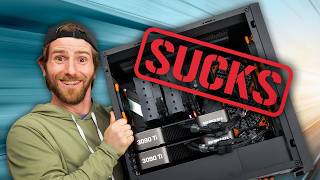

SLI: Double GPUs, Double Power?
45sNostalgic tech concept with a shocking twist—two 3090 Tis vs. one 5090—sparks debate on value and performance.
▶ Play Clip"Title accurately reflects the experiment: testing dual 3090 Tis vs 5090, with honest conclusion that SLI is dead."
This video explores whether two RTX 3090 Ti cards in SLI can compete with a modern RTX 5090. The host tests performance, power consumption, and game compatibility, ultimately concluding that SLI is impractical for modern gaming due to micro-stuttering, heat, and limited support.
SLI allowed using two GPUs to double compute for gaming, last supported on RTX 3090 Ti.
Building a dual 3090 Ti system years ago cost ~$4000, similar to a 5090 system today.
Single 3090 Ti has 24GB GDDR6X, 384-bit bus, ~10,000 CUDA cores, power draw up to 600W.
NVIDIA acquired SLI from 3DFX in 2004; bridges evolved from flexible to HB to NVLink (100 GB/s).
Graphics score nearly doubled in synthetic tests, but CPU limited overall score.
Secondary card waits for primary; never double frame rate; micro-stuttering due to inconsistent frame times.
SLI settings removed from control panel; compatibility bits in Profile Inspector; DX11 profiles ignored; Steam Overlay caused crashes.
System draws over 1000W; GPU 2 hits 90°C with throttling; thermal camera shows extreme heat.
In some games (e.g., Strange Brigade), SLI ran well with 130 FPS 1% lows, but GPU utilization only 60%.
3090 Tis are legendary for budget AI due to NVLink memory pooling; NVIDIA removed NVLink from 40/50 series to avoid competing with enterprise.
5090 has 32GB GDDR7, 512-bit bus, 80% bandwidth increase; better architecture and software support; lower power (~600W system).
5090 outperforms dual 3090 Tis but not by a huge margin in some tests; single card is better overall.
NVIDIA only enables NVLink on professional/enterprise cards; game support is minimal; DirectX 12 multi-GPU is separate.
SLI is impractical for modern gaming due to micro-stuttering, heat, power, and limited support. The RTX 5090 is a better choice, though dual 3090 Tis remain useful for AI workloads.
What does SLI stand for?
Scalable Link Interface
02:14
What was the last consumer GPU to support SLI?
RTX 3090 Ti
00:13
What is the maximum bandwidth of the 30-series NVLink bridge?
Over 100 GB/s
03:42
Why does SLI never achieve double the frame rate?
The secondary card must wait for orders from the primary, and the primary must combine results, adding latency and waiting.
04:41
What is micro-stuttering in SLI?
Inconsistent frame times due to variable waiting periods between cards, causing sudden stutters despite high average FPS.
06:45
What was the power draw of the dual 3090 Ti system in-game?
Over 1000 watts
07:52
Why are 3090 Tis still popular for AI workloads?
They support NVLink, allowing high-speed memory access between cards, useful for pooling memory.
10:11
What is the memory bus width of the RTX 5090?
512-bit
10:56
What caused random crashing in Shadow of the Tomb Raider during SLI testing?
The Steam Overlay
06:19
Smelling the heat
The host notes you can smell the heat from the GPUs, comparing it to a hair dryer.
08:20Unexpectedly good performance
SLI runs surprisingly well in some games, making the host want SLI back.
08:47Tinfoil hat theory on NVLink removal
The host speculates NVIDIA removed NVLink from consumer cards to avoid competing with their AI products.
10:11[00:00] SLI was freaking awesome! By using two cards instead of one to render your games, you could double your total compute for any game performance. And it looked pretty sweet.
[00:13] Now the last consumer card to support this mind-blowing technology was the RTX 3090 Ti, which is a little on the older side now, with only about half as many CUDA cores as an RTX 5090.
[00:25] But, certainly how, why not run two of them? On the surface, it seems like a great way to get today's performance yesterday. Even the pricing seems reasonable. If we were building this rig a few years ago, we'd be looking at about $4,000 for our GPU,
[00:41] plus the cost of an SLI-compatible motherboard, a fast-gaming CPU from a DDR4 RAM, and the rest, putting us really close, both in terms of specs and price, to a comparable system with a 5090 today.
[00:55] Was I the ultimate future-preaching hack? No. No, it wasn't. That's not how any of this works. And it turns out that NVIDIA killed this track for a pretty good reason. But I'm still not going to be able to sleep until I can see for myself
[01:10] just how close the old insert-son-son-enco-champion you can get to the new cage. I also won't sleep until I see how close I can get to our sponsors, Ridge.
[01:22] They started their Father's Day sale early this year. You can save up to 40% on a new wallet for you or your dad, or I mean, hey, tons of other cool video gear too, just by checking out our link below.
[01:43] To establish a baseline for our performance, we're going to start with just one of our 39D Ti Founders Edition cards. With 24 gigs of DDR6X memory on a 384-bit bus, and a little over 10,000 plus-de-cores clocked at about 1860 MHz boost clock,
[02:00] she may not be the fastest anymore, but on release, she was clearly the best. And she's clearly still pretty decent. Efficiency is an area she's fallen behind a little bit. We saw power draw as high as nearly 600 watts in 3DMark.
[02:14] But when it comes to real-world games, whether we're talking about the cutting-edge titles of yesterday, or even many modern games, she holds up pretty well. But what about second 39DTi? For the uninitiated, all the way back in 2004, NVIDIA announced SLI, or Scalable Link Interface, a trademark that they acquired along with 3DFX, whose similarly named StanLine Interlude debuted way back in 1998.
[02:41] While NVIDIA's methods were different, the idea of both was pretty much the same. Use multiple processors in parallel to pool together rendering power for better performance. This required close coordination and communication between your two cards.
[02:57] Fun fact, though, while you did have to use two cards with the same model number, they didn't have to be identical PCBs in order to use SLI. In fact, back in the day, in addition to these regular solid bridges, you could get flexible
[03:12] ones that more easily accommodated different slot spacing and different card heights. But, unfortunately over time, as gamers demanded higher and higher resolutions and frame rates, Nvidia found that these early bridges just weren't fast enough for the cards to coordinate
[03:27] their work. So cheap, flexible bridges were replaced by HB, or high bandwidth bridges, in 2016, then again by ND-link bridges in 2018, which boasted data speeds of up to 50 GB per second.
[03:42] Then those were replaced again by 30 series specific ND bridges that could do in excess of 100 GB per second That is what we be using today Man that a lot of bandwidth
[03:57] Now let's fire up our NVIDIA control panel where, miraculously, it just worked. Hey, look, as someone who played around with FLI a lot back in the early days, you cannot take that for granted. You're holding the thousands!
[04:10] That's a pretty huge uplift in our synthetic benchmarks. This score doesn't look as much bigger as you might expect, but that's because our CPU didn't change. Our graphics score is nearly double, but as you might expect, synthetic benchmarks tend to get optimized for.
[04:28] Why don't we check out real games? So now our cards are linked up in a primary, secondary configuration. One handles output to the monitor, and then the other one will work in the background to double your performance,
[04:41] is what I would say. The secondary card can't even begin its work until it gets marching orders from the primary card. And the primary card can't actually output anything until it dishes together the work that it did itself
[04:55] and the work that the secondary card did. So while we are offloading some of the rendering, there's now additional steps and a lot of waiting around. That means that even under the absolute ideal condition,
[05:08] you will never see double the frame rate from doubling your graphics cards. More on the downsides of SLI later, though, because for now, I've got some games to play really, really, really fast. Psych again! Because first, we're going to have to do one of the best parts of SLI,
[05:23] troubleshooting. Now, to be fair to NVIDIA, this is a feature that less than 1% of their gaming customers used even when it was current, and it's pretty much completely dead at this point. But we were still a little frustrated to find out
[05:35] that per-application SLI settings have vanished from the NVIDIA control panel. We did find them in Profile Inspector, but one of the settings is SLI Compatibility Bits, which is a 4-byte text field that can have all sorts of different values set, so good luck finding the right ones.
[05:52] Also, for our 39 ETIs specifically, they ignore any SLI profiles with DirectX 11 and older games now. It's apparently written right into the driver, which made it kind of hard for us to find a bunch of games to try.
[06:05] We also found out that NVIDIA's driver repository seems to be broken at the moment. Though luckily, Gulu 3D has all the old NVIDIA drivers, which, as it turns out, were not actually causing our biggest headache, which was random crashing on Syrup in Shadow of the Tomb Raider.
[06:19] Guys, I don't know why, I don't know how, but the Steam Overload was at fault. So disable that, and immediately, you should be gaming in SLI. Assuming that you want to do that. Man, I forgot how well this game scales.
[06:32] Dude, we're getting way more performance. In averages. It doesn't take long for one of the chief bugbears of SLI, though, to raise its head here. And that is, of course, micro-stuttering.
[06:45] Remember when I mentioned that SLI requires our cards to wait around for data all the time? Well, this waiting was often inconsistent, depending on the game, the rest of your system, and the type of theme that was being rendered from moment to moment.
[06:59] So you'd have things going really smoothly for a while with consistent data handling leading to consistent frame times, and then a longer wait would result in a much longer frame time, which is going to manifest as a sudden pitch or a stutter that makes the
[07:15] gaming experience feel like it's running at low FPS, even though your frame rate counter says one bazillion frames per second. Now, a lot of people hated on NVIDIA for not bothering to solve this problem and for giving
[07:28] up on SLI. But, if you ask me, I don't actually think that it was for a lack of effort. I mean does Nvidia seem like the kind of company that wouldn sell you two top GPUs if they could Another major trend that contributed to FLI death is of course power consumption and heat Right now in game we are sitting at over 1000 watts of which like
[07:52] less than 100 is our CPU. That's a huge night and it's a huge problem when it comes to thermal management. You may or may not have noticed that this computer is pretty freaking loud and even
[08:06] Even though the fans sound like my GPUs are trying to escape from my system, we're still sitting at like 90 degrees on GPU 2. And that's even with it throttled down just shy of 100 MHz. You know it's bad that you can smell the heat.
[08:20] It smells like a hair dryer right here. Don't take my word for it though. Take our clear thermal camera's word for it. That's awful and it's so cheap. And that's not the dye. Like that's the outside of this heat sink.
[08:33] Ow. I hope you can find a game that struggles a little more with MicroStutter so you guys can really see what we're talking about. Actually, even this is behaving a lot better than I expected. Oh, no way. Did SLI get good just in time to be killed?
[08:47] You guys spotted any yet? No, it looks pretty good. Man! And I'm getting like 130 FPS on my 1% lows on a 30 series card.
[08:59] This thing's shredding it. Now I want SLI back. That was not the conclusion to this video that I expected. How about Strange Brigade? Oh man, why does everything have to look like Fortnite? What button was it? Ba-bow, ba-bow, ba-bow, ba-bow, ba-bow, ba-bow, ba-bow, ba-bow.
[09:15] I gotta say, as much as it's not gonna magically make me good at video games, Strange Brigade is also running amazing. Though, this is more down to Microsoft eventually building multi-GPU support into DirectX,
[09:29] and then a handful of games supporting it than NVIDIA's actual SLI feature. And if you look closely, each of our GPUs is only sitting at about 60% utilization.
[09:41] So when you consider everything from performance issues to the inefficiency to the limited game support, it's pretty clear that going this route years ago was already kind of dumb,
[09:53] and doing it today to compete with the 5090 is even dumber. At least for gaming. 3090s and 3090TIs are actually still kind of legendary as budget AI cards due to their support for NvLink, which allows them to access each other's memory at very high speeds.
[10:11] This gives a pretty significant uplift in some workloads. Well, that's really hot. Anyway, my tinfoil hat theory is that that may be part of the reason that NVIDIA removed NvLink from their consumer 40 and 50 series cards to avoid competing with their AI products.
[10:26] Anyway, let's see how the gaming experience compares between our two 3090 Ti's and an RTX 5090, which, now that 5090's are so much more expensive than their launch MSRP, actually would not be that far off in price.
[10:40] Now, the first thing you're probably thinking is, hold on a second, isn't 32 gigs of VRAM a downgrade? And you're sort of right. 32 gigs is less than the 48 gigs total that we had before. But it's not a downgrade.
[10:56] For starters, we're now using DBDR7 rather than DBDR6X. It's measurably faster. For another, the 5090 uses a massive 512-bit memory bus, which, combined with that DBDR7, results in a real-world benefit increase of about 80% compared to one of these cards.
[11:15] Also, adding together the VRAM of two cards in SLI is at best misleading. See, in order for both cards to work together to render a single frame, both cards have to independently store all the necessary data in their frame buffer But why I thought they had that 100 gigabyte per second link over the SLI bridge That sounds like a lot but that is just one tenth of the bandwidth
[11:38] of the memory that's sitting right next to the GPU and at much higher latency. So we haven't downgraded our memory. We've actually upgraded it with more available capacity and more usable bandwidth.
[11:51] On top of that, there are big architectural improvements here. We've got newer generation Tensor and ray tracing cores, not to mention much better software support. So whether you like multi-frame gen or don't like it, at least now we have the option to enable it.
[12:07] We're also using way less power. We peaked at a little over 600 watts for our entire system, and as large as a 5090 is, it kicks up a lot less space in our case and kicks out a lot less heat than two of these.
[12:21] Now it's time to see our score, and it even performs better than two of these. Although, eh, not by as much as you might have thought, huh? 16,230? Like, that's pretty close.
[12:34] And that translates to better performance in the real world as well. Even in games that are extremely cooperative with multi-GPU setups, a single card with twice as many reverses is just plain better.
[12:47] So SLI is well and truly dead. Or is it? Well, not exactly. The same Blackwell architecture that this GPU is built on still supports NVLink, but NVIDIA only enables it on the professional versions of their cards, which are used in workstations, or on enterprise versions of their GPUs, where NVLink is used as a backbone for linking together many, many GPUs for AI and other massive compute workloads.
[13:15] They technically could then have still put SLI on these gaming cards, but it would only serve to make them even more expensive than they already are, and NVIDIA has clearly demonstrated that they just, along with game developers,
[13:28] don't have the appetite to continue to support this. Even though we've been calling what we've been doing SLI today, because it's involved two cards and an SLI bridge, the games that we've actually been able to run are more enabled by Microsoft's efforts with DirectX 12.
[13:42] So in conclusion, does SLI across two or even more cards look freaking awesome? Absolutely. But is it that sad that it now lives in the dustbin of computer history? Yeah, probably not.
[13:54] I'd say the only exception for folks who could really use it today would be Homelab people who probably wish that they could still link together consumer cards for more available memory for AI stuff, but I actually doubt that a lot of gamers would be on their side for that.
[14:09] If you guys are interested in any of the parts that we used today, we're going to have them linked in the video description. And if you're looking even closer down there, I bet you can even find a segue to our sponsor. Ridge. Father's Day is coming up, and Ridge knows that a good dad is reliable, durable,
[14:22] and meant to get you through the years. And that's why they built their wallets and gear to match that vibe. Their Father's Day sale is starting early this year, with up to 40% off a bunch of their great stuff for dad or for you.
[14:35] If your dad's a man of culture, that's a good diner. A drive-in or a dive, he's going to love the new 90s inspired hot rod colorway. Or maybe he's more of a distinguished type. I'm not a class. Well then, the Heritage Leather Wallet
[14:49] could be perfect for him. Ridge has been improving their wallets and their 2.0 models are now lighter weight, more modular, and have more unique designs. While they can't help you through a bad breakup, they can certainly help you through a broken up wallet. Every Ridge wallet comes with a lifetime
[15:04] warranty covering damaged, lost, or stolen gear. Your father, he raised you not to procrastinate. So what are you waiting for? Go to Ridge.com slash LTT and get him something nice today. If you guys enjoyed this video, why not check out the last time that we
[15:18] fired up an ancient super expensive computer that doesn't make any sense anymore.




⚡ Saved you 0h 15m reading this? Transcribe any YouTube video for free — no signup needed.