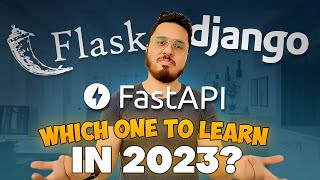

Which Python framework should you choose?
45sDirectly addresses a common dilemma for Python developers, sparking curiosity.
▶ Play Clip"Title accurately reflects content: a clear comparison of Django, Flask, and FastAPI."
This video compares Flask, Django, and FastAPI to help you choose the right Python web framework for your next project. It covers the strengths and weaknesses of each, including factors like minimalism, built-in features, performance, and community support.
Flask is minimalistic, giving you granular control. It lacks built-in ORM and other features, making it lightweight and easy to learn.
Django comes with a built-in admin dashboard, ORM, and many other features. It's ideal for large projects and team collaboration, but has a steeper learning curve.
FastAPI supports async IO and type hints, offering high performance. It's recommended for serious projects where speed and scalability are crucial.
FastAPI is the best in terms of performance, but Django's built-in CRUD operations can be efficient if used correctly.
Flask is easiest, followed by FastAPI, then Django. Flask's simplicity allows rapid prototyping.
Flask and Django have strong community support, while FastAPI's community is smaller, which may lead to fewer solutions for unique problems.
Choose Flask for minimalistic projects and full control, Django for large, feature-rich applications with team collaboration, and FastAPI for high-performance, modern web apps. Consider your project's needs and your familiarity with each framework.
What type of framework is Flask?
Flask is a micro-web framework, meaning it is minimalistic and does not include built-in features like ORM.
00:29
What does ORM stand for?
Object Relation Model.
00:38
When should you choose Django over Flask?
Choose Django for large projects that need built-in features like an admin dashboard, ORM, and easy app reusability, especially for team collaboration.
02:26
What is a key advantage of FastAPI over Flask and Django?
FastAPI supports async IO and type hints, offering high performance and scalability.
07:33
Which framework has the steepest learning curve?
Django has the steepest learning curve due to its many built-in features and conventions.
06:10
What is a drawback of FastAPI compared to Flask and Django?
FastAPI has a smaller community, so finding solutions to unique problems may be harder.
11:29
Which framework is recommended for rapid prototyping of a minimal API?
Flask is recommended for rapid prototyping due to its simplicity and minimalism.
08:37
Flask's minimalism
Flask gives granular control and avoids unnecessary overhead, making it ideal for lightweight apps.
00:27Django's batteries-included approach
Django provides built-in admin, ORM, and app reusability, which speeds up development for large projects.
02:26FastAPI's modern features
FastAPI leverages async IO and type hints for high performance, suitable for scalable applications.
07:33Performance hierarchy
FastAPI leads in performance, but Django's built-in CRUD can be efficient if used correctly.
09:59[00:00] In today's video, I'll tell you which framework you have to choose
[00:08] Does it depend on what kind of project
[00:11] Or does it depend on whether you guys are making any project,
[00:15] "How to select a framework?" I'll tell you in
[00:21] What options do we have in 'Django'' that
[00:25] Let me tell you from the starting.
[00:27] Firstly we'll talk about 'Flask',
[00:29] 'Flask' is a micro-web framework.
[00:31] Which means it is quite minimalistic.
[00:33] If you have to do anything in it,
[00:36] It does not have ORM support.
[00:38] What does ORM mean?
[00:40] It means that you won't get native
[00:45] You won't get wrappers in 'Flask'
[00:49] I'll discuss about 'Django' in a short while.
[00:50] But I'd like to tell you that 'Flask'
[00:54] If you want almost full control on your app,
[01:03] Then you can use 'flask'.
[01:05] Now you'll say "What's for me if my app
[01:09] When you work on a project in which
[01:14] You want to have every bell &
[01:18] "I can change it" , "Or I can over-write a
[01:24] And let us say if you're connecting to a database, but
[01:31] Basically you need granular control.
[01:33] So you look for a minimalistic framework,
[01:36] Secondly, you don't want unnecessary overheads.
[01:39] For eg. There may be some things working behind
[01:45] You have installed a package, which you will
[01:50] Which you're not using in actual,
[01:51] That means you have a code which
[01:55] But in 'Flask' this gets minimized.
[01:57] You don't keep the code in your source-code
[02:02] 'Flask' is quite lightweight & minimalistic,
[02:08] In 'Django' you have to make efforts
[02:10] In 'FastAPI' you have to understand the concept,
[02:13] 'Flask' & 'FastAPI' are a little bit similar.
[02:17] 'Django' is a different framework.
[02:19] If asked, which is more similar to 'FastAPI' - 'Flask' or 'Django'?
[02:22] I'll say 'Flask'.
[02:24] Now let's talk about 'Django'.
[02:26] When do you have to use 'Django'?
[02:27] You have to use 'Django' when you need a built-in dashboard,
[02:32] Along with that you have to use
[02:36] If you want a framework in which
[02:40] In which you want ORM, which means you're not writing
[02:46] You want to get functionality for built-in search.
[02:52] Which will connect to your database,
[02:54] And along with that you want a lot
[02:58] I'd like to talk about one more thing,
[03:04] Suppose you created a blog in
[03:08] And you want the same blog to plug-in,
[03:13] So this can be done very easily from 'Django'.
[03:16] And if you're using ORM then you automatically
[03:21] For eg. Suppose you want to fetch all
[03:29] In that if you write code for ORM then you
[03:33] In that case I use IDE like PyCharm
[03:36] I've done all the development, related to 'Flask'
[03:41] Because that make things easier
[03:43] So in my opinion there's a big role of IDE
[03:47] If you're using 'Django' then I'll recommend
[03:52] For eg. "JetBrains PyCharm"
[03:54] There are a lot of good features in 'JetBrains PyCharm'
[03:58] In-fact I made my first Python course
[04:02] And it gives a very good experience
[04:06] For eg. Suppose you're calling a module.
[04:08] It automatically figures out what properties and functions
[04:15] Along with that if you're opening multiple files
[04:20] And if you're working on a major project
[04:24] If you want to download "JetBrains PyCharm"
[04:28] And you'll get a link for community version which is
[04:35] If you're a student then professional
[04:39] I'll add a link in the description for
[04:42] Another big advantage of using 'Django' is,
[04:46] Suppose you want to embed a blog or an
[04:50] And along with that you want to embed an
[04:54] So different developers can work
[04:58] Then in the end, these can then be merged
[05:02] However you can do that in 'Flask' & 'FastAPI' too,
[05:06] Because I've done these type of
[05:10] I'll choose 'Django' if I have to divide
[05:15] Specifically if I have to divide apps based on work
[05:20] In that case it'll be easy for me to monitor
[05:28] This 'Master App' is called 'Project' in 'Django'.
[05:31] In 'Django' you have a lot of commands.
[05:33] For eg. Start Project, Create App & Create Super User
[05:37] You can do these type of things from 'Django'
[05:40] You just have to write command in
[05:44] code of 'Django' which generates automatically
[05:49] For eg. If you want to create a super user
[05:52] Or if you want to delete a super user
[05:56] If you want to create a new app
[05:58] You can add multiple apps in a single project
[06:00] If you want to create a big project then
[06:04] Otherwise I'll suggest you 'Flask' & 'FastAPI'
[06:06] Now if I talk about the drawbacks of using 'Django'
[06:11] It'll take time for you to understand things
[06:13] When you'll install 'Django' with 'pip' then you'll
[06:17] Honestly, it's similar to normal Python Module
[06:23] Because once, 'Django' installs, then you create
[06:29] Then you create a lot of apps in that,
[06:31] Then "How to do it's URL parsing?",
[06:36] "How to create a URL for it?" and all.
[06:38] Suppose I created a Blog, then how can I display
[06:45] If you're a Django beginner, neither Python
[06:50] But a Django beginner and you
[06:52] Then it'll take time for you to understand it.
[06:57] You can start using 'Flask' & 'FastAPI' in
[07:03] But in Django it'll take some time
[07:06] So yes! It's a little time taking
[07:07] But there are a lot of in-built features in Django,
[07:13] But it's bad if you're creating a basic minimal app,
[07:22] And you're doing model migration
[07:25] You're doing all these when there's minimal
[07:30] And if you use Django in that so in
[07:33] Now, 'FastAPI' relatively is a new framework
[07:35] Earlier there used to be wars between
[07:39] Not wars but confusions,
[07:44] But after the launch of FastAPI, I recommend FastAPI
[07:50] And if you're a Python expert and you
[07:54] You know how to work with Types in Python
[07:57] Then you can use FastAPI
[07:58] But I'm telling you again if you start with
[08:04] From learning stand point 'Flask'
[08:06] But if you want performance and you want to
[08:14] Then you can switch to FastAPI.
[08:16] Thus if you're creating such an application in
[08:20] Then you'll use FastAPI.
[08:22] And if you want your app to be scalable,
[08:25] And you want to handle thousands of users
[08:32] But if you want to create a minimal prototype,
[08:37] If I have to create a very minimal API,
[08:43] It works quite simple for me
[08:44] Yes it can be done using 'FastAPI'....
[08:46] But I personally feel, with 'Flask' it's faster.
[08:53] And maybe this is because, I'm using flask for quite a lot
[08:58] So I'm able to use it quite easily.
[09:00] Now if I compare these frameworks once again
[09:02] So at a high-level 'Flask' is quite
[09:06] 'Django' is not minimalistic at all, takes up a
[09:11] Comes with a lot of built-in features.
[09:13] There are a lot of things which
[09:16] But those things are useful & saves a lot of time.
[09:18] You get a built-in admin panel which contains all the things
[09:24] Those things are sometimes useful
[09:28] But once you learn, how to built a Django App and
[09:34] If someone ask you to create a Blog,
[09:36] If someone ask you to built an e-commerce website, then you'll
[09:42] It'll be easy for you do queries, but only
[09:45] But if you don't know how to use it
[09:48] If I talk about 'FastAPI',
[09:50] You can perform async IO in that.
[09:53] And it was designed keeping
[09:56] So this was high-level overview
[09:59] Now if I tell you on the terms of performance,
[10:04] But it's not like 'Django' & 'Flask' are not
[10:08] Look, somethings are built-in in Django.
[10:11] If you start to write the logic of CRUD Operations
[10:15] Then there's a chance, as a solo developer
[10:18] And your performance may not be as good as
[10:22] I hope you're getting my point.
[10:24] Now let's talk about ease-of-use.
[10:27] I already told you it's 'Flask' then comes
[10:31] Now there are a lot of third-party packages in Flask,
[10:34] You can use Flask along with MongoDB.
[10:37] There are a lot of things you get as a Python package,
[10:43] Same goes for Django, there are a lot of
[10:50] But in Django, as I already told you, the best part is,
[10:56] And those apps makes the over all development of
[11:02] I made an e-commerce website on
[11:05] I chose Django because there are a lot of ins & outs
[11:10] Then there are a lot of things which
[11:14] But here I got a built-in admin panel & a lot of
[11:19] I've done a lot of projects using 'Flask'.
[11:22] You'll use flask when you don't wanna use someone
[11:27] And same goes for FastAPI as well.
[11:29] Now let me talk about community support.
[11:30] In my opinion 'Flask' have the most community
[11:34] But FastAPI somewhere lacks this.
[11:37] Now, who's community support between 'Flask' & 'Django'
[11:41] I don't have the exact numbers to be honest.
[11:43] But their community support is a
[11:47] So it also matters somewhere.
[11:48] Because if you get stuck on a problem,
[11:53] If you're unable to find a solution
[11:57] You get to know that no one has posted it's solution
[12:04] So before using FastAPI you can
[12:08] That you might face unique problems
[12:12] So I hope you got a high-level overview
[12:17] And you can now create your next project.
[12:20] You can choose the best framework
[12:23] That's it for this video guys.
[12:25] Thank you so much guys for
[12:27] And I'll see you next time.
⚡ Saved you 0h 12m reading this? Transcribe any YouTube video for free — no signup needed.