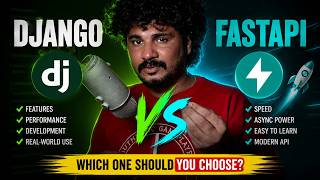

Stop Asking Which Framework Is Better
38sChallenges the common question and reframes the decision, making viewers rethink their approach.
▶ Play Clip"Title accurately promises to end the confusion, and the video delivers clear, practical advice."
This video helps Python developers decide between Django and FastAPI by reframing the question from 'which is better' to 'which is right for your current situation.' Django is a batteries-included framework for full web applications, while FastAPI is a lightweight, modern microframework for APIs, especially in data science and microservices.
Instead of asking which framework is better, ask which is right for where you are now. Both are great but solve different problems.
Django provides user authentication, admin panel, ORM, form handling out of the box. Designed to build complete applications fast.
FastAPI is lightweight, modern, and fast. Built specifically for APIs, excellent for machine learning models and microservice architecture.
Person 1: New to Python, want to build a web app → Django. Person 2: Experienced in data science/ML, need to deploy models as APIs → FastAPI. Person 3: Career switcher wanting a back-end job → Django.
Django appears in the majority of Python back-end job descriptions. FastAPI is growing but more common in newer, ML-heavy companies.
The best path is to learn Django first to understand web fundamentals, then pick up FastAPI later. Starting with FastAPI without foundation leads to confusion.
Choose Django if you're new to web development or seeking a back-end job; choose FastAPI if you're experienced in data science/ML and need to build APIs. The best long-term strategy is to learn Django first, then FastAPI.
What does 'batteries-included' mean for Django?
Django comes with built-in features like user authentication, admin panel, ORM, and form handling out of the box.
00:42
What is FastAPI primarily built for?
FastAPI is built specifically for building APIs, especially for machine learning models and microservice architecture.
01:01
According to the video, which framework dominates Python back-end job postings in 2026?
Django still dominates the majority of Python back-end job descriptions.
03:02
What is the recommended learning path for most developers?
Learn Django first to understand web fundamentals, then pick up FastAPI later.
03:56
For which type of person is FastAPI the best fit?
Someone who already knows Python well, works in data science or machine learning, and needs to deploy models as APIs or works on large-scale microservice projects.
02:14
Reframe the Question
Shifts the mindset from 'which is better' to 'which is right for your situation', a more practical approach.
00:20Django: Batteries-Included
Clearly defines Django's all-in-one nature, helping beginners understand its value.
00:42FastAPI: Microframework
Highlights FastAPI's specialization in APIs and speed, key for data science and microservices.
01:01Job Market Dominance
Provides data-driven advice for career switchers: Django appears in most job descriptions.
02:52Learn Django First
Offers a clear, actionable learning path that builds foundational knowledge before moving to FastAPI.
03:56[00:00] So, you're trying to learn Python web
[00:01] development, but now you're stuck
[00:03] between a Django and a FastAPI. I know
[00:06] you've watched a lot of videos on this,
[00:08] but somehow you're more confused. And
[00:10] don't worry, I've been there, and in the
[00:12] next couple of minutes, I'm going to
[00:13] make this decision super, super easy for
[00:15] you. All right, before I compare between
[00:17] a Django and FastAPI, I want to change
[00:20] the question.
[00:21] Most people ask me, "Which framework is
[00:24] better?"
[00:25] But you know what? This question itself
[00:28] is wrong. The right question is, "Which
[00:31] framework is right for where I am right
[00:34] now?" Because both Django and FastAPI
[00:36] are great. They just solve different
[00:38] problems. So, let me quickly explain
[00:40] more. Django is what we call a
[00:42] batteries-included framework. That means
[00:45] when you start a Django project, you
[00:47] already get user authentication, an
[00:49] admin panel, a database ORM, form
[00:51] handling, all out of the box. You don't
[00:54] have to manually write the code for all
[00:55] of these features. It's actually
[00:57] designed to build the complete
[00:58] applications fast. Now, the FastAPI, on
[01:01] the other hand, is a microframework.
[01:03] What do I mean by microframework? Is
[01:05] that it's lightweight, it's modern, and
[01:08] as the name says, it's really, really
[01:10] fast. It is built specifically for
[01:12] building APIs, and it's excellent if
[01:14] you're working with machine learning
[01:15] models or microservice architecture. So,
[01:18] think of it this way, Django is a fully
[01:21] equipped framework to build whole web
[01:23] application.
[01:25] Now, FastAPI is a minimalist framework.
[01:28] You get exactly what you need to build
[01:30] APIs, and you assemble everything
[01:32] yourself to make it a full application.
[01:34] All right, there can be three types of
[01:36] people. You just tell me which one
[01:37] sounds like you. So, person one, let's
[01:40] say you're fairly new to Python. Maybe
[01:42] you've done some tutorials, you
[01:44] understand the basics, and now you want
[01:47] to build something real, like like a web
[01:50] website or web application,
[01:52] portfolio project, or maybe you know,
[01:54] you're you're on a startup project, or
[01:57] maybe like a web app idea you've been
[01:59] thinking of. If this sounds like you,
[02:02] Django is your answer. It will teach you
[02:04] how the web works, how requests and
[02:07] responses work, how databases connect to
[02:09] your app, how users log into your app.
[02:12] This is the foundation. Now the person
[02:14] two, let's say you already know Python
[02:16] very well, you're working in data
[02:18] science or machine learning and you need
[02:20] to deploy your models as an API. Or if
[02:23] you're working on a kind of a
[02:25] large-scale project or maybe it's a
[02:27] microservice project. If that's you,
[02:29] FastAPI is probably the best fit for
[02:32] you. It is built for exactly that use
[02:34] case. Now person three, let's say you're
[02:36] switching careers into tech.
[02:39] You want to get a job as a back-end
[02:40] developer within the next three to
[02:44] six months.
[02:45] So you need a skill that employers are
[02:47] actually hiring for right now. So again,
[02:49] if that sounds like you, again Django is
[02:52] your answer. You can go and search
[02:54] Python back-end developer on LinkedIn or
[02:56] Indeed right now.
[02:57] You'll see Django and Django REST
[02:59] framework in the majority of those job
[03:01] descriptions.
[03:02] So honestly, most of my viewers
[03:05] fall into the person one and person
[03:07] three category. So Django is the clear
[03:09] starting point for them. No doubt,
[03:11] FastAPI is growing fast,
[03:13] but right now in 2026, if you look at
[03:16] actual Python back-end job postings,
[03:18] Django still dominates. Companies that
[03:20] have been running web applications for
[03:22] years, like startups, product companies,
[03:25] agencies, service-based companies, like
[03:28] they are built on Django.
[03:30] They need a developers who know Django.
[03:32] So FastAPI is more common in newer
[03:34] companies, like you know, ML-heavy teams
[03:37] or AI research companies and those
[03:40] large-scale companies that uses
[03:42] microservice architecture. FastAPI jobs
[03:44] also exist a lot, but they usually
[03:46] expect you to have the solid
[03:48] fundamentals. So if getting hired is the
[03:51] part of your goal,
[03:52] Django gives you more doors to knock on
[03:54] right now. To be frank, these two
[03:56] frameworks are not at all enemies. You
[03:59] don't have to pick one forever. In fact,
[04:01] the best path for most developers is
[04:03] learn Django first and then pick up
[04:06] FastAPI later. Because once you
[04:08] understand how web works and how HTTP
[04:11] requests and responses work, then it
[04:13] will be easy for you to pick up FastAPI.
[04:16] But if you try to start with FastAPI
[04:18] without that foundation knowledge,
[04:21] you'll get confused. Okay, now ask
[04:23] yourself if you think, "Okay, Django
[04:26] makes sense for me." then I have a free
[04:28] resource for you. Just go to
[04:30] techwithratan.com and you can learn
[04:32] Django for free. Just enroll to this
[04:34] course and learn the fundamentals of
[04:36] Django. And if you're looking to learn
[04:38] the advanced Django concepts, you can
[04:40] join my four-week live back-end
[04:42] developer program where I teach you
[04:44] exactly how to create the scalable APIs
[04:47] using Django REST framework.
[04:50] And also, I will teach you how to build
[04:52] the architecture and how to work with
[04:54] the authentication systems like JWT. And
[04:57] also, you'll be building the full
[04:58] e-commerce project and deploy it on the
[05:00] cloud server using Docker and CICD
[05:03] pipeline. So, this is kind of an
[05:04] industry standard deployment practice
[05:06] that nobody else is teaching you on the
[05:08] internet. So, if you're interested, you
[05:10] can join me on the live program. I'll
[05:12] leave a link in the description. And
[05:13] thanks a lot for watching and I'll see
[05:15] you in the next one.
⚡ Saved you 0h 05m reading this? Transcribe any YouTube video for free — no signup needed.