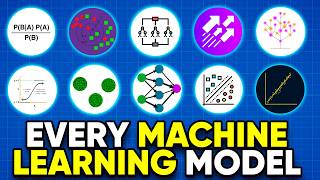
Stop Wasting Time on ML Tutorials
45sOpens with a bold, contrarian statement that challenges common learning myths, immediately grabbing attention.
▶ Play Clip"The title accurately reflects the video's content: it provides a practical, no-nonsense roadmap to learn ML efficiently, avoiding common time-wasting pitfalls."
This video provides a practical, no-nonsense roadmap for learning machine learning efficiently, based on the speaker's eight years of experience and teaching hundreds of students. It emphasizes learning how to learn, focusing on the 20% of effort that yields 80% of results, and avoiding common pitfalls like tutorial hell. The roadmap covers Python, pandas, essential math, core ML algorithms, and the importance of real projects and collaboration.
The speaker failed initially when trying to learn ML by just applying for jobs, but those failures taught them what works.
Even if you don't become a data scientist, you'll gain valuable skills in programming, data analysis, statistics, and communication.
Learning how to learn is crucial because technology evolves fast; focus on adaptability and problem-solving over memorization.
80% of results come from 20% of effort; constantly ask if your current activity is the most useful use of your time.
Start with Python and Jupyter Notebooks; learn fundamentals, then master pandas for data manipulation.
Work on a real data analysis project before ML; find a dataset, clean it, explore correlations, and present findings.
Essential math: statistics & probability (most important), linear algebra (tools), calculus (derivatives for optimization).
Master simple algorithms (linear regression, logistic regression, decision trees) before deep learning; they are more interpretable and form the basis for complex ones.
Use the book 'An Introduction to Statistical Learning' and its free video series; implement algorithms from scratch and with scikit-learn.
Avoid tutorial hell by building real projects; collaborate with others, share work, and get feedback.
Only after mastering fundamentals should you explore advanced topics like deep learning, and only if your project requires them.
What is the main programming language recommended for data science and machine learning?
Python
3:42
What is Python's primary data manipulation library for handling tabular data?
Pandas
4:36
What percentage of a data scientist's job is data preparation and exploratory data analysis?
60 to 80%
5:17
Which free online course is recommended for learning statistics and probability for machine learning?
Khan Academy's statistics and probability course
7:05
List the core machine learning algorithms the video recommends mastering before moving to deep learning.
Linear regression, logistic regression, decision trees, random forests, gradient boosting
9:36
What is the number one machine learning library for basic algorithms?
Scikit-learn
10:17
What principle does the speaker use to prioritize learning efforts?
The 80/20 principle (Pareto principle): 80% of results come from 20% of effort.
3:00
What three-step approach does the speaker recommend for learning each new algorithm?
Implement from scratch in Python, then using scikit-learn, then apply to a real dataset.
10:56
What is 'tutorial hell' as described in the video?
Tutorial hell: following tutorials without building your own projects.
11:15
What principle should guide learning advanced topics like deep learning?
Learn by need, not by FOMO (fear of missing out).
14:16
Pareto Principle (80/20)
Provides a powerful mental model to prioritize the most impactful 20% of learning efforts.
3:00Data Prep is 60-80% of the Job
Highlights the often-underestimated importance of data cleaning and analysis over modeling.
5:17Three-Step Algorithm Learning
Offers a concrete, actionable method to deeply understand any ML algorithm: implement from scratch, use scikit-learn, apply to real data.
10:56Avoid Tutorial Hell
Warns against a common pitfall and emphasizes building real projects for genuine learning.
11:15Learn by Need, Not FOMO
Encourages focused, project-driven learning rather than chasing every new trend.
14:16[00:00] so you want to learn machine learning
[00:01] and you somehow ended up here well I've
[00:03] got good news and bad news the bad news
[00:06] I'm not here to sell you some become an
[00:08] ml engineer in 3 months fantasy could it
[00:10] happen sure people also win the lottery
[00:13] the good news I've been exactly where
[00:16] you are about 8 years ago I thought I
[00:18] knew enough Basics to just apply for
[00:20] jobs and learn the rest while working
[00:22] spoiler alert I failed miserably but
[00:25] those failures taught me exactly what
[00:26] works and what doesn't and that's what
[00:28] I'm sharing today I've since taught all
[00:30] of this to hundreds of students in
[00:31] several countries so I think I have a
[00:33] good idea on what works and what doesn't
[00:35] hopefully I can save you months of
[00:37] frustration by showing you the smart way
[00:39] to learn machine learning learning data
[00:41] science was one of the best decisions I
[00:43] ever made and most of you can do it and
[00:45] you will learn some cool stuff on the
[00:47] way that even if you don't become a data
[00:49] scientist or machine learning engineer
[00:50] you will have learned programming how to
[00:52] build apps how to analyze and visualize
[00:55] data you will have strong statistics and
[00:57] research skills and be able to
[00:58] communicate data clearly
[01:00] many amazing job options will be open to
[01:02] you even if you don't become a data
[01:03] scientist but you will have to work hard
[01:06] but what should you work hard on and how
[01:08] do we even start that's what I'm here to
[01:10] tell you learning how to learn before we
[01:13] even touch machine learning let's talk
[01:15] about something crucial learning how to
[01:17] learn why because machine learning and
[01:20] AI like most things in Tech are
[01:22] constantly evolving and what matters
[01:23] isn't just what you know but how quickly
[01:25] you can adapt and learn new things a
[01:27] little secret I actually suck at at
[01:30] programming and algorithms but I am
[01:31] really good at learning new stuff here's
[01:33] why this matters specifically for
[01:34] machine learning technology changes fast
[01:37] new platforms and Frameworks drop
[01:38] constantly and new papers come out daily
[01:41] what's hot today might be obsolete
[01:42] tomorrow problem solving is everything
[01:45] machine learning isn't about memorizing
[01:46] algorithms it's about understanding data
[01:48] and patterns about breaking down complex
[01:50] problems and finding Creative Solutions
[01:52] confidence AKA don't get overwhelmed or
[01:55] scared of big problems people who know
[01:57] how to learn and problem solve don't get
[01:58] paralyzed when faced with a new big
[02:00] problem they develop a strategy for how
[02:02] to look at a new problem and break it
[02:04] down into manageable problems they have
[02:05] faced before they know how to look up
[02:07] Solutions and find tools necessary to
[02:09] solve new problems they adapt more
[02:11] quickly when Tech changes efficiency if
[02:14] you know how to learn you won't waste
[02:16] time on unnecessary things time is money
[02:19] learn what you actually need to get
[02:21] where you want to be there's no one size
[02:23] fits all solution for learning something
[02:25] it depends on your style of learning but
[02:26] also on your goals not everyone needs to
[02:29] learn everything so how do you learn how
[02:31] to learn this one you kind of have to
[02:33] figure out for yourself because what
[02:35] works for one person doesn't necessarily
[02:37] work for the next some people learn well
[02:39] with graphs and diagrams others with
[02:41] text others maybe with voice notes some
[02:43] people need to understand the theory
[02:44] before applying it others need to jump
[02:46] right in and use an algorithm before
[02:48] asking what it actually does in this
[02:51] video I will try to show you what worked
[02:52] for me while giving you resources that I
[02:54] believe will get you there as quickly as
[02:55] possible I will just mention a principle
[02:57] that has helped me a lot throughout my
[02:59] career the the Paro principle sometimes
[03:01] called 8020 principle it says that 80%
[03:04] of the results come from 20% of the
[03:06] effort constantly ask yourself why am I
[03:09] doing this is this actually getting me
[03:11] where I want to be or can I do something
[03:13] more useful with my time well the answer
[03:15] to this question isn't always the same
[03:17] for everyone I will try to now give you
[03:19] the 20% of the work that would have
[03:20] gotten me 80% of the way to becoming a
[03:23] data scientist adapt as needed but where
[03:25] do I start now let's build your machine
[03:28] Learning Foundation the right way
[03:30] here's your road map python while the
[03:33] next skill is at least as important I
[03:34] would start with learning python the
[03:36] main reason is that you will get a
[03:37] feeling of achievement fairly quickly
[03:39] and python is super simple why python
[03:42] python is the main language of data
[03:44] analytics data science and machine
[03:45] learning while also being a full-fledged
[03:47] programming language allowing you to
[03:49] write scripts build apps and websites
[03:51] and much more python will allow you to
[03:53] actually start writing real code within
[03:55] days without having to learn super
[03:57] complicated computer science Concepts
[03:59] like pointers memory allocation and
[04:00] garbage collection also with python you
[04:03] will be able to get a job as a
[04:04] programmer or data analyst or web
[04:06] developer even if you don't learn all
[04:08] the hard machine learning stuff I
[04:10] suggest you first install jupyter
[04:12] notebooks as they make learning much
[04:13] easier and jupyter notebooks are also a
[04:15] core tool for data analysts and data
[04:17] scientists all over the world then learn
[04:19] about these Core Concepts programming
[04:21] fundamentals basic syntax indentation
[04:24] rules comments and so on variables math
[04:26] if else Loops printing data types like
[04:29] strings ins floats booleans lists
[04:31] dictionaries functions classes and
[04:33] objects modules packages and importing
[04:36] do a pandas tutorial pandas is Python's
[04:38] primary data manipulation Library built
[04:40] for handling tabular data through data
[04:42] frame objects imagine it as Excel
[04:44] spreadsheets on steroids it will be your
[04:46] main tool for data analysis cleaning and
[04:48] transformation with powerful functions
[04:50] for merging reshaping and analyzing data
[04:53] the library strength lies in combining
[04:56] the power of numpy arrays with
[04:57] spreadsheet like functionality and SQL
[05:00] database like joints it also comes with
[05:03] built-in plotting functionality built on
[05:04] top of Python's powerful met plot lib
[05:06] libraries pandas is a true data analysis
[05:09] Powerhouse if you truly Master pandas
[05:11] you will excel at most data analysis
[05:13] positions in the world also because
[05:15] exploratory data analysis and data
[05:17] preparation are about 60 to 80% of a
[05:19] data scientist job it will also lay the
[05:21] foundation for that 8020 principle
[05:24] remember your First Data analysis
[05:26] project so before you get into any
[05:28] machine learning I would take the time
[05:30] here to work on an actual project to
[05:31] deepen your python pandas and data
[05:33] analysis knowledge as I mentioned in my
[05:35] previous videos real projects beat
[05:37] tutorials at developing a good data
[05:39] scientist find some data you want to
[05:41] analyze maybe from one of your old jobs
[05:43] or school maybe you can export some data
[05:45] from your favorite health tracker or ask
[05:47] some friends if they have some data they
[05:49] want analyzed or maybe download public
[05:51] data from the government the World Bank
[05:53] or a nonprofit any topic you're
[05:55] interested in it could be economics
[05:58] Sports politics video games the board
[05:59] games this last one was a passion of one
[06:02] of my former students work on importing
[06:04] the data into pandas clean up the data
[06:07] make the units uniform decide what to do
[06:09] about missing data and outliers plot the
[06:11] different variables look at correlations
[06:13] between variables and come up with some
[06:15] hypothesis about the data and test them
[06:17] by making more plots turn your results
[06:19] into a slideshow with nice graphs that
[06:21] tell a story that you can present to
[06:22] friends and family Pro tip Jupiter
[06:24] notebooks with data and plots can be
[06:26] turned directly into a slideshow this
[06:28] will also be the first project for your
[06:29] port portfolio which you can show when
[06:30] applying for jobs as a data analyst
[06:33] essential math for machine learning this
[06:36] might be the part that most of you fear
[06:37] the most but I think it is the most
[06:38] important part for anyone wanting to
[06:40] learn machine learning you should take
[06:42] this seriously you don't need to be a
[06:44] math genius or know about all of math to
[06:46] become good at machine learning but you
[06:48] need to really understand the Core
[06:49] Concepts from the areas I'm about to
[06:51] mention for more details on math for
[06:53] machine learning check out my video on
[06:54] the topic basic statistics and
[06:57] probability this for me is the most
[06:59] important Branch as a data analyst and
[07:01] data scientist now there are many online
[07:03] resources for statistics but I highly
[07:05] suggest taking the Con Academy
[07:07] statistics and probability course this
[07:09] course is completely free and is the one
[07:11] I took when I prepared for my first job
[07:12] as a data scientist the full course is
[07:14] probably around 50 hours of content so
[07:16] if you have prior math knowledge you
[07:18] probably won't spend more than 100 hours
[07:19] on this but it might take you longer
[07:21] that's around 2 3 weeks of full-time
[07:23] self-study more if much of this is
[07:25] completely new to you but please take
[07:27] the time to do this it will make
[07:29] everything that follows so much easier
[07:30] and save you much more than 100 hours of
[07:32] headaches later on ideally while you
[07:35] learn new Concepts here you go to your
[07:37] data set from the previous data analysis
[07:39] project phase and try to apply them
[07:40] there to deepen your intuition linear
[07:42] algebra
[07:44] fundamentals while also important linear
[07:46] algebra for machine learning is much
[07:47] more about learning some tools and rules
[07:49] this should be much quicker than
[07:50] learning probability and statistics
[07:52] Concepts the main thing you want to
[07:54] learn is how to operate with vectors and
[07:56] matrices and learn what the different
[07:57] operations mean this is more about
[07:59] mathem iCal tools and notations than
[08:00] Concepts I think learning this will take
[08:03] about a quarter to a third of the time
[08:05] it took you to learn the statistics
[08:06] Concepts so one or two weeks of studying
[08:09] should be enough for people with prior
[08:10] math
[08:11] knowledge I will also leave the link to
[08:13] the Khan Academy linear algebra course
[08:15] in the description calculus here again
[08:18] it's about learning some tools but also
[08:20] understanding what derivatives are
[08:21] conceptually and how they help in
[08:22] optimization problems you should really
[08:24] understand how functions and their
[08:26] derivatives work and know the basic
[08:27] rules of differentiation like the chain
[08:29] rule I would again calculate with one or
[08:31] two weeks if you have prior math
[08:33] knowledge I will also leave a con
[08:34] Academy Link in the description Pro tip
[08:38] you need working knowledge not a math
[08:40] PhD focus on intuition over proofs spend
[08:44] most your time on statistical concepts
[08:46] for linear algebra and calculus focus on
[08:48] learning the tools like Matrix
[08:49] operations and how to take the
[08:51] derivative of a function the core
[08:53] machine learning Concepts and algorithms
[08:56] now here's where many people mess up
[08:58] they jump straight to Deep learning but
[09:00] that's a mistake in my opinion you
[09:02] should spend most of your time on simple
[09:03] algorithms the reasons for that are
[09:05] manifold and discussed in my previous
[09:07] videos but basically many problems don't
[09:09] require complicated solution simple
[09:12] algorithms like linear regression are
[09:13] quicker to run they're more
[09:15] generalizable more interpretable and
[09:17] easier to learn from and communicate and
[09:19] more importantly these algorithms form
[09:21] the basis for the more complicated
[09:23] algorithms like neural networks so truly
[09:25] understanding them will help you
[09:27] understand the more complicated
[09:28] algorithms better too check out my video
[09:30] on machine learning algorithms but
[09:32] basically before getting into neural
[09:34] networks or even svm make sure you
[09:36] understand how linear regression and
[09:37] logistic regression work then look at
[09:39] decision trees and Ensemble algorithms
[09:42] like random forests and gradient
[09:43] boosting I learned most of these topics
[09:45] from the book an introduction to
[09:47] statistical learning the majority of you
[09:49] will prefer learning from videos so just
[09:51] watch the Youtube video series about
[09:53] this book by the authors themselves
[09:55] completely for free on YouTube I will
[09:58] leave a link in the description
[09:59] all the videos together are about 20
[10:01] hours but since you will want to pause
[10:03] and take notes and read up on certain
[10:05] Concepts I think this will be another
[10:07] 100 hours or so of study time so that
[10:09] should be another two or more weeks of
[10:11] full-time self-study all these numbers
[10:13] are estimates as everyone learns at
[10:15] different speeds do a scikit learn
[10:17] tutorial scit learn is the number one
[10:19] machine learning library in the world
[10:21] for basic machine learning algorithms
[10:23] you can do a basic sklearn tutorial in a
[10:25] day or two and the good thing is that
[10:27] the simple and consistent syntax makes
[10:29] it such that once you know how to use
[10:31] the library for one algorithm you know
[10:33] how to use it for any algorithm as long
[10:35] as you know what algorithm is meant for
[10:36] what which you now know because you just
[10:38] learned it pyit learn also comes with
[10:41] great documentation and toy data sets to
[10:43] play around with I suggest you start
[10:44] using psyit learn while you are learning
[10:46] about the algorithms in the statistical
[10:48] learning course the genius move while
[10:51] you learn about the theory behind new
[10:52] algorithms for example going through the
[10:54] statistical learning course and starting
[10:56] with linear regression Implement and use
[10:58] the algorithm in the following three
[10:59] three ways implemented from scratch
[11:01] using basic python implemented using
[11:04] scikit learn using a toy data
[11:07] set then use both your own
[11:09] implementation and the syit learn
[11:10] toolkit to try out the algorithm on a
[11:12] real data set that you have prepared
[11:13] yourself now there's a common Pitfall
[11:15] that many beginners get stuck in
[11:17] tutorial hell it's where you essentially
[11:20] just keep following tutorials without
[11:21] striking out on your own and actually
[11:23] building something most learning comes
[11:25] from the trial and error of building an
[11:26] application so if you always follow a
[11:28] tutorial you get Stu at a basic level
[11:31] how do you not get stuck there do just
[11:32] one or two tutorials per area Max and
[11:35] then work on a real project your first
[11:37] machine learning project here you can
[11:39] either continue with your data analysis
[11:41] project from before or find a new more
[11:43] interesting data set for a machine
[11:44] learning project but don't forget to
[11:46] still use pandas to do an exploratory
[11:48] data analysis to prepare your data for
[11:50] modeling and form hypothesis about your
[11:52] data more often than not the goal of a
[11:55] machine learning project will be to
[11:56] predict some variable from other
[11:57] variables research the industry of your
[11:59] project a bit look at the data and make
[12:02] some hypothesis about what might
[12:03] influence your target variable either
[12:05] based on intuition about the industry or
[12:07] from looking at correlations and Scatter
[12:10] Plots of different
[12:11] variables design new features based on
[12:13] your knowledge of the problem then start
[12:15] modeling but start with simple
[12:16] algorithms like linear regression
[12:18] logistic regression and decision trees
[12:21] then move on to more complex algorithms
[12:22] like svm random forests or gradient
[12:25] boosting note how as complexity
[12:26] increases accuracy usually increases but
[12:29] interpretability decreases your goal is
[12:31] usually to find a sweet spot also don't
[12:33] forget over fitting as you increase in
[12:35] model complexity keep validation and
[12:37] test sets aside before starting to model
[12:39] and compare your models using the test
[12:41] set at the very end many times the more
[12:44] complex algorithms don't look as good
[12:45] anymore once you use the final test set
[12:48] it might be a good idea to work with
[12:50] data sets that have been published on
[12:51] sites like kaggle to then compare your
[12:53] Solutions and accuracies to other
[12:54] people's Solutions and get an idea of
[12:57] how well your models are in comparison
[12:58] to others but don't get frustrated a lot
[13:01] of people on kaggle are professionals
[13:03] with years of experience if you get
[13:05] anywhere close in accuracy you should be
[13:07] happy don't know what to work on you can
[13:09] start with a tutorial but instead of
[13:11] following it directly after building the
[13:12] core features add some features change
[13:15] some features swap out the data set and
[13:17] try to break your code and then fix it
[13:19] this is one of the best ways to learn
[13:21] while not getting stuck in tutorial hell
[13:24] collaborate and share your projects with
[13:25] others learning ML and isolation is the
[13:28] slowest way to learn instead find coding
[13:30] buddies to work on a project with
[13:32] present your work to friends and family
[13:33] or post it publicly on GitHub or in
[13:35] machine learning communities have
[13:37] someone more advanced than you give you
[13:38] feedback this will speed up your
[13:40] learning 10 times don't know anyone to
[13:42] work on a project with participate in a
[13:44] hackathon or write to people with
[13:46] similar interests on kaggle GitHub
[13:48] Discord Reddit LinkedIn Etc the
[13:50] connections you form this way will not
[13:52] only help you learn better but boost
[13:53] your career in unexpected ways check out
[13:55] my most recent video to learn more about
[13:57] the importance of networking and data
[13:59] science Advanced topics only now should
[14:01] you look at more advanced topics deep
[14:03] learning architectures cnns for computer
[14:06] vision RNN for sequential data or
[14:08] Transformers for NLP Advanced
[14:10] optimization techniques model deployment
[14:12] strategies and the latest research
[14:14] papers remember learn these by need not
[14:17] by fomo you don't need to know
[14:19] everything just learn these techniques
[14:20] if they are important to your project
[14:22] here some dos and don'ts don't don't get
[14:25] stuck in tutorial hell don't try to
[14:27] memorize everything don't learn in
[14:29] isolation don't chase every new trend
[14:32] don't copypaste code without
[14:33] understanding don't try to learn every
[14:35] new fancy tool or research paper instead
[14:38] build real projects focus on
[14:40] understanding share your progress join
[14:42] communities Master fundamentals first
[14:46] Implement from scratch learn by doing if
[14:49] you found this video helpful share it
[14:50] with someone who you think might also
[14:52] like it and get started on one of the
[14:54] tutorials in the description or on this
[14:56] very Channel also consider liking the
[14:58] video and subscri subcribing to be
[14:59] notified about similar content in the
[15:01] future thanks for watching
⚡ Saved you 0h 15m reading this? Transcribe any YouTube video for free — no signup needed.