
Why You Need Math for AI
47sAddresses a common debate about whether math is necessary for AI, creating engagement from both sides.
▶ Play Clip"Title accurately promises a breakdown of essential math and a roadmap, which the video delivers."
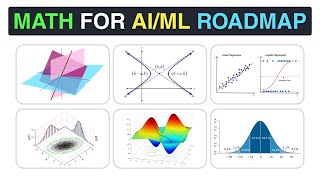
This video breaks down the essential math needed for AI and machine learning, covering statistics, linear algebra, and calculus, along with a roadmap and resources for learning them.
While libraries abstract math, understanding it helps debug training issues and interpret model behavior.
Statistics & probability, linear algebra, and calculus form the foundation for AI/ML algorithms.
Statistical intuition helps choose the right algorithm and tune hyperparameters effectively.
Populations, sampling, mean, median, mode, variance, covariance, random variables, distributions, central limit theorem, Bayes' theorem, MLE, regression.
Data is represented as vectors, matrices, and tensors; operations like multiplication, determinants, eigenvalues, SVD, PCA are key.
Derivatives, gradients, chain rule, and optimization concepts are essential for gradient descent and backpropagation.
Start with visual intuition (3Blue1Brown), then Coursera specialization, Khan Academy, ISLR book, and Mathematics for ML ebook.
Learning the math behind AI/ML is crucial for deeper understanding and troubleshooting, and a step-by-step approach with quality resources makes it manageable.
What are the three main math areas for AI/ML?
Statistics & probability, linear algebra, and calculus.
01:12
Why is statistical intuition important in ML?
It helps choose the right algorithm and tune hyperparameters effectively.
01:24
What is the central limit theorem?
It describes the distribution of sample means, often normal, regardless of population distribution.
02:05
What is maximum likelihood estimation (MLE)?
Estimating model parameters by finding values that make observed data most likely.
02:20
What are the key linear algebra concepts for ML?
Scalars, vectors, matrices, tensors, matrix operations, determinants, inverses, eigenvalues, SVD, PCA.
02:50
What calculus concepts are essential for training models?
Derivatives, gradients, chain rule, vector calculus, optimization (local/global minima, convexity).
03:47
What is the chain rule's role in neural networks?
It is at the heart of backpropagation.
04:14
Name two recommended resources for learning ML math.
3Blue1Brown YouTube channel and Mathematics for Machine Learning Specialization on Coursera.
04:45
You can build models without math
Reveals that practical ML is possible without deep math, but understanding helps when problems arise.
00:31Learning roadmap revealed
Provides a clear, actionable sequence of resources that the creator personally used.
04:30Mathematics for ML ebook recommendation
Ties all concepts together, showing how math builds ML algorithms.
05:49[00:00] In this video, I'm going to break down the essential math you need for AI and machine learning. I'll also share the exact roadmap and resources that have helped me along the way. Let's get straight to it. Hi, I'm Harry. I'm an AI Master's student here in the UK and have spent the last year
[00:15] learning a lot of the essential math behind artificial intelligence. Along the way, I've picked up key concepts and some practical resources that made a huge difference for me. First up, why should you even learn the math? With packages like scikit-learn, pytorch and tensorflow that abstract a lot of the math for you,
[00:31] you can be totally competent without knowing all the underlying details. For example, you can build and deploy a model without ever manually working through gradient descent or fully understanding how it works. However, problems can arise, whether it's debugging training issues or interpreting model behavior
[00:47] and without some sense of the language and meaning of the relevant maths, you can struggle to work out what's gone wrong or how to fix it. That said, it's perfectly fine to begin without a complete deep understanding of the math.
[00:59] As you continue learning and working on projects, gradually building up your math skills will make things clearer. Alright, with that out of the way, let's now talk about the actual math topics and concepts you'll want to learn. There are three main areas you'll want to focus on.
[01:12] These form the foundation for most of the algorithms, models and techniques you'll come across in AI and machine learning. Starting with statistics and probability. Having a solid statistical intuition helps you choose the right algorithm
[01:24] for the problem you trying to solve and just as importantly for the data you working with A lot of the time you don need anything overly complex If you understand what your data is telling you simple models can go a long way This can save you time and reduce complexity
[01:39] Plus, when you actually understand the math behind your algorithms, tuning them becomes way easier. You'll have a much clearer sense of what each hyper parameter is doing and how it affects your model, rather than just guessing and hoping something sticks.
[01:51] The key concepts to focus on here include things like populations and sampling that lets you work with subsets of data, the mean, median, mode, and expected values, variance, which tells you how spread out your data is, and covariance, which shows you how two
[02:05] variables relate. Random variables, common probability distributions like the normal, binomial, and uniform, the normal distribution in particular shows up all over the place in data science and machine learning, so it's worth getting really familiar with. The central limit theorem,
[02:20] conditional probability, so understanding how the likelihood of one event changes based on another, Bayes' theorem, maximum likelihood estimation, which is all about estimating the parameters of a model by finding the values that make the observed data most likely.
[02:35] And last but definitely not least, linear and logistic regression. Next is linear algebra. This is the language of data in machine learning. Whether you're working with images, text or tabular data, it can all be represented as vectors and matrices.
[02:50] Understanding how to work with these structures is key, especially as you get into deep learning. Here you want to get comfortable with scalars vectors which you can think of as a list of numbers matrices which extend vectors into 2D grids of numbers and tensors which are generalizations of all of these to any number of dimensions Matrix operations like addition subtraction multiplication and transposition as well as determinants and inverses which are important for solving systems of linear equations and optimization problems
[03:20] Matrix rank and linear independence, eigenvalues and eigenvectors, matrix decompositions such as singular value decompositions, and lastly, principal component analysis, which can help to reduce the dimensionality and number of features in your data sets.
[03:35] Finally, there's calculus, particularly multivariable calculus and differential calculus. This comes into play when you're training models, for example, in understanding how gradient descent works to minimize loss functions.
[03:47] You don't need to be able to solve complex integrals or memorize every rule, but having a solid grasp of a few core ideas will make a big difference. Firstly, derivatives and gradients. Derivatives tell us how a function changes and gradients extend this idea into multiple dimensions.
[04:02] These are essential for then understanding how algorithms like gradient descent adjust model parameters to reduce error and improve performance. Vector or matrix calculus, i.e. the calculus of multiple variables.
[04:14] This includes concepts like the Jacobian and Hessian. The chain rule, this is really at the heart of how backpropagation works in neural networks. And lastly, the fundamentals of optimization. things like local vs global minima, saddle points and convexity will help you understand
[04:30] why certain models converge well while others might get stuck or overfit Alright so now that we covered what maths is important I want to wrap up by showing how I actually went about learning it and some of the resources that helped me the most I leave links to these in the description First
[04:45] I found it really helpful to begin with a visual and intuitive grasp of the core concepts before reading any textbooks or working through practice problems. For this I highly recommend the YouTube channel FreeBlue1Brown, especially his video series on the essence of linear algebra and
[05:01] calculus. These videos will give you a really solid introduction and appreciation for how these ideas actually work. After that, I moved on to the Mathematics for Machine Learning Specialization by Imperial College London on Coursera. It covers both linear algebra and multivariable calculus,
[05:18] and it's taught in a really practical, clear way. That said, it doesn't go into statistics or probability so to fill that gap in I turned to can academy series on this to go a bit deeper especially into how these ideas apply specifically to machine learning I also read through parts of
[05:33] an introduction to statistical learning it's a great book with real world examples and it helped connect the theory to actual ml techniques lastly a final recommendation I've just finished recently is the mathematics for machine learning ebook it does a good job of tying everything together
[05:49] and showing how the concepts mentioned in this video are actually used to build machine learning algorithms. If you found this video useful, you might like to check out this video over here where we break down what principal component analysis is,
[06:01] one of the core AI and machine learning concepts mentioned in this video via a practical example. Thank you for watching.
⚡ Saved you 0h 06m reading this? Transcribe any YouTube video for free — no signup needed.