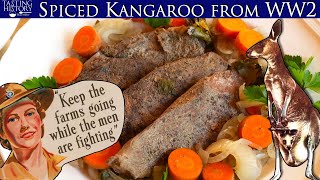

Why Australians Ate Kangaroo During WWII
41sReveals a surprising wartime food adaptation that challenges modern perceptions of Australian cuisine.
▶ Play Clip"Delivers on the promise of cooking kangaroo with historical context, though the history takes up a significant portion of the video."
This video explores the Australian home front during World War II, focusing on rationing and the inventive use of kangaroo meat in a spiced recipe from a 1943 wartime cookbook. It combines historical context with a cooking demonstration, revealing how food shaped daily life and morale.
In 1943, Australia supplied 95% of the food for the American military in the Pacific, leading to shortages for locals.
Australians ate twice as much beef and 12 times as much mutton and lamb as Americans.
The recipe involves marinating meat with sugar, mustard, vinegar, and salt for 12 hours, then simmering with vegetables for 2-3 hours.
Kangaroo is very lean, so it only needs 45-60 minutes in the oven instead of 2.5-3 hours for brisket or flank.
After Japanese attacks in December 1941, Australia focused on defense and food self-sufficiency.
Young women were recruited to work on farms, helping to maintain food production.
Tea was rationed in July 1942 at half a pound per adult every five weeks.
Americans' demand for pork and chicken increased their consumption in Australia.
The spiced kangaroo was gamey and earthy, described as tasting like dirt, but texture was tender.
Boiling meat was common during wartime, though modern preference is for quick grilling of kangaroo.
The spiced kangaroo dish provides a tangible link to the Australian home front experience, highlighting the ingenuity and sacrifices made during World War II, even if it wasn't the most palatable meal.
What percentage of food for US military in the Pacific did Australia provide in 1943?
95%
00:14
How much more mutton and lamb did Australians eat compared to Americans?
12 times as much
00:56
What was the first food item rationed in Australia during WWII?
Tea
11:00
How much tea were Australians allowed per adult every five weeks?
Half a pound
11:13
When was meat rationed in Australia?
January 1944
13:45
What did Australians use as a substitute for butter in sandwiches?
Kraft processed cheese spread
12:12
Which vitamin-rich yeast extract was mostly sent to troops?
Vegemite
13:01
How long should kangaroo cook in the oven compared to brisket?
45-60 minutes instead of 2.5-3 hours
05:52
What was the Australian Women's Land Army?
Recruited young women to work on farms to maintain food production
10:03
Describe the flavor of the spiced kangaroo according to the host.
Gamey and earthy, almost like dirt
19:13
Australia's massive food contribution
Demonstrates the scale of Australia's role in supporting Allied forces despite its own shortages.
00:14American soldiers changed Australian eating habits
Shows how cultural exchange during war had lasting dietary impacts.
14:18Women's resistance to returning to domestic roles
Highlights the social change in gender roles spurred by wartime work.
16:24Historical cooking methods vs modern preferences
Illustrates the evolution of culinary techniques and tastes.
20:56[00:00] During World War II, while the Australian military fought the Axis powers on the battlefront, the men and women on the home front were doing their bit. And it was a big bit because in addition to supplying the American military in the Pacific with clothes, ammunition, and vehicles,
[00:14] they also provided 95% of their food in 1943. This meant Australians often had to go without or be rather inventive with dishes like this spiced kangaroo based on a recipe from a wartime cookbook.
[00:28] So thank you to Opera browser for sponsoring this video as we survive the Australian homefront this time on Tasting History.
[00:40] So before rationing started in 1942, Australians famously ate a lot of meat. The 'Pocket Guide to Australia', which was given to US servicemen before they went down under, said, "Australians are great meat eaters - they eat many times as much beef, mutton, and lamb as we do -
[00:56] and a lot more flour, butter, and tea. But they don't go in for green vegetables and salads and fruits as much as Americans." They actually ate twice as much beef as theaverage American at the time, and 12 times as much mutton and lamb.
[01:10] the government started printing recipes on ways to make the most of what meat people did have. Now people inside of the cities could still get mutton and lamb and beef, though in much smaller quantities
[01:25] and in much poorer cuts. But if you were out in the wilderness, Game like wallaby and kangaroo, which had lost popularity in the early part of the 20th century,
[01:39] "You may think it's a gag, but you will get kangaroo steak or kangaroo tail soup in the 'outback' and especially if you go hunting yourself. They're supposed to be tasty."
[01:51] So I decided that since I happen to have some kangaroo meat in the freezer, which one typically does, that I would make a recipe using the 1943 'Planning Meat Ration Meals', but instead of using beef or lamb, I would use kangaroo steaks.
[02:05] Now this is definitely an experimental recipe because the recipe is probably not meant to use kangaroo meat since kangaroo is extremely lean, but there's a war on and so you make do. So what the recipe says is,
[02:20] "Method: Mix sugar, mustard, vinegar, and salt together and rub over meat with the back of a wooden spoon. Place meat in a dish with bay leaves, cloves, and peppercorns. Leave for 12 hours. Turn occasionally.
[02:33] Place meat with juices, herbs, etc. sliced carrots, onion, and parsley in a saucepan. Just cover with water and simmer for 2 to 3 hours. Serve hot with liquid thickened as gravy or cold with liquid thickened and served as cold sauce.
[02:47] If the oven is in use, cook the meat in a casserole 2 and 1/2 to 3 hours in a slow oven, 325° F." And people are always asking me, where do I find all of these old cookbooks?
[03:01] And usually the answer is online. So, so many have been digitized. And very often I'll have multiple up on my screen at any one time along with many many tabs open for the research and the writing portion of my videos,
[03:15] so it tends to look a bit cluttered which is why I really appreciate today's sponsor, Opera. The Opera browser makes browsing the internet very easy with a bunch of wonderful features. See, I'm never working on just one video. I've always got two or three videos working at the same time in different parts of the process.
[03:35] And so I've got dozens of tabs open for each video and it's an absolute mess. Well, with the tab islands, Opera lets me group all of the tabs for one video together and then name that tab and color code it to keep it separate from the others. Then when I'm not working on that video,
[03:52] I can condense down all of those tabs into one to declutter my workspace. Now the feature I use most of all, except for maybe the tab islands, is the split screen, which lets you have two or even four tabs open. So I can have my script open while I have a primary source open and a tab to do translations all at the same time.
[04:09] And since I love to listen to music as I work, it can connect to different music services like Tidal, Spotify, or YouTube Music. I also love the video popout feature so I can watch a YouTube video in the corner or wherever I want on screen. So if you want to try out all of these wonderful features, then click the link in the description,
[04:24] let us get to spicing some kangaroo. You can also use brisket or flank because how many people actually have kangaroo at home.
[04:38] Then 1 teaspoon of sugar. And besides the meat, this is the only ration ingredient in the rest of the recipe because everything else you can use as much as you want, but it does give specific quantities. 1 teaspoon of salt, 2 tablespoons apple cider vinegar, 1 teaspoon of mustard, 2 bay leaves,
[04:53] 1 onion, 1 carrot, and 1 small bunch of parsley. So first mix the sugar and salt together along with the mustard and the apple cider vinegar. You can also use wine vinegar for this. And then lay your meat in a dish.
[05:08] Then coat it with the marinade, making sure that it gets well covered on both sides. Then add in the bay leaf, which you can break up, along with the pepper and the cloves, Then cover that and set it in the fridge for at least 12 hours. And once it is marinated, you can cut up your onion
[05:23] and chop the carrot, making sure to leave the peel on. There were numerous wartime notifications that went out saying, "Don't waste your peels for potatoes and carrots" so just don't peel it. Then set those at top the meat along with the leaves of parsley. Then add just enough water to cover everything.
[05:40] Set the lid on and place it in the oven at 325 Fahrenheit, 160 Celsius to cook for a while. Now the recipe says 2 and 1/2 to 3 hours. And if you're using brisket, I'd say go right ahead. But with kangaroo,
[05:52] like 45 to 60 minutes is going to be more than enough. And even then, this is really not the best way to make kangaroo. The best the modern way to make kangaroo is just to like grill it and make it medium rare and you're done. But all of the older recipes that I saw that
[06:09] specifically called for cooking kangaroo, they're all boiled pretty much. They're either in a soup or jugged. Yeah, they just- that's just how they made their meat.
[06:21] Now another interesting aspect of this recipe is the so-called "gravy" or cold sauce, but before we make that, I want to talk a little bit about what else they ate on the Australian home front.
[06:36] 2 days after Germany invaded Poland, France and the United Kingdom declared war on Germany. That same day, September 3rd, 1939, Robert Menzies, Prime Minister of Australia declared, "There is unity in the Empire ranks - one King, one flag, one cause.
[06:52] Before long, Australia was sending hundreds of thousands of men and women to fight in Europe, the Middle East, and North Africa. What they couldn't send much of was food. Originally, it was thought that they were going to supply Britain with food, but
[07:08] one is really, really far away, and two, there were a bunch of u-boats in the way, and so not that much food actually made it from Australia to Britain. Instead, it just kind of sat in warehouses very often going bad.
[07:22] But early on, they had at least a lot of food to offer. But that was not going to last very long because by 1941, so many farm workers had joined the military that the production of food began to lag.
[07:36] And then on December 8th, 1941, the country's participation in the war changed overnight when following Japanese attacks on both Pearl Harbor and then on the Australian troops in the British territory of Malaya, Australia declared war on the Empire of Japan.
[07:51] it doesn't seem that they ever intended to, or were capable, of actually invading Australia itself, but the Australians didn't know that. So they were preparing for a possible invasion, especially following
[08:07] the fall of Singapore in 1942. When the Japanese took the city in February, the new prime minister, John Curtin said, The protection of this country is no longer that of a contribution to a world at war,
[08:21] but the resistance to an enemy threatening to invade our own shore... It is now work or fight, as we have never worked or fought before... On what we do now depends everything we may like to do when this bloody test has been survived."
[08:37] Fear of invasion only grew when on February 19th, only 3 days after the prime minister gave that speech, Japan sent 242 aircraft to bomb the city of Darwin, the largest attack ever mounted by a foreign power in Australia. These developments changed everything in Australia,
[08:54] and so very quickly they tried to regain the amount of food production that they had had back in 1939 because not only did they have a lot of their own troops now coming back and fighting in the South Pacific,
[09:06] but they were about to play host to 150,000 to 250,000 American GIs. And with Japanese subs prowling the ocean, most of the food for those Americans would need to come from Australia
[09:19] So to meet this new surge in the need for food, there was a plan put in place. And two major prongs of that were one increase the actual supply of food, and two
[09:32] Now the first way to increase production was to stop allowing rural workers to enter the military which happened in May of 1942. Another was to put prisoners of war and those Australian nationals who were in internment camps to work on the farms.
[09:48] The Australian internment camps were similar to those in the US. And I did a whole video on what it was like to live and eat in a Japanese internment camp in the 1940s. Now another group of newly made farm workers were the Australian Women's Land Army,
[10:03] who recruited young women, often from the cities, to travel to the countryside for several weeks or up to 12 months But I love that one of the ways that they tried to sell this idea of backbreaking labor to the women of Australia was to say,
[10:18] one, you'll be helping out your country, but two, you're going to get a real nifty outfit. "Join the keen, and smart-looking girls who are doing a wonderful job in the Australian Women's Land Army." Of course, in addition to those doing the farming, there were many, many more who stayed in the cities to work in factories
[10:35] This led to, if not a surplus of food, than at least enough that the rationing was nowhere near as severe as it was, say, in Britain.
[10:48] Many people actually ended up getting more food than they had before the war, But even though the rationing was not as stringent as in many other places,
[11:00] that doesn't mean that it didn't still really affect everyone on the home front. In July of 1942, tea became one of the first food items to be rationed, as most of Australia's tea came from Java, which Japan now controlled.
[11:13] The ration allowed for each adult to have a half pound of tea every 5 weeks, enough to make about three cups per day, But complaints were such that after 5 months, the government reclassified tea as a necessity
[11:28] Shortly after tea came sugar. Now, at first, many people actually thought that sugar wouldn't need to be rationed because Australia grew and processed a lot of its own sugar.
[11:41] Unfortunately, most of the fertilizer for growing the sugar actually came from the islands that were now controlled by Japan. So in August of 1942 it was rationed at one pound of sugar per week, about half the average consumption,
[11:55] though it was still double what those in the UK were getting at the time. Dairy items also became hard to find, especially butter, which was rationed in June of 1943. And butter was a huge part of the Australian diet at the time. Not only did they use it in cooking and baking,
[12:12] they also used it in almost every type of sandwich that they made. This led to Kraft, the then cheese company, to offer suggestions on how to make sandwiches without butter. Instead, they suggested using their processed cheese spread to make cheese spread with grated apple and salt sandwiches,
[12:30] cheese spread with worcesteshire sauce and tomato sauce sandwiches, and several sandwiches which paired the cheese spread with Bonox, a popular beef extract filled with vitamins.
[12:44] If anyone is in Australia and they still eat that, let me know because I couldn't actually find anyone saying the word. That said, when it comes to Australian extracts, I don't think of Bonucks, or Bonix or Boneox.
[13:01] What I do think of is the vitamin B-filled yeast extract, Vegemite. Though according to their own ads at the time, "Vegemite fights for the men up north". That is, most of the country's Vegemite was actually going to feed the troops. And so they asked the public,
[13:15] "If you are tough, husky, and bursting with health, remember there are many people who need Vegemite more than you do... If you are one of those who doesn't need Vegemite medicinally, then thousands of invalids and babies
[13:27] are asking you to deny yourself of it for the time being." Perhaps the most unpopular item to be rationed, meaning it was a popular item, so rationing was unpopular, was meat. It was so important to the Australian diet that it didn't become rationed until January of 1944.
[13:45] And even then, it only applied to mutton, lamb, and beef. Other meats like fish and rabbit and sausages and a lot of potted meats and things, This actually started to kind of change the Australian diet
[14:02] and so more people began eating pork and chicken and stuff like that so that was one aspect that changed the Australian diet at least in the short term. Another aspect were the American soldiers- or was the American soldiers
[14:18] Now Americans in general had for some time cut way back on mutton and lamb and rather they demanded more pork and chicken both of which found a stronger foothold in the Australian diet than they had before.
[14:32] Now they still didn't outperform beef and they wouldn't for a very long time. Mutton and lamb remained the mainstay of the Australian diet for decades to come Other food items that got a big burst in popularity thanks to the Americans were tomatoes, sweet corn,
[14:51] Now by the end of the war, the food production in Australia was actually more than it had been before the war. And so this made it so rationing did not have to last nearly as long as in other places.
[15:07] It still lasted for a couple years in some ways, but like in Britain, it didn't end until like 1954, What did happen was that all of these soldiers were now coming home and they wanted their jobs back.
[15:24] And so all of the women who were now working on farms and in factories and everything, And the government quickly looked to address the problem of the women's services.
[15:37] They began a program of what was called rehabilitation, which was to reaclimate both men and women to civilian life. For women, this meant taking them out of the workplace and giving them lessons on home cooking,
[15:50] home making in general, sewing, things that they had known before, but this was to kind of reaclimate them to that way of life. And for many, that was perfectly fine. But there were some who didn't want that. It was one woman in a newspaper article where she says that
[16:08] the last few years of working and being independent had so changed her view of the world that "she had no desire to revert to the placid little woman she was prior to enlistment. She wanted to retain that feeling of equality, at any rate and mental outlook that army had given her;
[16:24] and had no desire to become the chattel or slave of a basic-wage-earning male - to have babies, and live in semi-poverty." Now while the war did change the working habits of women and the eating habits of most Australians,
[16:38] It had been quite popular, but it lost favor in the 1910s and 1920s. And then there was a brief reprieve around the war and then again it was pretty much gone,
[16:53] and didn't really become popular again until around the 1980s when it was sold widely commercially. But I did find a number of references to eating kangaroo meat during the war,
[17:05] mostly from the south near the city of Adelaide. Like this one from 1943 which describes 'An Outback War-Time Dinner. Last Sunday we had what we called a wartime dinner (except dessert) -
[17:17] kangaroo-tail soup, and roast wild duck and pigeon. We should have had quondongs, too, Alas, I tried to get some kangaroo tail, but it doesn't seem to really be available here in the United States, at least that I could find.
[17:29] So, maybe I'll have to go to Australia for that because that is what you use to make kangaroo tail soup. Also, I had to look up the word quondong because I hear that and I think of like a duck or a Pokémon of some sort. Turns out it is an Australian fruit, that at least according to the internet,
[17:44] is sweet and tangy like a peach meeting a rhubarb. But I don't have any quondongs. So instead I'm just going to have to be satisfied with my spiced kangaroo. So once the meat is cooked or likely overcooked, take it out to rest a while while you prepare the gravy,
[18:00] which is basically just the cooking liquid mixed with a little flour or cornstarch. I used 1 tablespoon of cornstarch for two cups of the liquid And here we are, spiced kangaroo from the Australian home front of World War II.
[18:16] It is not the prettiest thing because boiling or simmering meat is never a pretty picture at the end 'cus it just kind of looks gross on the outside. But it's also, you know, like I said, it's usually just quickly grilled to a medium rare.
[18:30] This ain't medium rare. This is well done, I would say. But let's give it a taste. [chomp] Actually, the texture falls apart quite nicely.
[18:47] So here's the thing. I don't know if it is the flavor of the kangaroo or the flavor of this preparation of the kangaroo,
[18:59] I usually like gamey things, like I like venison and and boar and elk and stuff. This takes gamey to a whole new level. It's gamey and
[19:13] earthy would be the polite term to use, but I would actually say dirt. It kind of tastes like it fell in the dirt. But again I don't know if it's actually the meat. The gaminess is definitely the meat,
[19:28] but maybe the mixture of the meat with the mustard and spices and everything is actually It's hard because none of the single flavors jump out.
[19:41] And I didn't put any dirt in this dish, so I know that's not it. You know what, let me try one of the like just one of the carrots and onion. Maybe that will inform...
[19:54] Hm. yeah, it might be- it might be that mixture of spices just does not really work.
[20:07] It's not my favorite thing. It's definitely not my favorite uh thing. What I should do, and I think I still have some kangaroo in the freezer. I should defrost it and try just like
[20:23] and just having it plain to to get a better idea of what that tastes like. So, maybe I'll I'll do that. Make a short of it or something. I don't know! But again, not the best way to make pretty much any food, boiling meat.
[20:41] It's just not my favorite thing. And yet, historically, it is so so common. I think last week's video was probably boiled meat as well. but that's part of the fun here on Tasting History. It is not about
[20:56] liking the food. It is about trying the food. So, try some kangaroo if you ever get a chance, preferably cooked in a different way, and I will see you next time on Tasting History.

⚡ Saved you 0h 21m reading this? Transcribe any YouTube video for free — no signup needed.