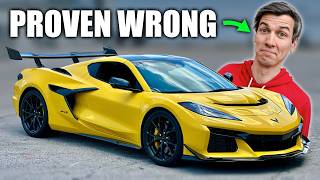

I Was Wrong About the Corvette ZR1
47sAdmitting mistake creates trust; surprising fact that RWD beats AWD engages car enthusiasts.
▶ Play Clip"Delivers on the bold claim with detailed engineering breakdown, though the rollout caveat tempers the excitement."
The Corvette ZR1 has been revealed to be even quicker than initially thought, claiming the title of the quickest accelerating rear-wheel-drive car ever tested by Car and Driver to 60 mph. This video delves into three fascinating details: how the RWD ZR1 beats the AWD E-Ray to 60 mph, a secret redline above the spec sheet value, and whether the chassis can handle the immense power. Through discussions with engineers and on-track data, the video provides an in-depth engineering breakdown.
The Corvette ZR1 is the quickest accelerating rear-wheel-drive car ever tested by Car and Driver to 60 mph, surpassing expectations.
Despite being RWD and 400 hp more, the ZR1 achieves a true 0-60 of 2.5 seconds, beating the AWD E-Ray's 2.7 seconds.
Chevy claims 2.3 seconds using a 1-foot rollout, but actual performance adds about 0.2 seconds.
Custom launch control settings (five modes) and a rolling burnout in first gear optimize grip and acceleration.
Revised assumptions (62% rear weight distribution, 19-inch CG height, tire grip coefficient 1.35) yield 1.1g and 2.5 seconds.
In sixth gear only, the engine revs to 8,100 RPM for a top speed of 233 mph, beyond the official 8,000 RPM redline.
At Circuit of the Americas in 100°F, the ZR1 showed excellent throttle control, minimal turbo lag, and consistent acceleration.
Eight spirited laps showed 60-160 mph times consistent within 0.4 seconds, indicating robust cooling with 15 heat exchangers.
The ZR1 does 60-120 mph in 4.2 seconds, less than half the Z51's 9.3 seconds, and reached 175 mph on the straight.
The chassis handles 1,064 hp well, with 1,200 lb of downforce at top speed, and the driver felt confident pushing harder.
The Corvette ZR1 defies expectations with its RWD layout, delivering blistering acceleration and track performance that feels approachable. It stands as a testament to engineering excellence, proving that the chassis can handle—and even exceed—its immense power output.
What is the true 0-60 mph time of the Corvette ZR1 without rollout?
2.5 seconds.
01:34
What does SAE J1491 define as 'initial vehicle movement'?
Movement of the vehicle a distance of 0.3048 m (1 ft) from rest position.
02:44
What are the three main variables in the acceleration equation mentioned?
Weight distribution, center of gravity height, and tire grip.
07:05
At what RPM can the ZR1 rev in sixth gear for top speed?
8,100 RPM.
09:09
How many heat exchangers does the ZR1 have?
15 heat exchangers.
13:37
What is the 60-120 mph time for the ZR1 compared to the Z51?
ZR1: 4.2 seconds; Z51: 9.3 seconds.
14:29
How much downforce does the ZR1 generate at top speed?
1,200 lb.
15:14
ZR1 Beats E-Ray
Confirms that despite being RWD, the ZR1 out-accelerates the AWD E-Ray with a 2.5s 0-60.
01:34Launch Procedure
Detailed steps including custom launch control and rolling burnout reveal how the time is achieved.
03:28Secret Redline
The 8,100 RPM limit in sixth gear is a unique engineering solution to reach 233 mph.
08:39Consistent Performance
Lap data shows minimal degradation in 60-160 mph times across 8 hot laps, proving excellent cooling.
12:13Chassis Can Handle More
Driver notes the car felt approachable and could handle even more power, highlighting engineering margin.
15:00[00:02] I was wrong about the Corvette ZR1. It is even quicker than I thought. In fact, it is the quickest accelerating rearwheel drive car ever tested by Car and Driver to 60 mph. And in this video, after lengthy discussions with many of
[00:17] the engineers involved, we're going to be diving into three fascinating details. First, how in the world is the rearwheel drive Corvette ZR1 actually quicker to 60 mph than the all-wheel drive Corvette -? Now, you'll notice
[00:33] immediately your boy, that is myself, got this completely wrong in two previous videos. They're not talking about the ZR1 0 to 60, probably because the -ay might have a better 0 to 60. So, major props to Chevy for pulling
[00:49] this off. Second, this car actually has a secret red line. On all of the spec sheets, you'll see the red line is listed as 8,000 RPM, but there's a special situation it can actually go above this. Third, and finally, we'll
[01:04] discuss if the ZR1's chassis can actually handle how much power it has and dig through some of the fascinating data from track testing the car at Circuit of the Americas in Austin, Texas. This is going to be an absolute
[01:17] treat for the brain. All right, so let's talk 0 to 60. So comparing the ZR1 to the Corvette -ray. Yes, it's up about 400 horsepower and yeah, it's down about 100 lb, but it is rearwheel drive, which is very limiting and acceleration versus
[01:34] thought the -ray was going to be quicker. It has a 0 to 60 of 2.7 seconds, but in fact, when Corvette seconds, but in fact, when Corvette engineers tested the ZR1, they managed a
[01:47] engineers tested the ZR1, they managed a 0 to 60 of just 2.5 seconds. Okay, now I genuinely thought I was going to give Chevy some major props here because on their website for the Corvette ZR1 0 to 60, it says the 0 to 60 time is 2.3
[02:01] 60, it says the 0 to 60 time is 2.3 seconds, quote, based on initial vehicle movement. Now, to me, initial vehicle movement sounds like when a vehicle starts to move, not the 1 foot of rollout nonsense that the rest of the
[02:14] industry uses. All of that is to only learn from the engineer himself who performed this 0 to 60 test that initial vehicle movement actually means deleting the first foot. Sometimes I hate it here. If you
[02:29] were standing 8 in in front of a stopped car and then that stopped car accelerated and hit you after traveling those 8 in, would you say it has not yet initially moved? Of course not. But to be fair, Chevy isn't the only party to
[02:44] blame here. If you look up what initial vehicle movement means in SAPEJ1491, which is the standard for how to perform acceleration testing, it reads initial vehicle movement movement of vehicle a distance
[02:59] of vehicle a distance of3048 m, 1 ft from rest position. So all of this is just a long way of simply saying that when Chevy says the Corvette ZR1 has a 0 to 60 of 2.3 seconds, they are deleting that first foot. And in
[03:13] reality, you add about2 seconds to that. So the ZR1 getting a true 0 to 60 of 2.5 seconds and the E-Ray at 2.7 seconds. Okay, but enough distraction because the Corvette's actually rad. So let's get back to it. All right, but we still
[03:28] haven't answered the question. How is the ZR1 actually quicker to 60 than the -ay? Now, there's two parts of this. First the procedure, how it's actually done, how the launch is done as broken down very specifically from the engineer
[03:42] himself who performed this testing and then where did my math go wrong. So starting with the procedure, first of all, you have something called custom there's some settings here that you can change in order to optimize your launch.
[03:55] basically changing what RPM you're launching at. And so with each progression in a higher RPM, you're going to be able to launch a little bit better, assuming the surface allows for it. So custom launch control mode one is
[04:09] the easiest, and it should get you at 0 to 60 of around 2.8 seconds. Custom to 60 of around 2.8 seconds. Custom launch control 2, 2.6, 2.7, and so on until you get to custom launch control fourth, which is the second most
[04:21] aggressive setting, and where they reach this 2.3 second claim in doing so. So, fifth of this custom launch control would be for a drag strip where you have a prep surface and even more grip. So, you launch at a bit higher of an RPM.
[04:34] And then they had their slip setting somewhere between 10 and 11%. Either one of those should work. So, those are your two settings for your custom launch settings, you need to do a quick burnout. So, you hold both paddles, you
[04:48] let go of one, you put it back in, and then you do the burnout. And in doing so, they don't have a line lock mode, right? because there's so much weight over that rear engine and not enough weight over the front tires that
[05:00] actually it just pushes the front tires even if they're locked up. So, the best you can do is a rolling burnout. But regardless, you do a burnout in first gear for about 2 to 3 seconds. Stay in that first gear, get the tires hot and
[05:13] launch. Now, for their testing, this was performed in two directions on a nice asphalt surface. It was not a prep surface. Uh, and then what's controlling pedal, you've got a foot on the gas, foot on the brake pedal. Once you
[05:28] happening is the clutch is controlling that initial launch. So, you're going to have some slip in the clutch, allowing you to dig out from 0 mph, start accelerating, and they say that this ZR1 is on the true edge of these tires grip
[05:44] for the entirety of that 0 to 60 pull. Very cool. Now, this is obviously not true for the -ay, right? If the -ray was on the limit of both the front and rear tires grip, it would have a quicker 0 to 60 time. Also worth mentioning, they do
[05:58] take the average of it. One of them, they actually got a tenth quicker than they actually got a tenth quicker than that, 2.3, uh, so 2.2 with roll out. And so they believe it actually is possible to go slightly quicker than that claim.
[06:10] Now, as far as the tires used, there's two options on the ZR1. You've got a sport tire on the base base ZR1, and then you've got the cup tire. Now, with using in order to get this better launch, but they actually believe it's
[06:25] possible with both. The only caveat there being they said if you start to slip with the sport tire, it never recovers. It simply can't be done. So, it has to be absolutely perfect the whole way down that 0 to 60 versus the
[06:38] cup tires are a bit more forgiving and a bit easier to nail that better time. All right, so where did my math go wrong? Well, let's get into it. Now, here's our equation that's governing how quickly a vehicle can accelerate from 0 to 60.
[06:51] Basically looking at maximum G's that that vehicle could provide. And previously, I estimated that for the Corvette to peak out at about.99 GS, giving it a 0 to 60 of 2.76 seconds. Now, the three biggest
[07:05] variables that are part of this equation, assuming you have plenty of power, which the ZR1 obviously does, first of all, weight distribution. The more weight you put on those driven wheels, then of course the better the
[07:17] gravity height. The higher your center of gravity height gets, the more weight wheels and thus can improve the acceleration. And third, and finally, and probably most important, of course, being the tires. So, the tire grip. Now,
[07:31] any one of these three you can adjust and make whatever number you want here. However, just three very small adjustments and we get exactly where I made assumptions about the weight distribution, the CG height, and the
[07:46] tire grip. But what if we just slightly change these assumptions? So, if we simply raise the amount of weight resting on the rear axle from 60% to 62%, small increase there. If we raised our center of gravity height just an
[07:59] inch and a half from 17.5 to 19 inches if we increased our coefficient of if we increased our coefficient of friction from 1.3 to 1.35. And these are friction from 1.3 to 1.35. And these are new cup tires specific to the Corvette.
[08:11] grip. Plus of course you're doing that burnout to increase the grip that they have for the launch. And you make these small changes. All reasonable to believe, right? Because we've got a turbocharged engine now. You're adding
[08:24] of the car, potentially raising that CG slightly, and that gives you very easily slightly, and that gives you very easily 1.1 gs of acceleration or 0 to 60 in 2.5 seconds. Exactly what it is doing. So, it is not that difficult to find a
[08:39] realistic number. I absolutely believe that they have done it. Now, let's move on to the top speed discussion. And keep in mind, the Z06's naturally aspirated in mind, the Z06's naturally aspirated 5.5 L V8 engine was able to rev to 8600
[08:53] RPM, while the ZR1's engine doesn't go quite so high, but still hits a very respectable 8,000 RPM, except for one scenario where it can go higher. All right. So, the official red line of the Corvette ZR1 is 8,000 RPM, but when it
[09:09] Corvette ZR1 is 8,000 RPM, but when it hits its top speed of 233 mph, it can rev up to 8,100 RPM. What What's going on here? So, if it was able to hit 233 at 8,100 RPM, it's probably hitting about 230 mph
[09:27] at 8,000 RPM. Now, as you run into red line, the engine's going to start to adjust. And so what I bet happens is they're running this test, they get up to about 229 miles per hour and they think, "Hey,
[09:39] 229 miles per hour and they think, "Hey, we're so close. We basically got 230. All we need to do is add another 100 RPM." So that's exactly what they did. So, for sixth gear only, only in sixth gear, and this is true for all customer
[09:53] cars that will get this Corvette ZR1. Uh, and you're going to want the low arrow package in order to reach this top speed. But in sixth gear, it can rev up speed. But in sixth gear, it can rev up to 8,100 RPM. It has been fully mapped
[10:06] and calibrated in order to do this, and that has enabled it to reach this top speed of 233 mph. Now, you might ask, well, why not just raise the RPM across the board? Well, it's a good question. So basically power is starting to drop
[10:20] as you're reaching 8,000 RPM. You can see the torque curve here in blue is dropping down fairly dramatically. So if you just keep going, this torque curve just keeps dropping. And realistically, you want to shift gears and get back
[10:33] into this power band here. So why they did this is if you were to shift to seventh, well, it's going to be a significant drop in gear ratio from sixth to 7th. So you have a significant drop in wheel torque. But if you just
[10:47] add a little bit of RPM on the end of sixth gear, you can actually even though power is going to decrease slightly, you can enable hitting that 230 mark and in fact the 233 mph mark. So their adjustment there for customer cars
[11:02] adjustment there for customer cars allowing you to hit 8100 RPM in sixth gear. So, I kind of feel like there needs to be a bumper sticker that says, "I've hit 8100 RPM in my ZR1," which means you've actually hit 230 mph. So
[11:17] sick. All right, so what is it like to drive? I got to drive the ZR1 around Circuit of the Americas in Austin, Texas. It was a very hot day, about 100° Fahrenheit. And my biggest takeaways from the drive, first of all, excellent
[11:30] throttle control. Second of all, very little turbo lag. It was actually really impressive how quickly you get all of the torque when you put your foot down. And third, torque for days. I mean, this thing just never stopped accelerating.
[11:45] And what the biggest surprise to me was, I went into this very nervous because all that much time on tracks and so I was quite intimidated going into it. And yet, it was a very approachable car. I felt confident. It made me feel like a
[11:59] hero, which was quite surprising. Now, with 1,64 horsepower, you might think, okay, how many laps do you actually get that? Because that's so much heat being created. So, as your engine gets hotter, does it start to derate? Well, I
[12:13] fortunately have very clean data on this. And again, just a reminder, it was this. And again, just a reminder, it was about 100° outside, so not the ideal temperatures for cooling. So, I did eight spirited laps in a row without
[12:25] stopping. And in those eight laps, I measured the 60 to 160 mph time on the back straightaway. So, a 100 mph delta. Okay, so here's the results. On the
[12:37] first lap, it did it in 9.7 seconds. On the second lap, it did it in 10.1 seconds. So, about a/ third of a second slower. But look at what happens from here on out. Third lap, 10 seconds flat. Fourth lap, 10 seconds flat. Fifth lap
[12:55] Fourth lap, 10 seconds flat. Fifth lap 9.9 seconds. Sixth lap 10.1 seconds. 9.9 seconds. Sixth lap 10.1 seconds. Seventh lap 10.1 seconds. Eighth lap 10.1 seconds. So in my eighth and final spirited lap, it did the exact same 60
[13:09] spirited lap, it did the exact same 60 to 160 mph time as it did on the second lap. Now it is worth mentioning this car at wide openen throttle can use 2 gall of fuel in a minute. So, there was a meaningful fuel load difference between
[13:24] my first and eighth laps. So, while the times are consistent, the vehicle did weigh a little less each attempt. But regardless, the acceleration was very regardless, the acceleration was very consistent in 100° ambient temperatures
[13:37] while being pushed fairly hard. So, as far as the engine cooling and charge air intercooling, they've done a great job. That is thanks to a grand total of 15 heat exchangers on board the ZR1. And of course, the ZR1 loses the frunk in
[13:51] exchange for the front mounted intercooler and a large engine radiator. And a gurnie flap on front of the opening on the hood helps create a low pressure area behind it, sucking out the hot air from the radiator. All right,
[14:03] some other crazy stats. So, we were actually able to drive the base Corvette actually able to drive the base Corvette Z-51 package, not the ZR1, not the Z06. We're talking base C8 Corvette with the Z-51 package. And that we drove first
[14:16] around the track to get a feel for it. And I measured my 60 to 120 mph time on this back straightaway in both cars. In the Z-51, it did it in 9.3 seconds. In
[14:29] the Z-51, it did it in 9.3 seconds. In the ZR1, it did 60 to 120 mph in just 4.2 seconds, less than half the time. And I was able to reach a GPS verified top speed on that back straightaway of 175 mph. and that was breaking very very
[14:46] very early because I'm cautious and don't want to plow ahead even though there is plenty of runoff. So the thing is crazy crazy quick. I have driven on plenty of tracks and usually I never get above about 150 mph. This thing is just
[15:00] above about 150 mph. This thing is just hauling even at 150 mph. It's nuts. The ZR1 was also a remarkable improvement in handling over the base Stingray. I haven't driven the Z06 on track, but compared to the Stingray Z-51, even
[15:14] running the same sport tires, though a bit wider on the ZR1, you could feel the extra grip, not only from the tires, but from the downforce as well. This thing makes 1,200 lb of downforce at top speed. So, there actually is meaningful
[15:29] downforce even at lower track speeds. It was very sure-footed, stable, easy to push, and super fun. So, if you're wondering if the chassis can actually handle how much power it has, it absolutely can. Dare I say it, I think
[15:43] it could handle more. Not that it needs it. 1,000 horsepower is plenty. But my point is, the car does in fact handle its power quite well. Now, my lap times were nothing impressive. Story of my life. But more importantly, I wasn't
[15:57] scared. I could have pushed deeper into braking zones. I could have cornered at higher speeds. And when I did push it further, it always accepted it. It is a remarkable machine. If you enjoyed this video, I have a deep dive video on both
[16:10] the Z06 engine as well as the ZR1 engine. Full of engineering, juicy details, super interesting to watch. I'm also going to be making another video just on the turbos for this car because it is an absolutely wild story. Thank
[16:24] have any questions or comments, feel free to leave them below.


⚡ Saved you 0h 16m reading this? Transcribe any YouTube video for free — no signup needed.